Findings of Supreme Court-Appointed National Task Force (NTF) on Student Mental Health and Suicides

Findings of Supreme Court-Appointed National Task Force (NTF) on Student Mental Health and Suicides

Student suicides have emerged as a serious social, educational, and public health challenge in India. Recognising the growing severity of the problem, the Supreme Court constituted a National Task Force (NTF) under former Supreme Court Judge Justice S. Ravindra Bhat to examine student mental health concerns and recommend measures for suicide prevention in Higher Educational Institutions (HEIs).

Magnitude of Student Suicides in India

Student suicides have steadily increased over the past decade, making them a major concern for policymakers and educational institutions. The National Task Force (NTF) surveyed over 2.43 lakh students and 2,119 higher educational institutions across the country and found that : 

  • More than 13,000 students died by suicide in India in 2022, accounting for about 7.6% of all suicides in the country. Student suicides exceeded the number of farmer suicides recorded during the same year.
  • Student suicides have been reported across both premier institutions and ordinary colleges, indicating a systemic challenge.
  • Of the institutions surveyed, 56 reported one or more student suicides between April 2020 and March 2025.
  • The Supreme Court described the rising trend as “highly disturbing” while hearing a case related to the deaths of two students at IIT Delhi.

About National Task Force on Student Mental Health

Recognising the growing seriousness of the issue, the Supreme Court constituted the National Task Force (NTF) in March 2025 to examine student mental health concerns and recommend measures for suicide prevention in higher educational institutions.

Composition of the National Task Force:  Headed by former Supreme Court Judge Justice S. Ravindra Bhat and includes mental health experts, psychologists, education specialists, and social scientists.

Mandate of task force: 

  • Examine the causes of student suicides and mental health challenges in HEIs.
  • Assess the adequacy of counselling, grievance redressal, and student support mechanisms.
  • Recommend a comprehensive framework for suicide prevention and student well-being.

Methodology of the task force: 

  • Conducted surveys covering 2.43 lakh students and 2,119 institutions.
  • Undertook field visits across 10 states, including institutions such as IIT Delhi, AIIMS Delhi, JNU, and Jamia Millia Islamia.
  • Consulted students, parents, faculty members, administrators, and experts.
  • Submitted an interim report in November 2025 and has been granted time till October 2026 to submit its final report.

The Task Force adopted a multidisciplinary approach and concluded that student suicides are driven by a combination of psychological, academic, social, economic, and institutional factors rather than mental health concerns alone.

Major Findings of the Supreme Court-Appointed National Task Force (NTF)

The interim report of the National Task Force (NTF) reveals deep institutional, psychological, social, and governance-related challenges that contribute to student distress and suicide.

Absence of a Dedicated Suicide Prevention Framework: India lacks a specific statutory, regulatory, or institutional framework for preventing student suicides in higher educational institutions.

  • Existing interventions remain fragmented, generic, and largely reactive rather than preventive.
  • The National Suicide Prevention Strategy (2022) provides broad guidance but does not prescribe institution-specific implementation mechanisms.
  • No uniform national standards exist for early identification, counselling, crisis intervention, or post-crisis response.
  • Institutions often respond only after a suicide occurs rather than building preventive support systems.

Severe Deficit in Mental Health Services: The report highlights a widespread absence of professional mental health support across higher educational institutions.

  • Around 65% of surveyed institutions do not provide access to mental health service providers.
  • Only 35% of institutions reported offering professional mental health services.
  • Approximately 73% of institutions lack a full-time mental health professional.
  • Many institutions depend on occasional counselling sessions rather than continuous support mechanisms.
  • Mental health services remain particularly weak in smaller institutions and non-metropolitan regions.

Lack of Suicide Risk Assessment and Crisis Management Systems: The Task Force identified serious shortcomings in institutional preparedness for suicide prevention.

  • Fewer than 4% of surveyed institutions have formal suicide-risk management protocols.
  • There are no standard procedures for risk assessment, referral, intervention, and follow-up support.
  • Institutions generally do not maintain databases relating to student mental health vulnerabilities
  • Crisis response mechanisms remain poorly developed across campuses.

Disturbing Mental Health Indicators Among Students: The student survey reveals widespread psychological distress among young people.

  • Around 15% of students reported prolonged periods of anxiety, depression, distress, or low mood during the previous six months.
  • Approximately 9% reported experiencing suicidal thoughts often or very often during the previous year
  • Feelings of loneliness, alienation, and lack of belonging were common across institutions.

Academic Pressure and Performance Anxiety: The report identifies academic stress as a major contributor to student distress.

  • Intense competition for grades, placements, scholarships, and career opportunities creates continuous pressure.
  • Competitive examinations and demanding academic schedules contribute to anxiety and burnout.
  • Fear of failure often generates chronic stress and low self-esteem
  • Students frequently experience pressure arising from parental expectations and societal aspirations.
  • Rigid and unyielding attendance policies further aggravate academic stress.

Financial Stress and Scholarship-Related Challenges: Economic insecurity emerged as an important factor affecting student mental health.

  • Students reported delays, inconsistencies, and uncertainties in scholarship disbursement.
  • Delayed reimbursements often created financial hardships for economically vulnerable students.
  • Some institutions deducted expected scholarship amounts from fees and later demanded payment when government reimbursements were delayed
  • Financial pressures often intensified academic and emotional stress.
  • Students from disadvantaged backgrounds faced greater uncertainty regarding continuation of education.

Social Isolation and Lack of Belonging: Nearly 34% of surveyed students reported feeling like outsiders on their campuses.

  • Students from different linguistic, cultural, and regional backgrounds often struggle to integrate into campus life.
  • Only 56% of students expressed confidence that their institutions would address serious concerns fairly and effectively.
  • First-generation learners face additional challenges in adapting to institutional environments.
  • Social disconnectedness frequently contributes to anxiety, depression, and withdrawal.

Caste-Based Discrimination and Social Exclusion: The report draws attention to the continuing influence of social hierarchies within higher education institutions.

  • Students from SC, ST, and OBC communities often hesitate to discuss experiences of discrimination.
  • Fear of being labelled or marked discourages many students from reporting grievances.
  • Negative perceptions regarding reservation policies continue to shape campus interaction. Students from socially advantaged groups frequently expressed resentment regarding reservation policies.
  • Experiences of exclusion, prejudice, and stereotyping adversely affect mental well-being.

Sexual Harassment and Gender-Related Concerns: Students reported the prevalence of sexual harassment and dissatisfaction with institutional responses.

  • Cases of complaint suppression, delayed action, and biased proceedings were highlighted.
  • Internal Complaints Committees (ICCs) often failed to inspire confidence among students.
  • Fear of social stigma discouraged reporting of sensitive issues.

Committees Existing Only on Paper: The Task Force found a large gap between regulatory compliance and actual implementation.

  • Anti-ragging cells, counselling committees, and grievance bodies often existed only to satisfy formal requirements.
  • Committee members were frequently unaware of their mandated responsibilities.
  • Student-support structures lacked visibility, accessibility, and effectiveness.
  • Compliance was often procedural rather than outcome-oriented.

Weak Grievance Redressal Mechanisms: The survey revealed widespread dissatisfaction with complaint-resolution systems.

  • Grievance redressal mechanisms were frequently non-functional or minimally operational.
  • Students often perceived complaint systems as ineffective and inaccessible.
  • Transparency and accountability remained weak.
  • Delayed resolution reduced confidence in institutional processes
  • Fear of retaliation discouraged students from reporting concerns.

Lack of Institutional Empathy and Supportive Culture: The Task Force observed a serious absence of institutional empathy towards distressed students.

  • Institutions where suicides occurred often displayed denial of responsibility rather than introspection.
  • Student protests following suicides were sometimes discouraged, suppressed, or met with punitive actions.

Deep-Rooted Structural and Systemic Challenges: The Task Force emphasised that student suicides cannot be viewed solely as mental health issues.

  • Academic pressure, discrimination, financial stress, social isolation, harassment, and institutional failures interact in complex ways.
  • The diversity of Indian society requires tailored support mechanisms rather than a one-size-fits-all approach.
  • Significant gaps exist in data collection, monitoring, and evidence-based policymaking.

Existing Government Initiatives Related to Student Mental Health

  • National Suicide Prevention Strategy (2022): India’s first national suicide prevention framework aims to reduce suicide mortality through early identification of vulnerable individuals, strengthening mental health services, responsible media reporting, crisis intervention mechanisms, and awareness campaigns; however, it does not provide a dedicated operational framework for higher educational institutions.
  • National Mental Health Programme (NMHP): Seeks to improve access to affordable mental healthcare through capacity building, treatment facilities, community outreach, and integration of mental health services into the general healthcare system, though its direct linkage with university campuses remains limited.
  • District Mental Health Programme (DMHP): Operational under NMHP, it provides counselling, psychiatric treatment, awareness generation, and community-based mental healthcare at the district level, helping expand mental health service delivery beyond major urban centres.
  • Tele-MANAS (Tele Mental Health Assistance and Networking Across States): Launched under the National Tele Mental Health Programme, it offers free 24×7 tele-counselling and psychological support through trained professionals, enabling wider access to mental health services, particularly for youth and students.
  • MANODARPAN Initiative: Introduced by the Ministry of Education to provide psychosocial support, counselling services, stress management resources, and mental health awareness programmes for students, teachers, and families through digital platforms and helplines.
  • UGC Guidelines on Student Mental Health and Well-being: Require universities and colleges to establish counselling centres, wellness centres, anti-ragging committees, Internal Complaints Committees (ICCs), Equal Opportunity Cells, and grievance redressal mechanisms to address student concerns and promote a supportive campus environment.
  • UGC Guidelines for Promotion of Physical Fitness, Emotional Well-being and Mental Health of Students: Encourage institutions to organise regular counselling sessions, peer-support programmes, mental health awareness activities, stress-management workshops, and wellness initiatives.
  • Anti-Ragging Framework of UGC: Mandates anti-ragging committees, anti-ragging squads, online affidavits, and complaint mechanisms to prevent harassment and psychological trauma among students.
  • National Education Policy (NEP) 2020: Promotes holistic and multidisciplinary education, reduction of excessive academic pressure, flexibility in learning pathways, student-centric pedagogy, and the creation of inclusive and supportive educational ecosystems.
  • KIRAN Mental Health Rehabilitation Helpline: Provides a 24×7 toll-free national helpline offering psychological support, emotional counselling, crisis intervention, and referrals to mental health professionals for individuals facing mental health challenges.
  • Institutional Counselling and Wellness Centres: Several centrally funded institutions such as IITs, IIMs, AIIMS, and Central Universities have established wellness centres, student support cells, and professional counselling services to address academic stress, anxiety, depression, and emotional well-being.
  • NIMHANS-led Mental Health Capacity Building Programmes: The National Institute of Mental Health and Neurosciences supports training, research, awareness generation, and capacity building for mental health professionals, educators, and institutions across the country.

Gaps in Existing Initiatives

Despite multiple initiatives, substantial shortcomings remain.

  • No dedicated legal framework exists specifically for student suicide prevention.
  • Most initiatives focus on awareness rather than institutional accountability.
  • Mental health professionals remain unavailable in most institutions.
  • Existing guidelines lack effective monitoring and enforcement mechanisms.
  • Counselling services remain unevenly distributed across institutions.
  • Campus-specific risk management systems are largely absent.
  • Social and structural determinants of distress receive insufficient attention.

Way Forward

A comprehensive and preventive approach is required to address student suicides effectively.

  • Enact a dedicated national framework for student mental health and suicide prevention in higher educational institutions.
  • Mandate full-time psychologists, counsellors, and mental health professionals in all universities and colleges.
  • Establish standardised suicide-risk assessment, crisis intervention, and referral protocols across institutions.
  • Strengthen grievance redressal systems with transparency, independence, and student participation.
  • Ensure timely scholarship disbursement and expand financial support mechanisms for vulnerable students.
  • Promote inclusive campuses through anti-discrimination measures and sensitivity training.
  • Introduce flexible academic policies that balance excellence with student well-being.
  • Develop peer-support networks, mentorship programmes, and community-building initiatives.
  • Strengthen monitoring of UGC guidelines through periodic audits and accountability mechanisms.
  • Integrate mental health services into the broader framework of educational governance and student welfare.

Findings of Supreme Court-Appointed National Task Force (NTF) on Student Mental Health and Suicides FAQs

Q1: Why was the National Task Force (NTF) constituted by the Supreme Court?

Ans: The NTF was constituted in 2025 under Justice S. Ravindra Bhat to examine student mental health issues, identify causes of student suicides, and recommend preventive measures for Higher Educational Institutions (HEIs).

Q2: What is the most significant finding of the NTF?

Ans: The NTF found a complete absence of a dedicated statutory, regulatory, or institutional framework for preventing student suicides in India’s higher education system.

Q3: What percentage of students reported suicidal thoughts according to the NTF?

Ans: Around 9% of surveyed students reported experiencing suicidal thoughts often or very often during the previous year.

Q4: What are the major causes of student distress identified by the NTF?

Ans: Academic pressure, financial stress, social isolation, discrimination, harassment, inadequate mental health support, and weak institutional grievance mechanisms.

Q5: What key reform has been recommended by the NTF?

Ans: The NTF has emphasised creating a comprehensive suicide-prevention framework, strengthening campus mental health services, and improving institutional accountability and student support systems.

Prominent Rulers of India, List, Period of Rule, Territory

Prominent Rulers of India

Prominent Rulers of India includes a list of rulers who have ruled this country since ancient times. India has witnessed a number of brave rulers who have fought for this country as well as established their own independent kingdoms. Having knowledge about these rulers is important to help you understand the history of the Indian subcontinent. In this article, we are going to cover all the important rulers who have ruled the Indian subcontinent starting from ancient times. 

List of Important Rulers of India 

Here is a list of all the List of Important Rulers of India who ruled the Indian Subcontinent in a unique manner and left their mark through some way or another: .

List of Important Rulers of India
Name of Rulers Period of Rule Territory

Chandragupta Maurya

300-324 BC

Magadha

Akbar

1542-1605

Kalanaur

Ashoka

232-263 BCE

Pataliputra

Porus

315-340 BC

Between Jhelum & Chenab

Shivaji Bhosale

1627-1680

Maharashtra

Prithviraj Chauhan

1178-1192 CE

Sapadalaksha

Maharaja Ranjit Singh

1801-1839

Northwest Indian

Samudragupta

336-380 CE

West Bengal

Maharana Pratap

1326-1884

Mewar

Raja Raja Chola

985-1014 ECE

Southern India

Alauddin Khilji

1296-1316

Delhi Sultanate

Rana Sanga

1508-1528

Mewar

Rajendra Chola 1

947-1014

Lamuri

Harshvardhana

606-647 CE

Thanesar

Bimbisara

492-544 BCE

Magadha

Pulakeshin

610-642

Deccan

Bindusara

273-297 BCE

Deccan upto Mysore

Tipu Sultan

1782-1799

Mysore

Krishnadevaraya

1471-1529

Vijayanagar

Muhammad bin Tughluq

1324-1351

Delhi

Sher Shah Suri

1540-1545

North India & Delhi

Hemachandra Vikramaditya

1556

Delhi

Prominent Rulers of India

India is known as a country that not only has a royal heritage but also some of the most prominent rulers of ancient times. These rulers are not only remembered for their courage and the wars they fought, but also for their way of ruling, unique methods of running the economy and introduction of currencies and administration methods. Some of these important rulers are: 

  • Chandragupta Maurya

    • First historical emperor of India and founder of the Maurya Dynasty.

    • With Chanakya’s guidance, seized control of Magadha.

    • Ruled for 24 years.

    • Famous Monument: Palace at Pataliputra.

  • Jalal-ud-Din Muhammad Akbar

    • The third Mughal emperor, son of Humayun, ascended the throne at a young age.

    • Widely regarded as the greatest Mughal ruler; promoted religious tolerance.

    • Abolished tax on Hindu pilgrims; founded Din-i Ilahi blending Hindu, Islamic, and Parsi principles.

    • Defeated Hemu in the Second Battle of Panipat.

    • Famous Monuments: Agra Fort, Fatehpur Sikri 

  • Ashoka

    • Son of Mauryan Emperor Bindusara; known as Samraat Chakravartin.

    • Key figure in the spread of Buddhism worldwide.

    • Modern Indian emblem derived from his Lion Capital at Sarnath.

    • Advocated protection of minorities; renounced war after the Kalinga conflict.

    • Famous Monuments: Sanchi Stupa, Nalanda Mahavihara.

  • Porus

    • King of Pauravas (region in present-day Pakistan).

    • Famed for bravery against Alexander in the Battle of the Jhelum.

    • Reinstated by Alexander and granted territories up to the River Beas.

  • Shivaji Bhosale

    • Founder and greatest ruler of the Maratha Empire.

    • Expert in guerrilla warfare; resisted Mughal advances.

    • Established Raigad as the capital and was crowned Chhatrapati.

    • Known as the "Father of the Indian Navy."

    • Famous Monuments: Sindhudurg and Pratapgad Forts.

  • Prithviraj Chauhan

    • King of the Chauhan dynasty; one of the few Hindu rulers of Delhi.

    • Defeated Muhammad Ghori in the First Battle of Tarain (1191).

    • Legendary tale of elopement with Sanyogita.

    • Famous Monuments: Hansi Fort, Rai Pithora’s Fort.

  • Maharaja Ranjit Singh

    • Founder of the Sikh Empire in Punjab; first Sikh Emperor.

    • United Sikhs and others despite losing one eye.

    • Acquired the Koh-i-Noor Diamond after rescuing Shah Shuja.

    • Famous Monuments: Ram Bagh Palace, prominent Gurudwaras.

  • Samudragupta

    • Successor of Chandragupta I; greatest ruler of the Gupta dynasty.

    • Patron of art, culture, and religious tolerance.

    • Issued seven distinct types of coins.

  • Raja Raja Chola I

    • Initiated the Second Golden Age of Tamil Nadu.

    • Expanded the Chola Empire across South Asia.

    • Famous Monument: Brihadeeswarar Temple (Thanjai Big Temple).

  • Alauddin Khilji

    • Second ruler of the Khilji dynasty; known for military conquests and strong administration.

    • Governed Kara before ascending to the throne.

    • Conquered Gujarat in 1297 CE.

    • Famous Monuments: Alai Darwaza, Siri Fort, Jamait Khana Mosque.

  • Rana Sanga

    • Maharana Sangram Singh of Mewar; last major Rajput ruler before Mughal dominance.

    • Known for bravery and defending Rajputana against Babur.

  • Rajendra Chola I

    • Son of Raja Raja Chola I; expanded the empire beyond India.

    • Known for naval power and building a vast artificial lake.

  • Harshavardhana

    • Celebrated ruler of North India; patron of art and religion.

    • Supported Nalanda University; praised by Chinese traveler Xuanzang.

  • Bimbisara

    • Haryanka dynasty ruler of Magadha.

    • Used marriage alliances to expand territory; disciple of Buddha.

    • Founded the city of Rajgir.

  • Pulakeshin II

    • The great Chalukya ruler defended his kingdom from Harshavardhana.

    • Built several Shiva temples.

  • Bindusara

    • Son of Chandragupta Maurya; expanded the empire except Kalinga.

    • Had 16 wives and 8 sons.

  • Tipu Sultan

    • Known as the "Tiger of Mysore"; pioneer in rocket technology.

    • Wrote Fathul Mujahidin, a military manual.

    • Famous Monuments: Nandi Hills Fort, Manjarabad Fort.

  • Krishnadevaraya

    • Vijayanagara ruler led the empire to its peak.

    • Encouraged foreign trade.

    •  Tenali Rama served in his court.

  • Hemachandra Vikramaditya (Hemu)

    • Prime Minister of Adil Shah Suri; undefeated in 22 battles.
    • Crowned himself Emperor of Delhi after his 22nd victory.

Prominent Rulers of India FAQs

Q1: Who are the 5 famous rulers of India?

Ans: Chandragupta Maurya, Ashoka the Great, Akbar, Raja Raja Chola I, and Shivaji Maharaj.

Q2: What are the 10 major dynasties of India?

Ans: Maurya, Gupta, Chola, Mughal, Chalukya, Rashtrakuta, Vijayanagara, Delhi Sultanate, Kushan, and Pala dynasties.

Q3: Which dynasty was prominent in India's history?

Ans: The Maurya Dynasty, known for unifying most of the Indian subcontinent under Ashoka.

Q4: Who was the first known ruler of India?

Ans: Chandragupta Maurya was the founder of the Maurya Empire, 321 BCE.

Q5: Who was the last great ruler of India?

Ans: Aurangzeb was the last powerful Mughal emperor.

Dadasaheb Phalke Award 2026, Winners List from 1969 to 2026

Dadasaheb Phalke Award Winners List

Dadasaheb Phalke Award Winners List: Malayalam superstar Mohanlal was honoured with the Dadasaheb Phalke Award at the 71st National Film Awards for his remarkable four-decade career and over 350 films that transformed Indian cinema through his unmatched versatility and depth. Veteran Bollywood legend Mithun Chakraborty received the same honour during the 70th National Film Awards on October 8, 2024, celebrating his iconic performances in films like Mrigayaa, Disco Dancer, and Agneepath, which cemented his legacy as one of India’s most influential and dynamic actors.

Dadasaheb Phalke Award Winners

The Dadasaheb Phalke Award, introduced in 1969, is the highest honour in Indian cinema. It is named after Dhundiraj Govind Phalke, the visionary behind India’s first feature film, Raja Harishchandra, released in 1913. The award symbolises excellence in filmmaking and is given to individuals who have significantly contributed to Indian cinema. Winners receive a Golden Lotus medallion, a shawl, and ₹10 lakh as a cash prize. Over the years, iconic figures like Satyajit Ray, Raj Kapoor, and Lata Mangeshkar have been celebrated with this award.

Dadasaheb Phalke Award Winners List from 1969 to 2026

Below in the table we have shared the Dadasaheb Phalke Award Winners List from 1969 to 2026 with the industries they have worked with.

Dadasaheb Phalke Award Winners List from 1969 to 2026
Year Edition (NFA) Recipient Language(s)
2023 71st NFA Mohanlal Malayalam
2022 70th NFA Mithun Chakraborty Bengali, Hindi
2021 69th NFA Waheeda Rehman Hindi
2020 68th NFA Asha Parekh Hindi
2019 67th NFA Rajinikanth Tamil
2018 66th NFA Amitabh Bachchan Hindi
2017 65th NFA Vinod Khanna Hindi
2016 64th NFA K. Viswanath Telugu
2015 63rd NFA Manoj Kumar Hindi
2014 62nd NFA Shashi Kapoor Hindi
2013 61st NFA Gulzar Hindi
2012 60th NFA Pran Hindi
2011 59th NFA Soumitra Chatterjee Bengali
2010 58th NFA K. Balachander Tamil
2009 57th NFA D. Ramanaidu Telugu
2008 56th NFA V. K. Murthy Hindi
2007 55th NFA Manna Dey Bengali, Hindi
2006 54th NFA Tapan Sinha Bengali, Hindi
2005 53rd NFA Shyam Benegal Hindi
2004 52nd NFA Adoor Gopalakrishnan Malayalam
2003 51st NFA Mrinal Sen Bengali, Hindi
2002 50th NFA Dev Anand Hindi
2001 49th NFA Yash Chopra Hindi
2000 48th NFA Asha Bhosle Hindi, Marathi
1999 47th NFA Hrishikesh Mukherjee Hindi
1998 46th NFA B. R. Chopra Hindi
1997 45th NFA Kavi Pradeep Hindi
1996 44th NFA Sivaji Ganesan Tamil
1995 43rd NFA Rajkumar Kannada
1994 42nd NFA Dilip Kumar Hindi
1993 41st NFA Majrooh Sultanpuri Hindi
1992 40th NFA Bhupen Hazarika Assamese
1991 39th NFA Bhalji Pendharkar Marathi
1990 38th NFA Akkineni Nageswara Rao Telugu
1989 37th NFA Lata Mangeshkar Hindi, Marathi
1988 36th NFA Ashok Kumar Hindi
1987 35th NFA Raj Kapoor Hindi
1986 34th NFA B. Nagi Reddy Telugu
1985 33rd NFA V. Shantaram Hindi, Marathi
1984 32nd NFA Satyajit Ray Bengali
1983 31st NFA Durga Khote Hindi, Marathi
1982 30th NFA L. V. Prasad Telugu, Tamil, Hindi
1981 29th NFA Naushad Hindi
1980 28th NFA Paidi Jairaj Hindi
1979 27th NFA Sohrab Modi Hindi
1978 26th NFA Raichand Boral Bengali, Hindi
1977 25th NFA Nitin Bose Bengali, Hindi
1976 24th NFA Kanan Devi Bengali
1975 23rd NFA Dhirendra Nath Ganguly Bengali
1974 22nd NFA B. N. Reddy Telugu
1973 21st NFA Ruby Myers (Sulochana) Hindi
1972 20th NFA Pankaj Mullick Bengali, Hindi
1971 19th NFA Prithviraj Kapoor Hindi
1970 18th NFA Birendranath Sircar Bengali
1969 17th NFA Devika Rani Hindi

Dadasaheb Phalke Award Winners 2024

The India's highest honour in cinema, Dadasaheb Phalke Award, recognizes significant contributions to the film industry.

Dadasaheb Phalke Award Winners 2024

Category

Winner

Work

Best Actor

Shah Rukh Khan

Jawan

Best Actress

Rani Mukerji

Mrs Chatterjee vs Norway

Best Film

Jawan

-

Best Director

Sandeep Reddy Vanga

Animal

Best Actor (Critics)

Vicky Kaushal

Sam Bahadur

Best Actress (Critics)

Kareena Kapoor Khan

Jaane Jaan

Best Film (Critics)

12th Fail

-

Best Director (Critics)

Atlee

Jawan

Best Actor in a Negative Role

Bobby Deol

Animal

Best Actress in a Comic Role

Sanya Malhotra

Kathal

Best Actor in a Comic Role

Ayushmann Khurrana

Dream Girl 2

Best Actor in a Supporting Role

Anil Kapoor

Animal

Best Actress in a Supporting Role

Dimple Kapadia

Pathaan

Most Versatile Actress

Nayanthara

-

Most Promising Actor

Vikrant Massey

12th Fail

Most Promising Actress

Adah Sharma

The Kerala Story

Best Music Director

Anirudh Ravichander

Jawan

Best Playback Singer (Male)

Varun Jain

Tere Vaste (Zara Hatke Zara Bachke)

Best Playback Singer (Female)

Shilpa Rao

Besharam Rang

Outstanding Contribution to Film

Moushumi Chatterjee

-

Outstanding Contribution to Music

KJ Yesudas

-

Dadasaheb Phalke Award Winners 2023

The Dadasaheb Phalke Award Winners 2023 witnessed the presence of leading figures from Bollywood and the television industry, who were recognized for their contributions to Indian cinema. The award includes the presentation of the prestigious Swarna Kamal (Golden Lotus) medallion, a ceremonial shawl, and a monetary award of ₹10 lakh (approximately US$13,000).

Dadasaheb Phalke Award Winners 2023

S.No

Category

Name

1.

Best Film

Kashmir Files

2. 

Film Of The Year

RRR

3.

Best Actor

Ranbir Kapoor

4.

Best Actress

Alia Bhatt

5.

Critics Best Actor

Varun Dhawan

6.

Critics Best Actress

Vidya Balan

7.

Best Actor in Negative Role

Salmaan Dulquer

8.

Best Director

R. Balki

9.

Best Cinematographer

PS Vinod

10

Most Promising Actor

Rishabh Shetty

11.

Best Actor In A Supporting Role

Manish Paul

12.

Best Playback Singer (Male)

Sachet Tandon

13.

Best Playback Singer (Female)

Neeti Mohan

13.

Best Web Series

Rudra: The Edge of Darkness (Hindi)

15.

Most Versatile Actor

Anupam Kher

16.

Television Series Of The Year

Anupamaa

17.

Best Actor In A Television Series

Zain Imam For Fanaa

18.

Best Actress In A Television Series

Tejasswi Prakash

19.

Dadasaheb Phalke International Film Festival Awards 2023 for Outstanding Contribution In The Film Industry

Rekha

20.

Dadasaheb Phalke International Film Festival Awards 2023 for Outstanding Contribution In The Music Industry

Hariharan

21.

Dadasaheb Phalke Lifetime Achievement Award

Waheeda Rehman

Dadasaheb Phalke Award Winners 2022

The Dadasaheb Phalke Award Winners 2022 took place on February 20 at Taj Lands End in Mumbai. The ceremony celebrated the rich legacy and artistic brilliance of Indian cinema while also marking the historic occasion of 75 years of Indian Independence under the theme ‘Azadi Ka Amrit Mahotsav.’ Refer to the table below to get the complete List of Dadasaheb Phalke Award Winners 2022.

Dadasaheb Phalke Award Winners 2022

S.No

Category

Awarded to

1

Film of the Year

Pushpa: The Rise

2

Best Film

Shershaah

3

Best Actor

Ranveer Singh for '83'

4

Best Actress

Kriti Sanon for 'Mimi'

5

Best Director

Ken Ghosh for State of Siege: Temple Attack

8

Best Actress in Supporting Role

Lara Dutta for Bell Bottom

9

Best Actor in a Negative Role

Aayush Sharma for Antim: The Final Truth

10

Critics Best Film

Sardar Udham

11

Critics Best Actor

Sidharth Malhotra for Shershaah

12

Critics Best Actress

Kiara Advani for Shershaah

13

People’s Choice Best Actor

Abhimanyu Dassani

14

People’s Choice Best Actress

Radhika Madan

15

Best Debut

Ahan Shetty for Tadap

16

Best International Feature Film

Another Round

17

Best Web Series

Candy

18

Best Actor in Web Series

Manoj Bajpayee for The Family Man 2

19

Best Actress in Web Series

Raveena Tandon for Aranyak

20

Television Series of the Year

Anupama

21

Best Actor in Television Series

Shaheer Sheikh for Kuch Rang Pyar ke Aise Bhi

22

Best Actress in Television Series

shraddha Arya for Kundali Bhagya

23

Most Promising Actor in Television Series

Dheeraj Dhoopar for Kundali Bhagya

24

Most Promising Actress in Television Series

Rupali Ganguly for Anupama

25

Best Short Film

Pauli

26

Best Playback Singer Male

Vishal Mishra

27

Best Playback Singer Female

Kanika Kapoor

28

Best Cinematographer

Jayakrishna Gummadi for Haseen Dilruba

Dadasaheb Phalke Award 2026 FAQs

Q1: In whose remembrance DadaSaheb Phalke award is given?

Ans: Dada Saheb Phalke is recognised as the “father of Indian cinema”, the award, Dada Saheb Phalke Award is given to appreciate the contribution of this Indian filmmaker.

Q2: DadaSaheb Phalke award is awarded to whom?

Ans: Dadasaheb Phalke is honoured for the "Outstanding contribution to the growth and development of Indian cinema".

Q3: Who was the first recipient of this award?

Ans: Devaki rani was the first awardee of this prestigious honour at the 17th National Films Awards in the year 1969.

Q4: Dadasaheb Phalke was given to whom in the year 2020?

Ans: Veteran actor Asha Parekh is the 52nd recipient of the Dada Saheb Phalke award, she was awarded for the year 2020 in the year 2022 due to the Covid Pandemic for her majestic journey in the film industry.

Q5: Which four pairs of siblings have won the Dadasaheb Phalke award?

Ans: The four pairs of siblings have won the Dadasaheb Phalke award are- Bommireddy Narasimha Reddy (1974) and Bommireddy Nagi Reddy (1986); Raj Kapoor (1987) and Shashi Kapoor (2014); Lata Mangeshkar (1989) and Asha Bhosle (2000); Baldev Raj Chopra (1998) and Yash Chopra (2001).

Coal Mines In India, State Wise List, Types, Largest, Oldest, Map

Coal Mines In India

Coal Mining refers to the extraction of coal deposits from both the Earth’s surface and underground layers. Coal played a crucial role as the primary source of energy during the Industrial Revolution, driving industrial expansion and leading to large-scale exploitation of coal reserves.

By the late 20th century, open-pit mining gradually replaced underground mining as the dominant method in many industrial nations. With advancements in technology, Coal Mines In India today whether surface or underground has become a highly mechanized and efficient process.

In India, the first coalfield was discovered at Raniganj, where mining began in 1774 under the East India Company. Owing to its vast reserves of ancient hard rocks, India holds significant mineral resources, with coal continuing to be one of its most important.

Coal Mines in India

India holds significant coal reserves of around 319 billion tonnes, making it one of the largest coal producers in the world. The major coal-bearing areas are concentrated in the eastern and central regions of the country. The dominant types of coal found in India are bituminous and sub-bituminous, which are widely used for power generation and industrial purposes.

Coal Mines in India are broadly classified into two categories - Gondwana Coal and Tertiary Coal.

  • Gondwana Coal, among the oldest and most important reserves globally, is mainly located in central India. It forms the bulk of India’s coal resources.
  • Tertiary Coal, comparatively younger in age, is primarily found in the northeastern states, such as Meghalaya, Assam, and Arunachal Pradesh.

Within the Gondwana Reserves, coal is further categorized based on its carbon content into anthracite, bituminous, and sub-bituminous varieties. These categories determine the energy content and suitability of coal for different applications, ranging from domestic use to large-scale power generation and industrial consumption.

List of Coal Mines in India

In India, there are several places where coal is mined from the ground. These areas are called coal mines, and they are mainly located in states rich in mineral resources. Some of the well-known coal mines in India include:

List of Coal Mines in India
Coal Mine States

-Jharia, Dhanbad

-Bokaro

-Jayanti

-Godda

-Giridih (Karbhari Coal Field)

-Ramgarh

-Karanpura

-Daltonganj

Jharkhand

-Raniganj Coalfield,  

-Dalingkot (Darjeeling) Birbhum, 

-Chinakuri

West Bengal

-Korba

-Bishrampur

- Sonhat

- Jhilmil

- Hasdo-Arand

Chhattisgarh

-Jharsuguda,

- Himgiri,

- Rampur, 

-Talcher

Odisha

-Singareni, 

-Kothagudem,

-Kantapalli

Telangana/ Andhra Pradesh

-Neyveli

Tamil Nadu

-Kamptee(Nagpur)

-Wun field

-Wardha

-Walarpur

-Ghughus

-Warora

Maharashtra

-Ledo

-Makum

-Najira

-Janji

-Jaipur

Assam

-Darrangiri (Garo hills), 

-Cherrapunji, 

-Liotryngew, 

-Maolong

- Langrin coalfields (Khasi & Jaintia Hills)

Meghalaya

-Singrauli, 

-Sohagpur,  

-Johila, 

-Umaria,

- Satpura coalfield

Madhya Pradesh

Coal Types

Coal in India is classified into four main types based on its carbon content, heating capacity, and age. These types range from the oldest and most energy-rich (Anthracite) to the youngest and least carbon-rich (Lignite). Each type has distinct properties and uses, and their distribution varies across regions.

Coal Types

Type of Coal

Carbon Content

Properties

Major Uses

Major Deposits in India

Anthracite

80-95%

Hard, shiny, highest quality, burns cleanly

Industrial use, domestic heating

Jammu & Kashmir

Bituminous

60-80%

Black, soft, high heating value

Power generation, steel industry

Jharkhand, Odisha, Chhattisgarh, West Bengal

Sub-Bituminous

45-60%

Lower heat, burns cleaner than bituminous

Electricity generation

Madhya Pradesh, Maharashtra

Lignite

25-35%

Brown, soft, high moisture, lowest heating

Power generation in local plants

Tamil Nadu (Neyveli), Rajasthan, Gujarat

Also Check: Critical Minerals

Largest Coal Mines in India

India is home to some of the largest coal mines in the world, which play a crucial role in meeting the country’s energy needs. These mines supply coal for electricity generation, industries, and other everyday uses. Here are some of the most important Largest Coal Mine in India:

Largest Coal Mines in India

Coal Mine / Coalfield

State

Key Features

Jharia Coalfield

Jharkhand

Famous for high-quality bituminous coal; major source of coking coal for steel.

Raniganj Coalfield

West Bengal & Jharkhand

India’s first coalfield (mining started in 1774); supplies thermal coal.

Singrauli Coalfield

Madhya Pradesh & Uttar Pradesh

One of the largest coal reserves; key supplier for thermal power plants.

Korba Coalfield

Chhattisgarh

Major source for NTPC’s thermal power stations; rich in thermal coal.

Talcher Coalfield

Odisha

Among the largest coalfields in Asia; fuels several power plants and industries.

Neyveli Lignite Mines

Tamil Nadu

Famous for lignite (brown coal); supports Neyveli Lignite Corporation (NLC).

Oldest Coal Mines in India

Coal Mining in India has a long history, with some mines operating for more than a century. These mines not only powered industries during the colonial period but also laid the foundation for India’s modern energy sector. Here are two of the Oldest Coal Mines in India:

Oldest Coal Mines in India

Coalfield / Mine

State

Significance

Raniganj Coalfield

West Bengal

India’s first coal mining area, where operations began in 1774 during British rule.

Jharia Coalfield

Jharkhand

Known for its rich reserves of coking coal and a long history of underground mining.

Coal Mines in India Map

An illustration showing the geographical distribution of coal reserves in India is presented in a coal mines map. Such a map highlights the major coalfields and mining regions across the country. You can view an example of this Coal Mines in India Map here.

Also Check: Natural Resources

Coal Mines in India Challenges

Coal Mines in India face a range of challenges that affect its efficiency, safety, and sustainability. Some of the most pressing issues include:

  • Environmental Impact: Mining often causes deforestation, soil erosion, air and water pollution, and loss of biodiversity. Balancing energy needs with environmental protection remains a tough task.
  • Safety Concerns: Coal mines are hazardous workplaces. Risks include mine collapses, explosions, and long-term health problems like lung diseases among workers.
  • Land Acquisition and Rehabilitation: Securing land for mining projects often leads to disputes, displacement, and the need to resettle and rehabilitate affected communities.
  • Technological Modernization: Many mines still use outdated techniques. Introducing modern machinery and practices is vital for improving productivity and reducing harm to the environment.
  • Sustainable Practices: There is a growing need to restore mined areas, replant forests, and adopt eco-friendly methods to make coal mining more sustainable.
  • Regulatory Compliance: Mining companies must navigate complex laws, environmental norms, and safety standards, which can slow down operations if not managed well.
  • Social Impact: The displacement of local populations often results in loss of livelihoods and social tensions, making community relations a major challenge.
  • Economic Viability: Global coal price fluctuations, rising costs, and competition from renewable energy sources impact the profitability of coal mining.
  • Infrastructure Development: Efficient transport systems are critical for moving coal from mines to power plants and industries, but poor infrastructure in some regions adds to the challenge.
Also Check Other Posts
Geomorphology Major Dams in India
Composition and Structure of Atmosphere Major Ports in India
Types of Forests in India Coastal States of India
Ocean Acidification Migration in India
Deep Ocean Mission Natural Vegetation of India

Coal Mines In India FAQs

Q1: What are the 5 largest coal mines in India?

Ans: The five largest are Jharia, Raniganj, Talcher, Korba, and Neyveli, known for high production and significant contribution to India’s energy sector.

Q2: How many coal mines are there in India?

Ans: India has approximately 450 coal mines, both public (mostly Coal India Ltd) and private, spread across states like Jharkhand, Chhattisgarh, Odisha, and West Bengal.

Q3: Which state has the largest coal mine in India?

Ans: Jharkhand houses the largest coal mine in India, Jharia, known for its extensive reserves and metallurgical coal production.

Q4: Which city is known as the coal city in India?

Ans: Dhanbad, in Jharkhand, is called the Coal Capital of India, due to its extensive coal mines and mining industry.

Q5: Which is Asia's largest coal mine in India?

Ans: Jharia coalfield in Jharkhand is Asia’s largest coal mine, famous for high-quality metallurgical coal and long-term mining operations.

Mountain Passes in India, State Wise List, Significance

Mountain Passes in India

Mountain Passes in India is a natural route through or across a mountain range, often formed by geological activity, glacial movement, or erosion from rain and snow. At lower elevations, such routes are commonly referred to as hill passes. Mountain Passes in India may range from narrow high-altitude mountains to wide valleys stretching across several miles. They are commonly located near rivers fed by precipitation and snowmelt. While a Mountain Passes in India need not be entirely flat, it is characteristically much lower in elevation compared to the surrounding peaks, providing a navigable pathway through otherwise difficult terrain.

What are Mountain Passes in India?

Mountain Passes in India are navigable routes through mountainous terrain formed due to natural gaps or breaks. These serve as vital connectors between regions separated by mountain ranges. In India, passes such as Khardung La, Nathu La, and Rohtang Pass hold strategic, commercial, and touristic significance. Many of these are located in geopolitically sensitive areas, influencing defense strategy and international diplomacy. Mountain Passes in India are also crucial for supply chains and emergency access. Their accessibility often depends on weather, especially in snow-bound regions.

Mountain Passes in India Overview

Mountain Passes in India act as vital links between geographically isolated regions. Many are located in the Himalayas, connecting India to countries like China, Nepal, and Pakistan. These passes support military logistics, border management, and trade. Some like Rohtang and Zoji La also serve as popular tourist routes. The below table includes the Mountain Passes in India Overview:

Mountain Passes in India Overview

Key Aspect

Details

Geopolitical Importance

Mountain passes such as Nathu La and Khardung La connect India to neighbouring countries and act as strategic international borders. These passes are crucial for maintaining diplomatic and military relations, especially with countries like China, Nepal, and Pakistan.

Tourism and Adventure

Passes like Rohtang and Zojila attract tourists for their beauty and adventure activities like trekking, biking, and snow sports. These passes are major for tourism, especially in the Himalayan regions, promoting the local economy.

Weather Conditions

Mountain passes experience extreme weather with heavy snowfall and frequent landslides, especially during winter. Passes like Baralacha La and Zoji La often become unreachable due to harsh conditions, requiring road closures.

Military Significance

Passes such as Karakoram Pass and Bomdi-La are critical for military operations and supply chains. These high-altitude passes are vital for army movements and maintaining defence strategies along India’s borders.

Cultural Exchange

Historically, passes like Shipki La facilitated trade and cultural exchanges through routes such as the ancient Silk Route. These routes played a key role in the movement of goods, ideas, and cultures between India and its neighbours.

Environmental Challenges

High-altitude passes are prone to climate extremes, and their accessibility is often limited by changing weather patterns. Passes also face environmental concerns like glacial melts and landslides, impacting transportation and local communities.

Also Read: Mountain Ranges in India

List of Mountain Passes in India

There are various Mountain Passes in India across the Himalayas, Western Ghats, and Eastern Ghats. Some of the most prominent ones include Khardung La (Ladakh), Zoji La (Jammu & Kashmir), Nathu La (Sikkim), and Rohtang Pass (Himachal Pradesh). The passes have historically enabled the movement of armies, traders, and pilgrims across the subcontinent.

List of Mountain Passes in India

State

Mountain Pass

Description

Leh-Ladakh

Chang La

One of the highest motorable passes (17,590 ft), connecting Leh to Pangong Lake. Known for its extreme cold and low oxygen; DRDO center is nearby.


Bara-Lacha La

Connects Lahaul (Himachal) with Leh; considered the “Gateway to Ladakh.” Once a vital trade route.


Khardung La

Among the world’s highest motorable roads. Managed by BRO, it provides access to Nubra Valley and supports Siachen supply.


Imis La

Connects Ladakh with Tibet; opens into the historic and spiritually significant Hanle Valley.


Tanglang La

At 17,480 ft, it's one of the highest passes, linking Debring and Gya. Offers stunning Himalayan views.


Zoji La

Connects Kashmir Valley with Ladakh. Faces heavy snowfall; Zoji La Tunnel construction is underway to ease access.

Jammu & Kashmir

Karakoram Pass

Located in the Karakoram range, it links India and China. Once a major trade route, it's now a high-altitude barren corridor.


Pir Panjal Pass

Connects Kashmir Valley to Rajouri. Part of the Mughal Road. Significant for India-Pakistan connectivity.


Banihal Pass

Located in the Pir Panjal range. Once a key route from Jammu to Srinagar; now bypassed by Jawahar Tunnel.


Burzail Pass

Connects Astore Valley (Kashmir) with Deosai Plains (Ladakh); strategically important and scenic.


Pensi La

Connects Kashmir to Kargil through the Zanskar Range; vital route for transportation and tourism.

Himachal Pradesh

Rohtang Pass

Connects Kullu Valley with Lahaul-Spiti; heavily congested due to short open period (May–Oct).


Shipki La

On the India–Tibet border in Kinnaur; mostly used for Indo-Tibetan trade. Entry restricted for civilians.


Bara-Lacha La

Also lies partly in Himachal; important for connecting Manali to Leh via Zanskar Range.


Debsa Pass

Discovered in 1995 by Joydeep Sircar’s team; links Kullu to Spiti, offering trekking potential.

Uttarakhand

Mana Pass

At 18,478 ft, it connects Uttarakhand to Tibet; part of Nanda Devi Biosphere Reserve. Very strategic.


Niti Pass

Historic Indo-Tibet route closed since 1962. Lies in Chamoli district.


Lipu Lekh

A tri-junction between India, Tibet, and Nepal. Crucial for the Kailash Mansarovar Yatra and India-China trade.


Traill’s Pass

Located at the Pindari Glacier's end. Links Pindari and Milam valleys; difficult and steep trek.


Mangsha Dhura

Strategic Himalayan pass connecting India and Tibet; relevant during Kailash Yatra.


Muling La

Seasonal pass north of Gangotri at 5669m. Snow-covered in winter; links Uttarakhand and Tibet.

North-Eastern States

Nathu La (Sikkim)

Connects Sikkim with Tibet. Important for Indo-China trade and military communication; requires permit for civilians.


Jelep La (Sikkim)

Historic Indo-Tibet trade route, now closed since 1962. Offers smoother terrain.


Bom Di La (Arunachal)

Connects Arunachal Pradesh to Tibet. Located at 8,556 ft; key military post.


Diphu Pass (Arunachal)

Located on tri-junction of India, China, and Myanmar. Important strategic and trade route.


Dihang La (Arunachal)

Connects Arunachal with Burma; lies at 4000 m. Less used, but geopolitically important.


Pangsau Pass (Arunachal)

Connects Arunachal with Myanmar; offers direct access to Burma from Assam plains. Also called "Hell’s Pass" during WWII.

Western Ghats

Bhor Ghat (Maharashtra)

Important rail-road link between Palasdari and Khandala; vital for Mumbai-Pune route.


Thal Ghat (Maharashtra)

On the Mumbai–Nashik highway. Noted for steep gradient and scenic train route.


Palakkad Gap (Kerala-TN)

A low mountain pass at 460 ft that links Tamil Nadu and Kerala through the Nilgiri range.


Shencottah Gap (TN-Kerala)

Connects Madurai (TN) with Kottayam (Kerala). Second-largest pass in Western Ghats.

Also Read: Lakes in India

Mountain Passes in India Importance

The major significance of the Mountain Passes in India has been listed below:

  • Mountain Passes in India are the most convenient routes for crossing difficult mountainous terrain, aiding human movement and migration.
  • Historically, they played a crucial role in trade, cultural exchange, and settlement between regions separated by mountains.
  • Mountain Passes in India often provide the only flat or gentle terrain in mountainous regions, making them ideal for building villages or defensive outposts.
  • Their strategic locations made them easier to defend, often serving as military checkpoints or fortified locations in ancient and modern conflicts.
  • Mountain Passes in India act as vital links between different civilizations and cultures, promoting socio-economic interaction.
  • Example: Khyber Pass has connected Central and South Asia for thousands of years, linking modern-day Kabul and Peshawar and serving as a critical trade and invasion route.

List of Mountain Passes in India State Wise

List of Mountain Passes in India - State Wise helps understand their geographical distribution. For instance, Ladakh has Khardung La and Chang La; Sikkim has Nathu La and Jelep La; Himachal Pradesh hosts Baralacha La and Rohtang Pass. In the Western Ghats, Maharashtra has Thal Ghat and Bhor Ghat, while Kerala and Tamil Nadu share the Palakkad and Shenkottai Passes. Eastern Ghats include passes like Panchpatmali (Odisha) and Ganjikunta (Andhra Pradesh).

List of Mountain Passes in India State Wise List

Mountain Pass

State/Region

Height (m)

Area

Significance

Aghil Pass

Jammu and Kashmir

4,885

Karakoram Range

Links Ladakh with Xinjiang, China

Auden’s Col

Uttarakhand

5,490

Garhwal Himalayas

Popular trekking route, but difficult to access

Banihal Pass

Jammu and Kashmir

2,832

Pir Panjal Range

Links Jammu with Srinagar

Bara-lacha-la

Himachal Pradesh

4,890

Zanskar Range

Connects Lahaul district in Himachal to Ladakh

Bilafond La

Jammu and Kashmir

5,450

Siachen Glacier

Critical pass in the India-Pakistan border conflict zone

Bomdila

Arunachal Pradesh

2,217

Eastern Himalayas

Strategic military pass linking Tawang with the rest of India

Changla Pass

Ladakh

5,360

Ladakh Range

Links Leh to Pangong Lake

Chankan Pass

Jammu and Kashmir

4,900

Ladakh

Important route towards China’s border

Chanshal Pass

Himachal Pradesh

4,520

Shimla

Connects Rohru with Dodra Kwar

Dehra Compass

Uttarakhand

N/A

Garhwal Himalayas

Trekking route

Debsa Pass

Himachal Pradesh

5,360

Spiti Valley

High-altitude trekking pass

Dihang Pass

Arunachal Pradesh

4,049

Eastern Himalayas

Connects India with Tibet

Diphu Pass (Dipher Pass)

Arunachal Pradesh

4,587

Indo-Myanmar-China tri-junction

Tri-junction of India, Myanmar, and China

Dongkhala

Sikkim

4,880

Himalayas

Strategic importance near Indo-China border

Fotu La

Ladakh

4,108

Zanskar Range

The highest point on the Srinagar-Leh highway

Goecha La

Sikkim

4,940

Himalayas

Gateway to Kanchenjunga Base Camp

Gyong La

Jammu and Kashmir

5,680

Siachen Glacier

Critical in the India-Pakistan border conflict

Haldighati Pass

Rajasthan

607

Aravalli Range

Historical battlefield between Maharana Pratap and the Mughals

Hpungan Pass

Arunachal Pradesh

4,488

Eastern Himalayas

Links India with Myanmar

Imis La

Jammu and Kashmir

5,350

Karakoram Range

Located near the Siachen Glacier

Indrahar Pass

Himachal Pradesh

4,342

Dhauladhar Range

Popular trekking pass between Kangra and Chamba

Jalori Pass

Himachal Pradesh

3,120

Kullu Valley

The scenic route connecting Kullu to Shimla

Jelep La

Sikkim

4,267

Indo-China border

Ancient Indo-Tibet trade route

Kalindi Pass

Uttarakhand

5,950

Garhwal Himalayas

High-altitude trekking route

Karakoram Pass (Qara Tagh La)

Jammu and Kashmir

5,540

Karakoram Range

Strategic Indo-China trade route

Khardung La

Ladakh

5,359

Ladakh Range

World’s highest motorable road

Khunjerab Pass

Jammu and Kashmir

4,693

Karakoram Range

Connects Gilgit-Baltistan with China

Kongka Pass

Jammu and Kashmir

5,171

Aksai Chin

The disputed region between India and China

Kumjawng Pass

Arunachal Pradesh

N/A

Eastern Himalayas

Close to Indo-China border

Kaldang Kildang La

Himachal Pradesh

5,300

Zanskar Range

Trekking route

Kunzum Pass

Himachal Pradesh

4,590

Lahaul and Spiti

Links Lahaul to Spiti Valley

Lamkhaga Pass

Uttarakhand

5,282

Garhwal Himalayas

High-altitude trekking pass connecting Uttarakhand and Himachal

Lanak Pass

Jammu and Kashmir

5,409

Aksai Chin

The disputed area between India and China

Lekhapani Pass

Arunachal Pradesh

N/A

Indo-Myanmar border

Entry point to the Stilwell Road

Lipulekh Pass

Uttarakhand

5,334

Indo-China-Nepal tri-junction

The trade route to Tibet

Lungalacha La

Himachal Pradesh

5,059

Zanskar Range

Part of the Leh-Manali highway

Mana Pass

Uttarakhand

5,545

Indo-Tibet border

Highest vehicle-accessible pass in India

Mangsha Dhura

Uttarakhand

N/A

Garhwal Himalayas

Trekking route

Marsimik La

Ladakh

5,582

Ladakh Range

Higher than Khardung La, important for defence

Mayodia Pass

Arunachal Pradesh

2,655

Eastern Himalayas

Known for snowfall and strategic military importance

Mintaka Pass

Jammu and Kashmir

4,709

Karakoram Range

Old Silk Route link

Muling La

Himachal Pradesh

5,700

Zanskar Range

Trekking route

Nama Pass

Uttarakhand

N/A

Kumaon Range

Historical trade route

Namika La

Ladakh

3,700

Zanskar Range

Part of the Srinagar-Leh highway

Nathu La

Sikkim

4,310

Indo-China border

Trade route between India and China

Niti Pass

Uttarakhand

5,070

Indo-Tibet border

Important for defence and trade

Palakkad Gap

Kerala-Tamil Nadu

300

Western Ghats

The widest gap in the Western Ghats connects Kerala and Tamil Nadu

Pangsau Pass

Arunachal Pradesh

1,136

Indo-Myanmar border

Part of the Stilwell Road

Parpik Pass

Jammu and Kashmir

N/A

Karakoram Range

Important for trekking

Pensi La

Ladakh

4,400

Zanskar Range

Connects the Zanskar Valley with the Suru Valley

Pir-Panjal Pass

Jammu and Kashmir

3,490

Pir Panjal Range

Historic route linking Jammu with the Kashmir Valley

Rezang La

Jammu and Kashmir

5,500

Ladakh Range

Site of a famous battle in the 1962 Indo-China war

Rohtang Pass

Himachal Pradesh

3,978

Pir Panjal Range

Links Manali to Lahaul and Spiti

Sasser Pass

Jammu and Kashmir

5,411

Karakoram Range

Part of the route to the Siachen Glacier

Sela Pass

Arunachal Pradesh

4,170

Eastern Himalayas

Connects Tawang to the rest of Arunachal Pradesh

Sengottai

Tamil Nadu-Kerala

1,300

Western Ghats

Important transport route between Tamil Nadu and Kerala

Shashi La

Jammu and Kashmir

4,900

Karakoram Range

Strategic pass near Siachen

Shingo La

Himachal Pradesh

5,091

Zanskar Range

Important for trekking and border patrols

Shipki La

Himachal Pradesh

4,722

Indo-Tibet border

The trade route between India and Tibet

Sia La

Jammu and Kashmir

5,490

Siachen Glacier

Part of the Siachen conflict zone

Sin La

Uttarakhand

5,495

Garhwal Himalayas

Trekking route

Spangur Gap

Jammu and Kashmir

5,230

Indo-China border

Strategic military importance

Tanglang La (Thang La)

Ladakh

5,328

Ladakh Range

Second-highest motorable pass in India

Thamarassery

Kerala

900

Western Ghats

The scenic route connecting Kozhikode with Wayanad

Traill’s Pass

Uttarakhand

5,200

Kumaon Himalayas

High-altitude trekking pass

Umling La

Ladakh

5,882

Ladakh Range

Highest motorable road in the world

Yonggyap Pass

Himachal Pradesh

5,090

Zanskar Range

Remote trekking route

Zojila Pass

Jammu and Kashmir

3,528

Zanskar Range

Connects the Kashmir Valley to Ladakh

Also Check Other Posts
Biosphere Reserves in India National Parks in India
Waterfalls in India Highest Peak in India
Ramsar Sites in India Wildlife Sanctuaries in India
Dams in India Tiger Reserves in India
Mountain Passes in India Longest Bridge in India


Mountain Passes in India FAQs

Q1: How many mountain passes are there in India?

Ans: India has over 100 mountain passes, spanning the Himalayas, Western and Eastern Ghats, and other ranges, serving vital roles in trade, defense, and connectivity.

Q2: What are the 7 mountain ranges of India?

Ans: The seven major mountain ranges in India are the Himalayas, Aravalli, Western Ghats, Eastern Ghats, Satpura, Vindhya, and Purvanchal ranges, each holding geographical and ecological significance.

Q3: Which is the highest pass in India?

Ans: Khardung La in Ladakh is considered the highest motorable pass in India, at around 5,359 meters, crucial for strategic defense and access to Nubra Valley.

Q4: What are the passes of India?

Ans: India’s famous passes include Khardung La, Zoji La, Nathu La, Shipki La, and Rohtang Pass, enabling transport across mountain ranges and linking various cultural regions.

Q5: What is a mountain pass called?

Ans: A mountain pass is often called a "La" in Tibetan regions or simply a "ghati" in local languages; it’s a navigable route through mountain terrain.

106th Constitutional Amendment Act 2023, Provisions, Concerns

106th Constitutional Amendment Act

The 106th Amendment Act, 2023 provided for one-third reservation of seats in the Lok Sabha and State assemblies. The goal was to increase women participation in politics and work on overcoming the challenges associated with the patriarchal political landscape. In this article, we are going to cover the 106th Constitutional Amendment Act 2023. 

106th Constitutional Amendment Act 2023

The key highlights of the 106th Constitutional Amendment Act has been listed below:

  • The Women’s reservation bill has faced many challenges since its introduction. 
  • The bill was introduced multiple times in both the parliament as well as the state assembly in 1996, 1998, 1999 and 2008. 
  • The bill lapsed the first three times due to dissolution of assemblies in the Lok Sabha
  • The bill finally got passed in 2008 in the Rajya Sabha but again got lapsed in the Lok Sabha due to dissolution. 
  • In 2023, the Women Reservation Bill, also known as the Nari Shakti Vandan Adhiniyam bill got strong support from both the Lok Sabha as well as the Rajya Sabha.
  • The bill makes sure that women receive one-third reservation in the Lok Sabha, state assemblies and the Legislative Assembly of Delhi. 
  • However, the bill will only be implemented after the completion of the decennial census and delimitation of seats.

Women Reservation Act 2023

The Women Reservation Act was introduced for the first time in 1996 in the Lok Sabha. The Bill can be traced on the following timeline: 

  • The bill has passed by the Parliament in India to provide one-third reservation for women in the Lok Sabha, State Assemblies and the Legislative Assembly of Delhi. 
  • The bill will be implemented after the delimitation has been conducted.  

106th Amendment Act Provisions

The 106th Constitutional Amendment Act has the following key provisions: 

  • Article 239AA – One-third reservation for women in Delhi Legislative Assembly.
  • Article 330A – One-third reservation for women in Lok Sabha, including SC/ST seats.
  • Article 332A – One-third reservation for women in State Assemblies, including SC/ST seats.
  • Article 334A – Implementation post-delimitation, 15-year sunset clause, with provisions for extension and rotation.

106th Constitutional Amendment Act Concerns

There have been a few concerns related to 106th Constitutional Amendment Act 2023: 

  • Equality vs. Reservation: Some critics argue that reserving seats for women may conflict with the principle of merit-based competition and equality, as enshrined in the Constitution.
  • Restriction on Voter Choice: By mandating the reservation of certain seats for women, the Act may limit the voters’ ability to choose candidates freely from the entire pool of eligible contestants.
  • Lack of Homogeneity: Women, unlike caste groups, do not form a homogeneous category. Therefore, a uniform reservation policy may not address the diverse challenges faced by women from different socio-economic backgrounds.
  • Risk of Proxy Representation: Without deeper political reforms, there is a possibility that women representatives might act as nominal heads, with real political power being exercised by male relatives, as seen in the Sarpanch Pati phenomenon at the Panchayat level.
  • Uneven State Impact: The rotation of reserved seats and differences in state-wise implementation could lead to uneven representation and unpredictable political outcomes.
  • Exclusion of Upper Houses: The Act does not provide for any reservation in the Rajya Sabha (Upper House of Parliament) or in State Legislative Councils, which means women’s representation will remain limited to directly elected lower houses.

106th Constitutional Amendment Act FAQs

Q1: What is the 106th amendment of the Indian Constitution?

Ans: It is the Constitutional (106th Amendment) Act, 2023, providing one-third reservation for women in the Lok Sabha, State Assemblies, and the Delhi Legislative Assembly.

Q2: What is the 107th Constitutional Amendment?

Ans: The 107th Amendment to the Constitution of India pertains to reorganization of the northeastern states, specifically Arunachal Pradesh, Nagaland, and Mizoram (enacted in 2003).

Q3: What is the 106th amendment Nari Shakti?

Ans: It refers to the Nari Shakti Vandan Adhiniyam, 2023, which reserves one-third of seats for women in Parliament and State Assemblies.

Q4: When was the 106th Constitutional Amendment Act implemented?

Ans: It was passed in September 2023, but will be implemented after the next delimitation exercise following a census.

Q5: What is the Women’s Reservation Bill 2023?

Ans: It is the bill that became the 106th Constitutional Amendment, ensuring one-third reservation for women in Parliament and State Assemblies.

National Constitution Day of India 2025, History, Significance, Timeline

National Constitution Day of India

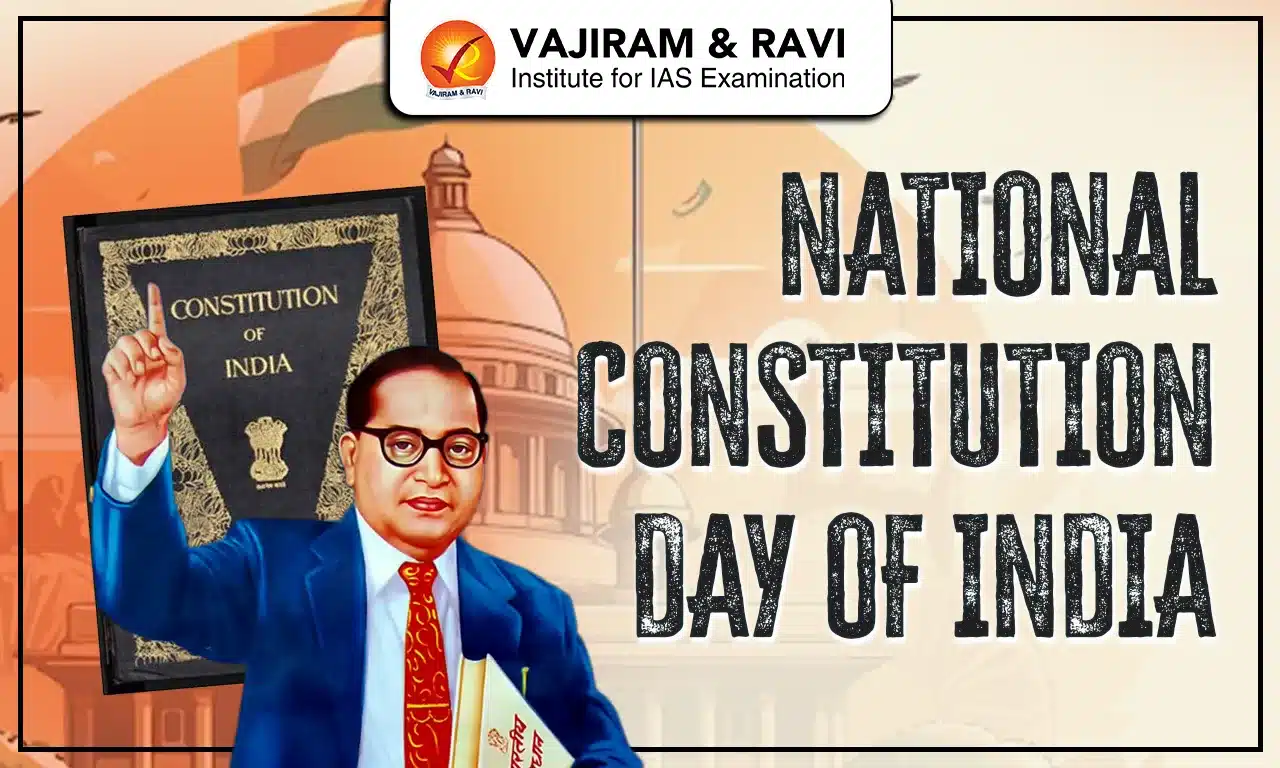
National Constitution Day of India, also known as Samvidhan Divas, is observed every year on 26 November to commemorate the adoption of the Indian Constitution. The day honours the vision of the Constituent Assembly and reinforces the role of constitutional values in shaping India’s democracy. It also aims to promote constitutional literacy among citizens, especially students and public servants. The detailed article on the Constitution Day of India has been shared below.

National Constitution Day of India

National Constitution Day of India, observed on 26 November, commemorates the adoption of the Indian Constitution in 1949 and honours the work of the Constituent Assembly. The Constitution’s drafting was an extensive process that lasted 2 years, 11 months, and 18 days, from 9 December 1946 to 26 November 1949. The day highlights the vision of Dr. B.R. Ambedkar and other framers who shaped India’s democratic foundations. It also promotes awareness of constitutional values, rights, duties, and the importance of safeguarding democratic principles.

National Constitution Day of India History

National Constitution Day was officially designated on 19 November 2015, when the Government of India decided to commemorate 26 November 1949, the date on which the Constitution was adopted. Prior to 2015, the day was observed informally as Law Day by legal institutions. The renaming highlighted the need to recognise the Constitution’s transformative impact on India’s socio-political fabric. The celebration pays tribute to Dr. B.R. Ambedkar and the Constituent Assembly for laying India’s democratic foundation.

  • Adopted by the Constituent Assembly on 26 November 1949.
  • Enforced fully on 26 January 1950, marking the birth of the Republic.
  • Declared officially as Constitution Day in 2015 to honour Dr. B.R. Ambedkar’s 125th birth anniversary year.
  • Earlier known as Law Day, celebrated primarily by legal bodies.

National Constitution Day of India Significance

National Constitution Day holds deep symbolic and educational importance, as it reaffirms India's commitment to democracy, liberty, equality, justice, and fraternity. It encourages citizens to understand the Constitution not as a legal document alone but as a living guide shaping governance and rights.

Why Constitution Day Matters

  • Raises awareness about Fundamental Rights, Duties, and Directive Principles.
  • Reinforces commitment to constitutional supremacy and democratic governance.
  • Pays homage to Dr. B.R. Ambedkar, the principal architect of the Constitution.
  • Encourages study of key values like secularism, federalism, equality, and rule of law.

National Constitution Day of India Drafting Timeline

The drafting of the Indian Constitution was a monumental process that spanned 2 years, 11 months, and 18 days, beginning with the Constituent Assembly’s first meeting on 9 December 1946 and culminating in its adoption on 26 November 1949. A major milestone was the creation of the Drafting Committee under the chairmanship of Dr. B.R. Ambedkar on 29 August 1947, which prepared the foundational text of the Constitution. The final draft was placed before the Assembly for detailed debate and scrutiny on 4 November 1948, marking the beginning of intensive discussions. The Constitution was finally adopted on 26 November 1949 and came into full effect on 26 January 1950, celebrated today as Republic Day.

National Constitution Day of India Drafting Timeline
Event Date

Formation of Constituent Assembly

9 December 1946

First meeting of the Constituent Assembly

9 December 1946

Dr. Rajendra Prasad elected as President of the Assembly

11 December 1946

Formation of Drafting Committee under Dr. B.R. Ambedkar

29 August 1947

Presentation of Draft Constitution

4 November 1948

Adoption of Constitution by the Constituent Assembly

26 November 1949

Enforcement of Constitution / Republic Day

26 January 1950

Constitutional Values Highlighted on Constitution Day of India

Constitution Day serves as a reminder of the core values enshrined in the Preamble, which guide India’s democratic, ethical, and governance framework. These values shape the relationship between the State and the citizen while promoting justice, equality, liberty, and national unity.

  • Justice - Ensuring social, economic, and political fairness for all citizens.
  • Liberty - Protecting freedom of thought, expression, belief, faith, and worship.
  • Equality - Guaranteeing equal rights, opportunities, and dignity for every individual.
  • Fraternity - Promoting national unity, integrity, and brotherhood across communities.
  • Secularism - Upholding religious neutrality and respect for all faiths.
  • Democracy - Ensuring participation, representation, and accountability in governance.
  • Rule of Law - Establishing supremacy of law over arbitrary power.

National Constitution Day & Republic Day Differences

National Constitution Day marks the adoption of the Indian Constitution on 26 November 1949, focusing on awareness of constitutional values and citizen duties. In contrast, Republic Day on 26 January 1950 celebrates the enforcement of the Constitution, symbolising India’s transition to a sovereign republic with a public holiday and national celebrations. The detailed key differences between Constitution Day & Republic Day have been shared below in the table.

National Constitution Day & Republic Day Difference
Feature Constitution Day (26 Nov) Republic Day (26 Jan)

Purpose

Marks adoption of the Constitution

Marks enforcement of the Constitution

Declared as

Constitution Day (2015)

National Festival

Focus

Awareness of constitutional values

Celebration of India becoming a Republic

Type of Holiday

Not a public holiday

National public holiday

Activities

Preamble reading, debates, lectures

Parade, awards, cultural displays


National Constitution Day of India FAQs

Q1: Why is National Constitution Day celebrated on 26 November?

Ans: It is celebrated to mark the adoption of the Indian Constitution by the Constituent Assembly on 26 November 1949.

Q2: Who announced Constitution Day in India?

Ans: The Government of India declared it in 2015, during Dr. B.R. Ambedkar’s 125th birth anniversary year.

Q3: What is the difference between Law Day and Constitution Day?

Ans: Earlier, 26 November was observed informally as Law Day by legal institutions; after 2015, it became Constitution Day to promote broader constitutional awareness.

Q4: Is Constitution Day a public holiday?

Ans: No, Constitution Day is not a public holiday but is widely observed in government institutions and educational establishments.

Q5: What activities are conducted on Constitution Day?

Ans: Activities include Preamble reading, essay competitions, seminars, judicial workshops, pledge ceremonies, and awareness campaigns on rights and duties.

Minimum Support Price (MSP), Meaning, Crops List 2025-26

Minimum Support Price (MSP)

The Minimum Support Price (MSP) is a market intervention scheme where the government sets a predetermined price for 22 crops. If market prices drop below the MSP, the government steps in to purchase the crops. This ensures that farmers receive a guaranteed price, protecting them from market fluctuations and ensuring financial stability. Keep reading the article to know the details of MSP, the List of Crops Covered Under MSP and many more.

What is Minimum Support Price (MSP)?

The Minimum Support Price (MSP) is the minimum price set by the government to ensure farmers receive fair value for their crops, even when market prices fall. This concept was introduced in 1966-67 during the Green Revolution as part of agricultural reforms, MSP serves as a safety measure taken by the union government to protect farmers from financial losses and maintain food security.

The Indian government announces MSP twice a year, before the Kharif (monsoon) and Rabi (winter) sowing seasons. The Commission for Agricultural Costs and Prices (CACP) recommends the MSP, which is then approved by the Cabinet Committee on Economic Affairs (CCEA). This system encourages farmers to grow essential crops while ensuring financial stability.

Minimum Support Price Crops List

The government sets the Minimum Support Price (MSP) for 22 crops to provide financial support to farmers. This includes 14 Kharif crops, Rabi crops 6, and 2 commercial crops. MSP is also determined for Toria and de-husked coconut, based on the MSPs of rapeseed & mustard and copra. The MSP is revised annually by the government, considering the existing economic and agricultural conditions to ensure fair price for the crop to the farmers.

Kharif Crops

  1. Paddy
  2. Jowar
  3. Bajra
  4. Ragi
  5. Maize
  6. Tur (Arhar)
  7. Moong
  8. Urad
  9. Groundnut
  10. Sunflower Seed
  11. Soyabean (Yellow)
  12. Sesamum
  13. Nigerseed
  14. Cotton

Rabi Crops

  1. Wheat
  2. Barley
  3. Gram
  4. Masur (Lentil)
  5. Rapeseed & Mustard
  6. Safflower

Commercial Crops

  1. Copra
  2. Jute

How to Determine Minimum Support Price?

The Commission for Agricultural Costs and Prices (CACP) recommends the Minimum Support Price (MSP) based on various factors, ensuring fair prices for crops to farmers. Before announcing the MSP, the government considers:

  • Cost of Production: The primary factor includes expenses on seeds, fertilizers, irrigation, and labour. Farmers are assured a minimum margin of 50% over the production cost.
  • Demand and Supply: The government analyzes market trends and consumer demand to determine appropriate pricing.
  • Market Price Trends: Domestic and international price comparisons ensure that the MSP remains competitive.
  • Inter-Crop Price Parity: A balanced pricing structure across different crops encourages diversified farming.
  • Terms of Trade: The government assesses the relationship between agricultural and non-agricultural sectors to maintain fair trade conditions.

Also Read: Fertilizer Security

Other Considerations

  • Changes in Input Prices
  • Input-Output Price Parity
  • Industrial Cost Structure
  • Cost of Living
  • Impact on Subsidies
  • Farmer’s Income Parity

The government uses the A2+FL formula to calculate MSP, which includes:

  • A2: Actual paid-out costs incurred by the farmer.
  • FL: The imputed value of family labour.

Minimum Support Price Needs

The Minimum Support Price (MSP) is a minimum price set by the government of India for Indian agriculture, offering stability, security, and motivation for farmers to sustain crop production. The below mentioned are the needs for the Minimum Support Price:

  • It guarantees a minimum income for farmers, protecting them from financial losses.
  • By providing assured prices, it motivates farmers to grow more staple crops, contributing to food security.
  • MSP acts as a buffer against price fluctuations, especially during harvest season.
  • A strong agricultural sector, backed by MSP, uplifts rural livelihoods and strengthens the economy.
  • Farmers are protected from being forced to sell their produce at unfair prices by traders.

Latest Minimum Support Price 2025-26

According to the Directorate of Economics and Statistics, Ministry of Agriculture and Farmers Welfare, according to the latest Minimum Support Price (MSP) applicable for the 2025-26 is as follows (as of 22 January 2025):

Latest Minimum Support Price 2025-26

Commodity

Variety

2023-24

2024-25

Increase in MSP (2024-25 over 2023-24)

Kharif Crops

Paddy

Common

2183

2300

117 (5.4%)


Grade 'A'

2203

2320

117 (5.3%)

Jowar

Hybrid

3180

3371

191 (6.0%)


Maldandi

3225

3421

196 (6.1%)

Bajra


2500

2625

125 (5.0%)

Ragi


3846

4290

444 (11.5%)

Maize


2090

2225

135 (6.5%)

Tur (Arhar)


7000

7550

550 (7.9%)

Moong


8558

8682

124 (1.4%)

Urad


6950

7400

450 (6.5%)

Groundnut


6377

6783

406 (6.4%)

Sunflower Seed


6760

7280

520 (7.7%)

Soyabeen (Yellow)


4600

4892

292 (6.3%)

Sesamum


8635

9267

632 (7.3%)

Nigerseed


7734

8717

983 (12.7%)

Cotton

Medium Staple

6620

7121

501 (7.6%)


Long Staple

7020

7521

501 (7.1%)

Rabi Crops

Wheat


2275

2425

150 (6.6%)

Barley


1850

1980

130 (7.0%)

Gram


5440

5650

210 (3.9%)

Masur (Lentil)


6425

6700

275 (4.3%)

Rapeseed & Mustard


5650

5950

300 (5.3%)

Safflower


5800

5940

140 (2.4%)

Toria


5650

5950

300 (5.3%)

Commercial Crops

Copra 

Milling

10860

11160

300 (2.8%)


Ball

11750

12000

250 (2.1%)

De-Husked Coconut


2930

3013

83 (2.8%)

Jute


5050

5335

285 (5.6%)


Minimum Support Price FAQs

Q1: What is the meaning of Minimum Support Price?

Ans: The Minimum Support Price (MSP) is the price set by the government to ensure farmers receive a guaranteed price for their crops, protecting them from market fluctuations.

Q2: What is the Minimum Support Price for 2025-2026?

Ans: Economics, the minimum price refers to the Minimum Support Price (MSP) set by the government to ensure farmers get fair compensation for their crops.

Q3: What is state minimum support price?

Ans: The State Minimum Support Price (State MSP) is a price set by individual state governments for certain crops, often higher than the central MSP, to support local farmers.

Q4: Who introduced Minimum Support Price in India?

Ans: The Minimum Support Price (MSP) was introduced in 1966-67 by the Government of India during the Green Revolution to support farmers and ensure food security.

Q5: What is the purpose of Minimum Support Price?

Ans: The Minimum Support Price (MSP) ensures farmers receive a fair price for their crops, protecting them from market fluctuations and ensuring agricultural sustainability.

UPSC Daily Quiz 14 June 2026

UPSC Daily Quiz

[WpProQuiz 186]

UPSC Daily Quiz FAQs

Q1: What is the Daily UPSC Quiz?

Ans: The Daily UPSC Quiz is a set of practice questions based on current affairs, static subjects, and PYQs that help aspirants enhance retention and test conceptual clarity regularly.

Q2: How is the Daily Quiz useful for UPSC preparation?

Ans: Daily quizzes support learning, help in revision, improve time management, and boost accuracy for both UPSC Prelims and Mains through consistent practice.

Q3: Are the quiz questions based on the UPSC syllabus?

Ans: Yes, all questions are aligned with the UPSC Syllabus 2025, covering key areas like Polity, Economy, Environment, History, Geography, and Current Affairs.

Q4: Are solutions and explanations provided with the quiz?

Ans: Yes, each quiz includes detailed explanations and source references to enhance conceptual understanding and enable self-assessment.

Q5: Is the Daily UPSC Quiz suitable for both Prelims and Mains?

Ans: Primarily focused on Prelims (MCQ format), but it also indirectly helps in Mains by strengthening subject knowledge and factual clarity.

Tetanus

Tetanus

Tetanus Latest News

Tetanus, once thought to have been eradicated, is resurging in the US.

About Tetanus

  • Tetanus, also known as lockjaw, is a serious bacterial infection that affects the body's nervous system. 
  • It's caused by a poison (toxin) made by the bacterium Clostridium tetani (C. tetani).
  • The bacterium usually enters the body through an open wound. 
  • Tetanus bacteria live in soil and manure. They can also be found in the human intestine and other places.
  • Tetanus occurs more often in warmer climates or during the warmer months.
  • It’s not spread from person to person.  
  • Anyone can get tetanus, but the disease is particularly common and serious in newborn babies and pregnant women who have not been sufficiently immunized with tetanus-toxoid-containing vaccines. 

Tetanus Symptoms

  • Once inside the body, tetanus toxins interfere with the release of neurotransmitters, leading to muscle contractions and intractable spasms.
  • Symptoms typically occur between 3 and 21 days (average 8 days) after exposure.
  • The early hallmark of tetanus is ‘lockjaw’, hence the name. It is a painful condition in which the jaw cannot move or open properly.
  • Other symptoms include:
    • Trouble swallowing
    • Sudden, involuntary muscle spasms — often in the stomach
    • Painful muscle stiffness throughout the body
    • Seizures (jerking or staring)
    • Headache
    • Fever and sweating
    • Changes in blood pressure and heart rate
  • The disease can cause serious health problems such as laryngospasm (uncontrolled tightening of the vocal cords), fractures, pulmonary embolism (blockage in the lungs caused by a blood clot), aspiration pneumonia (lung infection from inhaling saliva or vomit), and breathing difficulties. 
  • In severe cases, tetanus can lead to death

Tetanus Treatment

  • There's no cure for tetanus. 
  • Treatment focuses on managing symptoms and complications until the effects of the tetanus toxin resolve. 
  • People who recover from tetanus do not have natural immunity and can be infected again. 

Tetanus Prevention

  • Tetanus is completely preventable by being immunized (vaccinated). 
  • Immunization usually protects against tetanus infection for 10 years. 
  • The childhood schedule includes five doses, followed by boosters in adolescence and every 10 years.
  • Pregnant women are also advised to receive Tdap to protect their newborns.

News: TOI

Tetanus FAQs

Q1: What is tetanus?

Ans: Tetanus is a serious bacterial infection that affects the body's nervous system.

Q2: Which bacterium causes tetanus?

Ans: Clostridium tetani (C. tetani).

Q3: How does the tetanus bacterium usually enter the body?

Ans: Through an open wound.

Q4: What is the earliest hallmark symptom of tetanus?

Ans: Lockjaw.

Q5: How can tetanus be prevented?

Ans: Through immunization (vaccination).

Zardalu Mangoes

Zardalu Mangoes

Zardalu Mangoes Latest News

Every summer, more than 125 quintals of Bhagalpur's famed Zardalu mangoes are carefully selected, packed and dispatched to the President, the Prime Minister, and other top dignitaries, turning a regional fruit into a symbol of Bihar's agricultural heritage.

About Zardalu Mangoes

  • Zardalu mango, also called Jardalu, is a unique mango variety from Bhagalpur, Bihar.  
  • It is known for its light yellow skin and distinct special aroma. 
  • Its story dates back to the early 19th century when Maharaja Rahmat Ali Khan Bahadur of Haveli Kharagpur introduced its cultivation in the Bhagalpur region.  
  • The first sapling, planted between 1810 and 1820, still stands in Tagepur village, serving as a living testament to this mango's enduring legacy.  
  • The Jardaloo mangoes are available from mid-April through the end of June. 
  • The fruits generally weigh between 150 and 300 grams, have a rich, creamy, tender texture, and delicate, non-fibrous, juicy pulp. 
  • As the fruit matures, the skin of the Zardalu mango turns golden-yellow with a tinge of red across the top of the fruit.  
  • Jardalu mangoes are rich with fibre & enzymes; it's highly beneficial to the digestive system.  
  • In 2018, the Jardalu mango received the prestigious Geographical Indication (GI) tag.

News: BI

Zardalu Mangoes FAQs

Q1: Which state is famous for the Zardalu (Jardalu) mango?

Ans: Bihar.

Q2: What is the distinctive color of the Zardalu mango's skin?

Ans: Light yellow.

Q3: Who introduced the cultivation of Zardalu mango in the Bhagalpur region?

Ans: Maharaja Rahmat Ali Khan Bahadur of Haveli Kharagpur.

Q4: During which months are Jardalu mangoes available?

Ans: From mid-April to the end of June.

Q5: In which year did Jardalu mango receive a Geographical Indication (GI) tag?

Ans: 2018.

Giant’s Causeway

Giant’s Causeway

Giant’s Causeway Latest News

Geochronologists investigating how the Giant’s Causeway was created recently discovered it was formed over 5.5m years, 8m years less than previously estimated.

About Giant’s Causeway

  • It is located on the coastal edge of the Antrim Plateau in Northern Ireland. 
  • The region consists of 6 kilometers (4 miles) of stepping-stone-like black basalt columns. 
  • Some 40,000 stone pillars can be found here. 
  • Each stone is a curiously distinct polygon or hexagon, with seemingly unnatural straight edges. 
  • The pillars range in height, and shoot up out of the sea, increasing in height until they reach the cliff top. 
  • This stepping stone or stair-like appearance of the area is where the Giant’s Causeway name is thought to have originated, as the columns look much like steps for a giant. 
  • It was declared a UNESCO World Heritage Site in 1986.

Giant’s Causeway Formation

  • The rock and column formations were first formed some 50 to 60 million years ago, during the Paleogene Period.
  • The columns originally formed due to extensive volcanic activity in the area. 
  • Molten basalt rose up through a layer of chalk beds, creating what is known as a volcanic plateau. 
  • The lava then began to cool and contract, which caused fractures and edges within the rock. 
  • As the lava flow continued to cool, it receded, leaving behind tall column shapes. 
  • Because the lava cooled very quickly, it receded a great deal, leaving behind particularly prominent and large columns. 

News: TG

Giant’s Causeway FAQs

Q1: What is the Giant’s Causeway?

Ans: The Giant’s Causeway is a natural formation of basalt columns located in Northern Ireland.

Q2: Approximately how many stone pillars are found at the Giant’s Causeway?

Ans: Around 40,000 stone pillars are found there.

Q3: What natural process led to the formation of the Giant’s Causeway?

Ans: Extensive volcanic activity led to its formation.

Q4: In which year was the Giant’s Causeway declared a UNESCO World Heritage Site?

Ans: It was declared a UNESCO World Heritage Site in 1986.

Arbuscular Mycorrhizal Fungi

Arbuscular Mycorrhizal Fungi

Arbuscular Mycorrhizal Fungi Latest News

A new study published in Science has reported the first global map of the earth’s vast underground network of arbuscular mycorrhizal (AM) fungi.

About Arbuscular Mycorrhizal Fungi

  • These are groups of root obligate biotrophs belonging to the phylum Glomeromycota.
  • These are soil-borne microorganisms that form symbiotic associations with approximately 80% of terrestrial vascular plants.
  • AMF are primary biotic soil components which, when missing or impoverished, can lead to a less efficient ecosystem functioning. 
  • Structure: These are made up of tiny branching threads called hyphae.
  • These hyphal networks form two-way pipes to channel nutrients and carbon to and from plants.
  • Grassland ecosystems like those in South Sudan, the Tibetan plateau, and India’s Banni grasslands house 40% of the world’s AM fungal networks.
  • Its networks also weigh around 300 million tonnes of carbon, which is four- to six-times the weight of the entire human population.
  • Ecological Role
    • They are considered natural biofertilizers which provide the host with water, nutrients, and pathogen protection, in exchange for photosynthetic products.
    • They provide nutrients and water in exchange for the carbon produced by the plants, and help to regulate the climate by drawing carbon into soils.
    • It formed symbiotic relationships with 70% of plant species, trading nutrients for carbon and sequesters an estimated 4 billion tonnes of CO2-equivalent a year.

Source: TH

Arbuscular Mycorrhizal Fungi FAQs

Q1: Which tree-like structure formed by AMF inside root cortical cells facilitates nutrient exchange?

Ans: Arbuscules – site of phosphorus and carbon transfer between fungus and plant

Q2: Which plant family is a known non-host for Arbuscular Mycorrhizal Fungi?

Ans: Brassicaceae – includes mustard, cabbage, cauliflower, radish

Greater Hog Badger

Greater Hog Badger

Greater Hog Badger Latest News

Recently, the Kaziranga National Park and Tiger Reserve has released the first scientific assessment report on the greater hog badger (Arctonyx collaris).

About Greater Hog Badger

  • It is a nocturnal small burrowing omnivore mammal.
  • It is called ‘mati gahori’ in Assamese.
  • Globally, there are three extant species of this mammal—the greater hog badger, the northern hog badger (Arctonyx albogularis), and the Sumatran hog badger (Arctonyx hoevenii). The first two are found in India.
  • Appearance: It possesses an elongated pig-like snout and modified teeth which point forward and are used for turning over the soil.
  • Distribution: It is distributed across parts of South, Central, and Southeast Asia.
    • Its range extends from Bangladesh and northeastern India eastwards through Myanmar, Thailand, Lao PDR and Vietnam.
  • Habitat: They live in tropical evergreen forests, savanna, grasslands and shrubland, hills, and mountains.
  • Characteristics
    • It is a ground-dwelling, very shy and leads a secretive solitary life.
    • These are territorial creatures that mark their territories with their scents on the grass, rocks, and tree trunks.
    • They are excellent burrowers and dig into the ground to create burrows for shelter and to find their food.
    • Diet: Its diet includes worms, insects, small mammals but also fruits, tubers, and roots.
  • Ecological Role
    • It contributes to ecosystem function as a highly fossorial mammal (a term for animals adapted for digging, burrowing, or living primarily underground) through soil disturbance, nutrient redistribution, and leaf litter turnover during foraging.
    • Such digging behaviour enhances soil aeration and may facilitate seed germination and micro-habitat formation for invertebrates and small vertebrates.
  • Conservation Status

Source: TH

Greater Hog Badger FAQs

Q1: Which key physical feature gives the Greater Hog Badger its name?

Ans: Elongated, pig-like snout used for rooting and digging

Q2: Greater Hog Badger belongs to which animal family?

Ans: Mustelidae – same family as otters, weasels, and honey badgers

Peninsular Plateau of India, Map, Divisions, Rivers, States

Peninsular Plateau

The Peninsular Plateau of India, also known as the Indian Shield, is one of the oldest and most stable landmasses on Earth. It forms the core of the Indian subcontinent and dominates the geographical landscape of central and southern India. Its geological antiquity, mineral wealth, diverse physiographic divisions, and ecological significance make it an essential part of India. The plateau has shaped India’s river systems, agriculture, settlement patterns, industrial development, and biodiversity over millions of years.

Peninsular Plateau of India Features

The Peninsular Plateau stands out due to its unique terrain, geological stability, and mineral-rich composition.

  • The plateau covers nearly 16 lakh sq km, representing almost 50% of India’s total landmass.
  • It is composed primarily of crystalline, igneous, and metamorphic rocks, dating back to the Archean and Proterozoic ages (over 2.5 billion years old).
  • The plateau is roughly triangular in shape, drained by both east-flowing and west-flowing rivers, creating deep valleys, escarpments, and basins.
  • The Peninsular Plateau is bounded by the Aravalli Range, Vindhya, Satpura, Barmer, and Rajmahal Hills in the north; the Western Ghats in the west; and the Eastern Ghats in the east.
  • It consists of numerous plateaus, uplands, hill ranges, forest belts, and fertile valleys formed by tectonic movements and prolonged erosion.
  • The region is rich in minerals resources such as iron ore, coal, manganese, bauxite, gold, mica, making it India’s “mineral heartland.”

Peninsular Plateau of India Geological Formation

The geological evolution of the Peninsular Plateau is linked to tectonic activity, volcanic events, and the breakup of ancient continents.

  • Part of the Gondwana supercontinent, the plateau separated due to continental drift about 135 million years ago.
  • The foundation of the plateau is formed by some of the world’s oldest rocks, comparable to those found in Western Australia and South Africa.
  • Large igneous eruptions known as Deccan Trap volcanic events (around 60-68 million years ago) formed extensive basaltic layers, especially in Maharashtra.
  • Lineaments, faults, and rift valleys such as the Narmada-Son Lineament and Narmada-Tapti Rift Valley are prominent tectonic features.
  • Weathering, denudation, and fluvial erosion have shaped its current topography over millions of years.

Peninsular Plateau of India Divisions

The Peninsular Plateau is divided into several physiographic units, each with distinct geological structure, river systems, soil types, ecology, and agricultural patterns. Below are the Major Divisions of the Peninsular Plateau of India

Peninsular Plateau of India Map

Marwar Upland

The Marwar Upland lies in the northwestern part of the Peninsular Plateau and forms a transitional zone between the Thar Desert and the Aravalli Range. It is characterized by semi-arid climate, rocky terrain, and ancient residual hills.

  • Location: Western Rajasthan, mainly Jodhpur, Pali, Nagaur, Barmer regions.
  • Topography:
    • Rocky uplands, pediments, and residual hills.
    • Elevation ranges between 250-500 m.
  • Rivers: Seasonal rivers such as Luni, Sukri, and Bandi.
  • Geological Composition: Predominantly Aravalli schists, gneisses, quartzite, and granite.
  • Flora & Fauna:
    • Xerophytic vegetation - Khejri, Acacia, Ber, thorn scrub.
    • Wildlife: Chinkara, Desert fox, Blackbuck.
  • Major Crops: Bajra, Jowar, Pulses, Mustard, and limited wheat in irrigated areas.
  • States Covered: Rajasthan.

Central Highlands

The Central Highlands form the northern segment of the Peninsular Plateau, extending from the Aravallis to the eastern part of Madhya Pradesh. They include important plateaus and river basins.

  • Location: Rajasthan, Madhya Pradesh, parts of Uttar Pradesh.
  • Topography:
    • Elevation 300-600 m, dissected plateaus.
    • Slopes eastward towards the Gangetic plains.
  • Rivers: Chambal, Banas, Sind, Betwa, Ken.
  • Geological Composition: Granite-gneiss, Vindhyan sedimentary rocks (sandstone, shale, limestone).
  • Flora & Fauna: Dry deciduous forest - Teak, Salai, Palash.
  • Fauna: Leopard, Nilgai, Sloth bear.
  • Major Crops: Wheat, Soybean, Mustard, Pulses, Cotton (western part).
  • States Covered: Rajasthan, Madhya Pradesh, Uttar Pradesh.

Bundelkhand Upland

Bundelkhand Upland is a rugged region between the Yamuna and Narmada river systems known for granite outcrops, uneven terrain, and low water availability.

  • Location: Southern Uttar Pradesh & Northern Madhya Pradesh (Jhansi, Banda, Chhatarpur).
  • Topography:
    • Highly eroded upland, rocky plateau, inselbergs.
    • Average elevation 300-400 m.
  • Rivers: Betwa, Dhasan, Ken, Sonar.
  • Geological Composition: Ancient Bundelkhand granites, gneisses, quartzite.
  • Flora & Fauna:
    • Thorn & dry deciduous vegetation.
    • Wildlife includes Nilgai, Wild Boar, Indian Wolf.
  • Major Crops: Gram, Wheat, Bajra, Urad, limited paddy.
  • States Covered: Madhya Pradesh, Uttar Pradesh.

Malwa Plateau

The Malwa Plateau is a fertile volcanic region with black soil, forming an important agricultural zone in central India.

  • Location: Western Madhya Pradesh & southeastern Rajasthan.
  • Topography:
    • Flat to gently undulating plateau, elevation 500-600 m.
    • Northern boundary marked by Chambal ravines.
  • Rivers:
    • Western Drainage (towards the Arabian Sea): Includes Narmada, Tapi, and Mahi, which flow westward and drain into the Arabian Sea.
    • Eastern Drainage (towards the Bay of Bengal): Includes Chambal and Betwa, which flow northeast and join the Yamuna, ultimately draining into the Bay of Bengal.
  • Geological Composition: Basaltic lava flows from Deccan volcanism, which formed Black cotton soil.
  • Flora & Fauna:
    • Dry deciduous forest - Teak, Butea, Neem.
    • Fauna: Chital, Indian fox, Hyena.
  • Major Crops: Soybean (largest producer), Wheat, Cotton, Sugarcane, Maize.
  • States Covered: Madhya Pradesh, Rajasthan and some parts of Gujarat

Baghelkhand Plateau

The Baghelkhand Plateau lies in eastern Madhya Pradesh and is known for rugged topography, dense forest cover, and important mineral reserves.

  • Location: Eastern Madhya Pradesh, Uttar Pradesh & northern Chhattisgarh.
  • Topography: Dissected plateau, steep escarpments, elevation 300-600 m.
  • Rivers: Son, and Mahanadi
  • Geological Composition: Vindhyan & Gondwana sediments, sandstone, limestone, shales.
  • Flora & Fauna:
    • Moist deciduous forests - Sal, Bamboo.
    • Animals: Tiger, Leopard, Sambar, Indian Bison.
  • Major Crops: Paddy, Wheat, Pulses, minor millets.
  • States Covered: Madhya Pradesh, Uttar Praedesh, Chhattisgarh.

Chotanagpur Plateau

The Chotanagpur Plateau is India's mineral heartland, rich in coal, iron ore, mica, bauxite, and copper. It supports major industrial belts.

  • Location: Jharkhand, northern Odisha, eastern Chhattisgarh, West Bengal border.
  • Topography:
    • Uplands, valleys, and highest peak Parasnath (1365 m).
    • Ranchi, Hazaribagh, Palamu uplands.
  • Rivers: Damodar, Subarnarekha, Koel, Sankh.
  • Geological Composition: Archaean granites and Gondwana coalfields.
  • Flora & Fauna:
    • Tropical dry & moist deciduous - Sal, Bamboo, Mahua.
    • Fauna: Elephant, Leopard, Sloth Bear.
  • Major Crops: Paddy, Maize, Oilseeds, Pulses.
  • States Covered: Jharkhand, Odisha, Chhattisgarh, West Bengal.

Meghalaya Plateau

The Meghalaya Plateau is a detached fragment of the Peninsular block, famous for heavy rainfall, limestone caves, and biodiversity.

  • Location: Meghalaya (Khasi, Garo, Jaintia Hills).
  • Topography:
    • High hills (avg. 1200-1500 m), deep valleys.
    • Receives highest rainfall at Mawsynram & Cherrapunji.
  • Rivers: Umngot, Myntdu, Simsang, seasonal streams.
  • Geological Composition: Gneiss, schist, sandstone, limestone, rich cave systems.
  • Flora & Fauna:
    • Evergreen forests - Orchids, Pine, Bamboo.
    • Fauna: Hoolock gibbon, Clouded leopard, Elephants.
  • Major Crops: Jhum crops, Potatoes, Turmeric, Oranges, spices.
  • States Covered: Meghalaya.

Deccan Plateau

The Deccan Plateau is the largest and most prominent part of the Peninsular Plateau, covering almost the entire southern part of India. It is a volcanic plateau formed primarily during the Cretaceous period due to massive basaltic lava flows, commonly known as the Deccan Traps.

  • Location: Bounded by the Western Ghats on the west, Eastern Ghats on the east, and the Satpura and Vindhya ranges in the north.
  • Topography
    • Average elevation ranges from 500 to 1000 meters above sea level.
    • Broad, gently sloping plateau surface, mostly towards the east.
    • Western Ghats form a steep escarpment with narrow coastal plains; Eastern Ghats are discontinuous and eroded.
    • Contains hill ranges like Balaghat, Nilgiri, Anaimalai, and Cardamom Hills.
  • Geological Composition
    • Dominated by basaltic lava flows of the Deccan Traps.
    • Some areas with granite, gneiss, schist, and laterite formations.
    • Rich in minerals: iron ore, manganese, bauxite, and limestone.
  • Rivers and Drainage
    • East-flowing rivers: Godavari, Krishna, Kaveri, Tungabhadra, Bhima, Pennar (drain into Bay of Bengal).
    • West-flowing rivers: Some short rivers along Western Ghats, e.g., Mandovi, Sharavathi (drain into Arabian Sea).
    • Provides hydropower potential at dams like Srisailam, Nagarjuna Sagar, and Tungabhadra.
  • Soil and Agriculture
    • Black soil (Regur): Ideal for cotton cultivation.
    • Red and laterite soils: Support millets, pulses, oilseeds.
    • Alluvial soils along river valleys: Rice and sugarcane.
    • Major crops: Cotton, Jowar, Ragi, Groundnut, Sugarcane, Paddy, Millets.
    • Horticulture: Coffee, Rubber, Spices (especially in Karnataka, Kerala, and Tamil Nadu).
  • Flora and Fauna
    • Dry and moist deciduous forests in plateau areas.
    • Western Ghats: Biodiversity hotspot with tropical evergreen forests.
    • Wildlife includes Tiger, Leopard, Gaur, Elephant, Nilgiri Tahr, Sloth Bear.
  • Economic Significance
    • Agriculture: Major cotton, sugarcane, and food grain-producing region.
    • Minerals: Iron ore (Karnataka, Goa), Manganese (Maharashtra, Karnataka), Bauxite (Karnataka, Odisha).
  • States Covered: Maharashtra, Karnataka, Telangana, Andhra Pradesh, Tamil Nadu, Kerala, Chhattisgarh

Major Hillls of Peninsular Plateau of India

[my_image src="https://vajiramias.sgp1.cdn.digitaloceanspaces.com/wp/current-affairs/2025/12/Artboard-1.webp?v=2" size="full" align="center" width="auto" height="442px" alt="Major Hillls of Peninsular Plateau of India" title="Major Hillls of Peninsular Plateau of India"]

The Peninsular Plateau of India consists of several ancient hill ranges that influence river systems, climate, and biodiversity. These hills include both continuous ranges like the Western Ghats and discontinuous ranges like the Eastern Ghats, along with isolated highlands across central and southern India.

Major Hillls of Peninsular Plateau of India
Hill Range Location / States Highest Peak Significance

Aravalli Hills

Rajasthan, Delhi

Guru Shikhar (1,722 m)

Oldest fold mountains; influence desert ecology

Vindhya Range

Madhya Pradesh, Uttar Pradesh, Rajasthan

1,100 m

Natural divide between north & south India

Satpura Range

Madhya Pradesh, Maharashtra, Chhattisgarh

Dhupgarh (1,350 m)

Source of Narmada river; rich forests

Western Ghats

Maharashtra, Goa, Karnataka, Kerala, Tamil Nadu

Anamudi (2,695 m)

UNESCO Heritage Site; biodiversity hotspot

Eastern Ghats

Odisha, Andhra Pradesh, Tamil Nadu, Karnataka

Jindhagada or Arma Konda (1,690 m, Araku Valley)

Discontinuous hills; many rivers originate

Nilgiri Hills

Tamil Nadu, Kerala, Karnataka

Doddabetta (2,637 m)

Hill station & tourism; rich flora & fauna

Anaimalai Hills

Tamil Nadu, Kerala

Anamudi (2,695 m)

Coffee plantations; wildlife habitats

Cardamom Hills

Kerala

South Cardamom (1,670 m)

Spices cultivation; tropical forests

Meghalaya Hills

Meghalaya (Khasi, Garo, Jaintia Hills)

Shillong Peak (1,965 m)

Wettest region; unique biodiversity

Peninsular Plateau of India Mineral Resources

The Peninsular Plateau of India is rich in metallic, non-metallic, and fuel minerals due to its ancient geological formations like Archaean rocks, Deccan Traps, and Gondwana sediments. These minerals are crucial for India’s industrial growth, energy production, and infrastructure development.

  • Chotanagpur Plateau: Coal, iron, mica, copper.
  • Malwa & Bundelkhand Plateaus: Limestone, bauxite, some iron ore.
  • Karnataka Plateau: Gold, manganese, bauxite, granite.
Mineral Resources of the Peninsular Plateau
Mineral Major Producing States

Iron Ore

Odisha, Jharkhand, Chhattisgarh, Karnataka, Goa

Manganese

Madhya Pradesh, Maharashtra, Karnataka

Copper

Jharkhand (Singhbhum), Rajasthan (Khetri)

Bauxite

Maharashtra, Odisha, Jharkhand, Gujarat

Limestone

Madhya Pradesh, Rajasthan, Chhattisgarh, Andhra Pradesh

Coal

Jharkhand, Chhattisgarh, Odisha, Madhya Pradesh

Gold

Karnataka (Kolar, Hutti)

Mica

Jharkhand, Bihar, Andhra Pradesh

Graphite

Jharkhand, Tamil Nadu

Granite & Marble

Rajasthan, Karnataka

Diamond

Madhya Pradesh (Panna)

Gemstones

Andhra Pradesh, Rajasthan, Karnataka

Peninsular Plateau of India Economic Significance

The economic significance of the Peninsular Plateau of India has been listed below:

  • Fertile soils like black soil and alluvial soils support cotton, wheat, rice, sugarcane, millets, and oilseeds.
  • Rivers of the plateau provide irrigation through dams and canals, supporting agriculture.
  • Rich in iron, manganese, bauxite, copper, coal, mica, limestone, and gold, making it a mineral hub.
  • Mineral resources have led to the growth of steel plants, cement factories, and mining-based industries.
  • Plateau forests provide timber, medicinal plants, and other forest products.
  • Western and Eastern Ghats host biodiversity hotspots, contributing to eco-tourism and research.
  • Rivers are suitable for hydroelectric power projects, e.g., Srisailam, Nagarjuna Sagar.
  • Coal deposits in Jharkhand, Chhattisgarh, and Odisha support thermal power plants.
  • Hill stations, rivers, waterfalls, and scenic plateaus attract tourism.

Peninsular Plateau of India Challenges

Several environmental and ecological challenges faced by the Peninsular Plateau of India has been discussed below:

  • Deforestation - India’s forest cover on the plateau is around 21-23%, lower than the national average in some states. Western Ghats and Chotanagpur forests have lost 10-15% of original forest cover in the past two decades due to logging, mining, and urban expansion.
  • Soil Erosion - Over 35% of Bundelkhand and Malwa plateau areas are prone to soil erosion due to overgrazing, deforestation, and unsustainable farming.
  • Water Scarcity - Western plateau regions like Marwar and parts of Telangana receive less than 500-800 mm annual rainfall, leading to recurrent droughts and low groundwater levels.
  • Mining Impacts - Jharkhand and Chhattisgarh account for over 40% of India’s coal production, causing land degradation, deforestation, and siltation in rivers like Damodar.
  • Biodiversity Loss - Western Ghats are a UNESCO World Heritage site, yet nearly 150 species are critically endangered, including the lion-tailed macaque and Malabar civet.
  • Air Pollution and Water Pollution - Industrial regions in Odisha, Jharkhand, and Chhattisgarh contribute to high levels of suspended particulate matter, and heavy metal contamination in rivers like Brahmani and Mahanadi.
  • Climate Change Effects - Plateau areas have recorded temperature rise of 0.6-0.8°C over the last 50 years, impacting agriculture (e.g., reduced yields of millets, pulses) and increasing drought frequency.
  • Invasive Species - Plants like Lantana camara have invaded over 20% of degraded forest areas in Chhattisgarh and Madhya Pradesh, affecting local flora.
  • Landslides and Flooding - Western Ghats and Meghalaya Hills receive annual rainfall exceeding 2,500-11,000 mm, causing frequent landslides and flash floods during monsoon season.

Way Forward

  • Afforestation and Forest Management: Increase forest cover in degraded areas; India’s forest cover is 21.7%, lower than the ideal 33%, e.g., Western Ghats restoration projects.
  • Soil and Water Conservation: Adopt watershed management and rainwater harvesting; Bundelkhand has implemented Jaiv Krishi practices to reduce erosion.
  • Sustainable Mining Practices: Enforce eco-friendly mining and land reclamation, e.g., coal mining in Jharkhand and Odisha is being regulated under the Mine Environment & Safety Act.
  • Biodiversity Protection: Strengthen protected areas; the Nilgiri Biosphere Reserve conserves endemic species like lion-tailed macaque and Malabar civet.
  • Climate Change Adaptation: Promote drought-resistant crops and water-efficient irrigation, e.g., Telangana’s micro-irrigation schemes reduce water stress during erratic monsoons.
  • Pollution Control Measures: Implement industrial emission and effluent regulations; e.g., Odisha’s steel belt now follows stricter CPCB standards.

Peninsular Plateau FAQs

Q1: Why is the Peninsular Plateau important for the UPSC exam?

Ans: It forms a major part of India’s physical geography and is crucial for topics like physiography, minerals, environment, and river systems.

Q2: Which is the largest division of the Peninsular Plateau?

Ans: The Deccan Plateau, covering most of southern India.

Q3: Which region of the plateau is richest in minerals?

Ans: The Chotanagpur Plateau, known as India’s mineral heartland.

Q4: What type of rocks dominate the Peninsular Plateau?

Ans: Igneous and metamorphic rocks formed in the Precambrian era.

Q5: Why does the plateau have east-flowing rivers?

Ans: Because the plateau slopes gently toward the east, making rivers like Godavari and Krishna flow into the Bay of Bengal.

Arbitrage Funds

Arbitrage Funds

Arbitrage Funds Latest News

Arbitrage (arb) funds are positioned to take advantage of the mispricing in futures contracts.

About Arbitrage Funds

  • Arbitrage funds are equity-oriented hybrid funds that leverage arbitrage opportunities in the market. 
  • The basic principle behind arbitrage is to take advantage of temporary price differences to generate profits with minimal risk. 
  • These can be a pricing mismatch between two exchanges, different pricing in the spot and futures market, etc. 
  • The fund manager of an arbitrage fund buys and sells the shares at the same time and earns the difference between the selling price and the buying price of the share. 
  • The underlying principle is to capture the price spread between the buying and selling, often within a short time frame.  
  • This is fundamentally different from any other form of investing, where you purchase an asset and wait for it to grow in value before selling it. 
  • In an arbitrage fund, the fund manager invests in equities only when he finds a definite opportunity to earn returns. 
  • If there are no arbitrage opportunities available, then the fund invests in short-term money market instruments and debt securities to ensure stable returns. 
  • The important thing to note here is that the price difference is usually very small. Therefore, the fund manager has to make several trades in one day to book a reasonable profit. 
  • They are classified as hybrid mutual funds where according to the Securities and Exchange Board of India (SEBI), at least 65% of the fund’s assets must be in equities and equity-related securities. 

Arbitrage Funds Benefits

  • Low Risk, Equity-Like Returns: Since the buying and selling are hedged, the risk is minimal, making it an attractive option for risk-averse investors.
  • Tax Advantages: Gains from arbitrage funds held for more than one year qualify as long-term capital gains (LTCG).
  • Liquidity: Arbitrage funds offer high liquidity, allowing investors to redeem their money quickly when needed.
  • Diversified Portfolio: These funds diversify investments across various sectors and instruments, reducing the risk.

Arbitrage Funds Limitations

  • Market Dependency: Returns are linked to market volatility; low volatility means fewer opportunities for arbitrage.
  • Short-Term Focus: They may not be ideal for long-term wealth creation.

News: TH

Arbitrage Funds FAQs

Q1: What are Arbitrage Funds?

Ans: Arbitrage Funds are equity-oriented hybrid mutual funds that generate returns by exploiting price differences in the market.

Q2: What is the basic principle behind arbitrage?

Ans: The basic principle is to take advantage of temporary price differences to earn profits with minimal risk.

Q3: What type of opportunities do arbitrage funds utilize?

Ans: They utilize pricing mismatches between exchanges or between spot and futures markets.

Q4: What is the primary objective of arbitrage trading?

Ans: To capture the price spread between buying and selling prices within a short time frame.

Q5: Why are arbitrage funds considered low-risk investments?

Ans: Because the buying and selling positions are hedged.

Armenia

Armenia Latest News

Recently, Armenia’s ruling Civil Contract party has won the Parliamentary election.  

About Armenia

  • Location: It is a landlocked country, located in the south of Caucasus mountain range.
  • Bordering Countries: It is bounded by Georgia in the north, Azerbaijan in the east, Iran in the southeast and Turkey in the west. 
  • Capital: Yerevan.

Geographical Features of Armenia

  • Climate: Highland continental, hot summers, cold winter climate.
  • Terrain: The Lesser (or Little) Caucasus Mountains dominate much of Armenia’s landscape. 
  • Much of Armenia’s soil—formed partly by residues of volcanic lava—is rich in nitrogen, potash, and phosphates. 
  • Highest Peak: Mount Aragats (4,090 m) which is an extinct volcanic peak.
  • Rivers:  Aras, Hrazdan, Arpa, and Vorotan, rivers which provide hydropower and irrigation facilities to the country.
  • Lakes: Lake Sevan is the largest lake of Armenia.
  • Natural resources: It consists of small deposits of gold, copper, molybdenum, zinc, bauxite.

Source: News On Air

Armenia FAQs

Q1: The disputed Nagorno-Karabakh region lies between Armenia and which country?

Ans: Azerbaijan

Q2: Which Indian defense system was exported to Armenia for the first time in 2023-24?

Ans: Akash Surface-to-Air Missile system

Nobel Prize 2025, Winners List, Peace, Medicine, List in India

Nobel Prize 2025 Winners List

The Nobel Prize 2025 stands as one of the most prestigious honors in the world, awarded annually to individuals and organizations who have made exceptional contributions to the advancement of humanity. These prizes are presented in six major fields: Medicine (Physiology), Physics, Chemistry, Literature, Peace, and Economic Sciences, and represent the highest recognition of excellence, innovation, and service to society.

The Nobel Prize Winners 2025 announcements were made between 6th October and 13th October 2025, honoring extraordinary work that has transformed scientific understanding, promoted global peace, and enriched human culture.

What are the Nobel Prizes?

The Nobel Prizes are a set of international awards given every year to people or organizations that have made remarkable contributions to humanity. These prizes were established as per the will of Alfred Nobel, a Swedish chemist, engineer, and inventor who wanted his fortune to be used to reward those who bring the “greatest benefit to mankind.”

The awards were first presented in 1901, and since then, they have become a global symbol of excellence and humanitarian achievement.

Each Nobel Prize laureate receives:

  • A gold medal symbolizes their honor and achievement.
  • A diploma, personally signed by the awarding institution.
  • A cash award, which varies each year depending on the funds of the Nobel Foundation (in 2023, it was approximately 11 million Swedish kronor, equal to over 1 million USD).

Nobel Prize 2025 Categories

The Nobel Prizes originally began with five categories, as outlined in Nobel’s will. In 1968, a sixth category as Economic Sciences, was added by Sweden’s central bank, bringing the total to six.

Categories of the Nobel Prize 2025
Category Purpose Awarded By

Physics

For groundbreaking discoveries explaining the laws of nature and the universe.

The Royal Swedish Academy of Sciences

Chemistry

For advancements in chemical science and discoveries that improve human life.

The Royal Swedish Academy of Sciences

Physiology or Medicine

For discoveries that advance medical knowledge and improve human health.

The Nobel Assembly at Karolinska Institutet

Literature

For exceptional works of fiction, poetry, or writing that enrich global literature.

The Swedish Academy

Nobel Peace Prize

For efforts in promoting peace, resolving conflicts, and improving global relations.

The Norwegian Nobel Committee

Economic Sciences

Added in 1968; honors contributions to economics and financial science.

The Royal Swedish Academy of Sciences

Nobel Prize Winners List 2025

The Nobel Prize 2025 awards were announced from 6th to 13th October 2025. Each day corresponds to a specific field, with announcements made by the respective awarding committees in Stockholm and Oslo. The Nobel Prize Winners 2025 list has been shared below based on the category.

Nobel Prize 2025 Winners List
Category Date of Announcement Awarded By Nobel Prize Winners 2025 Contribution

Physiology or Medicine

6th October 2025

The Nobel Assembly at Karolinska Institutet, Wallenbergsalen, Solna

Mary E. Brunkow, Fred Ramsdell, and Shimon Sakaguchi

Discoveries concerning peripheral immune tolerance.

Physics

7th October 2025

The Royal Swedish Academy of Sciences, Stockholm

John Clarke, Michel H. Devoret and John M. Martinis

Discovery of macroscopic quantum mechanical tunnelling and energy quantisation in an electric circuit

Chemistry

8th October 2025

The Royal Swedish Academy of Sciences, Stockholm

Susumu Kitagawa, Richard Robson and Omar Yaghi

For the development of metal-organic frameworks

Literature

9th October 2025

The Swedish Academy, Börssalen, Stockholm

László Krasznahorkai

for his compelling and visionary oeuvre that, in the midst of apocalyptic terror, reaffirms the power of art

Peace

10th October 2025

The Norwegian Nobel Committee, Oslo

Maria Corina Machado

for her tireless work promoting democratic rights for the people of Venezuela and for her struggle to achieve a just and peaceful transition from dictatorship to democracy

Economic Sciences

13th October 2025

The Royal Swedish Academy of Sciences, Stockholm

Joel Mokyr; Philippe Aghion and Peter Howitt

for having explained innovation-driven economic growth

  • One half to Joel Mokyr “for having identified the prerequisites for sustained growth through technological progress”
  • Other half jointly to Philippe Aghion and Peter Howitt “for the theory of sustained growth through creative destruction.”

Also Read: Nobel Prize 2024 Winners

Nobel Peace Prize 2025

The Nobel Peace Prize 2025 has been announced on 10th October 2025 by The Norwegian Nobel Committee at the Norwegian Nobel Institute in Oslo. The Nobel Peace Prize Winner 2025 is Maria Corina Machado for her tireless efforts in promoting democratic rights in Venezuela. Recognized as a courageous leader, she has united a divided political opposition to peacefully strive for free elections and a just transition from dictatorship to democracy. Her work highlights the power of ballots over bullets and sets an inspiring example of civilian courage and commitment to democracy.

Nobel Peace Prize 2025 Winner Maria Corina Machado

Nobel Prize Winners 2025 Physiology or Medicine

The Nobel Prize Winners 2025 in Medicine have been awarded to Mary E. Brunkow, Fred Ramsdell, and Shimon Sakaguchi for their groundbreaking discoveries in the field of immunology. Their research revealed the crucial role of regulatory T cells (Tregs) in maintaining immune system balance and preventing autoimmune diseases. This discovery has paved the way for new treatments for conditions such as multiple sclerosis, type 1 diabetes, and rheumatoid arthritis, making a lasting impact on medical science and human health.

Nobel Prize Winners 2025 Physiology or Medicine

Nobel Prize Winners 2025 Physics

The Nobel Prize Winners 2025 in Physics has been announced on 7th October 2025 by The Royal Swedish Academy of Sciences in Stockholm. The Nobel Prize has been awarded to John Clarke, Michel H. Devoret, and John M. Martinis for their discovery of macroscopic quantum mechanical tunnelling and energy quantisation in an electric circuit. Their groundbreaking experiments proved that quantum effects can occur in large, hand-held systems, showing how superconducting circuits can tunnel between states and absorb or emit energy in specific, measurable quantities.

Nobel Prize in Physics 2025

Nobel Prize Winners 2025 Chemistry

The Nobel Prize in Chemistry 2025 has been awarded to Scientists Susumu Kitagawa, Richard Robson, and Omar Yaghi for the development of metal-organic frameworks (MOFs), the Royal Swedish Academy of Sciences announced in Stockholm on 8th October 2025. Their pioneering work on MOFs porous materials with vast surface areas has revolutionized applications in gas storage, catalysis, and environmental sustainability. The discovery represents a transformative advancement in chemical sciences, with potential benefits for medicine, clean energy, and climate solutions.

Nobel Prize 2025 Chemistry

Nobel Prize Winners 2025 Literature

The Nobel Prize in Literature 2025 has been awarded to László Krasznahorkai, the Hungarian novelist and screenwriter renowned for his dense, apocalyptic prose and profound philosophical insight. Often called the “writer of the apocalypse,” Krasznahorkai’s work explores humanity on the edge of collapse, transcendence, and revelation.

The announcement was made on 9th October 2025 by The Swedish Academy at Börssalen, Stockholm. This prestigious award honors an author whose writings demonstrate exceptional creativity, depth, and a profound understanding of the human experience, continuing the Nobel tradition of celebrating literary excellence that inspires readers across generations.

Nobel Prize Winners 2025 Literature

Nobel Prize Winners 2025 Economic Sciences

The Nobel Prize 2025 in Economic Sciences has been announced on 13th October 2025 by The Royal Swedish Academy of Sciences in Stockholm. The Sveriges Riksbank Prize in Economic Sciences 2025 has been awarded to Joel Mokyr, Philippe Aghion, and Peter Howitt for their groundbreaking work on innovation-driven economic growth. Mokyr explored historical conditions necessary for sustained technological progress, while Aghion and Howitt developed the theory of creative destruction, showing how new innovations replace old products to drive long-term growth. Their combined research provides deep insight into the forces shaping modern economic development. 

Nobel Prize Winners 2025 Economic Sciences

Nobel Prize Winners from India

India has produced several Nobel laureates who have made outstanding contributions to science, literature, peace, and economics. Their achievements have brought international recognition and have inspired generations across the country. Here is the list of all the Nobel Prize Winners from India along with the category and their contribution in various fields.

Nobel Prize Winners from India
Year Laureate Category Contribution / Work

1913

Rabindranath Tagore

Literature

Recognized for his profoundly sensitive, poetic, and humanistic writings

1930

C.V. Raman

Physics

Discovery of the Raman Effect, explaining the scattering of light

1968

Har Gobind Khorana

Medicine

Research on genetic code and protein synthesis

1979

Mother Teresa

Peace

Selfless work with the poor and sick in Kolkata, founded Missionaries of Charity

1983

Subrahmanyan Chandrasekhar

Physics

Theoretical studies on the structure and evolution of stars, especially white dwarfs

1998

Amartya Sen

Economic Sciences

Contributions to welfare economics, social choice theory, and development

2009

Venkatraman Ramakrishnan

Chemistry

Studies on the structure and function of the ribosome

2014

Kailash Satyarthi

Peace

Advocacy for children’s rights and fight against child labor

2019

Abhijit Banerjee

Economic Sciences

Experimental approaches to reducing global poverty

How are the Nobel Laureates Chosen?

The selection process for the Nobel Prizes is one of the most rigorous in the world. It involves months of confidential research, nominations, and evaluation by committees of leading experts.

Step-by-Step Selection Process:

  • Nominations: Qualified individuals, including previous laureates, university professors, and selected institutions, nominate candidates.
  • Evaluation: The Nobel Committees study the nominations, review research, and consult with experts.
  • Decision: The respective academies or committees vote to determine the winner(s).
  • Announcement: The results are made public in early October.
  • Award Ceremony: The prizes are formally presented on 10th December, the anniversary of Alfred Nobel’s death.

Significance of the Nobel Prize

The Nobel Prize is not merely an award; it is a symbol of human progress, compassion, and creativity. Its significance lies in its power to:

  • Encourage innovation: It motivates scientists, thinkers, and peacebuilders to continue pushing boundaries.
  • Recognize global impact: It honors efforts that have made lasting positive changes in the world.
  • Inspire future generations: Young researchers and writers often see laureates as role models.
  • Promote peace and cooperation: The Peace Prize especially plays a crucial role in acknowledging movements and individuals striving for global harmony.

Nobel Prize 2025 Winners List FAQs

Q1: Who founded the Nobel Prize?

Ans: The Nobel Prize was founded by Alfred Nobel, a Swedish chemist, engineer, and inventor, through his will in 1895.

Q2: When will the Nobel Prize 2025 winners be announced?

Ans: The Nobel Prize 2025 winners were announced between 6th and 13th October 2025.

Q3: How many Nobel Prizes are awarded each year?

Ans: Six Nobel Prizes are awarded annually, in Physics, Chemistry, Physiology or Medicine, Literature, Peace, and Economic Sciences.

Q4: Who won the first Nobel Prize?

Ans: The first Nobel Prizes were awarded in 1901. For example, Wilhelm Conrad Röntgen won the first Physics Nobel for discovering X-rays.

Q5: What is the prize money for Nobel Prize winners?

Ans: In recent years, the Nobel Prize amount has been around 11 million Swedish kronor, equivalent to over $1 million USD.

Difference between National Anthem and National Song

National Anthem and National Song

The ‘Azad Hind’ team decided “Jana Gana Mana” as India’s National Anthem and “Vande Mataram” as the National Song, representing the country’s culture/history. Check out Difference between National Anthem and National Song in the article below.

The terms National Anthem and National Song are often mentioned together, leading many to overlook confusions in the differences between them. However, for UPSC CSE aspirants, understanding these distinctions is essential as they can be relevant to questions on Indian polity, history, or culture. So, to make that easier for you we have created an elaborated Difference between National Anthem and National Song for your ease, which includes not only the difference but other important facts that an aspiring candidate should know.

Difference between National Anthem and National Song

In most countries, the topic Difference between National Anthem and National Song is a bit confusing as they don’t have the National Song separately and usually mix up the terms as well. In the table below, we have highlighted the major Difference between National Anthem and National Song for your reference. 

Difference between National Anthem and National Song
National Anthem National Song

A National Anthem reflects the history and culture of the country.

A country’s population will strongly relate to a National Song due to many different factors.

A National Anthem will have a particular pronunciation, specific tune and specified timings which must be adhered to by those singing it.

A National Song will have different variations depending on language and other cultural factors.

The National Anthem of India is the “Jana Gana Mana” composed by Rabindranath Tagore in 1911.

The National Song is “Vande Mataram” composed by Bankim Chandra Chatterjee in the 1870.

As per Article 51A of the Constitution of India, honouring the National Anthem is one of the fundamental duties of a citizen of India.

The National Song does not have such constitutional privileges where honouring it is listed as a fundamental duty of a citizen of India.

The Parliament of India has exercised its right to make the singing of the National Anthem mandatory on select occasions.

The National Song is held in equal reverence to the national anthem, but it is not mandatory to sing it at any given occasion.

The custom of officially adopting patriotic hymns as national anthems became a trend during the 19th century.

At the time, National Songs that were widely known and sung by the majority population of a country were at times adopted as the National Anthem. An example of this is the “La Marseillaise”, written in 1792 by Claude Claude Joseph Rouget de Lisle. It was composed during the initial years of the French Revolution as a means to inspire the population.

Meaning of National Anthem

In India’s democracy, the true ruler is not a king or a government, but the people, the citizens who form the backbone of this vibrant nation. Rabindranath Tagore, in his masterpiece Jana Gana Mana, beautifully expresses this sentiment, invoking Kala (Time) as the destiny maker of India, symbolising the collective will of its people. 

This national anthem is more than just a song; it is a tribute to India’s unity, diversity, and shared heritage. It tunes the nation to move forward and still stay united, celebrating the cultural and geographical richness of regions like Punjab, Sindh, Gujarat, Bengal, and the Dravidian heartlands. The anthem's words honour the sacred rivers, mighty mountains, and the unbreakable spirit of the land. It acknowledges the courage of soldiers guarding the borders and the efforts of farmers sustaining the nation. Tagore’s words remind us that India’s strength lies in its citizens, those shaping the nation’s future.

Key Features of Jana Gana Mana

  • Title: Jana Gana Mana
  • Composer and Lyricist: Rabindranath Tagore
  • Musical Scale: Based on Raag Alhiya Bilawal, blending classical melody with universal appeal.
  • Date of Composition: December 11, 1911
  • First Performance: December 27, 1911, at the Indian National Congress session in Kolkata.
  • Adopted as National Anthem: January 24, 1950
  • Duration: 52 seconds, embodying profound meaning in brevity.
  • Original Language: Bengali (Bharoto Bhagyo Bidhata)
  • Theme: Unity in Diversity

About the National Song

"Vande Mataram," written by Bankim Chandra Chatterjee in a blend of Sanskrit and Bengali, is the National Song of India. First featured in his novel Anand Math in 1882, with its tune composed by Yadunath Bhattacharya, it became a symbol of patriotism during India’s freedom struggle. 

Adopted as the national song by the Congress in 1905 and officially recognized in 1950, its powerful verses inspired unity and resistance during movements like Bengal’s partition and Gandhi’s non-cooperation. Even today, it evokes pride and devotion during national celebrations. Globally, it gained recognition when ranked second in a 2003 BBC poll of the world's greatest songs, reflecting its enduring legacy as a unifying anthem for India.

Why is Jana Gana Mana the National Anthem but not Vande Mataram?

In 1941, after escaping to Berlin, Subhas Chandra Bose formed a group of Indians determined to challenge British rule. During a meeting on November 2, 1941, the ‘Azad Hind’ team decided that “Jana Gana Mana” would be India’s National Anthem and “Jai Hind” its greeting, as these represented the country’s culture and history. 

There was debate over "Vande Mataram," which was opposed by Abid Hasan for being difficult for the masses to sing. Bose, however, believed "Jana Gana Mana" better represented India’s diverse regions. Months later, Bose introduced the 55-second version of the anthem at the inauguration of the German-Indian Society, where both Indian and German National Anthems were played by the Chamber Orchestra of Radio Hamburg.

Also Check
Difference Between Cabinet and Council of Ministers Difference between National Anthem and National Song
Difference Between GMT and IST Difference Between Citizenship and Nationality
Difference Between District Collector and District Magistrate Difference Between Kumbh and Mahakumbh
Difference Between Fundamental Rights and Fundamental Duties Differences Between Censure and No-Confidence Motion
Differences Between Absolute Poverty and Relative Poverty Difference Between Wildlife Sanctuary and National Park


Difference between National Anthem and National Song FAQs

Q1: Which is the National Song and National Anthem of India?

Ans: The National Anthem of India is Jana Gana Mana, composed by Rabindranath Tagore. The National Song of India is Vande Mataram which was written by Bankimchandra Chatterji.

Q2: When was the National Anthem written?

Ans: The National Anthem of India is the “Jana Gana Mana” which was composed by Rabindranath Tagore in 1911.

Q3: What is the difference between Rashtra Geet and Rashtra Gaan?

Ans: The meaning of the word 'Rashtra' is Nation. Rashtra Gaan is the National Anthem and Rashtra Geet is the National Song

Q4: Why does India have both national songs and national anthems?

Ans: National anthem and national song both refer to patriotic songs that describe the culture and pride associated with the country.

Mukundra Hills Tiger Reserve (MHTR)

Mukundra Hills Tiger Reserve (MHTR)

Mukundra Hills Tiger Reserve (MHTR) Latest News

To promote tourism and wildlife conservation, the Mukundra Hills Tiger Reserve (MHTR) administration in Kota launched a poster and trailer of a documentary entitled "Enchanting Mukundra" recently.

About Mukundra Hills Tiger Reserve (MHTR)

  • The Mukundara Hills Tiger Reserve, also known as the Darrah Wildlife Sanctuary, is spread across 4 districts – Bundi, Kota, Jhalawar & Chittorgarh in Rajasthan.
  • It is situated in a valley formed by two parallel mountains, viz. Mukundra and Gargola.
  • It encompasses the area of Mukandra National Park, Darrah Sanctuary, Jawahar Sagar Sanctuary, and part of Chambal Sanctuary (from Garadia Mahadev to Jawahar Sagar Dam), forming its core/critical tiger habitat. 
  • It is strategically located between Ranthambore and Madhya Pradesh’s Kuno National Park, making it a vital corridor for tiger movement.
  • This tiger reserve was once a hunting preserve belonging to the Maharaja of Kota.
  • River: It is located on the eastern bank of the Chambal River and is drained by its tributaries.
  • Vegetation: Dry Deciduous Forest
  • Flora: Kala Dhok, or Kaladhi, is the predominant species, along with Khair, Ber, Kakan, Raunj, etc.
  • Fauna:
    • The important fauna includes Leopard, Sloth bear, Nilgai, Chinkara, Spotted Deer, Small Indian Civet, Toddy Cat, Jackal, Hyena, Jungle Cat, Common Langur, etc.
    • The common reptiles and amphibians are Pythons, Rat Snake, Buff-striped keelbacks, Green keelback, crocodiles, Gharial, Otter, and Turtles.

Source: WEEK

Mukundra Hills Tiger Reserve FAQs

Q1: Mukundra Hills Tiger Reserve is located in which state?

Ans: Rajasthan

Q2: Which former wildlife sanctuary forms the core area of Mukundra Hills Tiger Reserve?

Ans: Darrah Wildlife Sanctuary

Atal Innovation Mission

Atal Innovation Mission

Atal Innovation Mission Latest News

Recently, the Atal Innovation Mission (AIM), NITI Aayog, and La Fondation Dassault Systèmes have launched the India–France ATL Bridge to strengthen innovation-led cooperation between the two countries. 

About Atal Innovation Mission

  • It is led by the NITI Aayog which was established in 2016 as an opportunity to improve the entrepreneurial and innovative culture of Indian administration.
  • It aims to promote a culture of innovation and entrepreneurship across India. 
  • Objectives
    • Encourage creativity as the foundation for strategic planning across various sectors
    • Facilitating collaboration by providing a platform for diverse stakeholders
    • Serving as a central body to oversee and integrate the nation’s technological infrastructure.

Key Initiatives Under Atal Innovation Mission

  • Atal Tinkering Laboratories (ATL)
    • It is designed to spark creativity and innovation among young minds.
    • It provides access to advanced technology for students who are 12 years and above.
    • Focus is on teaching concepts of science, technology, engineering, and mathematics (STEM) using modern tools and equipment.
  • Atal Incubation Centres (AIC)
    • It actively supports innovative entrepreneurs to enhance accessibility, sustainability, and scalability.
    • It aims to establish world-class startups and long-term businesses in 110 smart cities and the top five institutions in each state.
    • It provides infrastructure, mentorship, and access to funding to help innovators thrive in their fields.
  • Atal Research and Innovation for Small Businesses (ARISE)
    • It aims to enhance the performance of Indian startups and MSMEs by fostering research and technology-driven initiatives.
    • It focuses on creating a steady pipeline of innovative products, with initial clients being Central Government Ministries/Departments.

Source: DD News

Atal Innovation Mission FAQs

Q1: Atal Innovation Mission (AIM) is a flagship initiative of which organization?

Ans: NITI Aayog

Q2: Which AIM program is designed to stimulate innovation in MSMEs?

Ans: ARiSE – Atal Research & Innovation for Small Enterprises

India-France Relations – Expanding Cooperation in Trade, Technology, Defence and Global Governance

India-France Relations

India-France Relations Latest News

  • The Indian Prime Minister (PM) and French President (Emmanuel Macron) held bilateral talks in Nice, France. 
  • This was their first meeting after the elevation of India-France relations to a “Special Global Strategic Partnership”, marking a new phase in bilateral cooperation. 
  • The discussions covered defence, trade, innovation, artificial intelligence (AI), space, nuclear energy, education, mobility, and global geopolitical issues.
  • The Indian PM also discussed India's participation in the upcoming G7 Summit, reflecting France’s support for India's role in global governance discussions.

Strengthening Economic and Trade Ties

  • Target to double bilateral trade:
    • India and France agreed to establish a High-Level Mechanism to double bilateral trade from the current $16 billion (2025-26) to $32 billion within five years.
    • Both sides stressed the importance of the proposed India–EU Free Trade Agreement (FTA) to unlock greater trade and investment opportunities.
  • Economic security and supply chains:
    • A new India-France Economic Security Dialogue will be launched.
    • Cooperation will focus on strengthening supply-chain resilience, securing access to critical minerals, and expanding collaboration in SMEs, aviation and railways.
  • Skill development: Agreement to establish a Centre of Excellence for Skilling in Aeronautics in Kanpur, supporting India's aerospace manufacturing ecosystem.

Defence Cooperation - From Buyer-Seller to Co-Development

  • Focus on advanced defence manufacturing: The leaders agreed to intensify cooperation through co-design, co-development, and co-production of advanced defence platforms and technologies.
  • Key areas of existing cooperation: 
    • India-France defence partnership already includes:
      • Rafale fighter aircraft for the Indian Air Force and Navy.
      • Scorpene-class submarines.
      • Shakti helicopter engines.
      • Joint helicopter manufacturing initiatives.
    • A major milestone was the inauguration in 2026 of the H125 Helicopter Final Assembly Line (FAL) in Karnataka, established by Tata Advanced Systems Limited and Airbus.

Space and Nuclear Collaboration

  • Expanding space partnership: Building upon six decades of cooperation between Indian Space Research Organisation (ISRO) and Centre National d'Études Spatiales (CNES), both countries agreed to deepen collaboration in:
    • Human spaceflight.
    • Space Situational Awareness (SSA).
    • Private-sector participation in the space economy.
  • Civil nuclear energy: The leaders noted that India's SHANTI Act creates fresh opportunities for collaboration in:
    • Small Modular Reactors (SMRs).
    • Advanced Modular Reactor technologies.
    • Clean and reliable nuclear energy solutions.

Innovation Roadmap 2030 and AI Governance

  • Adoption of Innovation Roadmap 2030: Recognising technology as a pillar of the partnership, India and France adopted an Innovation Roadmap 2030 to guide long-term cooperation.
  • Joint AI working group: Both countries agreed to establish a Joint India-France AI Working Group focusing on:
    • AI governance.
    • Emerging technologies.
    • Responsible and ethical AI development.
  • Emerging technology collaboration:
    • Partnerships will be expanded in deep-tech, semiconductors, agri-tech, med-tech, renewable energy, defence technologies, and space technologies.
    • The leaders also welcomed the signing of 19 agreements among institutions within the innovation ecosystems of both countries.

Digital, Education, Mobility and Cultural Connectivity

  • Expansion of India’s UPI in France: Airports in Nice and Paris are expected to facilitate Unified Payments Interface (UPI) transactions, enhancing convenience for Indian travellers and promoting digital public infrastructure abroad.
  • Facilitating talent mobility:
    • Both leaders agreed to improve student and professional mobility, expand mutual recognition of educational qualifications, and strengthen academic exchanges.
    • The Indian PM invited French universities to establish campuses in India under the National Education Policy (NEP) 2020 framework.
  • Visa-free transit: France operationalised visa-free airport transit facilities for Indian nationals, improving connectivity and travel convenience.
  • Cultural cooperation: The two countries agreed to enhance collaboration among museums and cultural institutions, including the National Maritime Heritage Complex

India-France Relations

  • Overview: Diplomatic relations, established soon after India’s independence in 1947, were elevated to Strategic Partnership (first-ever for India with a Western nation, and the first for France with a non-Western nation) with France in 1998.
  • The core of partnership: Shared democratic values, belief in multilateralism, respect for international law, and strong economic, cultural, academic, and people-to-people ties (~119,000 Indian diaspora in mainland France). 
  • Horizon 2047: In 2023, the year which marked 25 years of India-France strategic partnership, both sides set the course for the next 25 years until 2047.
  • Bilateral trade: Within the EU, France is India’s 3rd-largest trading partner, after the Netherlands and Germany. Indian exports to France amounted to $7.1 billion in 2025-26 (out of total bilateral trade of $15.81 billion).
  • Defence cooperation: Bilateral army exercise SHAKTI; both air forces also participate in biennial Ex-GARUDA (bilateral), and TARANG SHAKTI and MILAN (multilateral); and bilateral naval exercise VARUNA.
  • India France Year of Innovation: India and France are celebrating the India-France Year of Innovation in the year 2026, which was jointly inaugurated by the French President and the Indian PM in 2026 in Mumbai.

Conclusion

  • The India-France Special Global Strategic Partnership is evolving beyond traditional defence cooperation into a comprehensive framework. 
  • The outcomes of the Nice summit underscore the shared ambition of both countries to build a resilient, technology-driven and strategically significant partnership capable of addressing 21st-century geopolitical and economic challenges.

Source: PIB | IE

India-France Relations FAQs

Q1: How does the India-France Special Global Strategic Partnership contribute to India's strategic autonomy?

Ans: It diversifies India's defence, technology, energy and diplomatic partnerships, reducing overdependence on any single power bloc.

Q2: What is the significance of the India-France Innovation Roadmap 2030?

Ans: It provides a long-term framework for cooperation in AI, semiconductors, deep-tech, renewable energy, etc.

Q3: Why is the proposed India-France Economic Security Dialogue important?

Ans: It aims to strengthen supply-chain resilience and secure access to critical minerals essential for strategic and industrial sectors.

Q4: How does India-France defence cooperation support the objective of Atmanirbhar Bharat?

Ans: The focus on co-design, co-development and co-production promotes indigenous defence manufacturing and technology transfer.

Q5: What role can the India-EU FTA play in India-France economic relations?

Ans: It can significantly boost bilateral trade, investment flows and market access, helping achieve the target of doubling trade within five years.

Ship Recycling in India and the New Green Recycling – Explained

Ship Recycling

Ship Recycling Latest News

  • India recently issued its first ship recycling credit note under a new incentive scheme aimed at promoting green ship recycling and domestic shipbuilding.

Ship Recycling in India

  • Ship recycling refers to the dismantling of old or decommissioned ships for recovering valuable materials such as steel, machinery, spare parts, and reusable equipment
  • It also ensures the environmentally safe disposal of hazardous substances present in ships.
  • Ship recycling is economically important because ships contain large quantities of recyclable steel and equipment, making the sector valuable for the metal, manufacturing, and shipping industries.
  • India is one of the world’s leading ship recycling nations and plays an important role in the global maritime economy.

Major Ship Recycling Centres in India

  • India’s ship recycling industry is concentrated primarily in:
    • Alang-Sosiya Ship Recycling Yard, Gujarat
    • Ship recycling facilities in Maharashtra and Tamil Nadu
  • Among these, Alang in Gujarat is globally significant and represents one of the largest ship recycling clusters in the world
  • The region hosts around 120 operational plots, representing one of the highest concentrations of Hong Kong International Convention (HKC)-compliant ship recycling facilities worldwide.

Legal and Environmental Framework

  • Ship recycling involves environmental and occupational safety risks because old vessels often contain hazardous materials such as:
    • Asbestos
    • Heavy metals
    • Toxic oils and chemicals
    • Polluting waste materials
  • To regulate the sector, India enacted the Recycling of Ships Act, 2019, which aligns domestic regulations with the Hong Kong International Convention for the Safe and Environmentally Sound Recycling of Ships (HKC).
  • The Act seeks to:
    • Promote safe recycling practices
    • Improve worker safety standards
    • Reduce marine and coastal pollution
    • Encourage environmentally sustainable dismantling
  • India ratified the Hong Kong Convention in 2019, strengthening its position as a major global ship recycling destination.

Economic Importance of Ship Recycling

  • The ship recycling sector contributes to:
    • Recovery of steel for domestic industries
    • Employment generation in coastal regions
    • Growth of maritime ancillary industries
    • Reduction in dependence on imported scrap metal
  • Additionally, the sector supports India’s broader maritime ambitions under initiatives such as the Maritime India Vision 2030 and the Blue Economy framework.

News Summary

  • India has issued its first-ever ship recycling credit note to Bella Shipping, marking the beginning of a new incentive framework intended to strengthen the circular economy and promote environmentally sustainable ship recycling.
  • The company received the credit note after recycling and dismantling a Capesize bulk carrier at an Indian shipyard.
  • The scheme was introduced under the Budget 2025-26, as part of broader efforts to boost maritime growth through a ship recycling and shipbuilding support mechanism.

How the Credit Note Scheme Works

  • Under the scheme, ship owners will receive a credit note equal to 40% of the scrap value generated from a recycled ship.
  • The credit note can later be redeemed for up to 5% of the fair price of a new vessel built in an Indian shipyard.
  • The scheme seeks to create a stronger link between ship dismantling and domestic shipbuilding, thereby encouraging shipping companies to place orders with Indian shipyards.
  • According to officials, the initiative aims to:
    • Increase domestic shipbuilding activity. 
    • Strengthen circular economic practices. 
    • Improve the competitiveness of Indian shipyards. 
    • Encourage environmentally safe recycling practices. 

Eligibility and Environmental Conditions

  • The benefits are available only to HKC-compliant recycling yards, ensuring that environmental safeguards remain central to the scheme.
  • To qualify, recycling facilities must maintain standards related to:
    • Hazardous waste handling
    • Worker safety and emergency preparedness 
    • Environmental monitoring systems 
    • Pollution control measures 
  • The Directorate General of Shipping, State Maritime Boards, and recognised agencies conduct inspections and certification to ensure compliance.

Early Industry Response and Challenges

  • Industry stakeholders have welcomed the move, viewing it as a positive beginning for India's maritime manufacturing ecosystem.
  • According to the Ship Recycling Industries Association (India), around 119 ships were recycled in the country during FY26, accounting for nearly one-third of global ship recycling activity by number of vessels. 
  • However, India processed only around 13% of recycled tonnage globally, indicating that the country still mainly handles relatively smaller ships.
  • Experts argue that while the scheme is promising, success will depend on:
    • Faster implementation of digital credit note systems
    • Simplified approval processes
    • Expansion of domestic shipbuilding capacity
    • Availability of skilled maritime labour
  • A major concern highlighted by industry representatives is India’s current inability to build many large commercial vessels domestically, which may initially limit utilisation of the credit note scheme.

Source: Hindu | ET

Ship Recycling FAQs

Q1: What is ship recycling?

Ans: Ship recycling involves dismantling old vessels to recover reusable materials and safely dispose of hazardous waste.

Q2: Which is India’s largest ship recycling centre?

Ans: Alang-Sosiya Ship Recycling Yard in Gujarat.

Q3: What is the purpose of the ship recycling credit note scheme?

Ans: It aims to promote green ship recycling and domestic shipbuilding.

Q4: How much credit is provided under the scheme?

Ans: Ship owners receive a credit note equal to 40% of the ship’s scrap value.

Q5: Which international convention governs safe ship recycling?

Ans: The Hong Kong International Convention (HKC).

Indian Seafarers Under Fire: Challenges of Protecting Citizens in the Gulf

Indian Seafarers

Indian Seafarers Latest News

  • India has lodged a strong protest with the United States after the U.S. Navy fired missiles at three merchant ships carrying Indian crew members in the Gulf region. One of these attacks killed three Indian seafarers aboard the tanker Settebello. 
  • India summoned a U.S. Embassy representative to register its objection. In response, U.S. Secretary of State Marco Rubio told External Affairs Minister S. Jaishankar that violations of the American blockade and "illicit transport of Iranian oil" would not be tolerated. 
  • EAM reiterated India's position publicly, calling such lethal action against commercial shipping "not justified."

How Many Indians Work as Seafarers, and Where

  • India has an estimated 3.5 lakh seafarers working on ships around the world — meaning one in every six seafarers globally is Indian. 
  • More than half of them are in active service at any given time, mostly on foreign-flagged ships (ships registered under another country's flag).
  • In the Gulf region specifically, India's shipping authority (DG Shipping) estimates around 23,000 Indian seafarers are currently working, with more than half based in the UAE. 
  • The International Maritime Organization (IMO) estimates that around 20,000 seafarers of all nationalities are currently stranded on ships in the Persian Gulf due to the ongoing tensions.

What Are "Sanctions," and Why Were These Ships Targeted

  • Marivex was sanctioned by the U.S. in December 2025 for alleged Iranian connections. 
  • Settebello had been flagged (identified as suspicious) by an American advocacy group called United Against Nuclear Iran, also citing Iranian links.
  • It's important to understand: U.S. sanctions only legally apply within the U.S. — they are not automatically binding on other countries. 
  • However, sanctions have serious real-world consequences. Once a ship or its operating company is sanctioned, it often loses access to the international financial system and, critically, loses insurance cover. 
  • Without insurance, ports refuse to let the ship dock, and cargo owners refuse to use the ship — effectively crippling its operations even without direct military action.

Why Does the "Flag" of a Ship Matter So Much

  • All three ships were registered under "flags of convenience" (FOCs) — meaning they were officially registered in countries like Panama, Marshall Islands, Liberia, or Guinea-Bissau (in this case, Palau for Settebello), even though their actual ownership and management had strong Indian links.
  • This is a common practice in global shipping — companies register ships in countries with lighter regulations and oversight, regardless of where the ship's owners, crew, or operators are actually based. 
  • Such flags are also commonly used by ships carrying Russian or Iranian oil, since FOC countries are less likely to enforce sanctions strictly.

Why This Limits India's Options

  • If a ship were Indian-flagged, India would have a much clearer legal basis to act — for example, the Indian Navy could escort or protect it more directly, citing its right to protect its own vessels. 
    • Historically, during the Iran-Iraq war, the U.S. got several ships to re-flag as American specifically so it could legally escort them through the Strait of Hormuz.
  • Since these ships were foreign-flagged, India's legal standing to intervene is much weaker — even though the crew, and in some cases the operational links, were Indian. 

What Can India Actually Do

  • India has previously shown it can and will act to protect its seafarers — for example, through Operation Sankalp, under which the Indian Navy and Coast Guard protected four merchant ships from Houthi attacks in 2024, and earlier action was taken against Somali pirates.
  • However, the current situation is different and far more difficult for India to navigate. 
  • The Houthis and Somali pirates are non-state actors — relatively easier for India to act against without major diplomatic fallout. 
  • In this case, the parties involved are the United States and Iran — two powerful states locked in direct conflict. 
  • This significantly limits India's room for manoeuvre, leaving diplomatic protest as the primary tool available for now.

Does International Law Protect Seafarers

  • The main global body for shipping rules is the International Maritime Organization (IMO), a UN agency. 
  • While IMO sets technical, safety, and environmental standards through consensus, it has no real power to stop or punish military attacks on ships — when individual nations act unilaterally, the IMO has historically been unable to intervene.
  • The broader legal framework for the oceans is the United Nations Convention on the Law of the Sea (UNCLOS) — a comprehensive treaty covering issues like passage through straits (such as Hormuz). 
  • However, UNCLOS has significant gaps in practice: the United States has never signed UNCLOS (it objects to provisions treating the deep seabed as a global commons), and Iran has signed but never ratified it. 
  • Crucially, there is no overarching global authority that can enforce these rules — ultimately, outcomes depend on the goodwill and restraint of individual governments.

Conclusion

  • When global powers clash, it is often ordinary workers — far from any battlefield — who pay the price. 
  • For India, with hundreds of thousands of seafarers sailing under foreign flags, this episode is a sobering reminder that economic globalisation has outpaced the legal frameworks meant to protect those who keep it running.

Source: TH | PIB

Indian Seafarers FAQs

Q1: Why are Indian Seafarers facing increased risks in the Gulf region?

Ans: Indian Seafarers are caught in geopolitical tensions involving sanctions, military actions and disruptions to commercial shipping routes in the Gulf.

Q2: What are flags of convenience and why do they matter?

Ans: Flags of convenience allow ships to register in foreign countries, often limiting the legal ability of a crew member's home country to intervene.

Q3: How do sanctions affect merchant ships and Indian Seafarers?

Ans: Sanctions can cut access to insurance, ports and financial services, making shipping operations difficult and increasing risks for Indian Seafarers.

Q4: Why is India's ability to protect Indian Seafarers legally constrained?

Ans: Most affected ships are foreign-flagged, reducing India's legal authority to directly escort, defend or intervene on behalf of the vessels.

Q5: What international legal mechanisms protect Indian Seafarers?

Ans: Institutions such as the IMO and frameworks like UNCLOS provide guidelines, but enforcement remains limited during conflicts involving major powers.

India’s Ethanol Push: Beyond E20 and the Road Ahead for Fuel Blending

India's Ethanol Push

India's Ethanol Push Latest News

  • The government has exempted higher ethanol-petrol blends (22%-30% ethanol) from central excise duty, putting them on equal tax footing with the current E20 fuel. 
  • It has also proposed amendments to formally recognise E85 (85% ethanol) and E100 (100% ethanol) fuels under the Central Motor Vehicles Rules. 
  • Together, these moves signal that India is preparing to move beyond E20 — but the plan has raised concerns among both consumers and automakers.

Understanding Ethanol Blending: The Basics

  • Ethanol blending means mixing ethanol (a fuel made mainly from sugarcane or grain) with petrol. The number after "E" tells the ethanol percentage — so E20 means 80% petrol and 20% ethanol. 
  • India achieved the 20% blending target in 2025, five years ahead of schedule.
  • The government's new measures point in two different directions:
    • The first move — shifting from E20 to higher blends like E25 — affects most existing petrol cars on Indian roads today. 
    • The second move — recognising E85 and E100 — is meant for a completely new category of vehicles called flex-fuel vehicles, which can run on varying combinations of petrol and ethanol. 
      • These vehicles are still not widely available in India.

Why Are Consumers Worried

  • When India moved from E10 to E20 fuel, the transition happened in just three years, with little advance warning to vehicle owners. This experience has made people cautious about the next jump to E25. 
  • Several specific concerns have been raised:
    • Engine damage: Ethanol contains more water than petrol, and water is corrosive. Engines not designed for higher ethanol blends could suffer damage to engine components over time.
    • Drop in mileage: Many users reported a 5-12% drop in mileage after shifting from E10 to E20. The government, however, says this drop is only "marginal."
    • No choice at the pump: Unlike in Brazil, Indian consumers currently cannot choose between different fuel blends at the pump — everyone gets the same standard fuel, whatever it is. Brazil also gives price discounts for higher ethanol blends, something India does not currently offer.
    • Cold start problems: Ethanol burns at a higher temperature than petrol, which can make cars harder to start on cold winter mornings.
    • Worsening performance at higher blends: While E10 caused barely noticeable problems, blends above E10 create issues for non-compatible engines — and these problems get worse at a faster rate as the ethanol percentage increases. 
  • The Petroleum Ministry, however, maintains there is no scientific evidence to support these worries. 

Why Are Automakers Concerned

  • For carmakers, the E25 transition means fresh rounds of engineering work — testing engine calibration, fuel-system durability, corrosion resistance, and material compatibility — just months after completing similar work for the E20 transition.
  • There's also a supply-side challenge: Oil Marketing Companies (OMCs) have indicated they can practically manage only two ethanol blends at a time at their pumps — making a smooth, nationwide simultaneous rollout logistically difficult.
  • India's ethanol supply to OMCs has grown massively — from just 38 crore litres in 2013-14 (1.6% blending) to over 1,039 crore litres in 2024-25 (19.2% blending) — showing how rapidly the ethanol ecosystem has scaled up in just over a decade.

Why Is the Government Pushing for Higher Blends

  • Energy Security - India currently imports about 88.5% of its crude oil requirement. Higher ethanol blending is part of India's strategy to cut oil import dependence and improve energy self-reliance.
  • The Agricultural Angle - There is also a strong political and agricultural dimension. States like Maharashtra and Uttar Pradesh have large sugarcane-growing regions, and farmers there are sitting on excess sugarcane production. Higher ethanol blending creates a ready market for this surplus, benefiting the agricultural lobby in these states.

Government's Reassurance

  • The government insists the rollout will happen only after proper testing and consultation. 
  • The Bureau of Indian Standards (BIS) has already notified fuel standards for these higher blends. 
  • The transition is "not being pushed through in a hurry" and that adequate time will be given to both vehicle makers and oil companies to prepare.

The Brazil Model: What Can India Learn

  • Brazil's ethanol journey began in the 1970s, as a response to global oil market uncertainties. Over five decades, Brazil built a robust ethanol ecosystem using sugarcane-based fuel.
  • Today, at almost every petrol pump in Brazil, consumers can choose between blended petrol (27-32% ethanol) and pure ethanol (E100). 
  • Brazil also successfully promoted flex-fuel vehicles, helped along by government price support that made ethanol-blended fuel cheaper than petrol. By the late 1980s, 9 out of 10 new cars sold in Brazil could run on ethanol alone. 
  • As an added bonus, ethanol also improves acceleration — a feature that resonated in a country passionate about motorsport.
  • Crucially, Brazil rolled out its policy in phases, ensuring that people who had already bought vehicles under older fuel standards were not put at a disadvantage.

Conclusion

  • India's ethanol ambition is sound in principle — less oil imported means more energy security and a market for farmers' surplus crops. 
  • But Brazil's success shows that choice, pricing incentives, and phased implementation matter as much as the blending target itself. 
  • Without these, the cost of the transition risks falling unfairly on ordinary vehicle owners.

Source: IE | IT

India's Ethanol Push FAQs

Q1: What is India's Ethanol Push aiming to achieve?

Ans: India's Ethanol Push seeks to reduce crude oil imports, improve energy security, support farmers and promote cleaner fuel alternatives through higher ethanol blending.

Q2: Why are consumers concerned about India's Ethanol Push?

Ans: Consumers fear engine damage, reduced mileage, cold-start issues and the absence of fuel choices as ethanol blending levels increase.

Q3: What challenges do automakers face under India's Ethanol Push?

Ans: Automakers must redesign and test vehicles for higher ethanol compatibility, requiring additional investment in engine calibration and material durability.

Q4: How does India's Ethanol Push benefit the agricultural sector?

Ans: Higher ethanol demand creates a market for surplus sugarcane and grain production, providing additional income opportunities for farmers.

Q5: What lessons can India learn from Brazil's ethanol programme?

Ans: Brazil demonstrates the importance of phased implementation, consumer choice, flex-fuel vehicles and pricing incentives for successful ethanol adoption.

Longest Bridge in India, List of Longest Bridges in India

Longest Bridge in India

List of Longest Bridge in India 2026: Bridges are vital structures that span water bodies, valleys, or roads, facilitating smooth travel and transport. The Indian engineers community has risen to the occasion, constructing a variety of bridges, including roadways, rail-cum-road bridges, and other remarkable innovations. These structures not only represent the country’s engineering efficiencies but also serve as vital links between regions, stimulating economic growth by connecting key locations. Bridges in India form an integral part of the nation's infrastructure, enhancing connectivity and boosting overall productivity.

Longest Bridge in India 2026

The Dhola–Sadiya Bridge, officially known as the Dr. Bhupen Hazarika Setu, is the Longest Bridge in India 2026. Spanning approximately 9.15 kilometers over the Lohit River, a tributary of the Brahmaputra in Assam, it connects Dhola in Tinsukia district with Sadiya near Arunachal Pradesh. Inaugurated in May 2017, the bridge plays a vital role in improving road connectivity, boosting regional trade, and enhancing defense movement in India’s northeastern region.

List of Longest Bridge in India 2026

Dr. Bhupen Hazarika Bridge stands as the longest river bridge in India, stretching 9.15 kilometers over the Brahmaputra River in Assam. The bridge plays a vital role in improving connectivity between the northern and southern banks of the Brahmaputra River, offering enhanced transportation for both passengers and goods. Below is a List of Longest Bridge in India 2026:

List of Longest Bridge in India 2026
 

Name

Distance

Year of Opening

Connecting

Water Body/Location

1

Dhola Sadiya bridge

9.15 Km

2017

Assam and Arunachal Pradesh

Lohit River, Tinsukia, Assam

2

Dibang River Bridge

6.2 Km

2018

Arunachal Pradesh

Dibang River

3

Mahatma Gandhi Setu

5.75 Km

1982

South Patna to Hajipur

Ganga, Patna, Bihar

4

Bandra-Worli Sea Link (BWSL)

5.57 Km

2009

Bandra to Worli (South Mumbai)

Mahim Bay, Mumbai

5

Bogibeel Bridge

4.94 Km

2018

Dhemaji to Dibrugarh

Brahmaputra River, Assam

6

Vikramshila Setu

4.70 Km

2001

Bhagalpur to Naugachia

Ganga, Bhagalpur, Bihar

7

Vembanad Rail Bridge

4.62 Km

2011

Edappally to Vallarpadam

Vembanad Lake, Kochi, Kerala

8

Digha–Sonpur Bridge

4.55 Km

2016

Digha, Patna to Sonpur, Saran

Ganga, Patna, Bihar

9

Arrah–Chhapra Bridge

4.35 Km

2017

Arrah to Chhapra

Ganga, Saran, Bihar

10

Godavari Bridge

4.13 Km

2015

Kovvur to Rajahmundry

Godavari river, Rajahmundry, Andhra Pradesh

Second Longest Bridge in India

The Dibang River Bridge, also known as the Sisseri Bridge, is the Second Longest Bridge in India. Located in Arunachal Pradesh, it spans around 6.2 kilometers and connects important regions in the northeast, improving connectivity to the India-China border areas. This engineering marvel plays a crucial role in enhancing transportation and defense logistics in the region.

Top 10 Longest Bridge in India 2026

Here is a brief description for the Top 10 Longest Bridge in India:

Dhola Sadiya Bridge (9.15 km)

The Dhola Sadiya Bridge, also called the Bhupen Hazarika Setu, is the Longest Bridge in India that spans over water. Stretching across the Brahmaputra River, this 9.15 km bridge was inaugurated by Prime Minister Narendra Modi. It connects the state of Assam to Arunachal Pradesh, reducing the distance between the two regions by 165 km and saving up to 5 hours of travel time. The bridge plays a vital role in improving regional connectivity and facilitating economic growth.

Dibang River Bridge (6.2 km)

The Dibang River Bridge, also known as the Sikang Bridge, is the second Longest Bridge in India, measuring 6.2 km in length. Located in Arunachal Pradesh, this bridge is crucial for national security, significantly reducing the time required for the Indian Army to access the China border.

Mahatma Gandhi Setu (5.6 km)

Bridge Over the Ganges Connecting Patna and Hajipur in Bihar, the Mahatma Gandhi Setu was once the Longest Bridge in India. Measuring 5.6 km, it stands as a major transportation over the Ganges River. Inaugurated by Indira Gandhi in 1982, it continues to be a key landmark and tourist attraction in Bihar.

Bandra Worli Sea Link (5.57 km) 

The Bandra Worli Sea Link, also known as the Rajiv Gandhi Sea Link, is a cable-stayed bridge that links Bandra to Worli in Mumbai. Spanning 5.57 km, it is not only a major traffic route but also an important part of Mumbai’s skyline. The bridge is a crucial part of the Western Freeway Project.

Bogibeel Bridge (4.94 km)

The Bogibeel Bridge is the longest rail-cum-road bridge in India, measuring 4.94 km. This strategic bridge connects Dhemaji and Dibrugarh districts, and is built to withstand earthquakes of up to magnitude 7. It is Asia’s second-longest such bridge and serves both civilian and military purposes.

Vikramshila Setu (4.7 km)

The Vikramshila Setu, spanning 4.7 km, crosses the Ganges River near Bhagalpur, Bihar. It is named after the ancient Vikramashila Mahavihara. This bridge is an important link for the region’s economic activities, reducing travel time and boosting connectivity.

Vembanad Rail Bridge (4.62 km)

The Vembanad Rail Bridge in Kerala is the Longest Railway Bridge in India at 4.62 km. This bridge connects Edappally and Vallarpadam in Kochi, primarily serving freight trains. It is set against the backdrop of Vembanad Lake, Kerala’s largest lake.

Digha Sonpur Bridge (4.55 km)

The Digha Sonpur Rail Road Bridge, also known as the J.P. Setu, connects Digha Ghat and Pahleja Ghat in Bihar. At 4.55 km, it is a vital infrastructure link, facilitating both road and rail transport between the northern and southern parts of the state.

Arrah Chhapra Bridge (4.35 km)

The Arrah Chhapra Bridge, also known as the Veer Kunwar Singh Setu, is a multi-span bridge across the Ganges River. Measuring 4.35 km, it has significantly reduced travel time between Arrah and Chhapra, promoting economic and cultural exchange between the two regions.

Godavari Bridge (4.13 km)

The Godavari Fourth Bridge, or Kovvur-Rajahmundry 4th Bridge, spans 4.13 km across the Godavari River in Andhra Pradesh. This bridge plays a crucial role in reducing the travel distance between Kolkata and Chennai, making the transportation and boosting regional economic integration easy.

Also Check Other Posts
Biosphere Reserves in India National Parks in India
Waterfalls in India Highest Peak in India
Ramsar Sites in India Wildlife Sanctuaries in India
Dams in India Tiger Reserves in India
Mountain Passes in India Longest Bridge in India


Longest Bridge in India FAQs

Q1: Which is the Longest Bridge in India?

Ans: Dhola Sadiya bridge (Dr. Bhupen Hazarika Bridge) is the longest bridge in India.

Q2: Which is the longest rail cum road bridge in India?

Ans: Bogibeel Bridge is the longest rail cum road bridge in India.

Q3: What is the length of the Longest Bridge in India?

Ans: 9.15 Km is the length of the Longest Bridge in India.

Q4: What is the length of the longest rail cum road bridge in India?

Ans: 4.94 Km is the length of longest rail cum road bridge in India.

Q5: Which is the second Longest Bridge in India?

Ans: Dibang River Bridge is the second Longest Bridge in India.

Indrayani River

Indrayani River

Indrayani River Latest News

Residents and environmental activists have expressed concern after dozens of dead fish were found floating in the Indrayani River near Dehu recently.

About Indrayani River

  • It is a river located in the state of Maharashtra.
  • It is a tributary of the Bhima River (a tributary of the Krishna River).
  • Course
    • It is a rain-fed river that originates from the Western Ghats, near the hill station of Lonavala, located along the Mumbai-Pune Highway. 
    • It flows eastward, making its way through parts of the Pune and Pimpri-Chinchwad districts before merging into the Bhima River at Tulapur.
    • It follows a course mostly north of the city of Pune. 
  • It travels a total length of 105.3 km.
  • The river has great religious importance, and the two sacred towns, Alandi and Dehu, are situated on its banks.
    • Dehu is known to be a sacred place for being the hometown of the poet Saint Tukaram, who was a popular saint of Maharashtra, and Alandi holds the samadhi of the poet Dnyaneshwar.
  • The Indrayani also passes through the industrial town of Pimpri-Chinchwad and plays a role in irrigation and local agriculture.
  • Valvan Dam at Kamshet, situated on the Indrayani River, is a hydroelectric generating station.

News: TOI

Indrayani River FAQs

Q1: What is the Indrayani River?

Ans: The Indrayani River is a river located in the state of Maharashtra.

Q2: Of which river is the Indrayani River a tributary?

Ans: The Indrayani River is a tributary of the Bhima River.

Q3: Where does the Indrayani River originate?

Ans: It originates in the Western Ghats near the hill station of Lonavala.

Q4: Where does the Indrayani River meet the Bhima River?

Ans: It merges with the Bhima River at Tulapur.

Q5: What is the total length of the Indrayani River?

Ans: The river is 105.3 km long.

Daily Editorial Analysis 15 June 2026

Daily-Editorial-Analysis

The Hidden History of the Thai-Bharat Connection

Context

  • The history of India's struggle for independence extends beyond the geographical boundaries of the subcontinent.
  • An important yet often neglected chapter lies in Thailand, where the Thai-Bharat Cultural Lodge (TBCL) emerged as a significant centre of nationalist activity.
  • The Lodge played a crucial role in connecting the Indian diaspora, nurturing anti-colonial sentiments, and laying the institutional foundations for the Indian National Army (INA).

Origins of Indo-Thai Cooperation

  • Cultural Foundations
    • The roots of Indo-Thai cooperation were strengthened in 1927 when Rabindranath Tagore visited Siam and met King Prajadhipok (Rama VII).
    • Their discussions highlighted the deep cultural connections between India and Thailand, rooted in religion, philosophy, and shared literary traditions such as the Ramayana and the Ramakien.
  • Role of Swami Satyananda Puri
    • Inspired by these cultural ties, Swami Satyananda Puri arrived in Bangkok in 1932.
    • A distinguished scholar, he quickly integrated into Thai society and became a respected professor at Chulalongkorn University.
    • To strengthen relations between Indians and Thais, he established the Dharam Ashram, which served as a centre for cultural, educational, and spiritual activities.

Transformation of the Thai-Bharat Cultural Lodge

  • From Cultural Institution to Political Centre
    • In 1940, the Dharam Ashram evolved into the Thai-Bharat Cultural Lodge (TBCL). What began as a cultural institution gradually became a centre of political mobilisation.
    • The hoisting of the Indian Tricolour at the Lodge symbolised open support for India's freedom struggle and challenged British colonial authority.
  • Impact of World War II
    • With the outbreak of World War II in Southeast Asia, the Lodge became an important meeting place for Indian nationalists.
    • It provided a platform for discussions, coordination, and planning among members of the Indian diaspora who sought to contribute to India's liberation.

Emergence of Organised Resistance

  • Contributions of Revolutionary Leaders
    • Among the key figures associated with the movement was Sardar Giani Pritam Singh, a veteran of the Ghadar Party.
    • Through his efforts, connections were established with Major Iwaichi Fujiwara and the Japanese intelligence unit F-Kikan, creating opportunities for collaboration against British rule.
  • Formation of the Indian National Council
    • In December 1941, the Indian National Council (INC) was established in Bangkok under the leadership of Swami Satyananda Puri and Debnath Das.
    • The organisation coordinated nationalist activities and strengthened cooperation among Indians living across Southeast Asia.

The Bangkok Conference and the Birth of the INA

  • Historic Gathering of 1942
    • The Bangkok Conference, held from June 15 to June 23, 1942, represented a major turning point.
    • Delegates from Burma, Malaya, Singapore, and other regions gathered to formulate a common strategy for India's independence.
  • Key Outcomes
    • The conference consolidated various nationalist groups under the Indian Independence League (IIL) and adopted a comprehensive 34-point resolution.
    • This framework outlined the organisation and objectives of the Indian National Army (INA).
    • The resolution emphasised that the INA should consist of volunteers and former prisoners of war while remaining under Indian political leadership rather than direct Japanese control.

Leadership, Sacrifice, and Expansion

  • Tragic Loss of Early Leaders
    • In March 1942, Swami Satyananda Puri and Sardar Giani Pritam Singh died in a plane crash while travelling to secure support for the movement.
    • Their deaths represented a major setback but also strengthened the determination of those who continued the struggle.
  • Arrival of Netaji Subhas Chandra Bose
    • Bose assumed leadership of both the IIL and the INA, converting a decentralised network into a disciplined political and military organisation.
    • His call for Total Mobilization inspired thousands of volunteers and former prisoners of war to join the cause.
  • Provisional Government of Free India
    • Under Bose's leadership, the movement gained international visibility through the establishment of the Provisional Government of Free India.
    • This development elevated the struggle from a regional initiative to a recognised anti-colonial campaign.
  • Role of the Indian Diaspora
    • The TBCL served as a centre for communication, coordination, and ideological inspiration.
    • These networks supplied leadership, manpower, and resources, demonstrating that India's independence movement was a global effort supported by overseas communities.

Legacy and Historical Significance

  • Revival After the War
    • Following the end of the war in 1945, the TBCL was banned and many of its leaders were imprisoned.
    • However, through the efforts of Pandit Raghunath Sharma, the institution was revived in 1946 and continued to preserve the memory of the independence movement.
  • A Living Archive
    • Today, the TBCL remains the only surviving institution directly linked to this chapter of history.
    • It houses valuable photographs, documents, and records that preserve the contributions of the Indian diaspora and the sacrifices made in the struggle against colonial rule.

Conclusion

  • The history of the Thai-Bharat Cultural Lodge reveals an important yet often overlooked dimension of India's freedom movement.
  • By developing cultural ties, mobilising the Indian diaspora, and providing the organisational foundation for the Indian National Army, the Lodge became a vital pillar of the anti-colonial struggle.
  • Its legacy highlights the importance of Indian nationalism, Asian solidarity, and international cooperation in achieving independence.

The Hidden History of the Thai-Bharat Connection FAQs

Q1. What was the Thai-Bharat Cultural Lodge (TBCL)?

Ans. The Thai-Bharat Cultural Lodge was an institution in Bangkok that evolved from a cultural centre into an important hub for India's independence movement.

Q2. Who founded the Dharam Ashram in Bangkok?

Ans. Swami Satyananda Puri founded the Dharam Ashram in Bangkok to promote cultural and spiritual exchange.

Q3. Why was the Bangkok Conference of 1942 significant?

Ans. The Bangkok Conference laid the foundation for the Indian National Army and united Indian nationalist groups in Southeast Asia.

Q4. What role did Netaji Subhas Chandra Bose play in the INA?

Ans. Netaji Subhas Chandra Bose transformed the INA into a disciplined military and political force fighting for India's independence.

Q5. Why is the TBCL important today?

Ans. The TBCL is important because it preserves documents and memories related to the Indian diaspora's contribution to the freedom struggle.

Source: The Hindu


Towards a Fair, Efficient Insolvency Regime

Context

  • India's Insolvency and Bankruptcy Code (IBC) has always struggled with a basic tension: how to give a financially distressed company a chance to recover, while also protecting the interests of those it owes money to (creditors).
  • This tension is often called the "Chakravyuha Challenge" — borrowed from the Mahabharata, referring to a formation that is easy to enter but very difficult to exit.
  • In India's case, it is easy for a company to enter the insolvency process, but exiting it — through resolution or recovery — has proven to be slow and complicated.
  • The 2026 Amendment to the IBC introduces a new mechanism called the Creditor-Initiated Insolvency Resolution Process (CIIRP) — a hybrid model meant to fix some of these problems.
  • However, the way this new process has been designed — by restricting who can use it — raises both constitutional concerns and practical problems, which this article examines.

A Brief History: From SICA to IBC

  • Before the IBC, India had the Sick Industrial Companies Act (SICA), which followed a "debtor-in-possession" model — meaning the company's existing owners/promoters retained control even during insolvency proceedings.
  • This model was widely misused by promoters to delay action and protect their own interests at the cost of creditors.
  • The IBC, introduced later, swung to the opposite extreme — a "creditor-in-control" model, where creditors (usually banks and financial institutions) take charge of decision-making once a company defaults.
  • While the IBC promised time-bound resolution, in practice it has often failed due to prolonged litigation and procedural delays.

What is CIIRP, and Why Was It Introduced

  • CIIRP is designed as a "swift yet stringent" middle path. Under this process, the existing management of the company continues to run day-to-day operations, but under the supervision of a resolution professional (an independent expert appointed to oversee the process).
  • The idea is to avoid the value destruction that typically happens when a company is forced into full liquidation — where assets get sold off, often at low prices, and the business essentially shuts down.
  • This new process has been added to the IBC through Sections 54C to 54P.
  • Responding to a Supreme Court Ruling

    • CIIRP is also a direct response to the Supreme Court's ruling in the Vidarbha Industries case.
    • Earlier, under Section 7(5)(a) of the IBC, the word "may" gave the National Company Law Tribunal (NCLT) — the body that hears insolvency cases — discretionary power to delay or even reject a case, even when it was clear that a debt existed and had not been repaid.
    • The 2026 Amendment changes this word from "may" to "shall" — meaning the NCLT is now legally required to accept such cases once the basic facts of debt and default are established through official records.
    • This makes CIIRP a quick, less disruptive option for creditors — but, as the analysts point out, only for some creditors.

The Core Problem: Who Gets to Use CIIRP

  • A New, Arbitrary Hierarchy

    • Here is the central issue: the 2026 Amendment allows only "notified financial institutions" to initiate the CIIRP process.
    • This creates a new hierarchy within financial creditors themselves — something quite different from before.
    • Earlier, in the Swiss Ribbons case, the Supreme Court had upheld a distinction between financial creditors (like banks, who lend money) and operational creditors (like suppliers, who are owed money for goods/services) — using what is called the "intelligible differentia" test under Article 14 of the Constitution.
      • This test essentially asks: is there a reasonable, logical basis for treating two groups differently?
    • But the new distinction — separating "notified" financial institutions from other financial creditors — doesn't have the same strong justification.
    • The government's reasoning is that notified institutions have special expertise to assess and restructure distressed companies.
    • This reasoning is outdated, since today's financial markets have many sophisticated investors — private equity funds, asset reconstruction companies, and others — who are equally capable of conducting detailed restructuring analysis.
  • Smaller Creditors Get Sidelined

    • Operational creditors and smaller financial creditors are already at the bottom of the repayment priority list when a company becomes insolvent — meaning they get paid last, if at all.
    • By concentrating the power to initiate CIIRP in the hands of only "notified" institutions, these smaller creditors lose their voice in restructuring discussions.
    • If they want to protect their interests, their only option is to pursue the older, more disruptive Corporate Insolvency Resolution Process (CIRP) — which is exactly the lengthy, litigation-heavy process CIIRP was meant to be an alternative to.
    • This undermines the fairness of the entire insolvency system.

How Do Other Countries Do

  • There are two major global models for comparison: the United States' Chapter 11 and the United Kingdom's Part 26A restructuring plans.
  • In both these systems, the ability to participate in restructuring is based on objective financial conditions — such as how much money a creditor is owed, or the nature of their financial stake — rather than on the regulatory category or institutional identity of the creditor.
  • This means a wide range of stakeholders, regardless of what "type" of entity they are, can take part as long as they meet certain financial thresholds.
  • India's approach of restricting initiation rights to a specific, named category of institutions is therefore seen as an anomaly.
  • This can make foreign investors wary of the Indian market, since they may perceive the system as structurally biased against certain types of investors — discouraging the very foreign capital India wants to attract into its distressed-asset and restructuring space.
  • It also makes Inter-Creditor Agreements (private agreements between lenders on how to coordinate) less transparent, since "notified" institutions effectively get more bargaining power in informal negotiations too.

The Way Forward: A "Universal CIIRP"

  • Experts propose a solution: a "Universal CIIRP" based on a "default-neutral initiation rule."
  • Under this proposal, the criteria for who can initiate CIIRP would shift from "what type of institution are you?" to "how much financial exposure do you have?"
  • Specifically, any financial creditor — regardless of whether they are a "notified" institution or not — could initiate CIIRP, as long as creditors holding at least 51% of the total financial debt support the move.
  • This approach achieves two things simultaneously: it removes the constitutional vulnerability created by arbitrary classification, while still protecting against one-sided or malicious filings, since a majority of financial creditors (by value) would need to agree before the process begins.

Conclusion

  • A truly efficient insolvency law must judge creditors by what they are owed, not who they are.
  • By replacing institutional labels with a fair, finance-based threshold, India's CIIRP can become a genuinely inclusive, constitutionally sound, and globally credible restructuring tool — benefiting debtors, creditors, and investors alike.

Towards a Fair, Efficient Insolvency Regime FAQs

Q1. What is the Creditor-Initiated Insolvency Resolution Process (CIIRP)?

Ans: CIIRP is a new insolvency mechanism where company management continues operations under supervision, aiming for faster resolution and reduced value destruction.

Q2. Why was CIIRP introduced under the IBC amendment?

Ans: CIIRP was introduced to provide a quicker, less disruptive insolvency process and address delays and litigation associated with traditional insolvency proceedings.

Q3. What is the main criticism of the current CIIRP framework?

Ans: The framework allows only notified financial institutions to initiate CIIRP, creating concerns about fairness, exclusion, and arbitrary classification among creditors.

Q4. How do insolvency systems in the US and UK differ from India's approach?

Ans: The US and UK allow participation based on financial stake and exposure, rather than restricting initiation rights to specific institutional categories.

Q5. What is the proposed Universal CIIRP model?

Ans: The proposal allows any financial creditor to initiate CIIRP if creditors holding at least 51% of total financial debt support the move.

Source: TH

Daily Editorial Analysis 2026 FAQs

Q1: What is editorial analysis?

Ans: Editorial analysis is the critical examination and interpretation of newspaper editorials to extract key insights, arguments, and perspectives relevant to UPSC preparation.

Q2: What is an editorial analyst?

Ans: An editorial analyst is someone who studies and breaks down editorials to highlight their relevance, structure, and usefulness for competitive exams like the UPSC.

Q3: What is an editorial for UPSC?

Ans: For UPSC, an editorial refers to opinion-based articles in reputed newspapers that provide analysis on current affairs, governance, policy, and socio-economic issues.

Q4: What are the sources of UPSC Editorial Analysis?

Ans: Key sources include editorials from The Hindu and Indian Express.

Q5: Can Editorial Analysis help in Mains Answer Writing?

Ans: Yes, editorial analysis enhances content quality, analytical depth, and structure in Mains answer writing.

Enquire Now