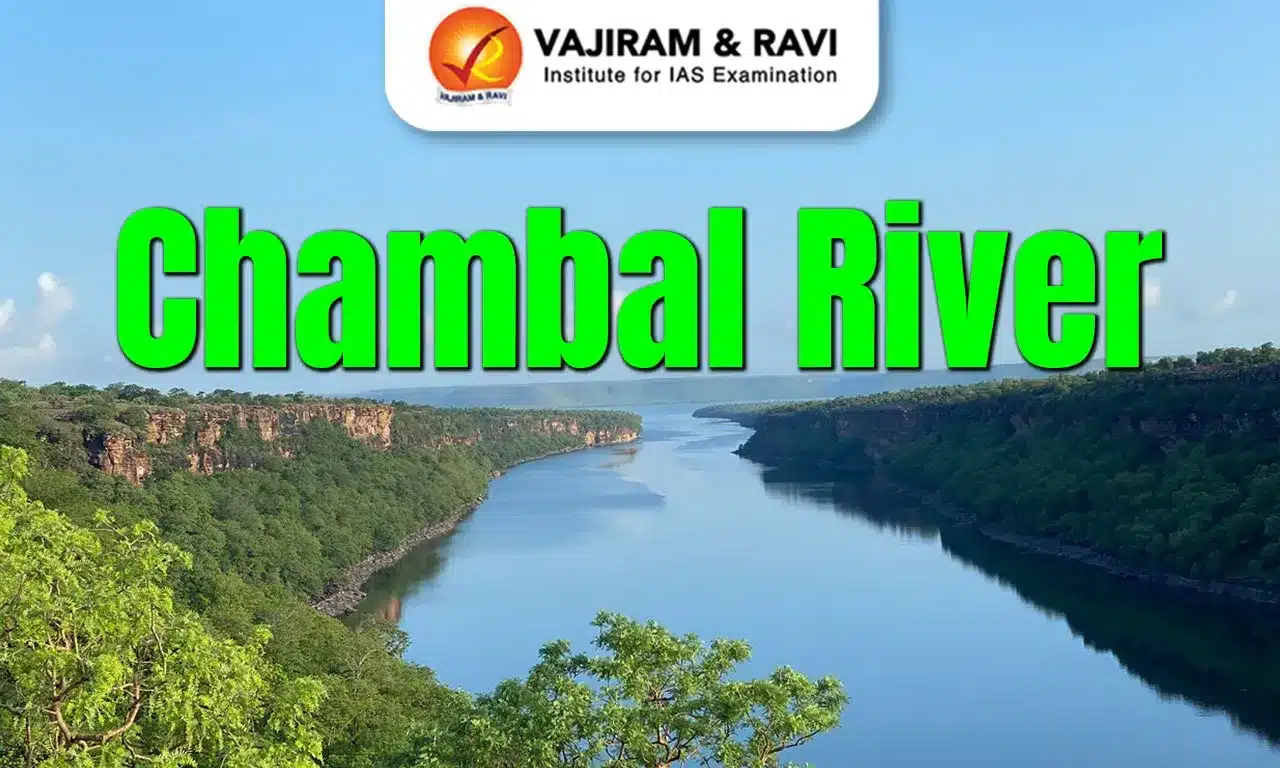
The Chambal River is one of the most important rivers of northern and central India and the largest river flowing through Rajasthan. The river is known as Charmanvati in the ancient texts. It is a major right bank tributary of the Yamuna River and forms part of the Gangetic drainage system. It is widely recognised as One of the cleanest rivers in India because of its clear water and relatively low pollution. The river is also called the ghost river of India due to its long association with deep ravines and the historic presence of dacoits. Today, the Chambal is equally important for irrigation, hydropower, biodiversity conservation and regional development across three Indian states.
Chambal River
The Chambal River has a unique geographical course, important tributaries, major dams and significant conservation projects that make it one of India’s most important river systems.
- Origin: The river starts at Janapav Hills, south of Mhow near Indore in Madhya Pradesh, on the southern slopes of the Vindhya Mountain Range. It is a perennial river and flows throughout the year.
- Length: The Chambal River has a total length of 1,024 km.
- River Course: From its source, it flows north-northeast through Madhya Pradesh, enters Rajasthan, forms the Rajasthan-Madhya Pradesh boundary, then turns southeast before joining the Yamuna in Uttar Pradesh as a major tributary.
- States: The Chambal flows through three states of India: Madhya Pradesh, Rajasthan and Uttar Pradesh which makes it crucial for Inter State Water Management.
- Longest flowing River of Rajasthan: It is the largest river flowing through Rajasthan and plays an important role in irrigation, drinking water supply and power generation.
- Confluence: The river ends its journey at the famous Pachnada confluence near Bhareh in Uttar Pradesh, where the Chambal meets the Yamuna along with the Kwari, Sind and Pahuj rivers.
- Drainage Basin: The Chambal basin is surrounded by the Vindhyan Range on the south, east and west, while the Aravalli Range forms its northwestern boundary. The basin mainly drains the Malwa Plateau of northwestern Madhya Pradesh.
- Tributaries: The main tributaries include Banas and Mej on the left bank, while Parbati, Kali Sindh and Shipra join from the right bank. The Banas is the largest tributary and drains southeastern Rajasthan.
- Dams and Projects: The river supports several major water resource structures including Gandhi Sagar Dam, Rana Pratap Sagar Dam, Jawahar Sagar Dam, Kota Barrage, Kotwal Dam, Pagara Dam and Pillowa Dam. These dams provide irrigation, hydroelectricity, flood control and water supply.
- Infrastructure Development: The Chambal has transformed Kota into an important industrial and agricultural centre. The Kota Barrage supplies irrigation water to large parts of Rajasthan and supports farming across the Chambal command area.
- Ravines and soil conservation: The lower Chambal valley contains nearly 16 km wide badland ravines created by severe soil erosion. These ravines have become the focus of major soil conservation projects aimed at reducing erosion and restoring degraded land.
- Ravines: These are steep sided valleys formed mainly by stream bank erosion. Their slopes generally range between 20% and 70%. They are larger than gullies but smaller than canyons and are a defining landscape of the Chambal basin.
- Latest environmental concern: Recent efforts to reclaim degraded Chambal ravines have raised ecological concerns. Experts warn that large scale land modification may increase erosion and flood risks while affecting wildlife habitats and local communities.
Chambal River Biodiversity
The Chambal River supports one of India’s richest freshwater ecosystems and remains an important centre for wildlife conservation because of its clean water and protected river habitats.
- National Chambal Sanctuary: Established in 1979, the National Chambal Sanctuary spreads over nearly 5,400 sq km across Rajasthan, Madhya Pradesh and Uttar Pradesh, making it India’s first and only tri-state protected riverine sanctuary.
- Gharial and Crocodile Conservation: The sanctuary is globally famous for protecting the critically endangered Gharial crocodile. It also conserves other crocodile species, freshwater turtles and numerous native fish found in the Chambal ecosystem.
- Rich bird diversity: More than 300 bird species have been recorded in the sanctuary. It is especially known for the endangered Indian Skimmer, making the river one of India’s most important birdwatching destinations.
- Freshwater ecosystem: The Chambal supports healthy fish populations, aquatic reptiles, turtles, river dolphins in some stretches and many migratory birds because its waters remain comparatively clean and less polluted than many other major rivers.
- One of the cleanest rivers: The Chambal is widely recognised as One of the cleanest rivers in India due to limited industrial pollution, lower urban discharge and strong conservation efforts that have helped preserve its natural ecological balance.
- Ghost river of India: The Chambal is often called the ghost river of India because its deep ravines once sheltered notorious dacoits. Today, these same landscapes are better known for wildlife conservation and ecological importance.
- Flora: Native grasses, thorn forests, scrub vegetation and dry deciduous trees dominate the riverbanks. This vegetation stabilises soil, reduces erosion and provides habitat for mammals, reptiles and nesting birds.
- Challenges: Recently, the Supreme Court of India stayed a Rajasthan notification that proposed altering the National Chambal Gharial Sanctuary by excluding 732 hectares along the river.


 Last updated on Oct, 2026
→ UPSC 2027 Notification will be released on 13 January 2027 at upsconline.nic.in.
→ Check Nobel Prize 2026 Winners List here.
→ Download PIB PRiSM Monthly Magazine 2026 here.
→ Check UPSC Monthly Current Affairs Magazine The Recitals here.
→ Check out the latest UPSC Syllabus here.
→ Download UPSC Model Answers for Mains 2026
→ UPSC Mains Question Paper 2026 is out now for Essay & GS Paper 1, 2, 3 & 4.
→ UPSC Calendar 2027 has been released.
→ Enroll in Vajiram & Ravi’s UPSC Mains Test Series 2027 for structured answer writing practice, expert evaluation, and exam-oriented feedback.
→ Join Vajiram & Ravi’s UPSC Mentorship Program 2027 for personalized guidance, strategy planning, and one-to-one support from experienced mentors.
→ Go through the UPSC Mains Previous Year Papers to enhance your preparation.
→ UPSC has released UPSC Toppers List 2025 with the Civil Services final result on its official website.
→ Also check Best UPSC Coaching in India
Chambal River FAQs
Q1. Where does the Chambal River originate?+
Q2. Which states does the Chambal River flow through?+
Q3. What are the major tributaries of the Chambal River?+
Q4. Which major Dams are built on the Chambal River?+
Q5. Which is the Ghost River of India?+
Tags: chambal river geography major rivers of the world river