The soils of India are diverse and shaped by climate, parent material, topography, biological activity, and time. The major soil types include alluvial, black, red, laterite, desert, forest, peaty, and saline soils, each with distinct characteristics and agricultural significance. Alluvial soil is the most fertile and widespread, crucial for agriculture, while black soil is ideal for cotton.
However, soil degradation affects 30% of India’s land, caused by unsustainable farming, poor water management, deforestation, and urbanisation. Conservation efforts are essential to maintain soil health, ensuring food security and economic stability.
Soils of India Introduction
India's diverse geography and climate have resulted in the formation of a wide variety of soils of India, each playing a crucial role in the agricultural landscape. Soil formation is a complex process influenced by several factors, including climate, parent material, topography, biological activity, and time.
- The type of parent material, such as igneous or sedimentary rocks, determines the soil's composition.
- Climate, particularly temperature and rainfall, affects weathering rates and soil fertility, with high rainfall regions experiencing leaching and arid zones leading to less fertile soils.
- Topography influences soil moisture and vegetation, while biological activity, including the decomposition of organic matter, contributes to soil fertility.
Soils of India Map
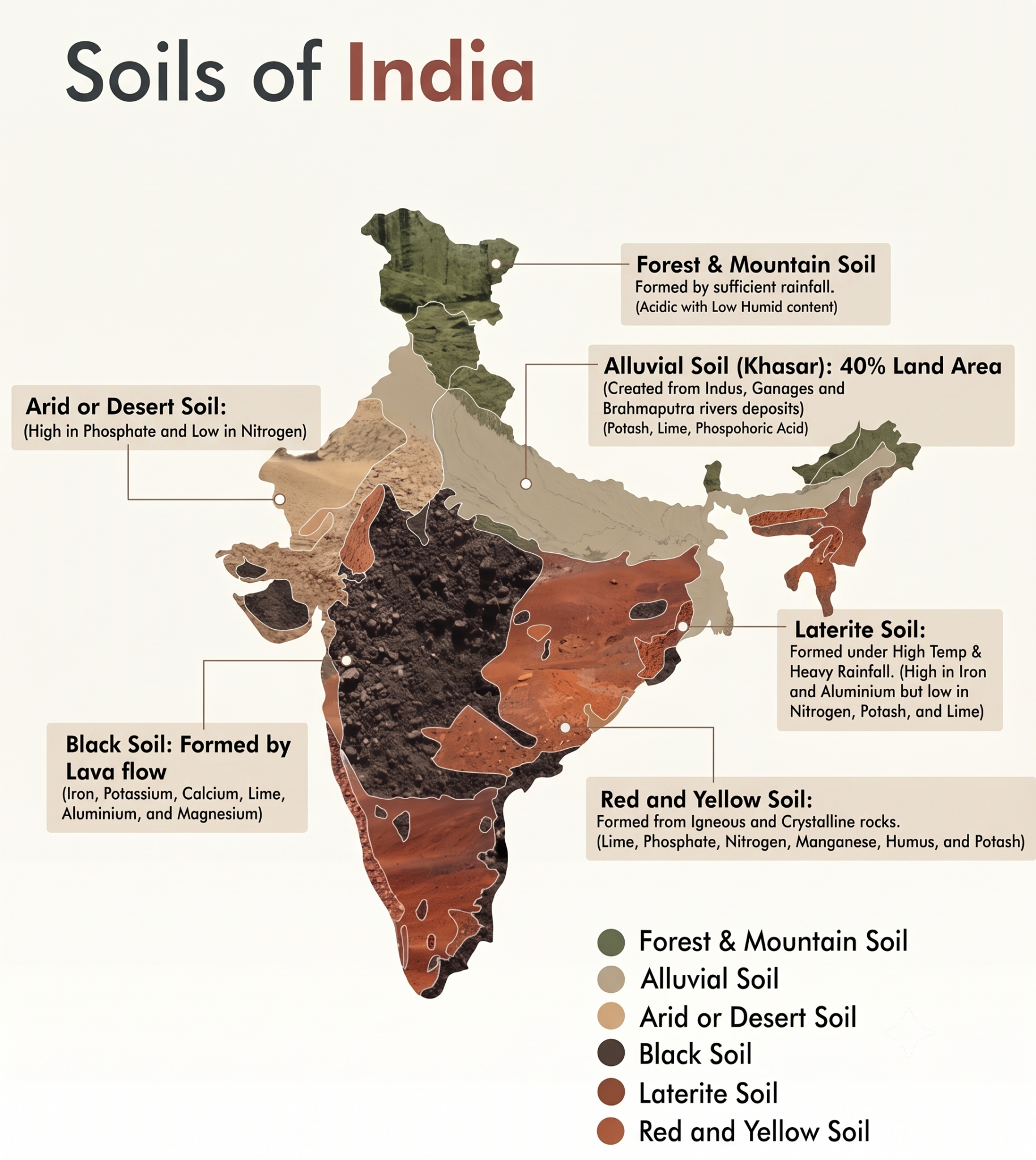
India has a wide variety of soils due to differences in climate, relief, parent rock and vegetation. The major soil types of India have distinct geographical distributions, making them important for understanding agriculture, natural vegetation and regional economic activities. The following is the map of soils of India:


Soils of India Characteristics
The Indian Council of Agricultural Research (ICAR) classifies the diverse soils of India into eight major groups, spanning across different climatic and geological regions.
- High Diversity of Types: India features a wide variety of soils—including alluvial, black, red and yellow, laterite, arid/desert, forest/mountain, saline/alkaline, and peaty soils—shaped by varied climates and parent rock materials.
- Dominance of Alluvial Soil: Alluvial soil covers the largest area in India (about 40% to 43% of the total land) and is formed by river silt deposition in the northern plains and coastal regions.
- General Deficiency in Nitrogen and Humus: Most Indian soils are largely deficient in nitrogen, phosphorus, and organic matter (humus) due to high temperatures that cause rapid decomposition and continuous farming over centuries.
- Moisture-Retention in Black Soils: Black soil (also known as Regur or black cotton soil) has a high clay content, swells when wet, develops deep cracks when dry, and possesses high moisture-retention capacity.
- Iron Oxide in Red and Laterite Soils: Red soils get their characteristic red color from the presence of iron oxides formed by the weathering of ancient crystalline rocks, while laterite soils are formed in heavy rainfall areas through intense leaching.
- Varying Fertility Levels: While river-fed alluvial and black soils are exceptionally fertile and vital for crops like wheat, rice, and cotton, soils like laterite and desert/arid soils have low natural fertility and require intensive manuring or irrigation to be productive
Soils of India Classification
The major soils of India are classified based on various criteria, including their physical and chemical properties, as well as their agricultural significance. The Indian Council of Agricultural Research (ICAR) has developed a comprehensive classification system that categorises Indian soils into eight major groups: alluvial, black, red, laterite, desert (arid), forest, peaty, and saline soils.
Alluvial Soil
Alluvial soil is the most extensive and agriculturally significant soil type in India. Covering about 15 lakh square kilometres or 45.6% of the country’s total land area, it forms the foundation of India's agricultural wealth and supports a majority of the population.
- Formation and Composition: Alluvial soils are formed by the deposition of sediments (alluvium) by rivers, winds, glaciers, and sea waves. They are rich in humus and nutrients like potash but often lack phosphorus.
- Their fertility is further enhanced as they are renewed annually by river floods.
- Types of Alluvial Soil: Alluvial soils are categorised into two types:
- Old alluvium (Bhangar) is clayey, sticky, and darker with lime nodules.
- New alluvium (Khadar) is lighter and deposited in floodplains and deltas.
- Distribution: Great Northern Plain (from Punjab to West Bengal and Assam), the lower valleys of the Narmada and Tapti rivers, the east coast deltas, and the northern Gujarat plains through a narrow corridor in Rajasthan.
- Characteristics: Alluvial soils range in texture from sandy loam to clay and vary in colour from light grey to ash grey based on maturity.
- They are more loamy and clayey in the lower Ganga plain and Brahmaputra valley, with sand content decreasing from west to east.
- Crops: Rice, Wheat, Sugarcane, Cotton, Tobacco, Pulses, Oilseeds and Jute.
Black Soil (Regur Soil)
The black soil, also known as Regur or Black Cotton Soil, is primarily found in the Deccan Plateau, covering approximately 5.46 lakh square kilometres (16.6% of India's total geographical area).
- Formation and Composition: Black soil, formed from fissure volcanic rock, is ideal for cotton cultivation, earning it the name "black cotton soil."
- It contains alumina, iron oxide, lime, magnesium carbonates, and poor nitrogen, phosphorus, and organic matter content.
- Characteristics: Black soils are highly argillaceous, with over 62% clay, and are excellent at retaining moisture.
- They have a black colour due to titaniferous magnetite or iron and are ideal for cotton cultivation despite being deficient in essential nutrients.
- Crops: Cotton, sugarcane, tobacco, millets (Jowar, sorghum), wheat, oilseeds (groundnut, linseed), pulses (lentils, chickpeas), citrus fruits, sunflowers, turmeric.
Red Soil
Red soils occupy about 3.5 lakh sq km, approximately 10.6% of India's total land area. They are widely distributed across the country, notably in parts of south Bihar, West Bengal, Uttar Pradesh, Aravallis, eastern Rajasthan, and parts of Assam, Nagaland, Manipur, Mizoram, Tripura, and Meghalaya.
- Formation and Composition: Red soil forms from the weathering of ancient crystalline rocks, with its red colour due to iron oxide. It is rich in iron but poor in nitrogen, phosphorus, and organic matter content.
- Characteristics: Red soils have textures from sandy to loamy, with moderate fertility, suited for dry farming but require irrigation and fertilisers for enhanced productivity.
- Crops: Cotton, groundnut, tobacco, and pulses, though less suitable for water-intensive crops due to limited moisture retention.
Laterite Soil
Laterite soils are named after the Latin word "later", meaning brick, which hardened upon exposure. Found in regions like South Maharashtra, the Western Ghats in Kerala and Karnataka, parts of Assam, Tamil Nadu, and Western West Bengal (especially in Birbhum district), as well as parts of the Eastern Ghats.
- Formation and Composition: Laterite soils form under high heat and rainfall, causing intense mineral leaching.
- They are rich in iron, aluminium, and manganese, giving them reddish to brown hues.
- Characteristics: Laterite soils are clayey, compact, and poorly drained, making them less suitable for farming without proper management.
- They are poor in essential nutrients like lime, nitrogen, and phosphorus, requiring fertilisers and soil amendments.
- Crops: Cashews, tea, coffee, tapioca, rubber, and tropical fruits.
- Other Uses: Laterite soils are often used in construction, particularly for making bricks and roads, and as a building material due to their hardened texture after exposure to air.
Desert (Arid) Soil
Desert soils are primarily found in the arid regions of Rajasthan, Haryana, South Punjab, and parts of Gujarat, as well as near the Indus River and the Aravallis. The Thar Desert is one of the largest stretches of desert soil in India, covering vast areas of northwestern India.
- Composition: Desert soils contain high amounts of soluble salts and calcium carbonate, with calcium increasing in deeper layers, making them less fertile.
- Distribution: Desert soils cover about 1.42 lakh square kilometres, which is approximately 4.32% of the total land area of India.
- These soils are concentrated in the northwestern and western parts of the country.
- Characteristics: Saline soils, with low rainfall and poor leaching, are challenging for cultivation without irrigation.
- Their sandy texture, low organic matter, and poor moisture retention hinder fertility and plant growth.
- Crops: Only drought-resistant and salt-tolerant crops like barley, cotton, wheat, millets, and pulses are grown in desert soils.
Forest Soil
Forest soils are predominantly found in the Himalayan region, Western Ghats, and parts of northeastern states like Assam, Nagaland, and Mizoram. These soils are also seen in tropical and subtropical areas, influenced by the type of vegetation and climate.
- Composition: Forest soils are rich in organic matter, including humus from decomposed plant material, and are high in essential nutrients like nitrogen, phosphorus, and potassium.
- Characteristics: Forest soils vary in texture from sandy loam to clayey, with colours ranging from light to dark brown due to high organic content.
- They are fertile but acidic, and deforestation can degrade soil quality, leading to erosion and reduced productivity.
- Crops: Tea, coffee, spices, wheat, maize, barley, etc.
Peaty Soil
Peaty and marshy soils form in humid regions with excess moisture and waterlogging, slowing plant decomposition. These soils accumulate organic matter under stagnant water and are found in wetland areas like Kottayam and Alappuzha in Kerala, coastal Orissa, Tamil Nadu, Sunderbans in West Bengal, and parts of Bihar and Uttaranchal.
- Formation and Composition: Peaty soils are black due to accumulated decomposed plant material, rich in organic matter and nitrogen, but often lacking in phosphorus and potassium, requiring additional fertilization for crops needing more minerals.
- Characteristics: Peaty soils are heavy, spongy, and moisture-retentive, while marshy soils are rich in organic matter and suited for paddy cultivation.
- Both are naturally fertile but highly acidic, requiring proper water management for optimal growth.
- Crops: Cabbage, broccoli, peas, beans, carrots, radishes, potatoes, lettuce, spinach.
Saline Soil
Saline soils are found in areas like Andhra Pradesh, Karnataka, Bihar, Uttar Pradesh, Haryana, Punjab, Rajasthan, Maharashtra, and parts of Gujarat, covering about 68,000 sq km. The accumulation of salts renders soil infertile, with 1.25 million hectares in Uttar Pradesh, 1.21 million hectares in Punjab, and areas around the Gulf of Khambhat in Gujarat affected.
- Formation: Saline and alkaline soils are formed in dry regions due to the accumulation of salts like sodium, magnesium, and calcium, primarily through evaporation and weathering of rock and mineral fragments.
- Characteristics: Saline and alkaline soils have compact, sandy or silty textures that hinder drainage and root growth.
- These soils are nutrient-poor, with pale or cracked surfaces, making them infertile for most crops.
- It is known by various local names such as reh, kallar, usar, thur, rakar, karl, and chopan.
- Crops: Barley, sugar beet, cotton, wheat, rice, sorghum, maize, sunflower, potato, citrus fruits, pomegranate, peas, lentils, cowpea, etc.
Soils of India Problems
The soils of India face a severe soil health crisis, with nearly 30% to 50% of its total geographical area affected by land degradation, erosion, and nutrient depletion. Some of the problems faced by the soils of India include the following:
- Massive Soil Erosion: Every year, India loses billions of tons of topsoil due to water erosion (the majority of it occurs through rills and gullies) and wind erosion in arid zones. This is accelerated by deforestation, overgrazing, and poor tillage.
- Imbalanced Fertiliser Use: Government subsidies favour urea over phosphate and potassium. This has significantly altered the appropriate N:P:K ratio to roughly 7.7:3.1:1 (against the ideal 4:2:1), leaving soils lacking in essential micronutrients.
- Soil Organic Carbon (SOC) Decline: Rapid depletion of organic matter, as well as agricultural waste burning (particularly in the Indo-Gangetic belt), damages native soil microbial ecosystems and impairs fertility.
- Salinity and Waterlogging: Over-irrigation in canal-fed and intense cereal-growing regions (such as Punjab and Haryana) raises groundwater levels, resulting in significant soil salinity, alkalinity, and waterlogging.
- Urban Pressures: Unchecked urban growth, opencast mining, and heavy metal accumulation from industrial waste all degrade arable land.
Soils of India Significance
India's diverse topography, from the Himalayan mountains to southern plateaus, fosters a wide range of soils. These varied soils of India are significant in sustaining diverse agricultural activities, maintaining ecological balance, and supporting the economy.
- Agricultural Productivity: Diverse soil types support a wide range of agricultural activities, directly sustaining over 40% of India's population. Alluvial soils, in particular, offer highly productive lands essential for farming.
- Ecosystem Health: Soils are vital for maintaining ecological balance, enabling plant growth that supports animal life and biodiversity. Each soil type fosters specific ecosystems critical for environmental stability.
- Economic Foundation: Agriculture, dependent on soil fertility, is the backbone of India's economy, supporting 65-70% of the population and influencing food production and economic stability.
- Carbon Sequestration: Soils are crucial for carbon sequestration, aiding in climate change mitigation. Properly managed soils can capture large amounts of carbon dioxide from the atmosphere, helping to regulate the climate.
- Resilience Against Natural Disasters: Healthy soils strengthen landscape resilience to natural disasters like floods and droughts. They help ecosystems recover by retaining moisture and minimising erosion during heavy rainfall.
Soils of India UPSC PYQs
Q1: The black cotton soil of India has been formed due to the weathering of (UPSC Prelims 2021)
(a) Brown forest soil
(b) Fissure volcanic rock
(c) Granite and schist
(d) Shale and limestone
Ans: (b)
Q2: With reference to agricultural soils, consider the following statements : (UPSC Prelims 2018)
- High content of organic matter in soil drastically reduces its water holding capacity.
- Soil does not play any role in the sulphur cycle.
- Irrigation over a period of time can contribute to the salinization of some agricultural lands.
Which of the statements given above is/are correct?
(a) 1 and 2 only
(b) 3 only
(c) 1 and 3 only
(d) 1, 2 and 3
Ans: (b)
Q3: Which of the following statements regarding laterite soils of India are correct? (UPSC Prelims 2013)
- They are generally red in colour.
- They are rich in nitrogen and potash.
- They are well-developed in Rajasthan and UP.
- Tapioca and cashew nuts grow well on these soils.
Select the correct answer using the codes given below.
(a) 1, 2 and 3
(b) 2, 3 and 4
(c) 1 and 4
(d) 2 and 3 only
Ans: (c)

 Last updated on Oct, 2026
→ UPSC 2027 Notification will be released on 13 January 2027 at upsconline.nic.in.
→ Check Nobel Prize 2026 Winners List here.
→ Download PIB PRiSM Monthly Magazine 2026 here.
→ Check UPSC Monthly Current Affairs Magazine The Recitals here.
→ Check out the latest UPSC Syllabus here.
→ Download UPSC Model Answers for Mains 2026
→ UPSC Mains Question Paper 2026 is out now for Essay & GS Paper 1, 2, 3 & 4.
→ UPSC Calendar 2027 has been released.
→ Enroll in Vajiram & Ravi’s UPSC Mains Test Series 2027 for structured answer writing practice, expert evaluation, and exam-oriented feedback.
→ Join Vajiram & Ravi’s UPSC Mentorship Program 2027 for personalized guidance, strategy planning, and one-to-one support from experienced mentors.
→ Go through the UPSC Mains Previous Year Papers to enhance your preparation.
→ UPSC has released UPSC Toppers List 2025 with the Civil Services final result on its official website.
→ Also check Best UPSC Coaching in India
Soils of India FAQs
Q1. What are the 8 types of soil in India?+
Q2. Who is the father of Indian soil?+
Q3. What are 7 types of soil?+
Q4. Which soil is 40% in India?+
Q5. Which is the 2nd largest soil group in India?+
Tags: quest soils of india UPSC Geography Notes