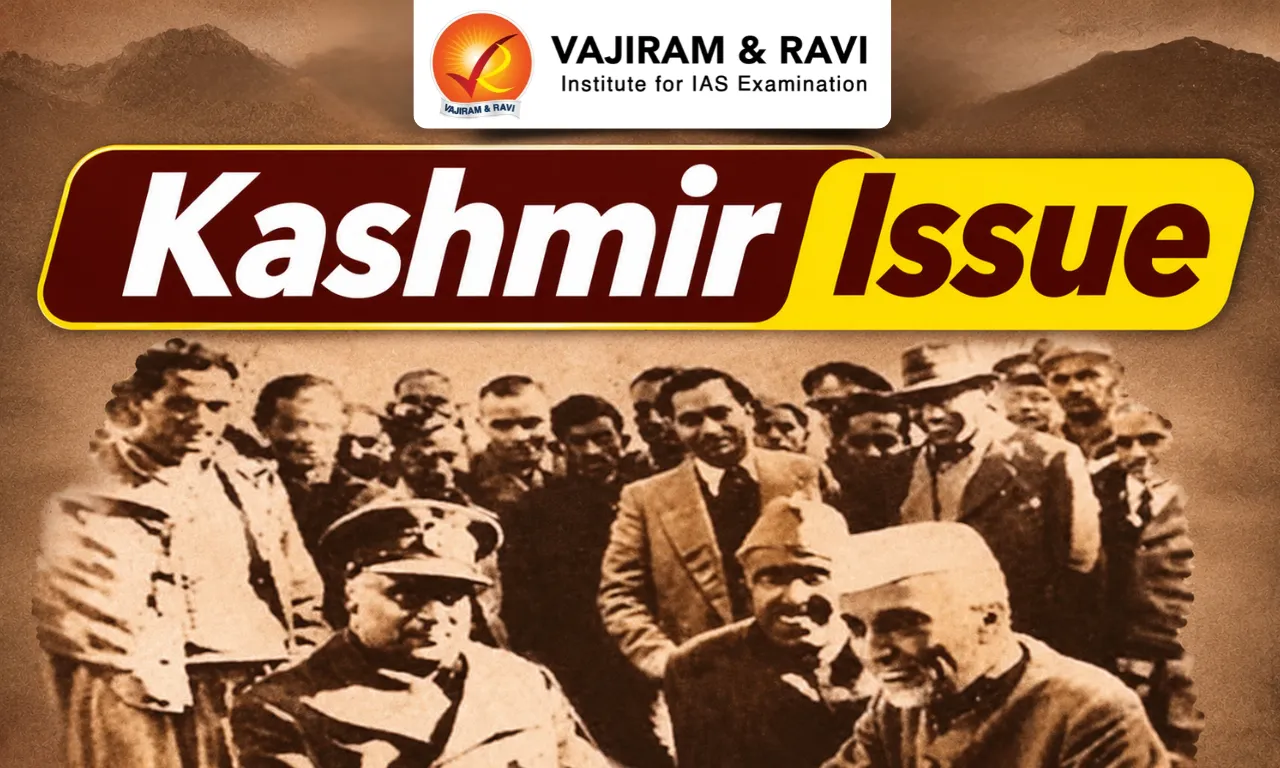
Kashmir Issue is a long-standing political, territorial, and security dispute between India and Pakistan, originating during the Partition of British India in 1947. The princely state of Jammu and Kashmir acceded to India through the Instrument of Accession. The issue subsequently became a source of India–Pakistan conflicts, international diplomatic engagement, and internal security challenges.
Despite constitutional changes, including the abrogation of Article 370 in 2019 and the reorganisation of the erstwhile state into two Union Territories, challenges persist, including cross-border terrorism, separatist sentiments, political alienation, unemployment, human rights concerns, and India–Pakistan tensions. A sustainable way forward requires strengthening democratic institutions and restoring public trust.
Kashmir Issue History
The history of the Kashmir Issue spans ancient Hindu and Buddhist kingdoms, medieval Sultanate and Mughal rule, Afghan and Sikh control, and the Dogra dynasty. Its modern political dispute emerged during the Partition of British India in 1947 and continues to influence India–Pakistan relations.
- Ancient Kashmir: Kashmir emerged as an important centre of Hindu and Buddhist civilisation, with its history documented in Kalhana's Rajatarangini (12th century). Emperor Ashoka is traditionally associated with the spread of Buddhism in the region.
- Karkota Dynasty (7th–8th century): Later, Lalitaditya Muktapida expanded the kingdom and promoted art, architecture, and cultural development.
- Medieval Kashmir (14th–18th century): Shah Mir established the first Muslim Sultanate in Kashmir in 1339. The region subsequently witnessed cultural development under Sultan Zain-ul-Abidin (1420–1470), whose reign was marked by religious tolerance and economic growth.
- Mughal and Afghan Rule: Later, Akbar annexed Kashmir into the Mughal Empire in 1586, followed by Afghan Durrani rule in 1752.
- Sikh and Dogra Rule (1819–1947): Maharaja Ranjit Singh captured Kashmir from the Afghans in 1819, bringing it under Sikh rule. Following the First Anglo-Sikh War, the British transferred Kashmir to Maharaja Gulab Singh under the Treaty of Amritsar (1846) for ₹75 lakh, establishing Dogra rule.
- Quit Kashmir Movement (1946): Sheikh Abdullah and the National Conference launched a movement against Dogra rule, demanding responsible government and greater political rights.
- Partition and Accession (1947): Following the lapse of British paramountcy on 15 August 1947, Maharaja Hari Singh initially sought to maintain Jammu and Kashmir as an independent state rather than accede to either India or Pakistan.
- Tribal Invasion and Accession (October 1947): Tribal forces from Pakistan invaded Kashmir, prompting Maharaja Hari Singh to seek military assistance from India.
- He signed the Instrument of Accession on 26 October 1947, which was accepted by Governor-General Lord Mountbatten on 27 October 1947, leading to the deployment of Indian troops in Kashmir.
Kashmir Issue Instrument of Accession
The Instrument of Accession was a legal document through which Maharaja Hari Singh, the ruler of Jammu and Kashmir, formally acceded to the Dominion of India in October 1947, following the tribal invasion from Pakistan.
- Signing (26 October 1947): Maharaja Hari Singh signed the Instrument of Accession, seeking India's military assistance to defend Jammu and Kashmir against the invading tribal forces.
- Acceptance (27 October 1947): Governor-General Lord Mountbatten formally accepted the accession, enabling the deployment of Indian troops in Srinagar.
- Scope of Accession: The Indian Dominion's legislative powers initially extended to three major subjects: Defence, External Affairs, Communications, and ancillary matters connected with these subjects.
- Constitutional Significance: The Instrument provided the legal basis for Jammu and Kashmir's accession to India and subsequently formed the basis of its constitutional relationship with the Union.


Kashmir Issue Causes
The Kashmir issue is rooted in the Partition of British India in 1947, competing territorial claims, disagreements over accession, and political aspirations within the region. Several historical, political, geographical, and security factors have contributed to its continuation.
- Partition of India (1947): The division of British India into India and Pakistan created competing claims over the princely state of Jammu and Kashmir, given its Muslim-majority population and Hindu ruler.
- Dispute over Accession: Maharaja Hari Singh's accession to India was contested by Pakistan, leading to conflicting territorial claims and the first Indo-Pakistan War (1947–48).
- Geopolitical Significance: Kashmir's strategic location, shared borders with India, Pakistan and China, and control over important river systems have increased its regional significance.
- Unresolved International Dispute: United Nations (UN) Security Council resolutions (1948) proposed a plebiscite subject to ceasefire and demilitarisation arrangements, but differences over their implementation prevented a settlement.
- Cross-Border Terrorism: Militancy, infiltration, and support for armed groups across the border have contributed to prolonged instability and security challenges.
- India–Pakistan Rivalry: Repeated wars, border clashes, and diplomatic tensions have prevented a lasting resolution of the Kashmir dispute.
Kashmir Issue Military Conflicts
The Kashmir conflict has been a major source of military conflict between India and Pakistan since Partition in 1947. The major wars and military conflicts have shaped the territorial and political situation of the region.
- First Indo-Pakistan War (1947–1948): Following the accession of Jammu and Kashmir to India, armed conflict broke out between India and Pakistan over control of the region.
- UN Intervention (1948): India referred the issue to the United Nations Security Council, which facilitated a ceasefire effective from 1 January 1949, dividing the region into areas administered by India and Pakistan.
- Second Indo-Pakistan War (1965): Pakistan launched Operation Gibraltar in August 1965 to infiltrate armed personnel into Jammu and Kashmir and encourage an uprising against Indian administration. The conflict escalated into a full-scale war between the two countries.
- Tashkent Declaration (1966): The war ended with a ceasefire, followed by the Tashkent Declaration mediated by the Soviet Union, under which both countries agreed to withdraw their forces to pre-war positions.
- Indo-Pakistan War (1971): Although primarily centred on the Bangladesh Liberation War, the conflict influenced the Kashmir dispute and India's strategic position in the region.
- Simla Agreement (1972): India and Pakistan agreed to respect the Line of Control (LoC), replacing the 1949 ceasefire line and committing to resolve differences through bilateral negotiations.
- Kargil War (1999): Pakistani soldiers and armed infiltrators crossed the Line of Control and occupied strategic heights in the Kargil sector of Ladakh, prompting India to launch Operation Vijay to regain control of the occupied positions.
- Indian forces regained the occupied positions by July 1999, and the conflict reinforced the importance of border surveillance and military preparedness.
Kashmir Issue and Article 370
Article 370 of the Indian Constitution provided special constitutional status to Jammu and Kashmir, recognising its distinct historical circumstances following accession to India in 1947. It was included in Part XXI (Temporary, Transitional and Special Provisions) and came into effect on 26 January 1950.
- Limited Legislative Powers: Parliament's legislative powers over Jammu and Kashmir were initially restricted to matters specified in the Instrument of Accession, particularly Defence, External Affairs and Communications.
- Separate Constitution: Jammu and Kashmir was permitted to have its own Constitution, adopted on 17 November 1956 and implemented on 26 January 1957.
- Presidential Orders: The Constitution (Application to Jammu and Kashmir) Order, 1954 extended several provisions of the Indian Constitution to the state.
- Article 35A (1954): Introduced through the 1954 Presidential Order, it empowered the J&K legislature to define permanent residents and provide them special rights relating to property, employment and scholarships.
Abrogation of Article 370 (2019)
On 5 August 2019, the Government of India issued a Presidential Order, followed by a Presidential declaration on 6 August, making the provisions of Article 370 inoperative.
- Constitutional Changes: The separate constitutional arrangements of Jammu and Kashmir ceased to operate, and all provisions of the Indian Constitution became applicable.
- Article 35A: The provision ceased to operate following the withdrawal of the 1954 Presidential Order.
- Jammu and Kashmir Reorganisation Act, 2019: The erstwhile state was reorganised into two Union Territories: Jammu and Kashmir (with a Legislative Assembly) and Ladakh (without a Legislative Assembly).
- Pakistan opposed Article 370's abrogation in 2019 because it viewed the move as a unilateral alteration of Jammu and Kashmir's disputed status and a violation of relevant UN resolutions.
- It argued that the decision undermined the region's autonomy and affected the interests of its people, while India maintained that the reorganisation was an internal constitutional matter.
Kashmir Issue Insurgency
Insurgency in Jammu and Kashmir emerged as an armed separatist movement during the late 1980s, driven by political discontent, demands for autonomy and independence, and cross-border support to militant groups. It intensified in 1989, creating prolonged security and governance challenges in the region.
- Political Discontent (1987): The allegations of electoral manipulation in the 1987 Assembly elections weakened public confidence in democratic institutions and contributed to youth radicalisation.
- Rise of Militancy (1989): Groups such as the Jammu and Kashmir Liberation Front (JKLF) and Hizbul Mujahideen emerged, advocating independence or merger with Pakistan.
- Cross-Border Support: Infiltration, arms supply, and training across the border contributed to the expansion of militant activities.
- Kashmiri Pandit Displacement: Targeted violence and threats during the onset of militancy in the late 1980s and early 1990s led to the large-scale displacement of Kashmiri Pandit families from the Valley.
- Security Challenges: Prolonged militancy resulted in civilian casualties, attacks on security forces, disruption of economic activities, and increased security deployment.
Kashmir Issue with Neighbouring Countries
The Kashmir issue has wider geopolitical implications due to its strategic location and overlapping territorial claims involving India, Pakistan, and China. It influences regional security, border relations, and economic connectivity in South Asia.
Pakistan
Pakistan has been a principal party to the Kashmir dispute since 1947, contesting India's accession of Jammu and Kashmir and maintaining territorial claims over the region.
- Territorial Dispute: Pakistan administers parts of the erstwhile princely state, including Pakistan-occupied Kashmir and Gilgit-Baltistan, which India claims as its integral territory.
- Cross-Border Terrorism: India's concerns over cross-border infiltration and support to militant groups have remained major sources of bilateral tensions.
- The 2019 Pulwama terror attack, attributed by India to Pakistan-based Jaish-e-Mohammed, led to heightened tensions between the two countries.
- Wars and Conflicts: The Kashmir dispute has contributed to the Indo-Pakistan wars of 1947–48 and 1965, and the Kargil conflict (1999).
- Internationalisation: Pakistan continues to raise the Kashmir issue at the UN and other international forums, while India maintains that it is a bilateral matter under the Simla Agreement (1972).
- Pakistan has repeatedly raised the issue at the United Nations and the Organisation of Islamic Cooperation (OIC).
China
China is involved in the Kashmir issue through its territorial control in Aksai Chin, its boundary dispute with India, and its strategic partnership with Pakistan.
- Territorial Dispute: China controls Aksai Chin, which India claims as part of Ladakh, and the two countries have differing perceptions of their boundary alignment.
- Shaksgam Valley: Pakistan ceded approximately 5,180 sq. km of territory in the Shaksgam Valley to China under the 1963 China–Pakistan Boundary Agreement, which India does not recognise.
- China-Pakistan Economic Corridor (CPEC): The corridor passes through territories claimed by India in Pakistan-administered Kashmir, raising concerns over India's sovereignty and territorial integrity.
- Border Tensions: Military face-offs and infrastructure development along the Line of Actual Control (LAC), particularly in eastern Ladakh, have affected India–China relations.
- The 2020 Galwan Valley clash in eastern Ladakh highlighted the continuing boundary tensions.
Kashmir Issue Challenges
The Kashmir issue presents complex challenges involving national security, political stability, socio-economic development, and regional aspirations. The six major challenges are:
- Political Representation and Democratic Trust: Delays in restoring full statehood, along with concerns about political autonomy and representation, have fueled demands for greater democratic participation. Strengthening public trust in elected institutions remains important.
- Human Rights and Civil Liberties: Preventive detentions, communication restrictions, and concerns over freedom of expression have raised questions about balancing national security requirements with constitutional rights and civil liberties.
- Socio-Economic Challenges: Unemployment, limited private investment, and dependence on tourism make livelihoods vulnerable to security disruptions. Educated youth also face challenges in accessing sustainable employment opportunities.
- Regional Aspirations: Different political, cultural, and developmental aspirations across Jammu, Kashmir, and Ladakh create governance challenges. Regional disparities, geographical isolation, and difficult Himalayan terrain further complicate balanced development.
Kashmir Issue Government Initiatives
The Government of India has adopted a multi-dimensional approach to address the Kashmir issue through security measures, economic development, political integration, rehabilitation, and improved connectivity.
- Security Related Expenditure (SRE) Scheme: It provides financial assistance for strengthening J&K Police and security infrastructure, including logistics and counter-insurgency operations.
- Border Security: Enhancing fencing, monitoring, and anti-infiltration measures along the Line of Control (LoC) is known as border security.
- Youth Engagement: Bharat Darshan and Watan Ko Jano programmes expose local youth to the country's cultural and socio-economic diversity.
- Prime Minister's Development Package (PMDP), 2015: PMDP was announced with an outlay of ₹80,068 crore to improve infrastructure, healthcare, education, tourism and employment.
- Infrastructure and Connectivity Development: The government has undertaken major connectivity projects such as the Udhampur–Srinagar–Baramulla Rail Link, Chenab Rail Bridge, Chenani–Nashri and Zojila tunnels to improve all-weather connectivity, lessen the Kashmir Valley's geographic isolation and integrate it with the rest of India.
- Education and Healthcare: Expansion of AIIMS, IITs, IIMs, and medical colleges to improve access to quality services and education.
- Tourism Infrastructure (2026): Over ₹564 crore was sanctioned for tourism infrastructure in J&K under the Swadesh Darshan and PRASHAD schemes.
Kashmir Issue Recent Developments
Recent developments in Jammu and Kashmir reflect changes in its political administration, security environment, infrastructure, tourism, and regional diplomacy. The developments indicate a continued focus on democratic governance, counter-terrorism, and economic integration.
- Terrorist Attack: Terrorists attacked tourists at Baisaran Valley near Pahalgam in Jammu and Kashmir, killing 26 people (25 Indians and one Nepali national).
- Targeted Violence: The attack involved religion-based targeted killings, adversely affecting tourism and communal harmony in the region.
- Operation Sindoor (May 2025): India conducted strikes against terrorist infrastructure in Pakistan and PoJK following the Pahalgam terror attack of April 2025.
- Indus Water Treaty Held in Abeyance: In the wake of the terror assault in Pahalgam, India decided to put the 1960 Indus Waters Treaty with Pakistan on hold until Pakistan genuinely and permanently stops supporting cross-border terrorism.
- OIC Support: At the 52nd OIC Council of Foreign Ministers meeting in Baghdad (October 2026), Pakistan welcomed the resolution reiterating support for the Kashmiri people's right to self-determination under relevant UN Security Council resolutions.
Kashmir Issue Way Forward
Addressing the Kashmir issue requires a comprehensive approach that balances national security with democratic governance, socio-economic development, and public aspirations.
- Strengthening Internal Security: Enhance intelligence coordination, border surveillance, and intelligence-led counter-terrorism operations to prevent infiltration and dismantle terror networks.
- Restoration of Statehood: Restore full statehood to Jammu and Kashmir to strengthen democratic representation, federal participation, and public confidence in governance.
- Political Dialogue and Reconciliation: Promote constructive dialogue among the Union Government, elected representatives, civil society and regional stakeholders to address political aspirations and rebuild trust.
- Inclusive Economic Development: Generate sustainable employment through tourism, horticulture, handicrafts, IT and entrepreneurship while encouraging private investment.
- Human Rights Protection: Ensure transparency, accountability, due process, and protection of constitutional rights while addressing legitimate security concerns.

 Last updated on Nov, 2026
→ UPSC Mains Result 2026 has been declared on 05 November 2026 at the official website at upsc.gov.in.
→ UPSC 2027 Notification will be released on 13 January 2027 at upsconline.nic.in.
→ Check Nobel Prize 2026 Winners List here.
→ Download PIB PRiSM Monthly Magazine 2026 here.
→ Check UPSC Monthly Current Affairs Magazine The Recitals here.
→ Check out the latest UPSC Syllabus here.
→ Download UPSC Model Answers for Mains 2026
→ UPSC Mains Question Paper 2026 is out now for Essay & GS Paper 1, 2, 3 & 4.
→ UPSC Calendar 2027 has been released.
→ Enroll in Vajiram & Ravi’s UPSC Mains Test Series 2027 for structured answer writing practice, expert evaluation, and exam-oriented feedback.
→ Join Vajiram & Ravi’s UPSC Mentorship Program 2027 for personalized guidance, strategy planning, and one-to-one support from experienced mentors.
→ Go through the UPSC Mains Previous Year Papers to enhance your preparation.
→ UPSC has released UPSC Toppers List 2025 with the Civil Services final result on its official website.
→ Also check Best UPSC Coaching in India
Kashmir Issue FAQs
Q1. What is the main issue of Kashmir?+
Q2. What is the current problem in Kashmir?+
Q3. What is the current status of Kashmir?+
Q4. Why are they protesting in Kashmir?+
Q5. Which countries support India on the Kashmir issue?+
Tags: kashmir issue quest UPSC Post-Independence India Notes