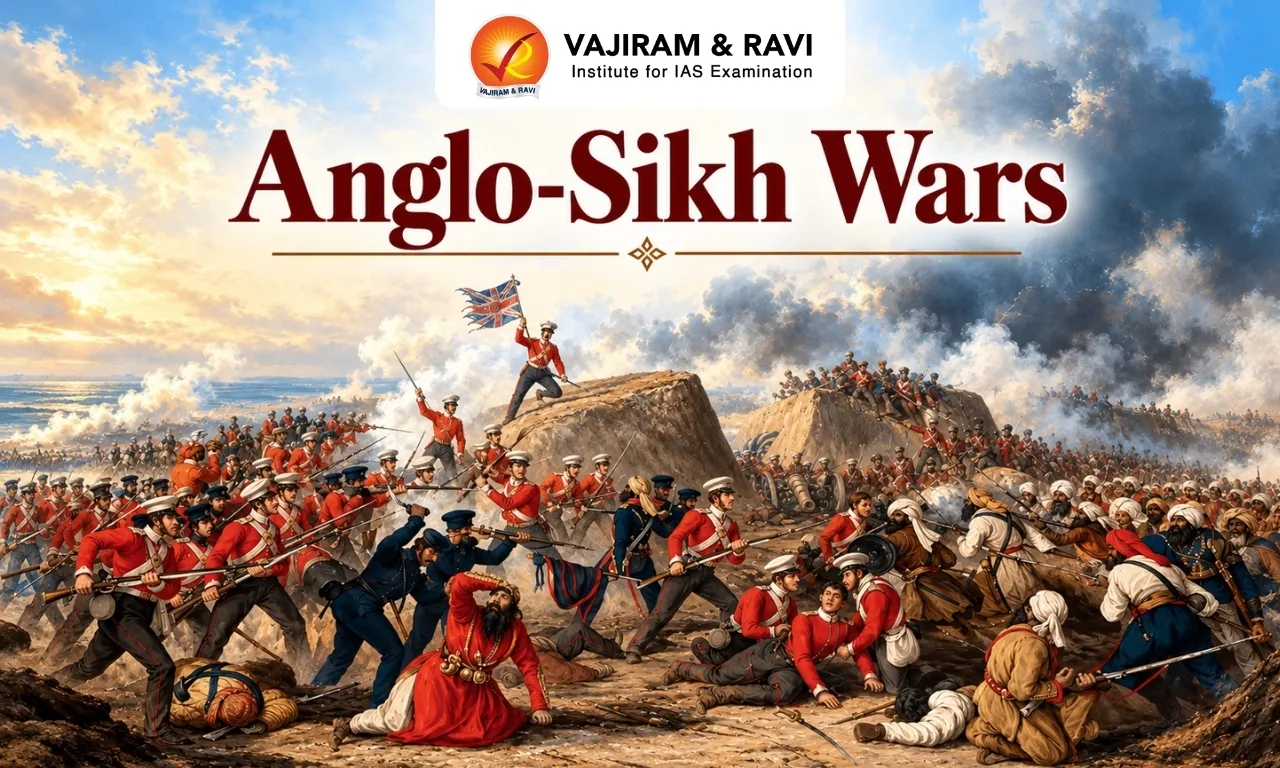
The Anglo-Sikh Wars were two conflicts fought between the Sikh Empire and the British East India Company in 1845–46 and 1848–49. The First Anglo-Sikh War weakened the independence of the Lahore kingdom, while the Second Anglo-Sikh War ended with the British annexation of Punjab on 29 March 1849. These wars removed one of the strongest remaining powers capable of challenging Company expansion in the Indian subcontinent. 1614
The conflicts followed the political instability that developed after Maharaja Ranjit Singh’s death. British expansion, tensions along the Sutlej frontier, and increasing interference in Punjab’s administration contributed to the wars. Major battles included Mudki, Ferozeshah, Aliwal, Sobraon, Chillianwala, and Gujrat.
Anglo-Sikh Wars Background
The Anglo-Sikh Wars stemmed from the rise of a powerful Sikh state under Ranjit Singh, its shifting relationship with the British, and its subsequent political weakening after his death.
Rise of Maharaja Ranjit Singh
The Sikh Empire emerged as a powerful regional state under Maharaja Ranjit Singh, who consolidated Sikh political authority and established Lahore as his capital in 1799. He was formally crowned Maharaja in 1801.
- Rise of Sikh Misls: Sikh power was initially organised into several misls, which functioned as independent military-political groups across Punjab.
- Sukerchakia Misl: Ranjit Singh inherited the leadership of the Sukerchakia Misl from his father, Mahan Singh, and used it as the base for his expansion.
- Capture of Lahore: In 1799, Maharaja Ranjit Singh captured Lahore, which became the political centre of his growing kingdom.
- Territorial Consolidation: He subsequently strengthened his position by extending control over important areas such as Amritsar and Jammu.
- Unified Sikh State: Through military expansion and political consolidation, Ranjit Singh brought much of Punjab under a strong central authority.
Ranjit Singh and the British
The Sikh Empire maintained a relationship with the British East India Company through the Treaty of Amritsar of 1809, which helped establish the Sutlej as an important boundary between their spheres of influence.
- Treaty of Amritsar (1809): The treaty defined their respective spheres of influence and helped maintain peaceful relations between the two powers.
- Territorial Restrictions: Ranjit Singh agreed to halt any further territorial expansion south of the Sutlej River (giving up claims over the Cis-Sutlej/Malwa Sikh chiefs, who came under British protection).
- Northward Expansion: In exchange, Ranjit Singh received a free hand to consolidate and expand his domains north of the Sutlej, allowing him to absorb territories like Jammu, Multan, and Kashmir.
- Tripartite Treaty (1838): Ranjit Singh later became a party to the Tripartite Treaty involving the British and Shah Shuja in the context of Afghanistan.
Decline of the Sikh Empire after Ranjit Singh
Anglo-Sikh Wars followed the weakening of the Sikh state after Ranjit Singh died in 1839, as succession disputes and internal factionalism undermined political stability.
- Succession Crisis: The period witnessed rapid changes in leadership involving Kharak Singh, Nau Nihal Singh, Sher Singh, and other claimants.
- Court Factionalism: Rival groups within the Lahore court competed for power, resulting in political instability and weakening of central authority.
- Rise of Khalsa Army: The Khalsa army became increasingly powerful and dissatisfied with the unstable Lahore administration.
- Weak Regency: Under the young Duleep Singh, political authority was exercised by competing figures such as Rani Jindan, Hira Singh, Jawahar Singh, Lal Singh and Teja Singh.
Anglo-Sikh Wars Causes
The causes of the Anglo-Sikh Wars involved political instability, military tensions, territorial ambitions, and opposition to British interference. The immediate trigger differed between the two wars.
- Political Instability in the Sikh Empire: The death of Ranjit Singh weakened central authority. Rivalries among nobles, court factions and military commanders reduced the ability of the Lahore government to maintain political stability.
- British Expansionist Policies: The East India Company was expanding its territorial control across India. The weakening of the Sikh Empire created an opportunity for the British to extend their influence into Punjab, a strategically important region in northwestern India.
- Military Concentration near the Sutlej: The movement and concentration of British troops near the Sikh frontier heightened fears of an impending invasion. The Sikh leadership viewed these developments with suspicion.
- Growing Influence of the Khalsa Army: The Khalsa army had become a powerful institution following Ranjit Singh's death. Political uncertainty and distrust between the army and the Lahore court contributed to the deterioration of relations with the British.
- British interference in Punjab's Internal Affairs: Following the First Anglo-Sikh War, British control over the Lahore government increased. Restrictions on Sikh political authority, the presence of British officials and the exile of Maharani Jind Kaur generated resentment.
- The Multan Uprising: The revolt at Multan in 1848 began amid disputes involving the appointment of a new governor and the transfer of authority from Dewan Mulraj. The killing of two British officers during the transfer crisis escalated the confrontation.


First Anglo Sikh War (1845-1846)
The First Anglo-Sikh War was the first major armed conflict between the Sikh Empire and the British East India Company. It emerged from the weakening of the Lahore state after Ranjit Singh’s death, growing tensions between the British and the Khalsa army, and the eventual Sikh advance across the Sutlej.
First Anglo Sikh War Causes
First Anglo-Sikh War (1845-46) resulted from political instability in Punjab, growing British pressure on the Sikh frontier, and increasing tensions involving the Khalsa army.
- Weakening of Lahore State: After Ranjit Singh died in 1839, succession disputes, court intrigues, and factional struggles weakened the Sikh government.
- Power of the Khalsa Army: The Khalsa army became increasingly powerful and dissatisfied with the unstable political situation at Lahore.
- British Military Buildup: The British strengthened their military presence near the Sutlej, increasing Sikh fears of British intervention.
- Mutual Suspicion: British movements and Sikh military preparations created growing distrust between the two sides.
- Political Instability: The position of Duleep Singh, the young ruler, was surrounded by competing court factions and influential figures.
- Sikh Crossing of the Sutlej: In December 1845, Sikh forces crossed the Sutlej, triggering open hostilities with the British.
First Anglo Sikh War Course of War
First Anglo-Sikh War was fought through a series of major battles around the Sutlej, ending with the defeat of the Sikh forces and the British advance towards Lahore.
- Battle of Mudki (18 December 1845): The opening major battle involved confused and costly fighting. British forces held the field, but Sikh resistance remained strong. British forces under Sir Hugh Gough confronted Sikh troops commanded by Raja Lal Singh.
- Battle of Ferozeshah (21–22 December 1845): The British faced strong Sikh resistance but ultimately secured the battlefield.
- Battle of Baddowal (21 January 1846): Sikh forces under Ranjodh Singh Majithia disrupted Harry Smith’s movements and captured baggage.
- Battle of Aliwal (28 January 1846): The Battle of Aliwal was fought between Sikh forces and British troops commanded by Sir Harry Smith. The British secured an important victory over the Sikh forces.
- Battle of Sobraon (10 February 1846): The decisive battle of the war; the defeat of the Sikh army enabled the British to advance towards Lahore.
- Fall of Lahore (February 1846): Following the defeat at Sobraon, British forces advanced to Lahore, compelling the Sikh government to negotiate.
First Anglo Sikh War Outcomes and Treaty
The First Anglo-Sikh War ended with the Treaty of Lahore, signed on 9 March 1846. Two additional agreements—the Treaty of Amritsar and the Treaty of Bhairowal—further reshaped the political settlement.
- Treaty of Lahore, 9 March 1846: The Treaty of Lahore was signed on 9 March 1846, bringing the First Anglo-Sikh War to an end. Its major provisions included:
- Recognition of Maharaja Duleep Singh as ruler of the Sikh state under significantly reduced political independence.
- Cession of the Jullundur Doab, the territory between the Beas and Sutlej rivers, to the British.
- Reduction of the Sikh army.
- Payment of a substantial war indemnity of 1.5 crore rupees.
- Acceptance of British political influence over the Lahore government.
- Since the Lahore Darbar could not pay the full indemnity, it ceded additional territories and interests to the British under the settlement.
- Treaty of Amritsar, 16 March 1846: Under a separate agreement, the Treaty of Amritsar, the British transferred control of Kashmir to Gulab Singh in return for a payment of 75 lakh rupees. Gulab Singh became Maharaja of Jammu and Kashmir.
- Treaty of Bhairowal, December 1846: The Treaty of Bhairowal further strengthened British control over Punjab. A British Resident and a council of regency exercised substantial authority over the administration during the minority of Maharaja Duleep Singh.
Second Anglo Sikh War (1848-49)
The Second Anglo-Sikh War was fought in 1848–1849. It began with a rebellion at Multan and expanded into a wider struggle against British interference in Punjab. Lord Dalhousie was Governor-General during the conflict. Sir Hugh Gough led the principal Company army, while Sher Singh Attariwala and Chattar Singh Attariwala became important leaders of Sikh resistance. The war ended with the defeat of Sikh forces at Gujrat and the annexation of Punjab.
Second Anglo Sikh War Causes
Second Anglo-Sikh War (1848-49) was driven by resentment against the post-war settlement, British interference in Punjab, and the outbreak of rebellion at Multan.
- Resentment after the First War: The Treaty of Lahore and subsequent British arrangements created dissatisfaction among Sikh political and military groups.
- British Control: The Treaty of Bhairowal increased British control over the Lahore administration, generating resentment.
- Rani Jindan’s Treatment: The removal and eventual exile of Rani Jindan, mother of Duleep Singh, became an important source of Sikh resentment.
- Restrictions on Sikh Nobles and Army: British interference and restrictions on Sikh chiefs and the Khalsa army intensified opposition.
- Revolt at Multan (1848): Mulraj, the governor of Multan, rebelled against the Lahore government and British authority.
- Spread of Rebellion: The revolt at Multan attracted wider Sikh support, and Sher Singh Attariwalla eventually joined the rebellion.
- British Decision for War: The widening revolt led Lord Dalhousie to adopt a more aggressive policy, turning the rebellion into a full-scale war.
Second Anglo Sikh War Course of War
Second Anglo-Sikh War developed from the siege of Multan into a broader military confrontation, culminating in the decisive British victory at Gujarat.
- Multan Revolt: Mulraj’s rebellion became the immediate centre of the conflict, and British forces began the siege of Multan.
- Battle of Ramnagar: British forces fought Sikh forces under Sher Singh, marking an important early engagement.
- Battle of Chillianwala: A fiercely contested battle in which the British suffered heavy losses, although the Sikh forces did not achieve a decisive strategic victory.
- Fall of Multan: British forces eventually captured Multan, weakening the Sikh rebellion.
- Battle of Gujrat: The decisive battle of the war; the British defeated the Sikh army and broke organised Sikh military resistance.
- Annexation of Punjab: Following the defeat at Gujarat, the remaining Sikh forces surrendered, bringing the war to an end.
Second Anglo Sikh War Outcomes
2nd Anglo-Sikh War ended the independent Sikh state and brought Punjab directly under British rule.
- Annexation of Punjab (1849): Lord Dalhousie annexed the Punjab to the British Empire following the Sikh defeat.
- End of Sikh Sovereignty: The annexation brought the Sikh Empire to an end as an independent political power.
- Duleep Singh: The young Maharaja Duleep Singh was removed from power, marking the formal end of the Sikh monarchy.
- British Administration: Punjab was initially administered through a Board of Administration and subsequently came under the authority of a Chief Commissioner, including John Lawrence.
- Extension of British Rule: The annexation significantly extended British control in northwestern India.
- Military Significance: Despite defeating the Sikh state, the British recognised the military qualities of Sikh soldiers and subsequently recruited many Sikhs into the British Indian Army.
- Long-term Impact: The conflict marked the final major stage in the British expansion across northern India and established direct British authority over Punjab.
Anglo-Sikh Wars Impacts
Anglo-Sikh Wars marked a major turning point in the history of north-western India, ending Sikh political independence and bringing Punjab under British control.
- End of Sikh Sovereignty: The defeat of the Sikh forces ended the independent Sikh Empire and its political authority. Punjab was formally annexed to the British Empire, bringing the former Sikh kingdom under British rule.
- Territorial Reorganisation: The 1846 treaties separated Kashmir from the Lahore kingdom, while the 1849 annexation brought Punjab under direct British authority.
- Direct British Administration: Punjab was placed under British administration, initially through a Board of Administration and subsequently under a Chief Commissioner.
- Transformation of the Khalsa: The independent military power of the Khalsa army was ended; subsequently, the British recruited many Sikhs into the British Indian Army.
Anglo Sikh War Memorial
The Anglo-Sikh War Memorial at Ferozeshah, in Punjab's Ferozepur district, commemorates the bravery and sacrifices of those who fought in the Anglo-Sikh Wars. The memorial preserves the memory of the major battles fought during the conflicts, including Mudki, Ferozeshah, Sobraon and Chillianwala. It serves as an important historical landmark for understanding the military history of nineteenth-century Punjab.

 Last updated on Oct, 2026
→ UPSC 2027 Notification will be released on 13 January 2027 at upsconline.nic.in.
→ Check Nobel Prize 2026 Winners List here.
→ Download PIB PRiSM Monthly Magazine 2026 here.
→ Check UPSC Monthly Current Affairs Magazine The Recitals here.
→ Check out the latest UPSC Syllabus here.
→ Download UPSC Model Answers for Mains 2026
→ UPSC Mains Question Paper 2026 is out now for Essay & GS Paper 1, 2, 3 & 4.
→ UPSC Calendar 2027 has been released.
→ Enroll in Vajiram & Ravi’s UPSC Mains Test Series 2027 for structured answer writing practice, expert evaluation, and exam-oriented feedback.
→ Join Vajiram & Ravi’s UPSC Mentorship Program 2027 for personalized guidance, strategy planning, and one-to-one support from experienced mentors.
→ Go through the UPSC Mains Previous Year Papers to enhance your preparation.
→ UPSC has released UPSC Toppers List 2025 with the Civil Services final result on its official website.
→ Also check Best UPSC Coaching in India
Anglo-Sikh Wars FAQs
Q1. Who won the Second Anglo-Sikh War?+
Q2. Have Sikhs ever lost a battle?+
Q3. How many Mughal soldiers did 40 Sikh warriors fight against?+
Q4. Which treaty ended the First Anglo-Sikh War in 1846?+
Q5. Who betrayed the Sikh Empire?+
Tags: anglo-sikh wars quest upsc modern history notes