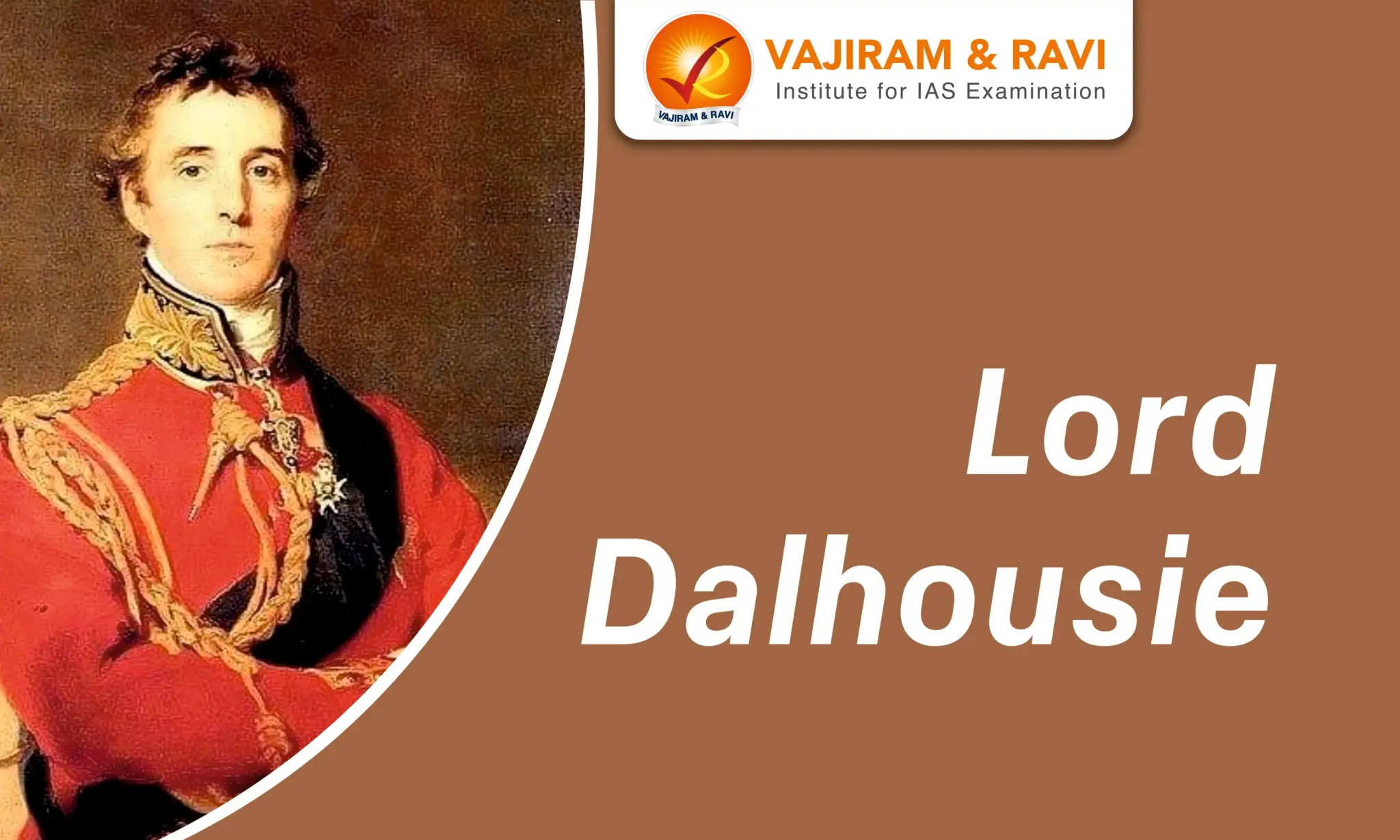
Lord Dalhousie was a prominent British Governor-General of India, known for combining territorial expansion with administrative and infrastructural modernisation. His tenure marked a major transformation in British rule, with initiatives in railways, telegraph, postal services, public works and education.
Dalhousie's policies laid important foundations for modern transport, communication and administrative systems in India, while strengthening the authority of the East India Company. However, his Doctrine of Lapse, annexation policies and interference in traditional political structures created resentment among Indian rulers, nobles and sections of society.
Lord Dalhousie, Maker of Modern India
James Andrew Broun-Ramsay, Lord Dalhousie, was born in 1812 into an influential Scottish aristocratic family. He entered British politics and became associated with administrative reform and the expansion of British interests. His political career prepared him for his later role in India.
Lord Dalhousie Time Period
Lord Dalhousie served as the Governor-General of India from 1848 to 1856. His tenure is considered a significant phase of British expansion and administrative transformation in India.
- Tenure: 1848–1856
- Position: Governor-General of India
- Predecessor: Lord Hardinge
- Successor: Lord Canning


Lord Dalhousie Reforms
Dalhousie is often regarded as the "Maker of Modern India" due to his implementation of transformative reforms that significantly shaped the country's trajectory. These reforms spanned various sectors, including infrastructure, administration, education, and social practices.
Lord Dalhousie Educational Reforms
Lord Dalhousie was a strong advocate of education. Dalhousie implemented Charles Wood's Dispatch in 1854, which laid the foundation for the modern education system in India. It emphasised the establishment of universities in Bombay, Calcutta, and Madras and promoted English as the medium of instruction. He supported the expansion of vernacular education to increase literacy among the Indian population.
Lord Dalhousie Administrative Reforms
Lord Dalhousie appointed a lieutenant governor to oversee Bengal's administration, thereby allowing the governor-general to focus on broader, nationwide issues. Frederick J. Halliday became the first Lieutenant Governor of Bengal. Similarly, the newly acquired territories, such as Punjab, were placed under the supervision of Commissioners to ensure effective governance and management.
Lord Dalhousie Social Reforms
Although Dalhousie is not primarily known for social reforms, his administration continued the policies of his predecessors in addressing social issues.
- Widow Remarriage Act (1856): Dalhousie drafted the Widow Remarriage Act, legalising the remarriage of Hindu widows and challenging traditional social norms.
- Suppression of Female Infanticide: He took measures to suppress the practice of female infanticide, particularly in northern India.
Lord Dalhousie Infrastructure Development
Lord Dalhousie's infrastructure reforms were pivotal in modernising India. He introduced key developments such as the establishment of the railway system, the expansion of the telegraph network, and the overhaul of the postal system.
- Railways: In 1853, Lord Dalhousie introduced the first railway line in India, connecting Bombay (Mumbai) and Thane. Another railway line was built between Calcutta and Raniganj, a coal-producing district in Bihar.
- Telegraph: In 1852, Lord Dalhousie established the Telegraph Department, which revolutionised communication in India. The first telegraph line was laid between Calcutta and Agra in 1854.
- Postal System: Dalhousie reformed the postal system, introducing uniform postage rates and establishing a network of post offices to improve mail delivery.
- The Post Office Act was passed in 1854, and the postal department was organised under a Director General.
- Public Works Department: Lord Dalhousie founded the Public Works Department to oversee infrastructure projects, including roads, canals, and bridges, contributing to economic development.
Lord Dalhousie Military Reforms
Lord Dalhousie focused on modernising the British Indian Army. Gurkha regiments were expanded and integrated, and the artillery from Calcutta was relocated to Meerut. To strengthen the military presence, he increased the number of English soldiers by creating three new British army regiments. Additionally, a Sikh force was formed in Punjab under British officers, and Gurkhas were integrated into the Indian army.
Lord Dalhousie Doctrine Of Lapse
The Doctrine of Lapse was one of Lord Dalhousie's most controversial policies. This doctrine stated that any princely state or territory directly influenced by the British East India Company would be annexed if the ruler died without a male heir. It prohibited such monarchs from adopting a son to ascend to their thrones. Dalhousie justified this policy as a means of preventing misrule by incompetent or corrupt rulers while also ensuring their subjects' stability and prosperity.
Doctrine Of Lapse Outcomes
The Doctrine of Lapse had significant political and administrative consequences, as it accelerated British territorial expansion and weakened the authority of Indian princely rulers. It also generated resentment that later contributed to opposition against British rule.
- Annexation of Satara: Became the first major state annexed under the policy.
- Annexation of Jhansi: The refusal to recognise Damodar Rao as heir led to the annexation of Jhansi and intensified Rani Lakshmibai’s opposition to British rule.
- Annexation of Nagpur: The death of Raghuji III without a natural heir resulted in the annexation of Nagpur.
- Annexation of Sambalpur: The state was brought under British control following the succession dispute.
- Political Resentment: The policy alienated Indian rulers and became an important grievance before the Revolt of 1857.
- End of the Policy: Following the Revolt, the British abandoned the Doctrine of Lapse and recognised the right of rulers to adopt heirs.
Lord Dalhousie Significant Events
Significant events were undertaken during Lord Dalhousie’s tenure as Governor-General. These events significantly strengthened British control while also laying the groundwork for future discontent.
- Second Anglo-Sikh War (1848-1849): The Second Anglo-Sikh War resulted in the annexation of the Punjab region, marking a significant expansion of British territory in India.
- Second Anglo-Burmese War (1852): This war resulted in the annexation of Lower Burma, further extending British influence in Southeast Asia.
- Annexation of Awadh (1856): Dalhousie annexed Awadh on the grounds of misgovernance despite its ruler being a long-time British ally. This move was deeply unpopular and contributed to the unrest leading to the 1857 rebellion.
Lord Dalhousie Criticism
Lord Dalhousie’s policies combined territorial expansion with administrative modernisation. While his reforms introduced several modern institutions, his aggressive approach towards Indian states and society attracted considerable criticism.
- Aggressive Expansionism: The Doctrine of Lapse was used to annex princely states, undermining the political authority of Indian rulers.
- Annexation of Awadh: The annexation of Awadh on grounds of alleged misgovernance was criticised as an attempt to acquire territory rather than merely improve administration.
- Economic Burden: Changes in revenue administration and the integration of territories into the colonial economy created difficulties for several sections of Indian society.
- Centralisation of Power: His emphasis on a strong and centralised administration increased British control but reduced the autonomy of indigenous political institutions.
Lord Dalhousie Death Reason
Lord Dalhousie died on December 19, 1860, at Dalhousie Castle in Scotland, aged 48. He died shortly after returning to Britain from India, exhausted by tremendous overwork and emotional tragedy. His contentious term as Governor-General ended in 1856.
Lord Dalhousie UPSC PYQs
Q1: "In many ways, Lord Dalhousie was the founder of modern India." Elaborate (UPSC Mains 2013)

 Last updated on Oct, 2026
→ UPSC 2027 Notification will be released on 13 January 2027 at upsconline.nic.in.
→ Check Nobel Prize 2026 Winners List here.
→ Download PIB PRiSM Monthly Magazine 2026 here.
→ Check UPSC Monthly Current Affairs Magazine The Recitals here.
→ Check out the latest UPSC Syllabus here.
→ Download UPSC Model Answers for Mains 2026
→ UPSC Mains Question Paper 2026 is out now for Essay & GS Paper 1, 2, 3 & 4.
→ UPSC Calendar 2027 has been released.
→ Enroll in Vajiram & Ravi’s UPSC Mains Test Series 2027 for structured answer writing practice, expert evaluation, and exam-oriented feedback.
→ Join Vajiram & Ravi’s UPSC Mentorship Program 2027 for personalized guidance, strategy planning, and one-to-one support from experienced mentors.
→ Go through the UPSC Mains Previous Year Papers to enhance your preparation.
→ UPSC has released UPSC Toppers List 2025 with the Civil Services final result on its official website.
→ Also check Best UPSC Coaching in India
Lord Dalhousie FAQs
Q1. Who was Lord Dalhousie?+
Q2. Why is Lord Dalhousie famous for?+
Q3. Which famous law was passed by Lord Dalhousie?+
Q4. When did Lord Dalhousie become Governor-General?+
Q5. Who was the youngest Governor-General of India?+
Tags: lord dalhousie quest upsc modern history notes