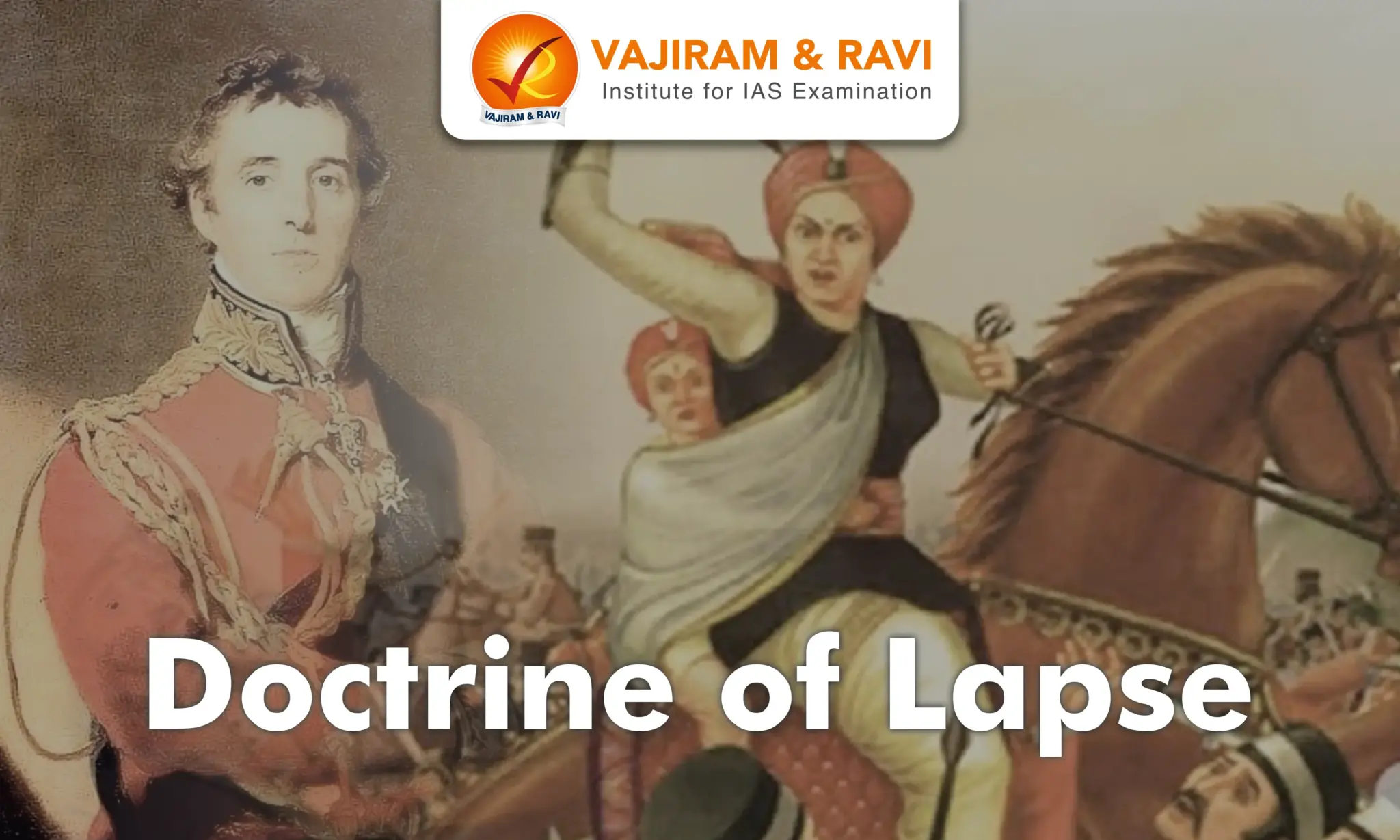
The Doctrine of Lapse was a policy implemented by the British East India Company in the mid-nineteenth century under the administration of Lord Dalhousie (1848 to 1856) as a strategic policy to expand British territories in India by peaceful means. This doctrine contributed significantly to the expansion of British territories in India by enabling the annexation of princely states without a direct male heir.
Although the British saw it as a tool for administrative efficiency, Indian rulers despised the doctrine, which is credited with sparking the Indian Rebellion of 1857. After the rebellion, the doctrine was abandoned as part of efforts to reconcile with princely states.
Doctrine of Lapse Introduction
Doctrine of Lapse was introduced by Lord Dalhousie (1848-1856), the then Governor-General of India. It arose from the British East India Company's desire to consolidate and expand its control in India. Many Indian princely states have traditionally adopted heirs in the absence of a direct male successor to ensure the continuation of their rule. The Doctrine of Lapse dictated that if an Indian princely state lacked a surviving male heir or faced a succession dispute, the British would annex the state's territory.
- Based on the principle that Britain, as the paramount power, could accept or reject adopted heirs of Indian rulers, the doctrine was justified as ensuring good governance in mismanaged states.
- The Court of Directors introduced this policy in 1847, initially targeting smaller Indian states. Lord Dalhousie later expanded its use to increase British control aggressively.
- The annexations also helped the financially struggling East India Company increase revenue and reduce the cost of maintaining the Subsidiary Alliance.
Doctrine of Lapse Features
The Doctrine was widely regarded as an imperialist approach by Indian rulers. They opposed this policy because it increased the power of the British government. The Doctrine of Lapse had several key features that defined its implementation:
- Annexation of States Without a Male Heir: The primary feature was the automatic annexation of any princely state where the ruler died without a natural male heir. The British refused to acknowledge adopted heirs, which was a common practice among Indian rulers.
- British Approval Required: Even in cases where adoption was previously accepted, the doctrine required that such adoptions receive explicit British approval before being considered valid for succession.
- Inheritance: An adopted heir could inherit only the prince's personal belongings and property, not the rulership of the kingdom. Thus, it directly challenged the traditional Indian practice of adopting an heir to succeed to the throne.
- Pension and Titles: The adopted son of a princely state’s ruler would be ineligible to receive any pensions previously granted to his father. It also prohibited the use of titles that his father might have received earlier.
- Selective Application: The policy was not uniformly applied to all princely states. Its implementation often depended on strategic and economic considerations. It applied to states without a competent ruler or legal heir to the throne.
- Legal Rationale: The Doctrine of Lapse was publicly portrayed as being grounded in Hindu law, but this was misleading. While Hindu law allowed for the adoption of a son to ensure succession, the annexation policy under the Doctrine of Lapse did not recognise adopted heirs, leading to their exclusion from succession rights.
- Misgovernance Clause: In some instances, states were annexed on the pretext of misgovernance, even when succession was not an issue.


Doctrine of Lapse Annexed States
The Doctrine of Lapse led to the annexation of several key princely states, significantly expanding British territories in India. Some of the most notable annexations include Satara (1848), Nagpur (1854), and Awadh (1856):
- Satara (1848): This was the first major state annexed by Dalhousie under the doctrine. The Raja of Satara died without a male heir, and despite the adoption of a son, the British annexed the state, citing the doctrine.
- Jaitpur and Sambalpur (1849): These smaller states were annexed in quick succession. The British took control, arguing that the absence of a natural heir nullified the state's sovereignty.
- Udaipur (1852): This was a state in present-day Chhattisgarh, not to be confused with the more famous Udaipur in Rajasthan.
- Jhansi (1853): The annexation of Jhansi became particularly controversial and led to Rani Lakshmibai's rebellion during the 1857 uprising.
- Nagpur (1854): One of the largest and most significant annexations under the doctrine.
- Awadh (1856): Although not strictly annexed under the Doctrine of Lapse (as there was a natural heir), Awadh was annexed on the grounds of misgovernance, using similar principles.
Doctrine of Lapse Effects
The Doctrine of Lapse had profound effects on British India. It led to significant territorial expansion but also incited widespread resentment among Indian rulers. Its implementation contributed to the unrest that culminated in the Indian Rebellion of 1857.
- Expansion of British Territories: The Doctrine of Lapse led to the annexation of key states, expanding British control and increasing administrative responsibilities.
- Loss of Sovereignty for Princely States: Indian princely states lost sovereignty, sparking unrest. Rulers like the Rani of Jhansi and Nana Sahib were denied their thrones.
- Erosion of Traditional Practices: The rejection of adopted heirs disrupted succession traditions, destabilised the political landscape, and weakened India's cultural fabric.
- Prelude to the Revolt of 1857: The annexations and policies like the Doctrine of Lapse fueled discontent, contributing to the Revolt of 1857 by Indians to end British Imperialism.
- Change in British Policy: After the rebellion, the British Crown assumed control, abandoned the doctrine, and adopted a more conciliatory approach toward Indian rulers.
Doctrine of Lapse UPSC PYQs
Q1: "In many ways, Lord Dalhousie was the founder of modern India." Elaborate (UPSC Mains 2013)
Q2: The ruler of which one of the following States was removed from power by the British on the pretext of misgovernance? (UPSC Prelims 2007)
(a) Awadh
(b) Jhansi
(c) Nagpur
(d) Satara
Ans: (a)
Q3: Consider the following Princely States under British rule in India: (UPSC Prelims 2004)
- Jhansi
- Sambalpur
- Satara
The correct chronological order in which they were annexed by the British is:
(a) 1-2-3
(b) 1-3-2
(c) 3-2-1
(d) 3-1-2
Ans: (c)

 Last updated on Oct, 2026
→ UPSC 2027 Notification will be released on 13 January 2027 at upsconline.nic.in.
→ Check Nobel Prize 2026 Winners List here.
→ Download PIB PRiSM Monthly Magazine 2026 here.
→ Check UPSC Monthly Current Affairs Magazine The Recitals here.
→ Check out the latest UPSC Syllabus here.
→ Download UPSC Model Answers for Mains 2026
→ UPSC Mains Question Paper 2026 is out now for Essay & GS Paper 1, 2, 3 & 4.
→ UPSC Calendar 2027 has been released.
→ Enroll in Vajiram & Ravi’s UPSC Mains Test Series 2027 for structured answer writing practice, expert evaluation, and exam-oriented feedback.
→ Join Vajiram & Ravi’s UPSC Mentorship Program 2027 for personalized guidance, strategy planning, and one-to-one support from experienced mentors.
→ Go through the UPSC Mains Previous Year Papers to enhance your preparation.
→ UPSC has released UPSC Toppers List 2025 with the Civil Services final result on its official website.
→ Also check Best UPSC Coaching in India
Doctrine of Lapse FAQs
Q1. Who introduced the Doctrine of Lapse?+
Q2. What is the Doctrine of Lapse?+
Q3. Which states were annexed by the Doctrine of Lapse?+
Q4. Who abolished the Doctrine of Lapse in India?+
Q5. Which state was first annexed by Lord Dalhousie?+
Tags: doctrine of lapse quest upsc modern history notes