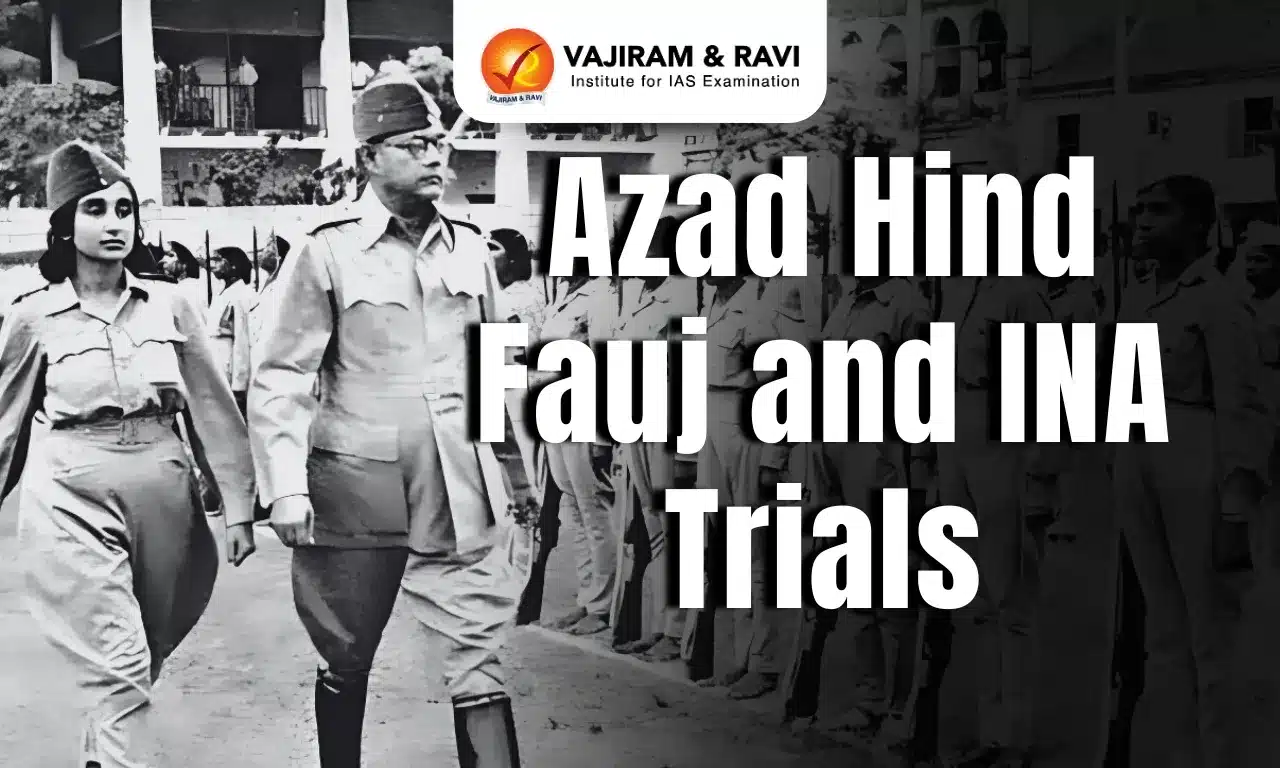
The Azad Hind Fauj and INA Trials were major events in India's freedom struggle that played a significant role in undermining British authority and intensifying the demand for independence. The Azad Hind Fauj, also known as the Indian National Army (INA), was an armed force formed during World War II to fight British colonial rule in India. It became one of the most powerful symbols of militant nationalism under the leadership of Netaji Subhas Chandra Bose.
The INA Trials, popularly known as the Red Fort Trials, were held by the British government between November 1945 and May 1946. The trials generated massive public support for INA soldiers and significantly weakened the moral authority of British rule in India.
Azad Hind Fauj or Indian National Army (INA)
The Indian National Army (INA), also known as the Azad Hind Fauj, was an armed force formed primarily from Indian prisoners of war captured by Japanese forces in Southeast Asia. It also recruited Indian civilians living in Malaya, Singapore, Burma, and other parts of Southeast Asia.
- The INA aimed to secure India’s independence from British rule through armed struggle. Its members fought alongside Japanese forces in the India–Burma theatre during the Second World War.
- The Indian National Army was not a single, uninterrupted organisation. It developed in two major phases:
- The First INA was established in 1942 under Captain Mohan Singh.
- The INA was later reorganised and led by Subhash Chandra Bose from 1943 onwards.
Founder of Indian National Army
The first Indian National Army was founded by Captain Mohan Singh in 1942. He was an officer in the British Indian Army who was captured by Japanese forces during the Malayan campaign.
- With Japanese support and the involvement of the Indian Independence League, he organised Indian prisoners of war into the first INA. However, the first INA did not survive for long.
- Differences emerged between Mohan Singh and the Japanese military authorities over the INA’s autonomy and role. By the end of 1942, the first INA had effectively collapsed. The movement was subsequently revived and reorganised under Subhas Chandra Bose.
Subhash Chandra Bose and Indian National Army
Subhas Chandra Bose arrived in Southeast Asia in 1943 after travelling from Germany to Japan and then to Japanese-controlled territories in Southeast Asia. His arrival marked a major turning point in the history of the INA. He took over the leadership of the Indian Independence League and the INA, giving both a renewed purpose and wider mass appeal.
- Under Bose, the INA adopted powerful nationalist slogans: Jai Hind; Delhi Chalo; and Give me blood, and I will give you freedom
- Bose emphasised discipline, sacrifice, unity, and armed resistance against colonial rule. He also encouraged participation across linguistic, regional, and religious backgrounds.
- Contribution by Bose:
- Reorganised the INA into a more structured military force.
- Mobilised Indian expatriates in Southeast Asia.
- Established the Provisional Government of Free India.
- Declared armed struggle against British rule.
- Sought Japanese military assistance.


Azad Hind Fauj Members
The Azad Hind Fauj members included soldiers, officers, prisoners of war, overseas Indians, political workers, and women volunteers. Important INA leaders included:
- Subhas Chandra Bose – Supreme Commander and political leader.
- Captain Mohan Singh – Founder of the first INA.
- Rash Behari Bose – Leader associated with the Indian Independence League.
- Shah Nawaz Khan – Prominent INA officer and accused in the first INA trial.
- Prem Kumar Sahgal – INA officer tried at the Red Fort.
- Gurbaksh Singh Dhillon – INA officer tried at the Red Fort.
- Lakshmi Sahgal – Commander of the Rani of Jhansi Regiment.
- A.C. Chatterji – Senior INA officer and political worker.
Azad Hind Fauj Structure and Composition
Unlike the first INA, which had multiple centres of authority, the second INA, under Bose's leadership, was solely committed to him. Ethnic and regional loyalties were subsumed under national sentiments through mixed regiments and political training. The practice of naming regiments after nationalist leaders continued, fostering a sense of unity.
- The INA was structured into three brigades - Gandhi, Azad and Nehru. At its peak strength, the INA had around 60,000 troops, including the Rani Jhansi regiment comprising women soldiers headed by Captain Lakshmi Swaminathan (Lakshmi Sehgal).
- Motivated civilian volunteers from the Indian Independence League were also attached to the INA formations. The soldiers took an oath of loyalty to both Netaji and the national cause.
- The INA had its own currency, postage stamps and symbols portraying a vision of a liberated India.
- Subhas Chandra Bose, through the first national army, introduced the Indian tricolour as the national flag and Tagore's song 'Jan Gan Man Adhinayak' as the national anthem.
- The INA flag with the springing tiger symbol and the motto 'Ittefaq, Etemad, Qurbani' inspired nationalist sentiment.
- He also established 'Jai Hind' as the national greeting, cultivating unity among all Indians regardless of caste and creed.
Azad Hind Government and INA
In October 1943, Subhas Chandra Bose proclaimed the Provisional Government of Free India, commonly known as the Azad Hind Government. The government claimed to represent a free India and received recognition from several Axis powers and their allies.
- The INA served as the military arm associated with this government.
- The broader objective was to enter India with military support from Japan, mobilise Indians against British rule and ultimately establish an independent Indian government.
Azad Hind Fauj (INA) Military Campaigns
The Azad Hind Fauj, led by Subhas Bose, controlled the Andaman islands and parts of Manipur briefly. In 1944, the INA attempted to invade India from Imphal and Kohima in Northeast India, moving down the coast toward Burma. However, this campaign ultimately ended in failure.
- However, the defeat of Japan and Germany in World War II dashed its hopes as INA lacked the resources to continue independently. Its major ambition of creating a march on Delhi remained unfulfilled.
- While the INA did not achieve its military objectives, it made significant political stridеs. Bosе's lеadеrship and thе INA's commitmеnt to thе causе of Indian indеpеndеncе inspirеd gеnеrations.
- The INA played a pivotal role in building a collеctivе consciousnеss of Indian identity and thе dеsirе for frееdom.
Azad Hind Fauj and INA Trials 1945
After World War II ended in 1945 with the defeat of the Axis powers, the British conducted a series of court-martial proceedings known as the INA trials or Red Fort trials between November 1945 and May 1946. These trials involved several officers of the Indian National Army (INA) who were charged with various offences, including treason, torture, murder, and abetment to murder, during their association with the INA during World War II.
- Early Trials of INA Personnel: In 1943 and 1944, courts-martial were held in India for former members of the British Indian Army who had joined the INA or supported its activities.
- Initially, these trials did not receive much attention or sympathy from the public and were based on charges of "Committing a civil offence" as per the Indian Army Act and Burma Army Act.
- The primary charge in these earlier trials was "Waging War against the King," as per the Indian Penal Code.
- Public INA Trials at Red Fort: Due to the increasing number of INA troops captured by Commonwealth forces towards the end of the Burma Campaign, a selective approach was adopted to prosecute those accused of the gravest allegations.
- The first notable public trial involved INA officers Shah Nawaz Khan, Prem Sahgal, and Gurbaksh Singh Dhillon.
- Recognising the political significance of these trials, they were conducted at the iconic Red Fort in Delhi, attracting widespread attention.
- INA Defence Committee: The Indian National Congress played a crucial role in making the release of these three defendants a significant political issue during the 1945-46 independence agitation.
- The INA Defence Committee was established by Congress in 1945 to provide legal defence to the accused INA officers.
- Besides legal defence, the committee coordinated information about INA troops held captive and arranged relief efforts for them.
- INA Lawyers: The principal lawyers associated with the defence included Bhulabhai Desai, Asaf Ali, Sharat Chandra Bose, Tej Bahadur Sapru, and Kailash Nath Katju.
Azad Hind Fauj and INA Trials Impacts
The Azad Hind Fauj and INA Trials shook the foundations of the British Empire in India. It demonstrated the possibility of a united armed resistance movement transcending religious and ethnic divides in the cause of freedom.
- Nationalist Mobilisation: The trials generated widespread demonstrations across India. Students, workers, political groups, and ordinary citizens demanded the release of INA personnel.
- Unity Across Communities: The first trial involved officers from three different communities: Shah Nawaz Khan, Prem Sahgal, and Gurbaksh Singh Dhillon. This became a powerful symbol of Hindu-Muslim-Sikh unity.
- Effect on Armed Forces: The trials affected morale within the British Indian armed forces. Sympathy for the INA grew among sections of soldiers, sailors, and airmen.
- The Royal Indian Navy Revolt of 1946 and other unrest within military services showed that British control over the armed forces was becoming increasingly uncertain.
- Pressure on British Rule in India: The INA movement and the public response to the trials demonstrated that British authority in India was weakening. They contributed to the wider political environment that led to India’s independence in 1947.
Royal Indian Naval Mutiny
The Royal Indian Navy (RIN) mutiny of 1946, significantly contributed to the anti-colonial struggle in India. The World War II's impact on Indian soldiers led to the RIN's expansion, including recruits from diverse backgrounds.
- Serving abroad exposed them to democratic principles, prompting questions about India's colonial status and realising their capabilities.
- Post-war challenges like demobilisation, unemployment, and British racism led to minor mutinies and labour movements.
- Memories of the 'Quit India' movement and INA trials fueled nationalist sentiments and anti-colonial attitudes.
- The mutiny began at HMIS Talwar in Bombay on February 18, 1946, when 1,500 ratings demanded better conditions. It spread to other locations, gaining public support and evolving into a call for freedom from British rule.
- Ultimately, on February 23, 1946, all ships surrendered, leaving a lasting legacy in India's struggle for independence. The RIN mutiny, alongside other movements, weakened British rule in India.
Azad Hind Fauj and INA Trials Significance
The Azad Hind Fauj and INA Trials remain important for several reasons:
- Armed resistance: The Azad Hind Fauj represented a major organised armed challenge to British colonial rule, demonstrating that India's independence struggle extended beyond constitutional and non-violent methods.
- Patriotic inspiration: The INA inspired strong patriotic sentiment among Indians in India and abroad, encouraging nationalist consciousness and strengthening public support for the broader independence movement.
- Overseas Indian contribution: The INA highlighted the significant contribution of overseas Indians to India's freedom struggle, particularly through financial, organisational, and military support across Southeast Asia.
- Women's participation: The Rani of Jhansi Regiment demonstrated women's active participation in the armed freedom struggle, challenging traditional gender roles and expanding the social base of nationalism.
- Mass mobilisation and British pressure: The Red Fort Trials triggered widespread public mobilisation, strengthened national unity, and undermined the political and psychological foundations of British colonial authority in India.

 Last updated on Oct, 2026
→ UPSC 2027 Notification will be released on 13 January 2027 at upsconline.nic.in.
→ Check Nobel Prize 2026 Winners List here.
→ Download PIB PRiSM Monthly Magazine 2026 here.
→ Check UPSC Monthly Current Affairs Magazine The Recitals here.
→ Check out the latest UPSC Syllabus here.
→ Download UPSC Model Answers for Mains 2026
→ UPSC Mains Question Paper 2026 is out now for Essay & GS Paper 1, 2, 3 & 4.
→ UPSC Calendar 2027 has been released.
→ Enroll in Vajiram & Ravi’s UPSC Mains Test Series 2027 for structured answer writing practice, expert evaluation, and exam-oriented feedback.
→ Join Vajiram & Ravi’s UPSC Mentorship Program 2027 for personalized guidance, strategy planning, and one-to-one support from experienced mentors.
→ Go through the UPSC Mains Previous Year Papers to enhance your preparation.
→ UPSC has released UPSC Toppers List 2025 with the Civil Services final result on its official website.
→ Also check Best UPSC Coaching in India
Azad Hind Fauj and INA Trials FAQs
Q1. What was Azad Hind Fauj?+
Q2. Who founded Azad Hind Fauj?+
Q3. Who was the main leader of Azad Hind Fauj?+
Q4. When was Azad Hind Fauj formed?+
Q5. Who advocated the famous INA trials?+
Tags: azad hind fauj and ina trials quest upsc modern history notes