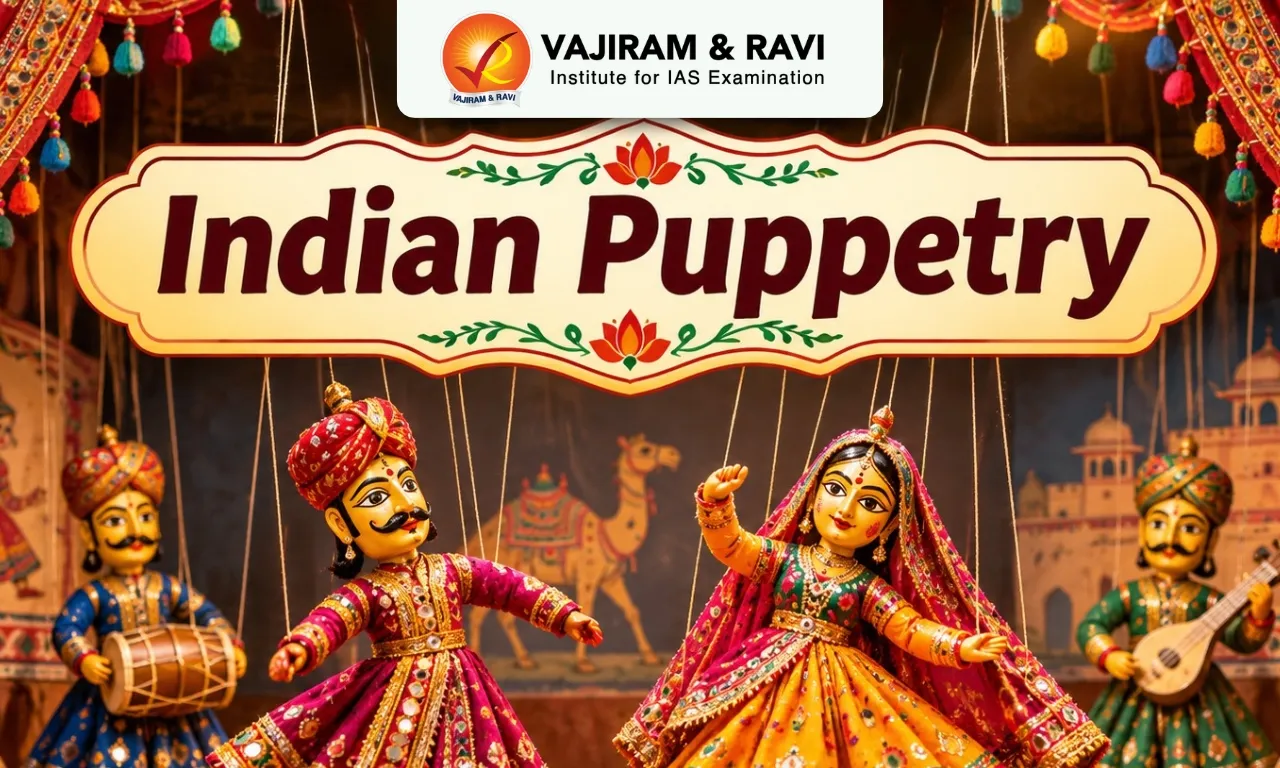
Indian Puppetry in India boasts a 4,000-year legacy, blending history, art, and philosophy. Rooted in texts like the Mahabharata and Silappadikaram, it intertwines storytelling with cultural rituals. Philosophically, the Bhagavad Gita likens God to a puppeteer, while myths of Brahma and Saraswati highlight its divine origins. Puppetry integrates painting, music, dance, and drama, with diverse traditions including string, rod, shadow, and glove puppetry.
In Indian Puppetry, regional forms like Rajasthan’s Kathputli and Kerala’s Pavakathakali narrate epics and folklore. Despite modernisation challenges, initiatives strive to preserve this vibrant art, connecting ancient heritage with contemporary storytelling.
Indian Puppetry History
Indian puppetry is one of the country's oldest storytelling and performing-art traditions. It has evolved through religious beliefs, mythology, folklore, and regional cultural practices, serving as a medium of entertainment, education, and social communication.
- Indus Valley Civilisation: Puppets with sockets attached to them have been discovered at the excavation sites of Harappa and Mohenjo-daro, indicating the presence of puppetry as an art form.
- However, the oldest written mention of puppetry can be found in the Tamil epic Silappadikaram, which was composed between the first and second centuries B.C.
- Vedic Literature: The Mahabharata and the Ramayana contain early references to wooden and string figures. The Sanskrit term "Sutradhar" (meaning "holder of the strings") originally referred to the stage manager or director of a play who pulled the conceptual strings of the performance.
- Religious and Ritual Development: Puppetry became closely associated with religious storytelling and community rituals. Performances often depicted episodes from the Ramayana, Mahabharata, and Puranas, along with local myths and legends.
- They were also organised during festivals, marriages and other social occasions, sometimes to ward off evil spirits or invoke rainfall.
- Medieval Period: Puppetry continued to develop through regional traditions, supported by hereditary performers, temples and local communities. Different regions developed distinctive styles of string, rod, shadow and glove puppetry, often influenced by local traditions. Shadow puppetry also became established in several parts of southern India.
- Colonial Period: Traditional puppetry continued largely through community-based and hereditary performers. However, changing social and economic conditions affected several traditional performance communities.
- Puppetry remained an important medium for preserving regional folklore, mythology, and cultural identities.
- Post-Independence Period: Efforts to preserve and promote puppetry gained institutional support through cultural organisations such as the Sangeet Natak Akademi and the Centre for Cultural Resources and Training.
Indian Puppetry Types
Indian puppetry is broadly classified into four categories based on the technique used to manipulate the puppets. The following table follows the classification:
| Type of Puppetry | Description |
|
String Puppets (Marionettes) |
Puppets are manipulated through strings attached to different parts of their bodies, allowing the puppeteer to control their movements. Examples: Kathputli, Kundhei, Bommalattam, Gombeyatta |
|
Shadow Puppets |
Flat, usually leather-made puppets are placed between a light source and a translucent screen. Their shadows create images on the screen. Examples: Tolu Bommalata, Togalu Gombeyata, Ravanachhaya |
|
Glove Puppets |
Puppets are worn over the hand like gloves, with the fingers controlling the head and arms to create movements. Examples: Pavakoothu |
|
Rod Puppets |
Puppets are manipulated using rods attached to their bodies, enabling the puppeteer to control their movements. Examples: Putul Nach, Yampuri |
String Puppetry in India
String puppets, or marionettes, are a key part of India’s heritage, originating in Rajasthan over 1,000 years ago with the Bhat community. These colourful wooden puppets, controlled by three to nine strings, often depict folk tales like Amar Singh Rathod. A unique feature is the puppeteers’ high-pitched boli, made using bamboo reeds. Some of the String puppets in India are as follows:
- Kathputli (Rajasthan): Kathputli puppets are legless wooden dolls dressed in vibrant traditional attire, controlled by strings attached to the puppeteer’s fingers. Performances, accompanied by dramatic folk music, often depict heroic tales.
- Kundhei (Odisha): Kundhei puppets, made from lightwood, feature long skirts and flexible joints. Influenced by Odissi dance, they use a triangular prop for string control, enabling elegant movements.
- Gombeyatta (Karnataka): Gombeyatta puppets are inspired by Yakshagana characters and require multiple puppeteers to synchronize their movements, creating dynamic performances.
- Bommalattam (Tamil Nadu): Bommalattam puppets are the largest in India, reaching up to 4.5 feet tall and weighing 10 kilograms. They use strings attached to an iron ring worn on the puppeteer’s head to enact stories from the Ramayana and Mahabharata in four distinct stages.
- Sakhi-Kandhei (Odisha): Sakhi-Kandhei puppets are colourful lightwood dolls with long skirts, typically used to narrate tales of Lord Krishna. Their design reflects influences from Assam and Rajasthan.
- Kalasutri Bahulye (Maharashtra): Kalasutri Bahulye puppets are small wooden figures with movable joints, originating in the Rajasthan-Gujarat region. They depict cultural stories but are declining due to modernisation and lack of interest.
Shadow Puppetry in India
India's shadow puppetry, or chaya nataka, features flat leather figures painted on both sides, creating captivating shadows. Thriving in states like Andhra Pradesh, Kerala, and Odisha, it dates back to the first millennium BCE, with the earliest script, Subhata’s Dutangada (1243 AD). Some of the Notable Forms of Shadow Puppetry are:
- Togalu Gombeyatta: Originating in Karnataka, this shadow theatre is characterised by puppets of varying sizes, reflecting social status—larger puppets represent kings and religious figures, while smaller ones depict common people and servants.
- Ravanchhaya: This theatrical style from Odisha employs puppets made of deer skin, known for their bold, dramatic postures. Lacking joints, these puppets are manipulated in complex ways, often including non-human figures like trees and animals. The performances are renowned for their lyrical and sensitive storytelling.
- Tholu Bommalata: Hailing from Andhra Pradesh, this shadow theatre features larger puppets that are vividly painted on both sides. The performances are accompanied by classical music and focus on mythological and devotional tales from Indian Epics and Puranas.
Glove Puppetry in India
Glove puppets, also known as hand or sleeve puppets, are one of the oldest and simplest forms of puppetry, found across India. The puppeteer controls the head with their forefinger and the hands with the thumb and middle finger.
- Glove puppetry is popular in states like Odisha (Sakhi Kundhei Nata), Kerala (Pavakathakali), Tamil Nadu (Pava Koothu), Uttar Pradesh (Gulabo-Sitabo), and West Bengal (Benir Putul).
- In Kerala, Pavakathakali, developed in the 18th century, mirrors the famous Kathakali dance form. The elaborately carved puppets, influenced by Kathakali costumes, depict epic stories like the Ramayana and Mahabharata.
- In northern India, Uttar Pradesh’s Gulabo-Sitabo glove puppetry, dating back to the 17th century, portrays the comical quarrels between two wives, Gulabo and Sitabo, married to the same man.
- This form of storytelling reflects local folk traditions, contrasting with the epic narratives common in southern glove puppetry.
- Glove puppets are generally made of wood or cloth, and performances are often accompanied by rhythmic beats from drums or dholak, adding a musical element to the storytelling.
Rod Puppetry in India
Rod puppetry in India is a traditional form practised mainly in Eastern India, including Odisha, Bengal, and Assam, where puppets are controlled using rods from behind a screen. Unlike glove puppets, rod puppets are larger and often have more joints, enabling more complex movements.
- Yampuri: A rod puppet from Bihar, Yampuri is carved from a single piece of wood without joints. These puppets are brightly painted and known for their simplicity and vibrant costumes.
- Putul Nach: Popular in Bengal, Odisha, and Assam, these 3-4 feet tall puppets have joints at the neck and shoulders. Puppeteers control them with rods attached to their waists, performing behind a curtain, accompanied by harmonium, cymbals, and tabla.
- Danger Putul Nach: A Bengal variation with puppets up to 1.2 meters tall and weighing 10 kg. They perform epic stories and modern themes, adorned in traditional styles.
- Kathi Kundhei Nacha: This Odisha tradition, once extinct, now thrives with performances of Ramayana and Purana stories, featuring classic formats and invocations.


Indian Puppetry Significance
Indian puppetry is an important traditional performing art that combines storytelling, music, dialogue, and visual expression. Its significance includes:
- Storytelling Medium: Puppetry communicates stories from epics, legends, and local traditions through an accessible performing form.
- Educational Tool: It has traditionally been used as an inexpensive medium for transmitting knowledge about Indian myths and legends and can support creative learning.
- Social Awareness: It can communicate social messages and contemporary issues engagingly. For example, during the COVID-19 pandemic, puppetry and other folk-performance forms were adapted to spread messages.
- Community Identity: Indian Puppetry reflects the distinct cultural identity and artistic traditions of different regions and communities.
- Livelihood Support: Sustains puppeteers, musicians, craftsmen, and other practitioners associated with traditional performing arts.
- Intergenerational Transmission: Training programmes and recognition of practitioners help pass traditional skills from experienced artists to younger generations.
Indian Puppetry Challenges
Indian puppetry faces several challenges that threaten the continuity and survival of traditional puppetry forms:
- Declining Patronage: Traditional performances receive limited audiences and financial support compared to modern entertainment.
- Changing Entertainment Choices: Television, cinema, and digital media have reduced the popularity of traditional puppet shows.
- Economic Insecurity: Puppeteers frequently lack stable income, social security, and adequate performance opportunities.
- Limited Institutional Support: Documentation, training, marketing, and infrastructure remain inadequate for several regional puppetry traditions.
- Commercialisation: Adaptation to market demands can sometimes weaken the traditional forms, themes, and techniques.
- Poor Visibility: Many regional puppetry traditions remain relatively unknown outside their local communities.
Indian Puppetry Government Initiatives
The government’s support for Indian puppetry is mainly aimed at financial assistance, skill transmission, documentation, research, and wider performance opportunities.
- Young Artist Scholarships: The Ministry of Culture provides 400 scholarships under the Scheme of Scholarships to Young Artistes in Different Cultural Fields.
- Puppetry is explicitly included under Folk, Traditional and Indigenous Arts, with the scholarship supporting 2 years of advanced training.
- Financial Assistance to Cultural Institutions: Sangeet Natak Akademi provides grants to registered institutions working in folk and tribal arts and puppetry.
- The scheme has been operational under revised guidelines from 2019–20, with applications invited for 2024–25.
- Kala Sanskriti Vikas Yojana (KSVY): Provides financial support for preserving Indian art and heritage, including pensions up to ₹6,000/month for veteran artists and grants of ₹5–20 lakh for cultural organisations.
- International Promotion: Under the Global Engagement Scheme, puppetry is included among folk arts presented through Festivals of India abroad. The Ministry has empanelled 627 artists/groups across various art forms for such international performances.
- Festivals, Workshops & Documentation: Sangeet Natak Akademi supports puppetry through festivals, workshops, training, documentation, publications and grants. A Parliamentary record notes that the Akademi had honoured 11 puppeteers with Akademi Awards up to 2002.
- Dedicated Award Category: Sangeet Natak Akademi's award framework specifically includes “Puppetry / Mime / Allied arts”, providing institutional recognition to practitioners.

 Last updated on Nov, 2026
→ UPSC 2027 Notification will be released on 13 January 2027 at upsconline.nic.in.
→ Check Nobel Prize 2026 Winners List here.
→ Download PIB PRiSM Monthly Magazine 2026 here.
→ Check UPSC Monthly Current Affairs Magazine The Recitals here.
→ Check out the latest UPSC Syllabus here.
→ Download UPSC Model Answers for Mains 2026
→ UPSC Mains Question Paper 2026 is out now for Essay & GS Paper 1, 2, 3 & 4.
→ UPSC Calendar 2027 has been released.
→ Enroll in Vajiram & Ravi’s UPSC Mains Test Series 2027 for structured answer writing practice, expert evaluation, and exam-oriented feedback.
→ Join Vajiram & Ravi’s UPSC Mentorship Program 2027 for personalized guidance, strategy planning, and one-to-one support from experienced mentors.
→ Go through the UPSC Mains Previous Year Papers to enhance your preparation.
→ UPSC has released UPSC Toppers List 2025 with the Civil Services final result on its official website.
→ Also check Best UPSC Coaching in India
Indian Puppetry FAQs
Q1. What are the four main types of puppetry in India?+
Q2. What are 5 basic types of puppets?+
Q3. What are some traditional puppets from India?+
Q4. Which state is famous for puppets?+
Q5. What are the three principles of puppetry?+
Tags: quest UPSC Art and Culture Notes