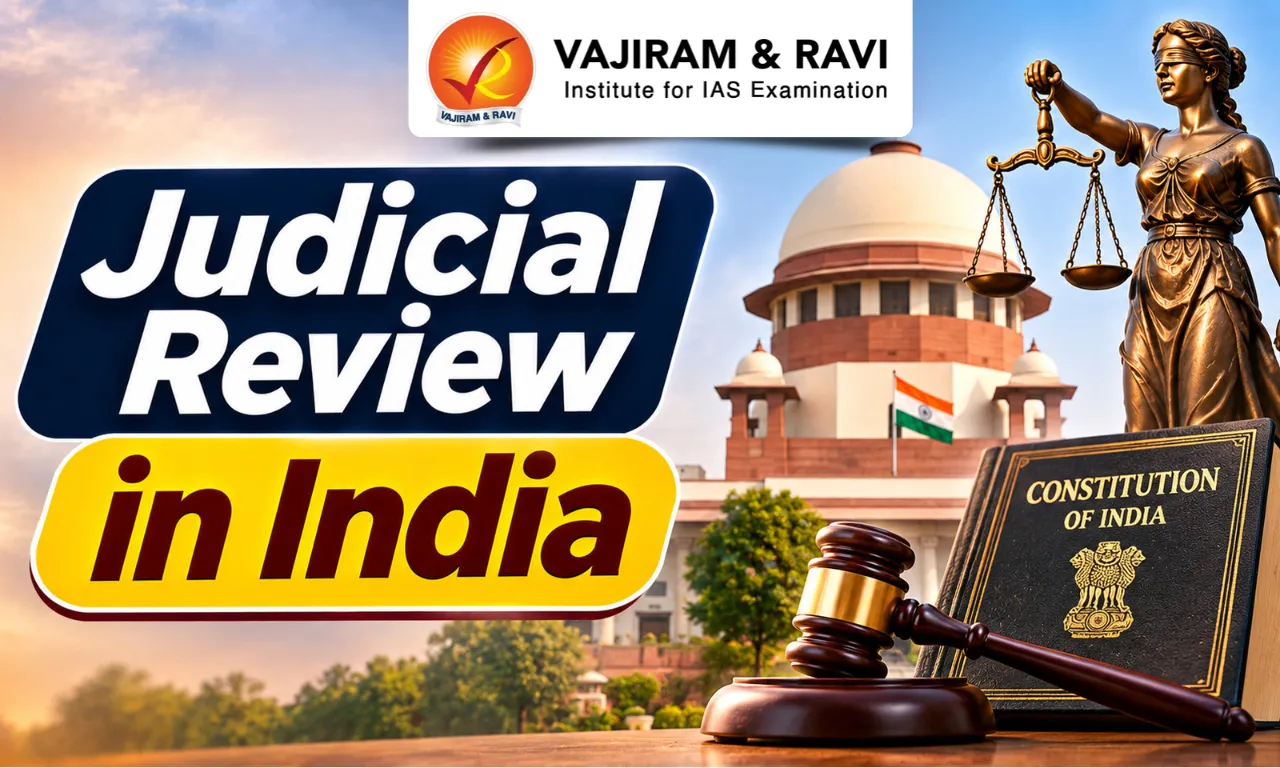
Judicial Review is the power of the judiciary to examine the constitutionality of legislative, executive, and administrative actions and acts as a guardian of the Constitution. In India, the Supreme Court and High Courts exercise judicial review to protect Fundamental Rights, uphold constitutional supremacy and maintain the balance of power among different organs of government.
The Constitution of India does not use the exact expression "Judicial Review" in a single provision. However, this power is derived from several constitutional provisions, particularly Articles 13, 32 and 226. Its significance lies in maintaining the rule of law, protecting individual liberties, ensuring checks and balances, and strengthening democracy.
Judicial Review Meaning
Judicial Review means the authority of the judiciary to review the constitutionality of legislative and executive actions. Courts assess whether a law or government decision is within the constitutional limits laid down for the legislature and executive.
Judicial Review Examples
Common examples of Judicial Review include:
- Striking down a law that violates the Right to Equality under Article 14.
- Reviewing an executive order that violates Article 21, the Right to Life and Personal Liberty.
- Examining whether a law falls within the legislative competence of Parliament or a State Legislature.
Judicial Review in India Evolution
The concept of Judicial Review evolved as a mechanism to ensure that governmental powers remain subject to constitutional limitations. The modern development of judicial review is closely associated with the United States.
- Roots in USA Judiciary: The landmark case of Marbury v. Madison (1803) established the principle that the US Supreme Court could examine the constitutionality of legislative acts and declare them unconstitutional.
- Constitutional Foundation: India adopted a written constitution featuring provisions like Article 13 (laws inconsistent with fundamental rights are void), Article 32, and Article 226 (writ jurisdiction).
- India also adopted the concept of judicial review inspired by the American Constitution.
- Early Judicial Development: In Shankari Prasad v. Union of India (1951), the Supreme Court examined the scope of Parliament's power to amend Fundamental Rights.
- In Sajjan Singh v. State of Rajasthan (1965), the Court reaffirmed this position.
- Expansion of Judicial Review (1967–1973): In I.C. Golaknath v. State of Punjab (1967), the Supreme Court held that Parliament could not amend Fundamental Rights. The judgment treated constitutional amendments as "law" for the purpose of Article 13.
- Basic Structure Doctrine: In Kesavananda Bharati v. State of Kerala (1973), the Supreme Court established that Parliament cannot alter the basic structure of the Constitution, strengthening judicial review.
- Further, in L. Chandra Kumar v. Union of India (1997), the Court held that judicial review under Articles 32 and 226 is part of the Basic Structure.
- Modern Judicial Activism: Through Public Interest Litigations (PILs) and relaxed rules on locus standi, the Indian judiciary expanded its role from passive review to active protection of rights and public governance.


Types of Judicial Review
Judicial Review in India can broadly be classified into three categories based on the nature of government action being examined.
- Review of Legislative Action: Courts examine whether laws passed by Parliament or State Legislatures violate the Constitution.
- Review of Executive Action: Courts examine whether government orders, notifications, and administrative decisions are constitutional and lawful.
- Review of Constitutional Amendments: Courts examine whether constitutional amendments destroy the Basic Structure of the Constitution.
Judicial Review in India Constitutional Provisions
The Constitution of India establishes a system of constitutional supremacy in which all organs of government must function within constitutional limits. The term 'judicial review' is not explicitly mentioned in the Constitution but derives its authority from different provisions.
- Article 13: Declares laws violating Fundamental Rights unconstitutional and void.
- Article 32: Empowers the Supreme Court of India to protect Fundamental Rights through writs.
- Article 136: Empowers the Supreme Court to hear appeals through Special Leave Petitions.
- Article 143: Allows the President to seek the Supreme Court's opinion on important legal and constitutional matters.
- Article 226: Empowers High Courts to issue writs for the protection of Fundamental Rights and other legal rights.
- Articles 245–246: Enable courts to examine whether laws are made within the legislative powers of Parliament and State Legislatures.
- Article 368: Gives Parliament the power to amend the Constitution, subject to the Basic Structure Doctrine.
Judicial Review and Basic Structure Doctrine
The Basic Structure Doctrine, established in Kesavananda Bharati (1973), limits Parliament’s power to amend the Constitution. It holds that Parliament cannot destroy the Constitution’s basic features, such as democracy, secularism, federalism, and judicial review. Judicial Review is itself considered part of the Basic Structure. This means Parliament cannot remove or dilute the power of courts to review laws and executive actions.
Judicial Review in the Ninth Schedule
The Ninth Schedule was added by the First Constitutional Amendment Act, 1951, to protect certain laws from judicial review on the ground of Fundamental Rights violations. However, in I.R. Coelho (2007), the Supreme Court held that laws added to the Ninth Schedule after 24 April 1973 can still be reviewed if they violate the Basic Structure.
Judicial Review of Supreme Court
The Supreme Court is the final interpreter of the Constitution and the highest court of Judicial Review in India. It can strike down laws, executive actions, and administrative decisions that violate constitutional provisions. The Supreme Court also has the power to review its own judgments under Article 137. This ensures that even the highest court can correct errors in its own decisions.
Judicial Review vs Judicial Activism
Judicial Review and Judicial Activism are two important concepts associated with the functioning of the judiciary. Although both involve judicial intervention, their scope and approach are different.
| Basis | Judicial Review | Judicial Activism |
|
Meaning |
Examination of the constitutional validity and legality of government actions. |
Proactive judicial approach to protect rights and address public issues. |
|
Objective |
Maintain constitutional supremacy. |
Ensure justice and protect public interest. |
|
Nature |
Constitutional power. |
Judicial approach or philosophy. |
|
Scope |
Examines legislative, executive and certain judicial actions through appropriate jurisdiction. |
Involves proactive interpretation and intervention within judicial jurisdiction. |
|
Approach |
Focuses on legality and constitutionality. |
May involve broader interpretation and proactive remedies. |
Judicial Review in India vs USA
Judicial Review is an important feature of both the Indian and American constitutional systems. However, there are differences in its constitutional foundations, scope and institutional framework.
| Feature | Udnite States (USA) | India |
|
Primary Origin |
Marbury v. Madison (1803), implied |
Explicit constitutional articles (Arts. 13, 32, 226) |
|
Standard |
Due Process of Law (Substantive & Procedural) |
Procedure Established by Law (evolved with substantive checks) |
|
Advisory Jurisdiction |
None |
Yes (Article 143) |
|
Special Tools |
Case/controversy suits |
Public Interest Litigation (PIL), Article 142 |
|
Key Limiting Doctrine |
Political Question / Separation of Powers |
Basic Structure Doctrine (Kesavananda Bharati) |
Judicial Review Supreme Court Cases
Different judgments by the Supreme Court helped in the evolution of the doctrine to ensure the protection of fundamental rights.
- Shankari Prasad v. Union of India (1951): It established the role of the judiciary in examining the laws made by Parliament.
- Golaknath v. State of Punjab (1967): It held that Parliament cannot amend Fundamental Rights, thus strengthening judicial review.
- Kesavananda Bharati v. State of Kerala (1973): The Supreme Court established the Basic Structure Doctrine, holding that while Parliament can amend any part of the Constitution, it cannot alter or destroy its basic and essential features. Judicial review itself was recognised as a core part of this basic structure.
- Minerva Mills v. Union of India (1980): It reaffirmed the Basic Structure Doctrine and declared that the limited power of amendment is itself a basic feature of the Constitution.
- L. Chandra Kumar v. Union of India (1997): The Supreme Court ruled that the power of judicial review vested in the High Courts (Article 226/227) and the Supreme Court (Article 32) is an integral, non-negotiable part of the basic structure of the Constitution. Provisions trying to exclude their jurisdiction were struck down.
- I.R. Coelho v. State of Tamil Nadu (2007): It made Ninth Schedule laws inserted after 24 April 1973 subject to judicial review if they violate the Basic Structure.
Judicial Review Significance
Judicial Review is one of the essential components of democratic governance, protecting rights and ensuring separation of powers.
- Protection of Fundamental Rights: Judicial review enables courts to protect citizens against laws and government actions that violate Fundamental Rights. For example, Article 32 and Article 226 provide constitutional remedies for enforcing Fundamental Rights.
- Upholds Constitutional Supremacy: The Constitution is the supreme law of India. Judicial review ensures that Parliament, State Legislatures and the executive cannot exercise powers beyond constitutional limits
- Maintains Checks and Balances: The Constitution distributes powers among the legislature, executive and judiciary. Judicial review ensures that one organ does not exercise arbitrary or unconstitutional authority over others.
- Protects the Basic Structure: The Basic Structure Doctrine prevents Parliament from destroying the essential identity of the Constitution through constitutional amendments.
- Strengthens Federalism in India: India follows a federal system with a constitutional distribution of powers between the Union and the States. Judicial review helps resolve disputes involving legislative competence and protects the constitutional division of powers.
- Promotes Rule of Law: It ensures that government authorities act according to law and remain accountable for unconstitutional or unlawful actions. It reinforces the principle that no individual or institution is above the Constitution.
Judicial Review Limitations
While judicial review is crucial for constitutional governance, several institutional and structural issues limit its effectiveness.
- Judicial Delays: A large number of pending cases in Indian courts can delay the delivery of justice. Close to 97,000 cases in the Supreme Court and over 65,00,000 cases in High Courts are pending.
- Judicial Overreach: Courts may sometimes enter into areas falling within the domain of the Legislature and Executive. Excessive judicial intervention can disturb the separation of powers.
- Lack of Direct Accountability: Judges are not directly elected by citizens. Therefore, critics argue that extensive judicial intervention in policy matters may raise questions about democratic accountability.
- Complex Legal Procedures: Lengthy and expensive court procedures make judicial review difficult for ordinary citizens.
- Policy Implementation Challenges: Courts can strike down unconstitutional decisions but may lack the administrative capacity to ensure effective implementation.
Judicial Review Way Forward
Addressing the limitations, a careful and restrained approach is required by the judiciary to uphold constitutional morality and safeguard separation of powers.
- Reduce Judicial Pendency: Fill judicial vacancies and improve court infrastructure to ensure timely justice.
- Maintain Separation of Powers: The judiciary should exercise restraint and respect the policy-making domains of the Legislature and Executive.
- Promote Judicial Accountability: Strengthen transparency in judicial appointments and functioning while protecting judicial independence.
- Promote Consistency: Encourage clear legal reasoning and consistent interpretation of constitutional provisions.
- Use Technology: Expand e-courts, virtual hearings, and digital case-management systems to improve efficiency.
- Encourage Constitutional Dialogue: Promote cooperation and constructive engagement among the Legislature, Executive and Judiciary.
Judicial Review UPSC PYQs
Q1: What was held in the Coelho case? In this context, can you say that judicial review is of key importance amongst the basic features of the Constitution? (UPSC 2016)
Q2: Consider the following statements: (UPSC 2020)
- The Constitution of India defines its ‘basic structure’ in terms of federalism, secularism, fundamental rights and democracy.
- The Constitution of India provides for ‘judicial review’ to safeguard the citizens’ liberties and to preserve the ideals on which the Constitution is based.
Which of the statements given above is/are correct?
(a) 1 only
(b) 2 only
(c) Both 1 and 2
(d) Neither 1 nor 2
Ans: (b)

 Last updated on Nov, 2026
→ UPSC Interview 2026 is scheduled from 7 December 2026 to 12 February 2027.
→ UPSC Interview Guidance Programme (IGP) 2026 by Vajiram & Ravi helps aspirants prepare confidently for the UPSC Personality Test.
→ UPSC DAF 2026 application form is available from 11 to 25 November 2026, till 6:00 PM.
→ UPSC 2027 Notification will be released on 13 January 2027 at upsconline.nic.in.
→ Download PIB PRiSM Monthly Magazine 2026 here.
→ Check UPSC Monthly Current Affairs Magazine The Recitals here.
→ Check out the latest UPSC Syllabus here.
→ UPSC Calendar 2027 has been released.
→ Enroll in Vajiram & Ravi’s UPSC Mains Test Series 2027 for structured answer writing practice, expert evaluation, and exam-oriented feedback.
→ Join Vajiram & Ravi’s UPSC Mentorship Program 2027 for personalized guidance, strategy planning, and one-to-one support from experienced mentors.
→ Go through the UPSC Mains Previous Year Papers to enhance your preparation.
→ UPSC has released UPSC Toppers List 2025 with the Civil Services final result on its official website.
→ Also check Best UPSC Coaching in India
Judicial Review FAQs
Q1. What is judicial review in simple terms?+
Q2. Is Article 137 judicial review?+
Q3. What was the first case of judicial review in India?+
Q4. What are the three main types of judicial review?+
Q5. Who can do judicial review in India?+
Tags: judicial review quest UPSC Polity Notes