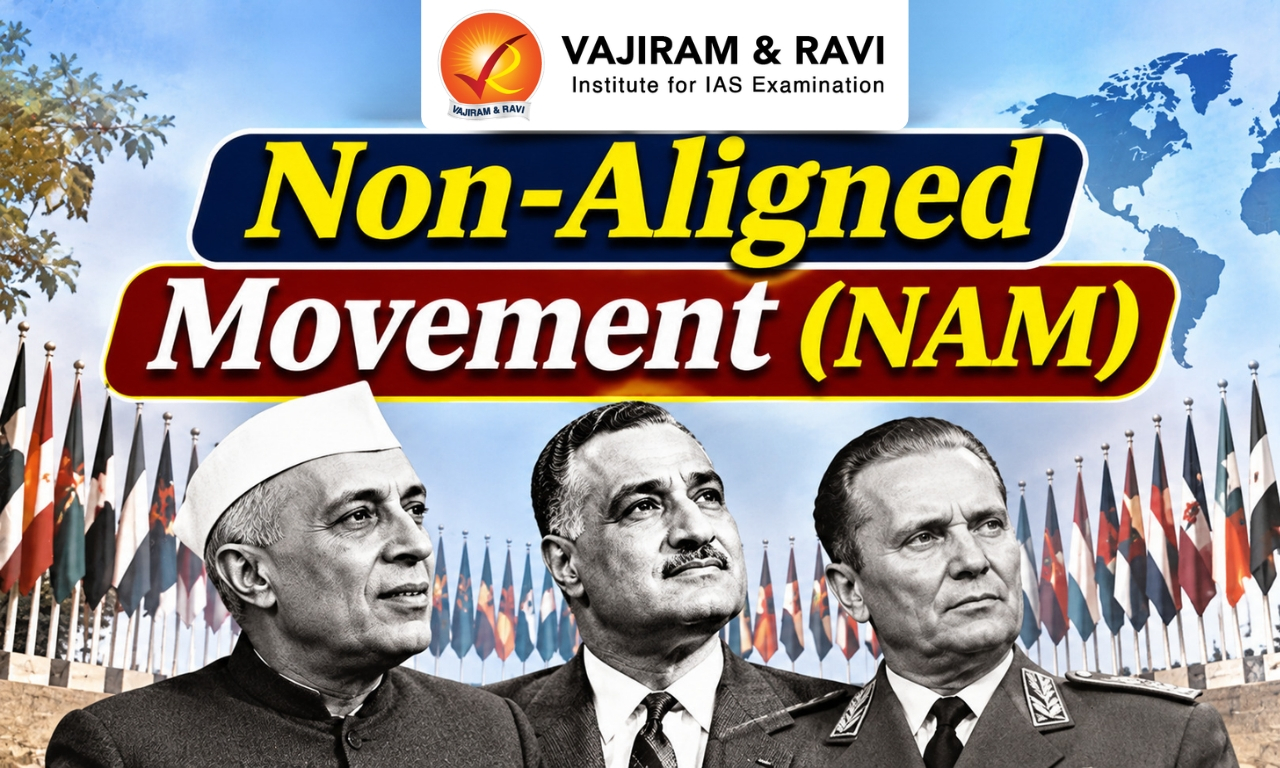
Non-Aligned Movement (NAM), established in 1961 at the Belgrade Summit, is an international grouping of countries that sought to maintain strategic autonomy by avoiding alignment with the US-led and Soviet-led blocs during the Cold War. Founded by leaders such as Jawaharlal Nehru, Josip Broz Tito, Gamal Abdel Nasser, Sukarno, and Kwame Nkrumah, it currently comprises 120 member states.
NAM played a significant role in promoting decolonisation, peaceful coexistence, sovereignty, and the interests of developing countries through South-South cooperation. However, its relevance has faced challenges due to divergent national interests, declining collective influence, geopolitical rivalries, and the emergence of new global power alignments.
Non-Aligned Movement About
The Non-Aligned Movement (NAM) is an international forum of developing countries that sought to maintain independence in foreign policy without formally aligning with major power blocs. The Movement was formally established at the First NAM Summit in Belgrade, Yugoslavia, in September 1961, with 25 participating countries.
- Historical Origin: Its foundations were laid at the Bandung Conference (1955) in Indonesia, which promoted Afro-Asian solidarity, decolonisation, and peaceful coexistence.
- Founders: Jawaharlal Nehru (India), Josip Broz Tito (Yugoslavia), Gamal Abdel Nasser (Egypt), Sukarno (Indonesia), and Kwame Nkrumah (Ghana).
- Nature: It is a movement rather than a formal international organisation, with no permanent headquarters, founding treaty, or permanent secretariat.
- Chairmanship: Uganda currently holds the chairmanship for 2024–2027, following the 19th NAM Summit in Kampala in January 2024.
Non-Aligned Movement History
The Non-Aligned Movement emerged during the Cold War as newly independent Asian and African countries sought to protect their sovereignty and pursue an independent foreign policy without joining either superpower bloc.
- Post-World War II Context (1945): The emergence of the US-led capitalist bloc and Soviet-led communist bloc created Cold War rivalries, prompting newly independent countries to seek an alternative to military alliances.
- Panchsheel Principles (1954): India and China adopted the Five Principles of Peaceful Coexistence, providing an important philosophical foundation for non-alignment.
- Bandung Conference (1955): The Afro-Asian Conference held in Indonesia brought together 29 countries to promote decolonisation, racial equality, sovereignty and peaceful coexistence. It laid the foundation for NAM.
- Preparatory Meeting (1961): A preparatory conference was held in Cairo, Egypt, from 5–12 June 1961, to establish the criteria and objectives of non-alignment.
- Belgrade Summit (1961): The first NAM Summit was held in Belgrade, Yugoslavia, from 1–6 September 1961, with 25 participating countries, formally establishing the movement.
- Expansion during the 1970s: NAM expanded significantly as more countries in Asia, Africa and Latin America gained independence, increasingly emphasising economic cooperation and a New International Economic Order (NIEO).
- Post-Cold War Phase (1991 onwards): Following the dissolution of the Soviet Union, NAM shifted its focus towards globalisation, disarmament, development cooperation, multilateralism and reform of international institutions.


Non-Aligned Movement Objectives
The Non-Aligned Movement aims to safeguard the political independence of member countries, promote international peace and strengthen the collective voice of developing nations in global affairs.
- Strategic Autonomy: To enable countries to pursue an independent foreign policy without becoming aligned with major power blocs or their geopolitical rivalries.
- Sovereignty and Territorial Integrity: To protect the independence, sovereignty and territorial integrity of all nations against external interference and domination.
- International Peace: To promote peaceful coexistence, diplomatic dialogue and peaceful settlement of international disputes while opposing the use or threat of force.
- Anti-Colonialism: To oppose colonialism, imperialism, neo-colonialism, apartheid and racial discrimination while supporting national liberation movements.
- Disarmament: To advocate global nuclear disarmament, arms control and the establishment of nuclear-weapon-free zones to strengthen international security.
- Economic Cooperation: To promote South-South cooperation, equitable international trade and a fairer global economic order that addresses the developmental concerns of poorer countries.
- Development and Equality: To reduce economic inequalities between developed and developing countries through cooperation in technology, education, health and sustainable development.
Non-Aligned Movement Principles
The Non-Aligned Movement is guided by principles of sovereign equality, peaceful coexistence, non-interference, and international cooperation, based on the UN Charter and international law.
- Non-Interference: It rejects external intervention, regime change, unconstitutional changes of government, and coercive measures against the sovereign rights of other countries.
- Peaceful Coexistence: Promotion of dialogue, diplomacy, and peaceful settlement of international disputes in accordance with the UN Charter, while rejecting aggression and the use of force.
- Self-Determination: The Movement supports the right of peoples to determine their political, economic, social and cultural systems, free from colonialism, foreign occupation and external domination.
- Human Rights and Democracy: It promotes human rights, fundamental freedoms, democracy, religious tolerance and rejection of genocide, war crimes, terrorism and crimes against humanity.
- Multilateralism and Solidarity: The Movement strengthens the United Nations (UN) and multilateral institutions, promoting international cooperation and solidarity, and respecting the political, economic and cultural diversity of nations.
Non-Aligned Movement Structure
Non-Aligned Movement does not have a formal constitution, permanent headquarters, or permanent secretariat. It follows a decentralised and rotational structure, with decisions generally taken through consensus.
- Summit of Heads of State and Government: The highest decision-making body, held ordinarily once every three years to review progress, discuss global challenges, and adopt collective declarations.
- Ministerial Meetings: Foreign Ministers meet periodically to review the implementation of summit decisions, coordinate foreign policy positions and prepare for subsequent summits.
- Chairmanship: The Chair rotates among member countries on a regional basis, with the host country of the summit assuming the chairmanship for the next three years.
- Coordinating Bureau: It is based at the United Nations in New York; it serves as the principal coordinating body, facilitating cooperation among member states and coordinating their positions in UN forums.
- Troika: It consists of the previous, current, and incoming chair countries, providing continuity and assistance to the incumbent chair.
- Working Groups and Committees: It addresses specific issues such as UN reforms, disarmament, human rights, and peacekeeping, while coordinating common positions among member states.
Non-Aligned Movement Members
The Non-Aligned Movement has expanded from its original 25 founding members in 1961 to 121 member states, representing countries across Africa, Asia, Europe, Latin America and the Caribbean.
- Total Membership: 121 member states, according to the 19th Mid-Term Ministerial Conference document (October 2025).
- Regional Distribution: Members are spread across Africa, Asia, Europe, Latin America and the Caribbean.
- Founding Members: 25 countries participated in the first NAM Summit at Belgrade in 1961.
- Observer Countries: Countries such as Brazil, China, Mexico and Serbia participate as observers rather than full members.
- Observer Organisations: Organisations such as the African Union also participate in NAM deliberations.
- India's Membership: India is a founding member and has played a significant role in shaping NAM's principles and agenda.
Non-Aligned Movement Summit
The Non-Aligned Movement (NAM) conducts periodic summits of Heads of State and Government, generally once every three years, to review global developments, strengthen cooperation, and formulate common positions on international issues.
- Belgrade Summit (1961): It formally established NAM with 25 participating countries, emphasising independence from Cold War power blocs.
- Algiers Summit (1973): It strengthened the movement's focus on economic cooperation and the demand for a New International Economic Order (NIEO).
- Colombo Summit (1976): It emphasised economic cooperation, disarmament and the interests of developing countries.
- New Delhi Summit (1983): It focused on disarmament, international peace, economic inequality and the concerns of developing countries.
- Havana Summit (2006): It reaffirmed NAM's founding principles and its relevance in the changing international order.
- Kampala Summit (2024): The 19th Summit was held on 19–20 January 2024 under the theme "Deepening Cooperation for Shared Global Affluence". Uganda assumed the chairmanship for 2024–2027.
Non-Aligned Movement and India
India has been one of the founding members and principal architects of the Non-Aligned Movement (NAM). Under Jawaharlal Nehru's leadership, India advocated an independent foreign policy based on strategic autonomy, peaceful coexistence, and opposition to colonialism and Cold War bloc politics.
- Founding Leadership: India, under Jawaharlal Nehru, played a pivotal role in establishing NAM in 1961 alongside leaders such as Tito, Nasser, Sukarno, and Nkrumah.
- Panchsheel Principles: India and China articulated the Five Principles of Peaceful Coexistence in 1954, which influenced the ideological foundation of NAM.
- Anti-Colonialism: India actively supported decolonisation, national liberation movements and the struggle against apartheid, giving voice to newly independent countries.
- Strategic Autonomy: India promoted an independent foreign policy by maintaining relations with both the US and the Soviet Union without formally joining either Cold War bloc.
- Leadership of NAM: India hosted the 7th NAM Summit in New Delhi in March 1983, under Prime Minister Indira Gandhi, focusing on disarmament, peace, and a more equitable international economic order.
- South-South Cooperation: India used NAM to advocate economic justice, technology transfer, development cooperation, and reforms in the global economic system.
Non-Aligned Movement Challenges
Despite its role in promoting strategic autonomy and cooperation among developing countries, the Non-Aligned Movement faces several challenges that have weakened its relevance and effectiveness in contemporary international relations.
- Declining Relevance: The end of the Cold War reduced the ideological and geopolitical basis of non-alignment, raising questions about NAM's contemporary relevance.
- Internal Differences: Divergent political systems, economic interests, and foreign policy priorities among member countries hinder collective decision-making.
- Great Power Rivalry: Increasing US-China competition and renewed geopolitical tensions make it difficult for members to maintain an independent position.
- Lack of Institutional Strength: The absence of a permanent secretariat, binding mechanisms, and effective enforcement powers limits the implementation of NAM decisions.
- Divergent National Interests: Bilateral partnerships and strategic alignments with major powers often take precedence over collective NAM commitments.
- Limited Global Influence: NAM has struggled to translate its declarations into concrete outcomes on issues such as global conflicts, economic inequalities, climate change, and international governance.
Non-Aligned Movement Recent Developments
The Non-Aligned Movement has increasingly focused on strengthening multilateralism, reforming global governance, and addressing contemporary challenges such as geopolitical rivalries, climate change, economic inequalities, and the interests of the Global South.
- 19th NAM Summit (2024): The 19th Summit was held in Kampala, Uganda (19–20 January 2024), under the theme “Deepening Cooperation for Shared Global Affluence”. Uganda assumed the chairmanship for 2024–2027.
- 19th Mid-Term Ministerial Meeting (2025): Held in Kampala on 15–16 October 2025 to review the implementation of the 2024 Summit outcomes and strengthen cooperation among member states.
- Focus on Palestine: The 2025 ministerial meeting adopted a Political Declaration on Palestine, reaffirming NAM's support for Palestinian rights and its longstanding position on the issue.
- Venezuela Issue (2026): Uganda, representing NAM, condemned the reported US military action against Venezuela at an emergency UN Security Council meeting on 5 January 2026, invoking sovereignty and international law.
Non-Aligned Movement Way Forward
The future relevance of NAM depends on its ability to move beyond traditional non-alignment and emerge as an effective platform for collective action in an increasingly multipolar world.
- Relevance in a Multipolar World: Reposition NAM as a platform for strategic autonomy, enabling members to engage with major powers without becoming dependent on any single power bloc.
- Institutional Reforms: Strengthen coordination mechanisms, establish a permanent secretariat, and improve follow-up on summit declarations.
- Unity Among Members: Build consensus on common priorities while accommodating differences in political systems and national interests.
- Global South Leadership: Strengthen collective bargaining on issues such as debt distress, trade inequalities, technology access, and climate finance.

 Last updated on Nov, 2026
→ UPSC Mains Result 2026 has been declared on 05 November 2026 at the official website at upsc.gov.in.
→ UPSC 2027 Notification will be released on 13 January 2027 at upsconline.nic.in.
→ Check Nobel Prize 2026 Winners List here.
→ Download PIB PRiSM Monthly Magazine 2026 here.
→ Check UPSC Monthly Current Affairs Magazine The Recitals here.
→ Check out the latest UPSC Syllabus here.
→ Download UPSC Model Answers for Mains 2026
→ UPSC Mains Question Paper 2026 is out now for Essay & GS Paper 1, 2, 3 & 4.
→ UPSC Calendar 2027 has been released.
→ Enroll in Vajiram & Ravi’s UPSC Mains Test Series 2027 for structured answer writing practice, expert evaluation, and exam-oriented feedback.
→ Join Vajiram & Ravi’s UPSC Mentorship Program 2027 for personalized guidance, strategy planning, and one-to-one support from experienced mentors.
→ Go through the UPSC Mains Previous Year Papers to enhance your preparation.
→ UPSC has released UPSC Toppers List 2025 with the Civil Services final result on its official website.
→ Also check Best UPSC Coaching in India
Non-Aligned Movement FAQs
Q1. What was the Non-Aligned Movement (NAM)?+
Q2. Who introduced the Non-Aligned Movement?+
Q3. Does the NAM still exist?+
Q4. What is the aim of NAM?+
Q5. Which countries are under NAM?+
Tags: non-aligned movement quest UPSC Post-Independence India Notes