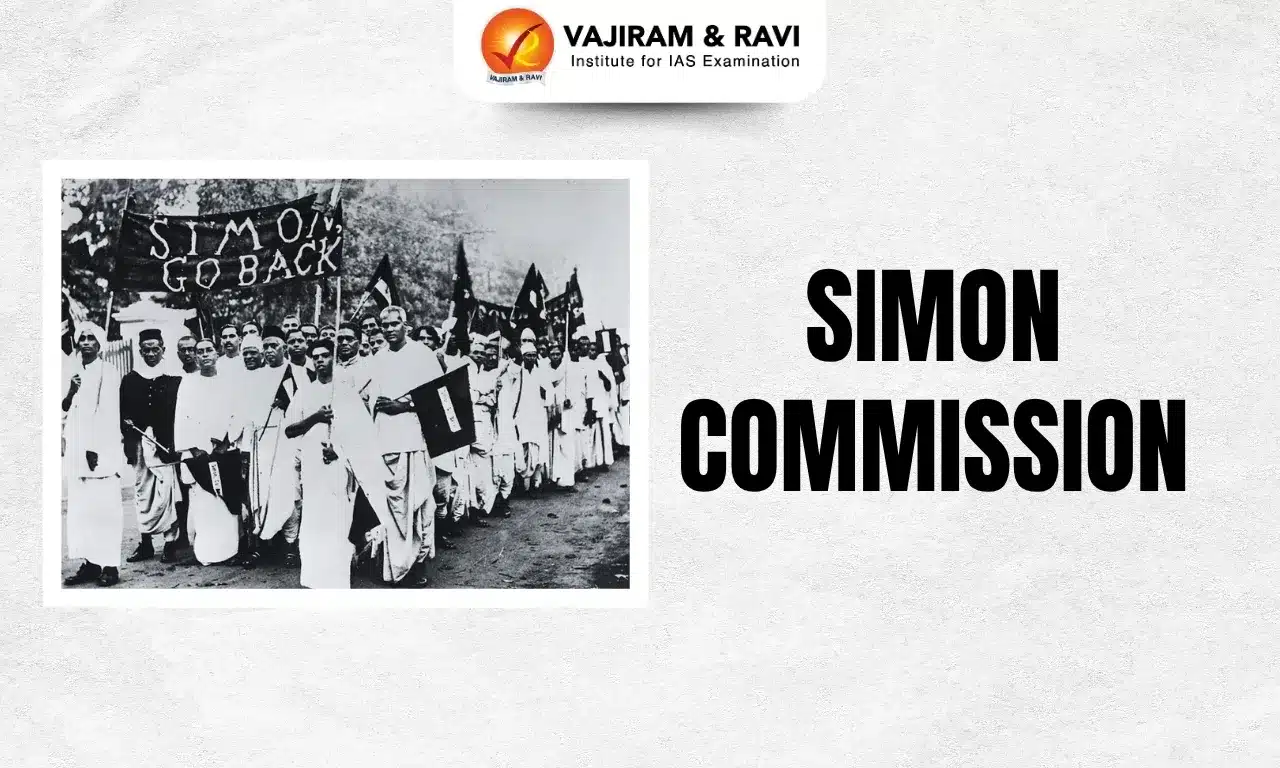
The Simon Commission (Indian Statutory Commission), formed by the British in 1927 to review the Government of India Act 1919, sparked widespread protests due to its all-British composition. Arriving in India in 1928, it was met with protests, including the iconic "Simon Go Back" demonstrations. The commission aimed to evaluate the Act, recommend reforms, and address communal representation and law and order.
However, the lack of Indian representation in the Simon Commission led to its boycott, driving nationalist sentiment. The protests influenced key developments like the Nehru Report and intensified demands for Indian self-governance, fostering new leaders and strengthening the independence movement.
Simon Commission 1927 About
The Simon Commission, officially known as the Indian Statutory Commission, was established by the British government in 1927 to review the Government of India Act 1919 and recommend constitutional reforms.
- Simon Commission Chairman: The commission was chaired by Sir John Simon and included seven British members, sparking controversy and anger in India due to the lack of Indian representation.
- Simon Commission Members: Sir John Simon (Chairman), Clement Attlee, Harry Levy-Lawson, Edward Cadogan, George Lane-Fox, Vernon Hartshorn, and Donald Howard.
- Simon Commission Date and Year: The Commission was constituted on November 8, 1927; arrived in India on February 3, 1928; and presented its final report on May 27, 1930.
Simon Commission Arrival
The Simon Commission arrived in Bombay, India, on 3rd February 1928, triggering widespread protests and public outrage. Demonstrations were organised by various political factions, including the Indian National Congress and a faction of the Muslim League led by Mohammed Ali Jinnah, both of which decided to boycott the commission. Reception in India took place with the following:
- Nationwide Protests: The commission's arrival was met with massive protests across India, with Indians expressing their opposition through strikes and demonstrations.
- Black Flag Demonstrations: Protesters carried black flags and shouted "Simon Go Back", symbolising their rejection of the commission and its exclusionary practices.
- The slogan “Simon Go Back” was coined by freedom fighter Yusuf Meherally.
- Students and youth were at the forefront of the protests, demonstrating their commitment to the cause of Indian independence.
Simon Commission Purpose
The purpose of the Commission was to evaluate the Government of India Act 1919, recommend constitutional reforms, address communal representation, and assess law and order amidst rising nationalist movements.
- Evaluate the Government of India Act 1919: The commission aimed to assess the functioning of the diarchy, where certain provincial responsibilities were divided between Indian ministers and British officials.
- Recommend Constitutional Reforms: It sought to propose constitutional changes that could address governance issues and Indian demands while maintaining British control.
- Address Communal Representation: The commission aimed to evaluate and propose solutions for communal representation, a contentious issue in British India.
- Assess Law and Order: The commission was tasked with reviewing the law and order situation in light of growing nationalist movements.


Simon Commission Criticism
The Commission faced criticism for lacking Indian representation, leading to a limited understanding of India's needs, and for prioritising colonial authority over genuine reforms. The absence of Indian members meant the commission lacked a genuine understanding of India's political climate and needs. Critics argued that the commission's purpose was more about preserving colonial authority than offering meaningful reforms.
Simon Commission Boycott
The boycott of the Commission was driven by several factors, such as the absence of Indian representation, lack of genuine reforms, and a boycott call by leaders, including the INC, at the 1927 Madras session chaired by M.A. Ansari.
- Absence of Indian Representation: The commission did not include any Indian members, which was perceived as a clear disregard for Indian political aspirations and a sign of British indifference to Indian demands for self-governance.
- Lack of Genuine Reforms: Many Indians viewed the commission as a tactic to delay substantial constitutional reforms and maintain British control over India, especially after the limited changes introduced by the Government of India Act 1919.
- Call for Boycott by Leaders: Indian political leaders, including members of the Indian National Congress (INC), called for a nationwide boycott, mobilizing the public to protest against the commission. The decision was made in 1927 during the Madras INC session, which was chaired by M.A. Ansari.
Major Protest Events
The Lahore Protest, led by Lala Lajpat Rai, saw brutal police action and his death, intensifying resistance and nationalist sentiment among students and the youth.
- Lahore Protest (30th October 1928): In Lahore, a significant protest led by Lala Lajpat Rai resulted in brutal police action, leading to Rai's death on 17th November 1928 and intensifying resistance against the commission.
- Student and Youth Protests: The involvement of students and youth highlighted the growing nationalist sentiment and the widespread demand for change.
Simon Commission Impacts
The Simon Commission significantly impacted India's independence movement, leading to the Nehru Report advocating dominion status and secular democracy, influencing the Government of India Act 1935, uniting the opposition, fostering new leaders, and intensifying demands for self-governance.
- Nehru Report: The Nehru Report (1928), formulated in response to the Simon Commission, proposed a new constitutional framework emphasising self-governance and democratic principles.
- The report called for dominion status within the British Commonwealth, marking a shift in political demands.
- It advocated for a secular and democratic framework, rejecting communal representation.
- Influence on Future Reforms: The Simon Commission's impact extended to future constitutional reforms, including the Government of India Act 1935.
- Provincial Autonomy: The Act of 1935 abolished dyarchy, introduced provincial autonomy, and instituted bicameralism in six of the eleven provinces, granting more powers to Indian ministers and legislatures.
- Criticism: Despite reforms, the Act was criticised for not granting full self-governance, leading to continued demands for independence.
- Emergence of New Leaders: The opposition to the Simon Commission provided a platform for new leaders and movements to emerge, contributing to the broader struggle for independence.
- Prominent Leaders: Figures like Bhagat Singh gained prominence for their activism and resistance against colonial rule.
- Legacy of Resistance: The opposition inspired a new generation of leaders and activists to continue the fight for independence.
- Strengthening of Independence Movement: The Simon Commission played a crucial role in strengthening the Indian independence movement, uniting diverse groups in their demand for self-rule.
- Unified Opposition: The boycott united various Indian political parties, including the Indian National Congress and the All India Muslim League, fostering a sense of national solidarity against colonial rule.
- Catalyst for Change: The commission acted as a catalyst for change, intensifying demands for independence and self-governance.
Simon Commission Outcome
The Simon Commission Report, published in 1930, advocated removing dyarchy in the provinces and establishing provincial autonomy while preserving considerable discretionary powers for Governors.
- It envisioned a future federal form but did not endorse responsible government at the centre or explicitly commit to Dominion Status. The study was generally rejected by Indian political organisations, fuelling nationalist hostility.
- Its proposals, however, served as a solid foundation for following constitutional deliberations, including the Round Table Conferences, and eventually influenced numerous parts of the Government of India Act of 1935.
Simon Commission UPSC PYQs
Q1: Evaluate the circumstances that led to the appointment of the Simon Commission. Why did its arrival trigger widespread protest across India? (UPSC Mains 2011)
Q2: With reference to Rowlatt Satyagraha, which of the following statements is/are correct? (UPSC Prelims 2013)
- The Rowlatt Act was based on the recommendations of the 'Sedition Committee'.
- In Rowlatt Satyagraha, Gandhiji tried to utilize the Home Rule League.
- Demonstrations against the arrival of Simon Commission coincided with Rowlatt Satyagraha.
Select the correct answer using the code given below:
(a) 1 only
(b) 1 and 2 only
(c) 2 and 3 only
(d) 1, 2 and 3
Ans: (b)
Q3: The people of India agitated against the arrival of Simon Commission because (UPSC Prelims 2013)
(a) Indians never wanted the review of the working of the Act of 1919.
(b) Simon Commission recommended the abolition of Dyarchy (Diarchy) in the provinces.
(c) There was no Indian member in the Simon Commission.
(d) The Simon Commission suggested the partition of the country.
Ans: (c)
Q4: With reference to Simon Commission’s recommendations, which one of the following statement is correct? (UPSC Prelims 2010)
(a) It recommended the replacement of diarchy with responsible government in the provinces.
(b) It proposed the setting up of interprovincial council under the Home Department.
(c) It suggested the abolition of bicameral legislature at the centre.
(d) It recommended the creation of Indian Police Service with a provision for increased pay and allowances for British recruits as compared to Indian recruits.
Ans: (a)

 Last updated on Oct, 2026
→ UPSC 2027 Notification will be released on 13 January 2027 at upsconline.nic.in.
→ Check Nobel Prize 2026 Winners List here.
→ Download PIB PRiSM Monthly Magazine 2026 here.
→ Check UPSC Monthly Current Affairs Magazine The Recitals here.
→ Check out the latest UPSC Syllabus here.
→ Download UPSC Model Answers for Mains 2026
→ UPSC Mains Question Paper 2026 is out now for Essay & GS Paper 1, 2, 3 & 4.
→ UPSC Calendar 2027 has been released.
→ Enroll in Vajiram & Ravi’s UPSC Mains Test Series 2027 for structured answer writing practice, expert evaluation, and exam-oriented feedback.
→ Join Vajiram & Ravi’s UPSC Mentorship Program 2027 for personalized guidance, strategy planning, and one-to-one support from experienced mentors.
→ Go through the UPSC Mains Previous Year Papers to enhance your preparation.
→ UPSC has released UPSC Toppers List 2025 with the Civil Services final result on its official website.
→ Also check Best UPSC Coaching in India
Simon Commission FAQs
Q1. Why was the Simon Commission constituted in 1927?+
Q2. When did the Simon Commission arrive in India?+
Q3. Why was the Simon Commission boycotted?+
Q4. Did Ambedkar support the Simon Commission?+
Q5. Who gave the slogan "Simon go back"?+
Tags: quest simon commission upsc modern history notes