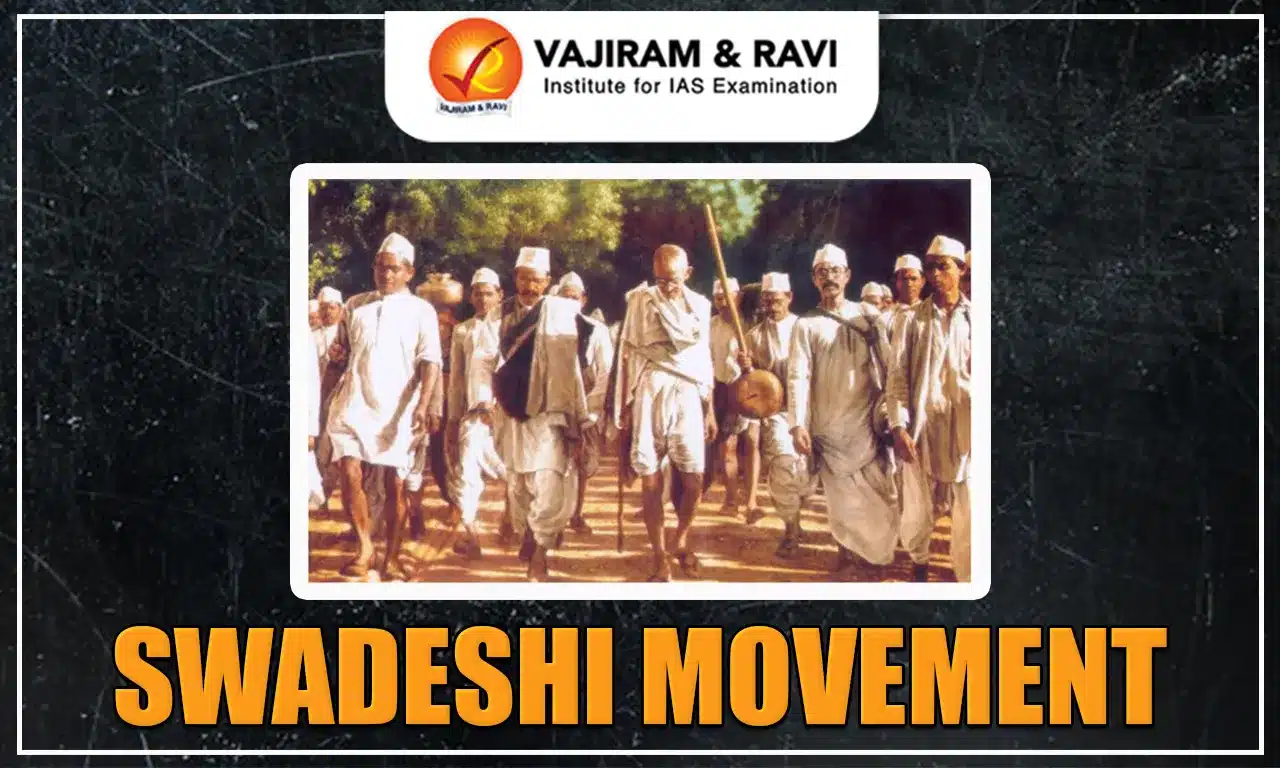
The Swadeshi Movement, which emerged at the beginning of the 20th century, stands as a momentous chapter in India's relentless struggle for independence. It began around 1905 when the partition of Bengal was proposed, an event that catalysed this movement. This period marked a pivotal juncture in India's history, as the Swadeshi movement not only ignited a powerful nationalist sentiment but also nurtured a resolute spirit of self-reliance among the Indian populace.
By using strategies like boycotts and Swadeshi goods, the movement aimed to challenge the dominance of British imperialism. At the same time, it worked towards nurturing and highlighting a unique Indian identity.
Partition of Bengal and Swadeshi Movement
The Swadeshi Movement began as a radical response to the Partition of Bengal (1905) implemented by Lord Curzon. While officially justified for administrative efficiency, the move was strategically intended to weaken the centre of Indian nationalism and divide Hindus and Muslims.
- Reactionary Legislation: Curzon’s administration passed several restrictive measures, including the Calcutta Corporation Act (1899) and the Universities Act (1904), which curbed local control and fueled extremist sentiments.
- Rise of Extremism: The perceived failure of Moderate methods to achieve major reforms led leaders like Bal Gangadhar Tilak and Lala Lajpat Rai to advocate for Swaraj (complete independence) through bolder means.
- Immediate Trigger: The enforcement of partition on October 16, 1905, was observed as a day of mourning, catalyzing a nationwide political awakening. This background shifted the national struggle toward the boycott of foreign goods and the promotion of indigenous industries and National Education.
Swadeshi Movement and Boycott Movement History
The Boycott Movement was first proposed in Krishnakumar Mitra’s Sanjivani on July 13, 1905, and was officially adopted at the Calcutta Town Hall meeting on August 7, 1905, as an economic and political weapon against the Bengal Partition. Supported by leaders like Rabindranath Tagore and Ramendra Sunder Trivedi through symbolic observances of Raksha-Bandhan and Arandhan, the movement successfully transformed local anti-partition protests into a massive national non-cooperation struggle.
- Foreign Goods Boycott: Target items like Manchester cloth and Liverpool salt were publicly burned in bonfires; domestic boycott extended to foreign bangles, sugar, and utensils. Swadeshi encouraged citizens to buy locally made products as a patriotic duty and became synonymous with the nation's economic self-sufficiency.
- Social Boycott: Involved picketing shops and ostracizing consumers of foreign products; service providers like barbers and washermen frequently refused to serve those dealing in British goods.
- Institutional Boycott: Students abandoned government schools, triggering national education initiatives like Bengal National College; activists also boycotted colonial courts and administrative bodies.
- Mass Mobilization: Outfits like Swadesh Bandhab Samiti spread the movement to rural areas using traditional folk theater, festivals, etc.
- Cultural Mobilization: Traditional folk theater and the mass singing of "Vande Mataram" were utilized to build community consensus against colonial authority.


Swadeshi Movement Objectives
The main aim of the Swadeshi movement, launched in 1905, was to achieve economic self-reliance and protest British colonial policies—specifically the partition of Bengal—by boycotting foreign goods and promoting Indian-made alternatives.
- Boycott British Goods: To harm the British economy, Indians avoided buying foreign products such as clothing, salt, and sugar.
- Promote Indigenous Products: The campaign urged people to purchase native goods, such as handspun cloth (Khadi) and items created in Indian factories.
- Build Self-Reliance: Communities strived for Atma Shakti (self-power) by relying on local resources rather than imported goods.
Swadeshi Movement Leaders
Swadeshi Movement mobilized leaders across ideological and regional lines, using passive resistance, economic boycott, national education, and cultural symbols to unite the nation against British colonial rule.
- Moderate Leaders: Surendranath Banerjea organized early constitutional petitions, press campaigns, and public meetings against partition.
- Extremist Leaders (Lal-Bal-Pal): Bal Gangadhar Tilak led Maharashtra via Ganpati festivals; Bipin Chandra Pal galvanized Bengal through radical oratory; Lala Lajpat Rai spearheaded Punjab agitations.
- Aurobindo Ghosh: Formulated the ideology of passive resistance, self-reliance, and national education.
- Rabindranath Tagore: Tagore inspired the masses through patriotic songs (Amar Sonar Bangla) and organizing Raksha-Bandhan for unity.
- Regional Leaders:
- V. O. Chidambaram Pillai: He led the movement in the Madras Presidency and launched the indigenous Swadeshi Steam Navigation Company.
- Syed Haider Raza: Raza popularized the boycott movement and resistance in Delhi.
- Ajit Singh: He co-led agrarian protests and nationalist campaigns in Punjab.
Swadeshi Movement Approach of Nationalists
During the Swadeshi Movement, Indian nationalists split into Moderates and Extremists, employing contrasting strategies, from constitutional petitions and constructive self-reliance to radical boycotts and passive mass resistance against British rule.
Approach of Moderates
Moderate leaders initially believed the British would reverse the Bengal partition if presented with logical arguments. They relied on constitutional methods and cautious agitation to express their opposition while maintaining faith in British justice.
- Constitutional Agitation: The Moderates criticised the partition scheme using petitions, prayers, and public meetings.
- Constructive Swadeshi: They promoted self-help and self-reliance by setting up indigenous enterprises, nationalistic educational processes, and village uplift societies to connect rural and urban populations.
- Cautious Stance: The Moderates remained careful not to escalate the agitation too far due to their belief in British administrative fairness.
Approach of Extremists
Dissatisfied with moderate methods, extremists sought complete independence from colonial rule. Their approach included expanding the movement beyond simple economic boycott into a broader struggle against all forms of British influence and authority.
- Ideology: The extremists demanded complete self-government (Swaraj) by severing all British connections and eliminating imperial influences, moving beyond moderate demands for governance under British paramountcy.
- Expanded Boycott: They passionately advocated for extending boycott strategies beyond foreign goods and schools into other administrative and social domains.
- Media & Propaganda: The Extremists used radical periodicals like New India (Bipin Chandra Pal), Bande Mataram (Aurobindo Ghosh), Sandhya (Brahmabandhav Upadhyaya), and Yugantar (Bhupendranath Dutta) to spread their message.
Indigenous Enterprise and Samitis
Nationalists established self-reliant Indian industries and organized volunteer organizations (samitis). These bodies promoted Swadeshi products, provided social service, and mobilized popular support across urban and rural communities.
- Industrial Ventures: Exclusive Indian enterprises like Bengal Chemicals, Bengal Lakshmi Cotton Mills, Mohini Mills, and National Tannery were set up.
- Volunteer Samitis: Bodies like the Dawn Society, Anti-Circular Society, Swadesh Bandhav, Brati, Anushilan, Suhrid, and Sadhana Samiti were forced to enforce boycott and Swadeshi principles.
- Methods and Scope: Samitis conducted famine/epidemic relief, offered physical/moral training, and utilized patriotic songs by Rabindranath Tagore and Rajanikanta Sen to reach rural areas.
Swadeshi Movement Participation of People
The Swadeshi Movement transformed India's nationalist struggle into a broad-based protest, mobilizing diverse social groups across urban and rural spheres through boycotts, cultural symbols, and economic self-reliance.
- Women: Women stepped out of domestic spheres for the first time to actively participate in public political life, picketing shops selling foreign goods and adopting local alternatives.
- Working Class & Artisans: Workers organized strikes in foreign-owned mills and railways, while artisans actively revitalized domestic handloom industries and traditional crafts.
- Urban Middle Class & Zamindars: Middle-class professionals and local landlords organized early petitions and public meetings, though some conservative elements retreated as the movement radicalized.
- Rural Peasants: Peasantry showed active participation in specific regions such as Bengal and deltaic Andhra (Vandemataram Movement), though overall rural involvement remained limited compared to urban centers.
- Students: Students served as the movement's core vanguard by picketing foreign cloth shops and boycotting government institutions.
- In October 1905, Chief Secretary Carlyle issued the Carlyle Circular, threatening to revoke government grants, scholarships, and affiliations from institutions whose students joined anti-partition protests.
- This prompted leaders to build an independent educational system, establishing the Bengal Technical Institute, district schools, and the Bengal National College (1906) under Aurobindo Ghosh.
- Mobilisation Methods: Activists mobilised the masses through public bonfires of foreign goods, promotion of indigenous enterprises (Atmasakti), and the strategic use of traditional festivals.
All-India Aspect of the Swadeshi Movement
The call for Swadeshi and Swaraj resonated in other provinces of India too. Movements supporting Bengal's unity and boycotting foreign goods were organised in Bombay, Madras, and northern India. Tilak played a prominent role in spreading the Swadeshi movement across the country.
Swadeshi Movement Suspension
The Swadeshi Movement gradually declined as colonial repression intensified, organisational weaknesses emerged, leadership fractured, and its limited social reach prevented it from sustaining widespread mass mobilisation.
- Government Repression: By 1908, severe colonial repression, including arrests, deportations, censorship, and restrictions on political activities, had largely suppressed the movement’s open phase.
- Absence of Effective Leadership and Organisation: The movement failed to establish a strong and durable organisational structure. With several prominent leaders arrested or deported, it was increasingly deprived of effective leadership and direction.
- Sustaining the intensity of a mass movement became difficult without coordinated leadership.
- Internal Conflicts: Differences in political ideology and strategy among nationalist leaders weakened unity within the movement. The growing conflict between the moderates and extremists further disrupted collective action and diminished its momentum.
- Limited Social Reach: Despite its widespread political impact, the movement did not adequately penetrate the peasantry and remained largely concentrated among the urban middle classes, students, professionals, and sections of the educated elite.
- This limited its ability to develop into a sustained mass movement.
Swadeshi Movement Impacts
The Swadeshi movement had significant long-term economic and social consequences such as:
- Growth of Local Industries: It led to the revival of domestic cottage industries and handicrafts, which were declining under British industrial policies favouring imported machine-made goods.
- The production of indigenous textiles, soaps, matches, and other daily-use items received a boost.
- Swadeshi enterprises promoted Indian entrepreneurship and technical skills. Socially, it inculcated a spirit of pride in local products and craftsmanship.
- Mass Mobilisation: The involvement of students, women, peasants, and artisans, along with the middle class, fostered wider participation that bridged urban-rural divides.
- New Methods of Protest: While the Swadeshi agitation did not radically overturn British economic dominance, it laid the groundwork for the growth of an indigenous industrial and economic base aligned with national interests.
- Nationalism: The Swadeshi movement was also responsible for the spread of national ideas beyond the official and elite circles. Several million Indians settled abroad also became involved in the movement, and a new generation of Indian politicians emerged.
- Annulment of Partition of Bengal: In response to growing opposition and administrative difficulties, the partition was annulled by Lord Hardinge in 1911.
- The political capital sought by leaders in Bengal from Hinduism and Islam led to a widening gulf between the two major communities in the region.
- British authorities actively encouraged Muslim aristocrats, encouraging a distinct political identity that culminated in the formation of the Muslim League (1906).
Swadeshi Movement Evaluation
The Swadeshi movement, although not a full-fledged mass uprising, exhibited some secretive aspects and revealed certain weaknesses. However, it achieved significant success in terms of ideology, organisation, and political strategies.
- It led to the beginning of the organised political movement in India.
- It marked a total reversal of the earlier nationalist approach of "petitioning and praying" to the Raj for concessions, as well as a virtual rejection of the moderate political programme.
- It set before the Indian people the goal of Swaraj or independence and committed them to the task of doing away with Britain's imperialist stranglehold over India.
- In the pursuit of Swaraj, it advocated "passive resistance" or civil disobedience against British authority, placing constitutionalism in a secondary role.
Swadeshi Movement UPSC PYQs
Q1: Consider the following statements: (UPSC Prelims 2023)
Statement-I :
7th August is declared as the National Handloom Day.
Statement-II :
It was in 1905 that the Swadeshi Movement was launched on the same day.
Which one of the following is correct in respect of the above statements?
(a) Both Statement-I and Statement-II are correct and Statement-II is the correct explanation for Statement-I
(b) Both Statement-I and Statement-II are correct and Statement-II is not the correct explanation for Statement-I
(c) Statement-I is correct but Statement-II is incorrect
(d) Statement-I is incorrect but Statement-II is correct
Ans: (a)
Q2: With reference to the book ‘Deshar Katha’ written by Sakharam Ganesh Deuskar during the freedom struggle, consider the following statements: (UPSC Prelims 2020)
- It warned against the Colonial State’s hypnotic conquest of the mind.
- It inspired the performance of Swadeshi street plays and folk songs.
- The use of ‘desh’ by Deuskar was in the specific context of the region of Bengal.
Which of the statements given above are correct?
(a) 1 and 2 only
(b) 2 and 3 only
(c) 1 and 3 only
(d) 1, 2 and 3
Ans: (a)
Q3: With reference to Swadeshi Movement, consider the following statements: (UPSC Prelims 2019)
- It contributed to the revival of the indigenous artisan crafts and industries.
- The National Council of Education was established as a part of the Swadeshi Movement.
Which of the statements given above is/are correct?
(a) 1 only
(b) 2 only
(c) Both 1 and 2
(d) Neither 1 nor 2
Ans: (c)
Q4: The ‘Swadeshi’ and ‘Boycott’ were adopted as methods of struggle for the first time during the (UPSC Prelims 2016)
(a) agitation against the Partition of Bengal
(b) Home Rule Movement
(c) Non-Cooperation Movement
(d) Visit of the Simon Commission to India
Ans: (a)
Q5: The Partition of Bengal made by Lord Curzon in 1905 lasted until (UPSC Prelim 2014)
(a) The First World War, when Indian troops were needed by the British and the partition was ended.
(b) King George V abrogated Curzon’s Act at the Royal Durbar in Delhi in 1911
(c) Gandhiji launched his Civil Disobedience Movement
(d) The partition of India in 1947, when East Bengal became East Pakistan.
Ans: (b)
| Other Related Posts | |
| Swadeshi movement | Muslim League |
| Partition of Bengal | Hindu Mahasabha |

 Last updated on Oct, 2026
→ UPSC 2027 Notification will be released on 13 January 2027 at upsconline.nic.in.
→ Check Nobel Prize 2026 Winners List here.
→ Download PIB PRiSM Monthly Magazine 2026 here.
→ Check UPSC Monthly Current Affairs Magazine The Recitals here.
→ Check out the latest UPSC Syllabus here.
→ Download UPSC Model Answers for Mains 2026
→ UPSC Mains Question Paper 2026 is out now for Essay & GS Paper 1, 2, 3 & 4.
→ UPSC Calendar 2027 has been released.
→ Enroll in Vajiram & Ravi’s UPSC Mains Test Series 2027 for structured answer writing practice, expert evaluation, and exam-oriented feedback.
→ Join Vajiram & Ravi’s UPSC Mentorship Program 2027 for personalized guidance, strategy planning, and one-to-one support from experienced mentors.
→ Go through the UPSC Mains Previous Year Papers to enhance your preparation.
→ UPSC has released UPSC Toppers List 2025 with the Civil Services final result on its official website.
→ Also check Best UPSC Coaching in India
Swadeshi Movement FAQs
Q1. What was swadeshi movement?+
Q2. Who led the Swadeshi Movement in 1905?+
Q3. Which movement was started in 1905?+
Q4. Why did the Swadeshi Movement begin?+
Q5. Who is known as the father of the Swadeshi Movement?+
Tags: quest swadeshi movement upsc modern history notes