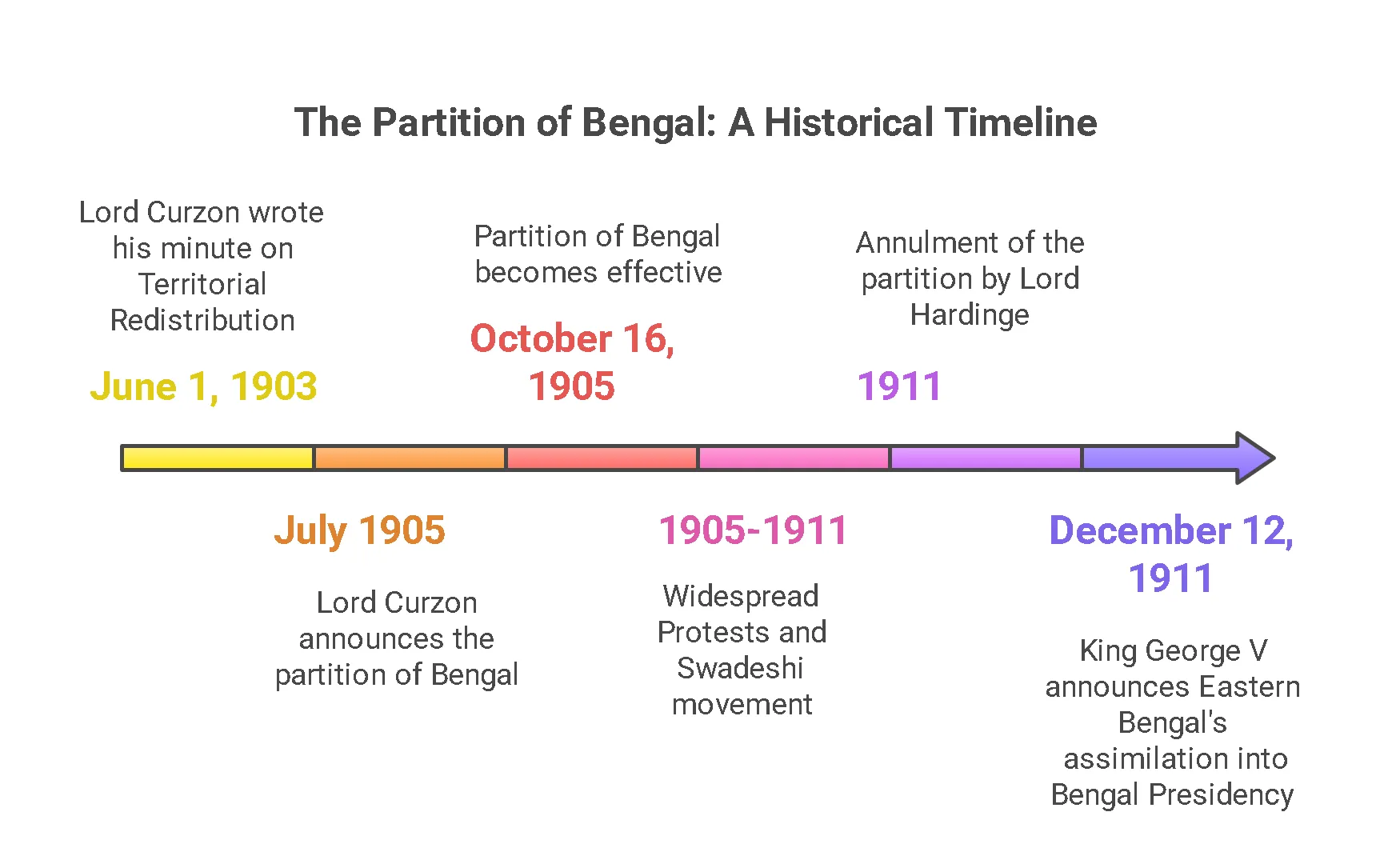
Partition of Bengal (1905) was a territorial reorganisation of the Bengal Presidency that separated the predominantly Hindu western areas from the predominantly Muslim eastern areas. The Partition of Bengal was announced by Lord Curzon, the then-Viceroy of India, on July 20, 1905. The reorganisation took effect on October 16, 1905. It was one of the most significant events in Indian history, which shaped India’s national movement.
The Partition of Bengal (1905) was intended to stifle the developing nationalist movement under the guise of administrative efficiency and development in all districts of Bengal. The partition sparked enormous protests, gaining support from all segments of society, and led to the emergence of the Swadeshi Movement. Following widespread objections, the Partition of Bengal was annulled in 1911 by Lord Hardinge.
Partition of Bengal Overview
Partition of Bengal (1905) was a territorial reorganisation of the Bengal Presidency by the British Raj, separating Muslim-dominated eastern areas from Hindu-majority western areas.
- Partition of Bengal Date: The Partition of Bengal, announced by Viceroy Lord Curzon on July 19, 1905, came into effect on October 16, 1905, dividing the Bengal Presidency for administrative purposes.
- Reaction and Annulment: Despite Curzon's claims of administrative efficiency, Hindus were outraged. The partition was annulled by royal proclamation at the 1911 Delhi Durbar after widespread political protests.
Partition of Bengal Background
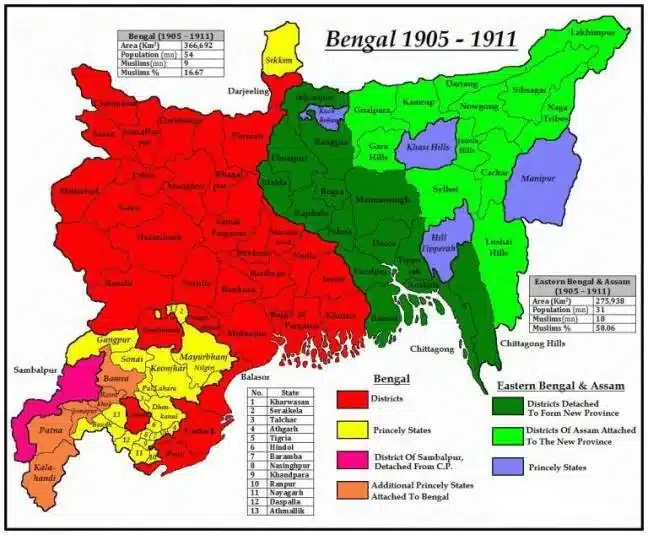
Bengal was British India's capital and one of the largest provinces of British India, comprising Bihar, West Bengal, and Orissa. It had a population of about 80 million before the partition and included both Bengali-speaking Hindus and Muslims. The British argued that governing such a large area was a challenge for them. To improve governance, the Viceroy Curzon announced the partition of Bengal in 1905. The Partition of Bengal was done in two provinces:
- Western Bengal: It comprised Western Bengal as well as the provinces of Bihar and Orissa.
- Eastern Bengal and Assam: It comprised the Chittagong, Dacca and Rajshahi divisions, Hill Tippera (Tripura), Malda and Assam.


Partition of Bengal Role of Lord Curzon
Partition of Bengal was announced by Lord Curzon. He was the Viceroy of India from 1899 to 1905 and was the primary figure behind the Partition of Bengal. He believed that dividing Bengal into smaller provinces would aid the British government in governing it efficiently. Curzon saw Bengal as a hub of the nationalist movement.
The partition exemplified the British's divisive policies, dividing Bengal into West Bengal, predominantly Hindu, and East Bengal, predominantly Muslim, causing conflict between Hindus and Muslims.
Partition of Bengal (1905) Reasons
The partition of Bengal (1905) was done for administrative convenience and equal development in all areas of Bengal, as per the British government. However, the reasons for Bengal's partition can be understood through British divisive policies.
- Growing Nationalism: Bengal became the growing centre of Indian Nationalism. Many nationalist leaders like Aurobindo Ghosh and Surendranath Banerjee emerged from Bengal and significantly strengthened the nationalist movement.
- Gather Muslim Support: Lord Curzon was trying to woo Muslims. He argued that Dacca could become the capital of the new Muslim-majority province, which would provide them with unity.
- Cripple Educated Class: Separation of urban bases of English-educated upper-caste Indians from the jute-cultivating areas to diminish Calcutta's significance.
- Counter INC: The creation of a Muslim-majority province in Eastern Bengal would counter the Indian National Congress (INC) in West Bengal.
Partition of Bengal Reaction
The Partition of Bengal in 1905 sparked widespread reactions across India. Many saw Lord Curzon's move as an attempt to divide and weaken the growing nationalist movement by creating religious divisions. This led to unrest, with both leaders and ordinary citizens responding in various ways. The day of partition (16 October 1905) also coincided with Raksha Bandhan Day, which celebrates sibling relationships.
- Moderates: Moderate leaders such as Surendranath Banerjee believed in peaceful protests through petitions and negotiations with the British government. They organised peaceful public meetings to reverse the partition. They wrote petitions appealing through constitutional methods.
- In protest, nationalist leaders such as Surendranath Banerjee, Tarak Nath Palit, and Ananda Mohan Bose founded the Federation Hall Society.
- Extremists: Extremist leaders such as Bal Gangadhar Tilak and Bipin Chandra Pal adopted a more radical approach. They promoted the Swadeshi Movement and the boycott of foreign goods.
- Common People: In Calcutta, a hartal was called, declaring a day of mourning. People fasted, and no fires were lit in the cooking hearth. They paraded on the streets singing Bande Mataram. People tied rakhis, symbolising solidarity.
- Rabindranath Tagore composed the renowned song 'Amar Sonar Bangla', which later became Bangladesh's national anthem.
Partition of Bengal (1905) Outcome
Partition of Bengal significantly impacted the Indian independence movement. It caused a wave of anger among every section of people across India. All factions of Congress, both the Moderates and the Radicals, opposed it.
- New Political Parties: The Partition of Bengal led to the formation of new political parties such as the Muslim League in 1906.
- Split in Congress: The division of Congress in 1907 at Surat into two factions, the Moderates and the Extremists, as extremists lost faith in the capacity of moderates to negotiate with the British government.
Partition of Bengal and Swadeshi Movement
The Partition of Bengal (1905) triggered the Swadeshi Movement, which encouraged people to boycott British goods and use Indian-made products.
- The movement promoted swadeshi industries, national education, and self-reliance and saw widespread participation through protests, public meetings, bonfires of foreign cloth, and the promotion of indigenous enterprises.
- The Partition of Bengal was revoked in 1911, but the Swadeshi Movement marked an important phase in the growth of Indian nationalism.
Partition of Bengal Annulment
Due to the intense and growing opposition, the British government decided to annul the partition in 1911. This decision was announced by the then Viceroy of India, Lord Hardinge, during his Delhi Durbar address in December 1911. The Delhi Durbar marked the coronation of King George V and Queen Mary as Emperor and Empress of India. The capital of British India was also shifted from Calcutta to Delhi to decrease the importance of Calcutta and the intellectuals of Bengal. This was announced because:
- The British realised that the partition was having the opposite effect of what they had intended.
- It had united Hindus and Muslims against British rule, leading to the strengthening of nationalist sentiments and calls for Indian independence.
- In addition, the partition led to administrative inefficiencies, and it was becoming increasingly difficult to manage the two provinces.
Partition of Bengal 1947
The Partition of Bengal in 1947 was the second and final division of Bengal, carried out as part of the Partition of India under the Indian Independence Act, 1947. Bengal was divided largely along religious lines.
- Hindu-majority West Bengal became part of India, while Muslim-majority East Bengal joined Pakistan and was later renamed East Pakistan in 1956.
- In 1971, East Pakistan became the independent nation of Bangladesh. The division, based on the Radcliffe Line, triggered communal violence and the migration of nearly 3.3 million people. Unlike the 1905 partition, it was permanent.
Partition of Bengal (1905) UPSC PYQs
Q.1: Evaluate the policies of Lord Curzon and their long-term implications on the national movement. (UPSC Mains 2020)
Q.2: With reference to the Swadeshi Movement, consider the following statements: (UPSC Prelims 2019)
- It contributed to the revival of the indigenous artisan crafts and industries.
- The National Council of Education was established as a part of the Swadeshi Movement.
Which of the statements given above is/are correct?
(a) 1 only
(b) 2 only
(c) Both 1 and 2
(d) Neither 1 nor 2
Ans: (c)
Q.3: The Swadeshi and Boycott were adopted as methods of struggle for the first time during the (UPSC Prelims 2016)
(a) Agitation against the Partition of Bengal
(b) Home Rule Movement
(c) Non-Cooperation Movement
(d) Visit of the Simon Commission to India
Ans. (a)
Q.4: The Partition of Bengal made by Lord Curzon in 1905 lasted until (UPSC Prelims 2014)
(a) The First World War was when Indian troops were needed by the British, and the partition was ended.
(b) King George V abrogated Curzon’s Act at the Royal Durbar in Delhi in 1911
(c) Gandhiji launched his Civil Disobedience Movement
(d) The partition of India in 1947, when East Bengal became East Pakistan.
Ans. (b)
| Other Related Posts | |
| Swadeshi movement | Muslim League |
| Partition of Bengal | Hindu Mahasabha |

 Last updated on Oct, 2026
→ UPSC 2027 Notification will be released on 13 January 2027 at upsconline.nic.in.
→ Check Nobel Prize 2026 Winners List here.
→ Download PIB PRiSM Monthly Magazine 2026 here.
→ Check UPSC Monthly Current Affairs Magazine The Recitals here.
→ Check out the latest UPSC Syllabus here.
→ Download UPSC Model Answers for Mains 2026
→ UPSC Mains Question Paper 2026 is out now for Essay & GS Paper 1, 2, 3 & 4.
→ UPSC Calendar 2027 has been released.
→ Enroll in Vajiram & Ravi’s UPSC Mains Test Series 2027 for structured answer writing practice, expert evaluation, and exam-oriented feedback.
→ Join Vajiram & Ravi’s UPSC Mentorship Program 2027 for personalized guidance, strategy planning, and one-to-one support from experienced mentors.
→ Go through the UPSC Mains Previous Year Papers to enhance your preparation.
→ UPSC has released UPSC Toppers List 2025 with the Civil Services final result on its official website.
→ Also check Best UPSC Coaching in India
Partition of Bengal (1905) FAQs
Q1. When was the partition of Bengal?+
Q2. Who declared the partition of Bengal in 1905?+
Q3. Who caused the partition of Bengal and why?+
Q4. Who divided Bengal in 1947?+
Q5. Who cancelled the partition of Bengal in 1905?+
Tags: partition of bengal quest upsc modern history notes