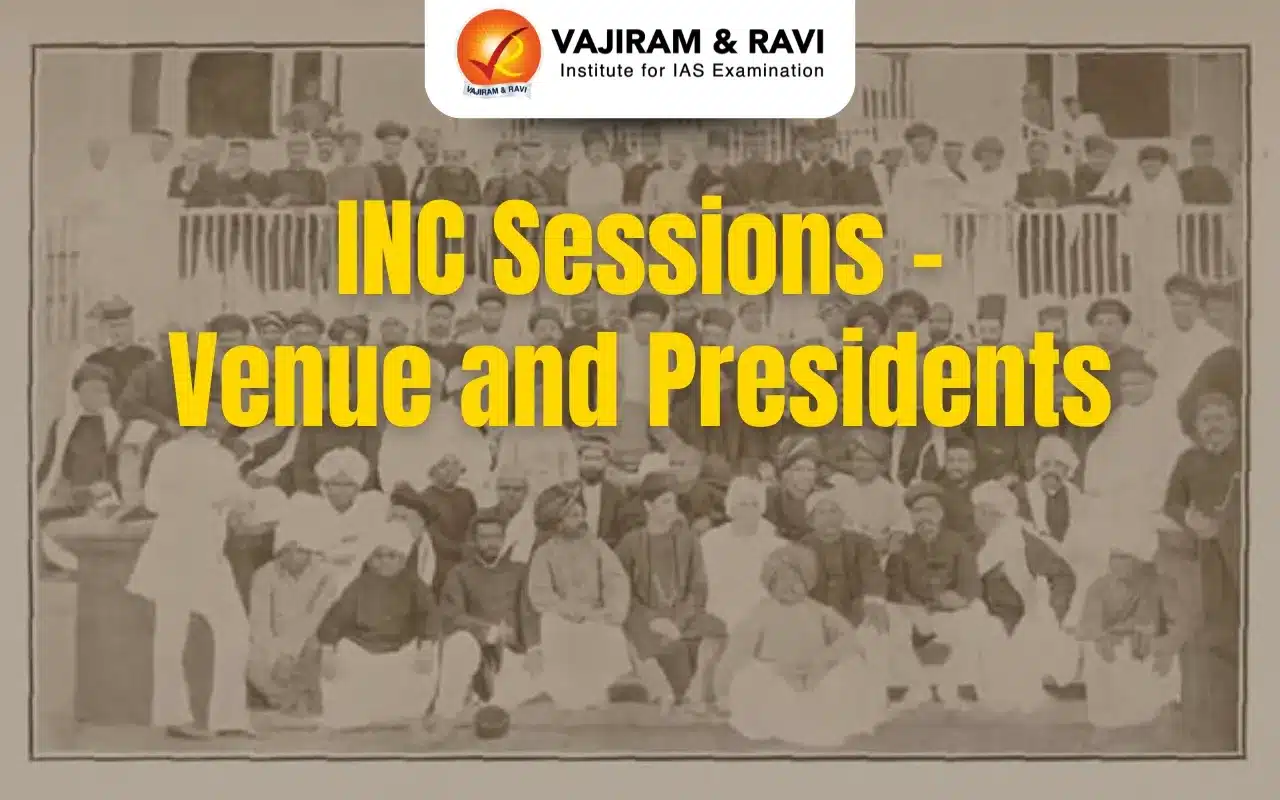
INC Sessions began in 1885, with the first session held in Bombay under the presidency of W.C. Bonnerjee. Indian National Congress (INC) sessions provided a national platform for Indian political leaders to debate colonial policies, formulate demands, and coordinate the nationalist movement.
The INC sessions were significant in shaping the ideological, organisational and strategic direction of the freedom movement. However, they also faced challenges such as Moderate–Extremist divisions, differences over council entry, ideological conflicts and leadership struggles, as seen in the Surat split and the Tripuri crisis of 1939.
INC Sessions About
The Indian National Congress (INC) was founded on 28 December 1885 by Allan Octavian Hume, initially as a platform for civil and political discussion among educated Indians. Over time, it evolved into the primary force behind India’s independence movement.
- The Congress held annual sessions called INC sessions, usually in December, where leaders from across India gathered to discuss policies and strategies.
- Additionally, special sessions were also convened during critical moments, such as the Non-Cooperation Movement (1920), reflecting the INC’s adaptability in key political junctures.
Important INC Sessions List and Presidents
The Indian National Congress sessions from 1885 to 1947 shaped India’s nationalist movement, evolved political demands, and provided direction to the struggle for independence. The following table highlights the important INC sessions, list, year, place, presidents, and significance of each major session of the Indian National Congress:
|
Year |
Venue |
President |
Significance |
|
1885 |
Bombay |
Womesh Chandra Bonnerjee |
- 72 social reformers, journalists, and lawyers convened at Gokuldas Tejpal Sanskrit College in Bombay for the INC's inaugural session. |
|
1886 |
Calcutta |
Dadabhai Naoroji |
- Merger of INC and National Conference -Decided to set up Provincial Congress Committees across the country. |
|
1887 |
Madras |
Badruddin Tyabji |
To promote unity and cooperation among the various regional groups, the appeal was made to the Muslims to join the INC. |
|
1888 |
Allahabad |
George Yule |
First English President of INC. |
|
1889 |
Bombay |
Sir William Wedderburn |
INC's British Committee was founded in Britain. |
|
1890 |
Calcutta |
Pherozeshah Mehta |
The first woman to graduate from Calcutta University, Kadambini Ganguly, spoke at the Congress in 1890. |
|
1891 |
Nagpur |
P. Ananda Charlu |
Congress continued its demands for administrative and legislative reforms, including greater Indian participation in governance |
|
1892 |
Allahabad |
Womesh Chandra Bonnerjee |
Congress criticized the Indian Councils Act of 1892 |
|
1893 |
Lahore |
Dadabhai Naoroji |
Naoroji's leadership reinforced Congress's focus on economic exploitation and the demand for greater Indian representation in administration. |
|
1894 |
Madras |
Alfred Webb |
Congress opposed discriminatory taxation, including the cotton excise duty, and criticised restrictions on the press and public services. |
|
1895 |
Pune |
Surendranath Banerjee |
There was a significant increase in the number of attendees for this session. |
|
1896 |
Calcutta |
Rahimatullah M. Sayani |
“Vande Mataram”, the national song, was sung for the first time; Passed a resolution blaming the British for the famine that had devastated many parts of India. |
|
1897 |
Amraoti |
C. Sankaran Nair |
Congress slammed the British for the arrest of Bal Gangadhar Tilak. |
|
1898 |
Madras |
Ananda Mohan Bose |
Congress continued its campaign against repressive colonial legislation and for constitutional and administrative reforms. |
|
1899 |
Lucknow |
Romesh Chunder Dutt |
Congress demanded that the British government should stop the 'drain of wealth’ from India to England. |
|
1900 |
Lahore |
N.G. Chandavarkar |
Congress further amended its constitution and discussed the Punjab Land Alienation Act, showing sensitivity to agrarian and community concerns. |
|
1901 |
Calcutta |
Dinshaw Eduljee Wacha |
- For the first time, Mahatma Gandhi appeared on the Congress platform. - Gandhi ji, a South Africa-based lawyer, then pleaded with Congress to back the fight against racial exploitation and injustice in the Country. |
|
1902 |
Ahmedabad |
Surendranath Banerjee |
Congress continued its campaign for constitutional reforms, greater Indian representation and administrative accountability. |
|
1903 |
Madras |
Lal Mohan Ghosh |
Congress continued discussions on economic grievances, administrative reforms and expansion of Indian participation in governance. |
|
1904 |
Bombay |
Sir Henry Cotton |
Congress expressed strong disapproval of Lord Curzon's misuse of Indian revenues for his aggressive policy in Tibet and vehemently protested the Curzon administration's plan to partition Bengal. |
|
1905 |
Banaras |
Gopal Krishna Gokhale |
- The divisions between the moderates and the extremists came to the fore; - Adopted the Swadeshi resolution. |
|
1906 |
Calcutta |
Shri Dadabhai Naoroji |
For the first time, Congress declared Swaraj as its aim. |
|
1907 (Suspended) |
Surat |
Rash Behari Ghosh |
Congress was split into two – the moderates and the extremists. |
|
1908 |
Madras |
Rash Behari Ghosh |
Congress attempted to reorganise itself after the Surat split while continuing constitutional opposition to colonial policies. |
|
1909 |
Lahore |
Madan Mohan Malaviya |
Congress opposed the Indian Councils Act of 1909's proposal to create separate electorates based on religion. |
|
1910 |
Allahabad |
Sir William Wedderburn |
Congress continued its campaign for constitutional reforms, civil liberties and greater Indian participation in administration. |
|
1911 |
Calcutta |
Bishan Narayan Dar |
It was the first time that "Jana Gana Mana," the national anthem of India, was performed. |
|
1912 |
Bankipore |
Raghunath Mudholkar |
Congress continued its programme of constitutional reform and administrative representation, while emphasising Indian participation in governance. |
|
1913 |
Karachi |
Nawab Syed Mohammed Bahadur |
Congress continued demands for self-government, civil liberties and greater Indian participation in administration. |
|
1914 |
Madras |
Bhupendra Nath Bose |
Congress demanded that Indians be allowed to have higher positions in the army. |
|
1915 |
Bombay |
Satyendra Prasanna Sinha |
To allow the delegates from the extremist section to be admitted, the Congress's constitution was appropriately changed. |
|
1916 |
Lucknow |
Ambica Charan Mazumdar |
Unification of the moderates and extremists. |
|
1917 |
Calcutta |
Annie Besant |
Congress got its first woman President. |
|
1918 |
Delhi |
Madan Mohan Malaviya |
Growing mass character: around 1,000 peasant delegates participated; Congress demanded repeal of repressive laws and greater self-determination. |
|
1918 (Special Session) |
Bombay |
Syed Hasan Imam |
Congress expressed disappointment with the Montague-Chelmsford Reform. It called for the Indian people to have a Declaration of Rights. |
|
1919 |
Amritsar |
Motilal Nehru |
Congress declared that it was in sympathy with the victims of the Jallianwala Bagh massacre. |
|
1920 (Special Session) |
Calcutta |
Lala Lajpat Rai |
INC approved the Non-Cooperation Movement (NCM). |
|
1920 |
Nagpur |
C. Vijayaraghavachariar |
- Congress intensified the NCM. -The importance of using non-violent means was emphasized. |
|
1921 |
Ahmadabad |
Hakim Ajmal Khan (Acting President for C.R. Das) |
Gandhiji was declared the only executive authority of the Congress and given full AICC authority. |
|
1922 |
Gaya |
Deshbandhu Chittaranjan Das |
Intense debate on the issue of council entry led to CR Das and others breaking away from the INC and forming the Swaraj Party. |
|
1923 (Special Session) |
Delhi |
Maulana Abul Kalam Azad |
Decided to permit members to run for office in the next elections. |
|
1924 |
Belgaum |
M.K. Gandhi |
The Only INC session presided over by Mahatma Gandhi. |
|
1Downpour |
nope |
Mrs. Sarojini Naidu |
Sarojini Naidu became the first Indian woman to preside over the Congress. |
|
1926 |
Guwahati |
S. Srinivasa Iyengar |
Congress laid emphasis on work in legislatures, while opposing official ministries and measures that strengthened colonial control. |
|
1927 |
Madras |
M.A. Ansari |
Congress resolved to boycott the Simon Commission. |
|
1928 |
Calcutta |
Motilal Nehru |
- The first All India Youth Congress was formed. - Resolution to adopt the Motilal Nehru report's suggestion to grant Dominion Status to India within two years. |
|
1929 |
Lahore |
Jawaharlal Nehru |
Congress declared Purna Swaraj as its ultimate goal. |
|
1931 |
Karachi |
Vallabhbhai J. Patel |
- Congress passed a resolution on Fundamental Rights and the National Economic Program. -It also endorsed the Gandhi-Irwin Pact. |
|
1933 |
Calcutta |
Mrs. Nellie Sengupta |
Nellie Sengupta became the third woman to preside over the INC; Congress continued its civil-disobedience-related political programme. |
|
1934 |
Bombay |
Dr. Rajendra Prasad |
Wearing Khadi was established as a rule for elected members. |
|
1936 |
Lucknow |
Jawaharlal Nehru |
Urged Congressmen to adopt Socialism. |
|
1937 |
Faizpur (Bombay Presidency) |
Jawaharlal Nehru |
The first Congress Session in a rural area. |
|
1938 |
Haripura |
Subhash Chandra Bose |
- Rejected the federal structure given by the GoI in 1935. - Under the chairmanship of Nehru, the National Planning Committee was formed. |
|
1939 |
Tripuri |
Subhash Chandra Bose |
Following Subhas Chandra Bose's resignation, Rajendra Prasad assumed the presidency. |
|
1940 |
Ramgarh |
Maulana Abul Kalam Azad |
The Congress objected to India being labelled as a belligerent nation in the war efforts. |
|
1946 |
Meerut |
J.B. Kripalani |
Last INC session before Independence. |
INC Session Importance
INC sessions served as crucial platforms for shaping nationalist policies, fostering unity, debating strategies, and defining major milestones in India's struggle for independence.
- Shaped the Freedom Movement: INC sessions provided a common platform for discussing political, economic and social issues and helped transform scattered opposition into an organised national movement.
- Formulated Key Demands: Important resolutions on Swaraj, civil rights, constitutional reforms, Swadeshi and economic issues were adopted, giving direction to the nationalist movement.
- Promoted National Unity: The sessions brought together leaders and delegates from different regions, communities and social backgrounds, strengthening the idea of a united Indian nation.
- Decided Movement Strategies: Major changes in Congress policy and methods of struggle were debated and approved at these sessions, including Non-Cooperation, Civil Disobedience and Quit India.
- Provided Leadership: The sessions facilitated the emergence of prominent leaders and helped build an organised political network across India.
- Historical Milestones: Sessions such as Lucknow (1916), Nagpur (1920), Lahore (1929) and Karachi (1931) marked important turning points in India's freedom struggle.
INC Sessions UPSC PYQs
Q1: Consider the following statements (UPSC Prelims 2015)
- The first woman President of the Indian National Congress was Sarojini Naidu.
- The first Muslim President of the Indian National Congress was Badruddin Tyabji.
Which of the statements given is/are correct?
(a) 1 only
(b) 2 only
(c) Both 1 and 2
(d) Neither 1 nor 2
Ans: (b)
Q2: The 1929 Session of the Indian National Congress is of significance in the history of the Freedom Movement because the (UPSC Prelims 2014)
(a) attainment of Self-Government was declared as the objective of the Congress
(b) attainment of Poorna Swaraj was adopted as the goal of the Congress
(c) Non-Cooperation Movement was launched
(d) the decision to participate in the Round Table Conference in London was taken
Ans: (b)


 Last updated on Oct, 2026
→ UPSC 2027 Notification will be released on 13 January 2027 at upsconline.nic.in.
→ Check Nobel Prize 2026 Winners List here.
→ Download PIB PRiSM Monthly Magazine 2026 here.
→ Check UPSC Monthly Current Affairs Magazine The Recitals here.
→ Check out the latest UPSC Syllabus here.
→ Download UPSC Model Answers for Mains 2026
→ UPSC Mains Question Paper 2026 is out now for Essay & GS Paper 1, 2, 3 & 4.
→ UPSC Calendar 2027 has been released.
→ Enroll in Vajiram & Ravi’s UPSC Mains Test Series 2027 for structured answer writing practice, expert evaluation, and exam-oriented feedback.
→ Join Vajiram & Ravi’s UPSC Mentorship Program 2027 for personalized guidance, strategy planning, and one-to-one support from experienced mentors.
→ Go through the UPSC Mains Previous Year Papers to enhance your preparation.
→ UPSC has released UPSC Toppers List 2025 with the Civil Services final result on its official website.
→ Also check Best UPSC Coaching in India
INC Sessions FAQs
Q1. What are the sessions of Congress?+
Q2. How many INC sessions held?+
Q3. What were the most important sessions of the Indian National Congress?+
Q4. Where was the first session of the INC held?+
Q5. Who never presided over an INC session?+
Tags: inc sessions quest upsc modern history notes