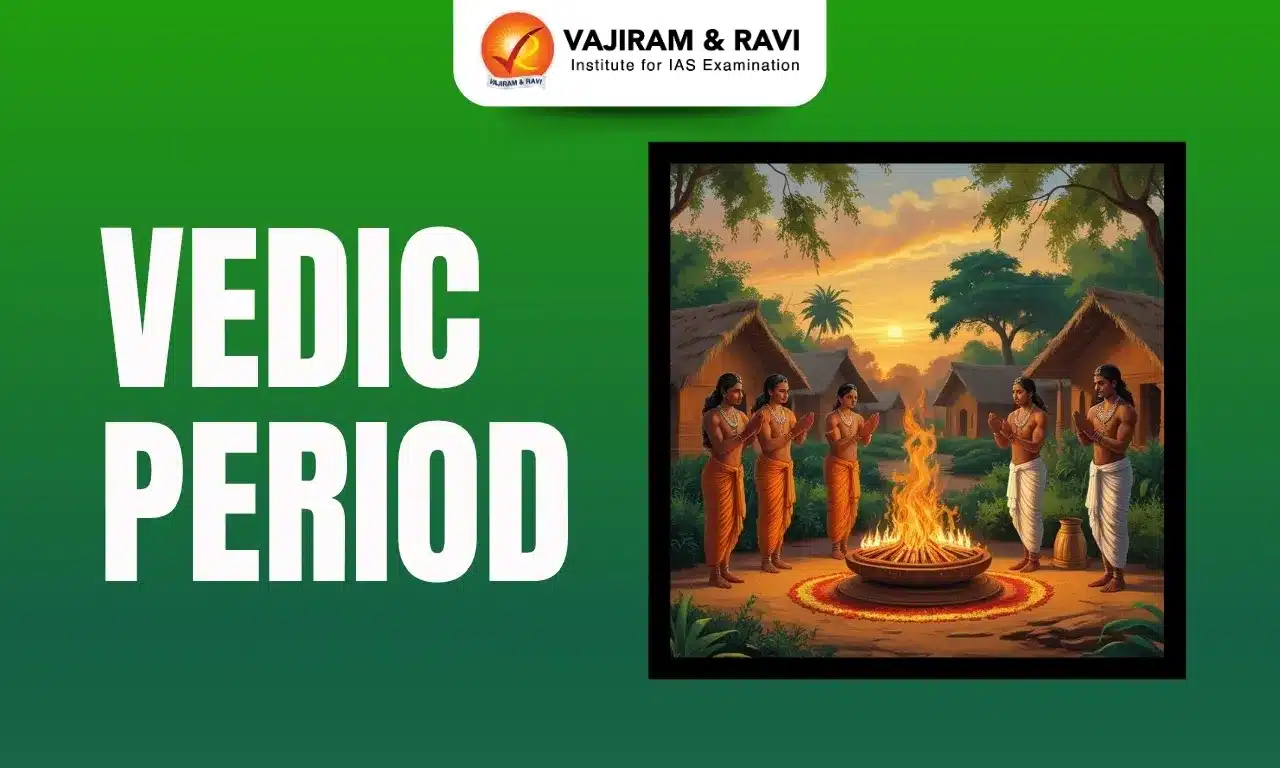
Vedic Period, spanning from 1500 to 600 BCE, marks a crucial phase in the evolution of ancient Indian civilisation. This era, defined by the rise of the Vedic religion, witnessed the composition of the Vedas, sacred texts central to Hinduism. The Vedic period was diverse and complex, laying the foundation for various aspects of Indian society, religion, and knowledge.
The Vedas are more than just religious scriptures. They form the bedrock of Indian culture and human civilisation. They encompass knowledge spanning philosophy, spirituality, science, and culture. As oral compilations, the Vedas preserve ancient cosmic wisdom, passed down through generations, continuing to influence Indian society and beyond.
Vedic Period Origin
The Vedic period originated in the latter half of the second millennium BCE, following the decline of the Indus Valley Civilization around 1900 BCE. The Vedic Period originated around 1500 BCE, following the decline of the Indus Valley Civilisation.
- This era began with the migration of Indo-Aryan groups into northwestern India through the Bactria-Margiana region (modern-day northern Afghanistan).
- This period marked a transition from nomadic lifestyles to settled agriculture, laying the groundwork for India's social, political, and religious structures. The Vedic Age thus represents a formative chapter in ancient Indian history.
Vedic Period Indo-Aryans
The Indo-Aryans of the Vedic Period (c. 1500–500 BCE) were a linguistic group speaking Indo-European languages and are credited with composing the Vedic hymns, the foundational texts of Hinduism. Some historians propose that they migrated to northwest India from regions such as southern Russia and Central Asia, though this theory remains debated.
- Indo-Aryans, distinct from non-Aryan Harappans, shaped Vedic society and culture through migration.
- Painted Grey Ware links Aryans to the Indian subcontinent, showing early civilisational influence.
- Andronovo Culture in southern Siberia provides evidence of Aryan migrations, with horse, spoked wheel, and fire cult artefacts.
- Vedic Aryans initially settled in Sapta-Sindhu (Punjab, Haryana, and parts of Afghanistan), later expanding to Uttar Pradesh and Bihar.
Vedic Period History
Vedic Period / Vedic Age represents a pivotal era in ancient Indian history, marked by the composition of the Vedas, the foundational texts of Hinduism. This period witnessed the transition from a semi-nomadic, pastoral lifestyle to settled agriculture, leading to the emergence of agrarian communities.
- The societal structure evolved with the establishment of the Varna system, delineating social classes.
- Politically, tribal assemblies gradually transformed into more complex forms of governance, laying the groundwork for future state formations.
- Religion elaborates rituals and sacrifices became central to Vedic practices, reflecting a deepening spiritual framework.
- The cultural and philosophical developments during the Vedic Age significantly influenced subsequent Indian civilisation, shaping its enduring traditions and societal norms.
- Vedic Period is divided into two phases:
- Early Vedic Period (c. 1500–1000 BCE): Characterised by the composition of the Rigveda, semi-nomadic pastoralism, and tribal organisation.
- Later Vedic Period (c. 1000–500 BCE): Marked by the composition of later Vedas (Samaveda, Yajurveda, and Atharvaveda), settled agriculture, and the rise of complex social and political structures.
Early Vedic Period
Early Vedic period, around 1500–1000 BCE, marked the arrival of the Aryans in the Indian subcontinent. During this time, society was largely pastoral, with tribes practising cattle rearing. The Vedas, composed during this era, focus on hymns dedicated to nature gods. The social structure was relatively egalitarian, and the rituals were centred around sacrificial ceremonies and hymns.
Later Vedic Period
Later Vedic period (1000–500 BCE) witnessed significant cultural and societal changes. The Aryans expanded eastward, settling in regions like Kosala and Videha. The political organization evolved with the emergence of larger kingdoms, and the social structure became more complex with the consolidation of the Varna system. The period also saw the composition of important philosophical and religious texts.


Vedic Period Timeline
The time Period for the Vedic Age spanned approximately from 1500 BCE to ~500 BCE, beginning with the arrival of Indo-Aryans in the Indian subcontinent. This era persisted until the emergence of major urban settlements and the development of new religious and philosophical ideas, which signalled the gradual transition toward the Mahajanapada period.
Vedic Period Sources
Vedic period sources primarily include the four Vedas—Rigveda, Samaveda, Yajurveda, and Atharvaveda—along with Brahmanas, Aranyakas, and Upanishads, which provide insights into early religious practices, society, and governance.
Early Vedic Period Sources
Early Vedic Period sources include both literary and archaeological evidence. The Rigveda, the oldest of the four Vedas, provides rich insights into the pastoral society. Archaeological finds from Punjab, Uttar Pradesh, and Rajasthan support the existence of post-Harappan settlements during this period.
Later Vedic Period Sources
Later Vedic period sources include the Samaveda, Yajurveda, and Atharvaveda, along with Brahmanas, Aranyakas, and Upanishads. These texts provide insights into evolving rituals, social hierarchies, philosophical ideas, and the transition from pastoral to agrarian life in ancient Indian society.
Vedic Period Political Life
Vedic period political life was initially tribal and egalitarian, with no defined political hierarchy. However, during the Later Vedic phase, a socio-political order began emerging, leading to the origin of the Varna system.
- Social Unit: In the Early Vedic Period, the chief social unit was known as Jana, while in the Later Vedic Period, the concept of Janapada emerged, and the term Rashtra was used for the first time.
- Chief/King: The Jana was led by a Rajan, whose primary responsibility was to protect the people and their cattle from enemies, but in the Later Vedic period, the Rajan became the protector of the territory settled by his tribesmen.
- Accession Rule: In the Early Vedic period, the post of the chief was not hereditary, and tribal assemblies played a role in selecting the Raja from among the clansmen; however, in the Later Vedic period, the post became hereditary, marked by grand rituals like Vajapeya and Rajasuya.
- Administration: The Rajan was assisted by tribal assemblies such as Sabha, Samiti, Vidatha, Gana, and Parishad, with Sabha being a council of select members and Samiti comprising the whole clan, but over time, the Sabha became more prominent.
- Taxation: In terms of taxation, people initially offered Bali voluntarily during special occasions, but eventually, Bali, Bhaga, and Shulka evolved into regular forms of tribute and taxes.
- Military Administration: The military in the Early Vedic period, known as Sena, was a temporary force made up of able-bodied men, but in the later Vedic age, a rudimentary standing army began to form, supported by public taxes.
- Status of Brahmins: Brahmins performed large yajnas as Purohitas and initially received generous gifts from the Raja, but in the Later Vedic period, their status grew significantly, becoming comparable to the gods, and their role was honoured through offerings known as Dana.
Vedic Period Social Life
Vedic Period social life initially featured an egalitarian, clan-based structure during the Early Vedic phase, which gradually evolved into a more complex society with Varna-based divisions in the Later Vedic period.
- Family: In the Early Vedic Period, the family belonged to a larger group known as a vis or clan, and one or more clans together formed a Jana or tribe, which was the largest social unit. The family remained the fundamental unit of society. In the Later Vedic Period, families grew larger, often including three or four generations, which led to the development of joint families.
- Varna System: The Varna System did not exist during the early Vedic period. However, by the later Vedic period, society was divided into four varnas—Brahmanas, Kshatriyas, Vaishyas, and Shudras.
- Status of Women: The Status of Women during the early Vedic period was relatively respectable despite the patriarchal setup. Women were educated and participated in assemblies, and poets like Apala, Viswavara, Ghosa, and Lopamudra emerged during this time. They had the freedom to choose their partners and marry at their will.
- In contrast, during the later Vedic period, women became subordinate to men, their role in public meetings was restricted, and child marriage began to spread.
- Varna-Ashrama System: The Varna-Ashrama system was absent in early Vedic times. In the later Vedic age, texts began mentioning three life stages—Brahmacharya (student life), Grihastha (householder), and Vanaprastha (hermitage). Eventually, Sanyasa (renunciation) was added, giving rise to the varna-ashrama dharma.
- Tribal Conflicts: Tribal Conflicts increased during both periods, but their nature changed over time. In the early phase, conflicts such as the Battle of Ten Kings were common due to the need for pasture and cattle. In the later Vedic period, the focus shifted to acquiring land, and intra-tribal conflicts intensified.
- Gotra System: The Gotra System was not present in early Vedic society. It later evolved to identify people descending from a common ancestor, and marriage within the same gotra was prohibited.
- Marriage: Marriage in the early Vedic period was mostly monogamous, though some chiefs practised polygamy. Monogamous marriages, however, were the societal preference.
- Social Groups: In terms of Social Groups, the early Vedic society did not base occupation on birth. The term varna was used to distinguish Vedic people from non-Vedic groups. Social divisions were fluid, and individuals could choose their occupation regardless of their birth.
Vedic Period Religion
Vedic Period Religion centred around the worship of natural forces like wind, rain, fire, and thunder, which were personified as gods. These deities were revered through hymns found in the Rigveda.
- Vedic Gods: In the Early Vedic age, the Rigveda mentions several male gods such as Indra, Agni, Varuna, Mitra, Dyaus, Pushana, Yama, and Soma. Goddesses like Ushas, Sarasvati, and Prithvi hold secondary positions in the pantheon, with Indra being the most frequently mentioned god.
- Vishnu and Rudra, initially minor deities, grew in prominence over time in the later Vedic period, while Pushan, originally a protector of cattle, became associated with the Shudra class.
- Yajnas: In the Vedic period, yajnas (sacrificial rituals) involved reciting hymns and prayers, typically performed by priests. These rituals contributed to the growth of knowledge, particularly in mathematics and animal anatomy.
- Major yajnas included ashvamedha, vajapeya, and rajasuya. Toward the end of the Vedic period, there was resistance against priestly control of these rituals, leading to the development of philosophical doctrines found in the Upanishads.
Vedic Literature
Vedic literature, foundational to Hinduism, comprises ancient texts composed in Sanskrit, primarily during the Vedic period (1500–500 BCE). It is categorised into four Vedas—Rigveda, Samaveda, Yajurveda, and Atharvaveda—each serving distinct purposes in rituals and hymns. These texts are further divided into Samhitas (hymns), Brahmanas (rituals), Aranyakas (theological discussions), and Upanishads (philosophical teachings).
Vedas
The Vedas are ancient sacred texts of Hinduism, consisting of a compilation of prayers and hymns offered by various poets and sages to different gods between approximately 1500 and 600 BCE. Recognised for their cultural significance, the Rigveda was recently included by UNESCO in the list of literature representing World Human Heritage.
Rigveda
Rigveda is recognised as the oldest and most significant of the four Vedas. It is composed of ten books, traditionally referred to as mandalas, which include a collection of hymns dedicated to various deities. Among its most renowned verses are the Gayatri Mantra, attributed to the sage Vishvamitra, and the Purusha Sukta.
Yajurveda
Yajurveda serves primarily as a practical guide for the Adhvaryu priest, who played a key role in conducting and performing various sacrificial rituals. Unlike other Vedas, it is largely composed in prose form, offering precise instructions for ceremonial duties.
Samaveda
Samaveda, the shortest among the four Vedas, primarily consists of Rigvedic verses arranged poetically for melodic chanting. It was specifically composed for use by the Udgatar priest during sacred rituals.
Atharvaveda
Atharvaveda, the most recent of the four Vedas, comprises hymns—some borrowed from the Rigveda—and a unique collection of magical spells and charms. It focuses on everyday concerns, including healing diseases and protecting individuals from evil forces or misfortune.
Vedic Period Philosophy
Vedic Period philosophy, derived from the Vedic texts, highlights the concepts of Rita (cosmic order) and Dharma (moral duty), which regulate both the universe and human life. It delves into understanding the nature of reality, the self (Atman), and the ultimate reality (Brahman), seeking to explore the relationship between the individual soul and the cosmic principle. Vedic thought also covers important ideas like karma, the cycle of rebirth, and the quest for liberation (Moksha), achieved through knowledge and righteous living.
Vedic Period Economy
The Vedic period economy initially centred around a pastoral lifestyle, with cattle rearing as the primary economic activity and people relying heavily on animal wealth rather than agriculture. As society evolved, particularly during the Later Vedic period, there was a transition towards a more sedentary agrarian economy, with settled agricultural practices becoming increasingly central.
- Occupational Activity: During the Early Vedic period, cattle rearing was the dominant occupational activity in a pastoral society. However, in the Later Vedic period, the society transformed from a pastoral to a sedentary agrarian one.
- Agriculture: Agriculture during the Early Vedic period was centred around barley, referred to as 'Yava.' By the Later Vedic period, shifting agriculture was practised, and rice became the staple diet, with other crops such as wheat, millet, and sugarcane being cultivated. Double cropping became common in later times.
- Domestication of Animals: The domestication of animals during the Vedic period included cattle, sheep, goats, and horses, used for milk, meat, and hides. The buffalo was also domesticated for agricultural tasks, and the God Indra was regarded as the "Lord of the Plough".
- Taxes: In terms of taxes, people offered voluntary contributions, such as Bali, to their chiefs on special occasions. Over time, Bali, Bhaga, and Shulka evolved into regular tributes and taxes, with Bhagalugha emerging as the tax-collecting officer.
- Use of Iron: The use of iron technology was not prevalent in the Early Vedic period, when copper was more common. However, the Later Vedic period saw the use of iron for tools like socketed axes and iron-tipped ploughshares, which enhanced agricultural productivity.
- Medium of Exchange: Cows were the main medium of exchange during the Vedic period, with priests receiving cows, horses, and gold ornaments as payment for sacrifices. In later times, gold coins, known as Niskha, became a common form of currency.
Vedic Period Decline
The Vedic Age gradually transitioned into the 16 Mahajanapada period around 600 BCE due to major political, economic, and social changes rather than a sudden collapse.
- Rise of Territorial States: Growing settlements and stronger political units led to the emergence of Mahajanapadas, replacing the earlier tribal-based political structure.
- Growth of Trade and Urban Centres: Increasing agricultural surplus encouraged craft production, trade and urbanisation, laying the foundation for early cities and market centres.
- Rise of New Religious Ideas: The growing ritualism and dominance of Brahmanical practices contributed to the emergence of Buddhism and Jainism, which questioned aspects of Vedic ritualism and social hierarchy.
- Emergence of New Political Powers: States such as Magadha, Kosala and Vatsa became increasingly powerful, marking the transition from the Vedic political order to the age of territorial kingdoms.
Vedic Period UPSC PYQs
Q1: Consider the following statements about the Rigvedic period: (UPSC Prelims 2026)
- Irrigation from wells allowed agriculture to expand away from flood plains and strips on river margins into the present Punjab and Haryana plains having underground water levels reasonably close to the surface.
- Draught-animal power was employed to draw up water out of the wells.
Which of the following information support/supports the above statements?
- There is evidence in the Rigveda of the use of ashma chakra (stone pulley wheel) and ahava (strapped wooden pails) to draw up water.
- Mention has been made in the Rigveda of the use of implements like parashu / kulisha (axe) and datra / sreni (sickle).
- There is a history of the use of oxen, even before the Rigveda, for ploughing the land and pulling the carts.
Select the answer using the code given below :
a) 1 and 2 only
b) 1, 2 and 3
c) 1 and 3 only
d) 3 only
Ans: (c)
Q2: Which of the following pairs of ancient and modern names of rivers is/are correctly matched? (UPSC Prelims 2026)
- Vitasta : Chenab
- Asikni: Jhelum
- Parushni: Ravi
- Yavyavati: Beas
Select the answer using the code given below :
a)1 and 2
b) 3 and 4
c) 3 only
d) 4 only
Ans: (c)
Q3: Consider the following statements: (UPSC Prelims 2024)
- There are no parables in Upanishads.
- Upanishads were composed earlier than the Puranas.
Which of the statements given above is/are correct? (UPSC Prelims 2024)
a) 1 only
b) 2 only
c) Both 1 and 2
d) Neither 1 nor 2
Ans: (b)
Q4: With reference to the difference between the culture of Rigvedic Aryans and Indus Valley people, which of the following statements is/are correct? (UPSC Prelims 2017)
- Rigvedic Aryans used the coat of mail and helmet in warfare whereas the people of Indus Valley Civilization did not leave any evidence of using them.
- Rigvedic Aryans knew gold, silver, and copper, whereas Indus Valley people knew only copper and iron.
- Rigvedic Aryans had domesticated the horse, whereas there is no evidence of Indus Valley people having been aware of this animal.
Select the correct answer using the code given below:
(a) 1 only
(b) 2 and 3 only
(c) 1 and 3 only
(d) 1, 2 and 3
Ans: (c)

 Last updated on Oct, 2026
→ UPSC 2027 Notification will be released on 13 January 2027 at upsconline.nic.in.
→ Check Nobel Prize 2026 Winners List here.
→ Download PIB PRiSM Monthly Magazine 2026 here.
→ Check UPSC Monthly Current Affairs Magazine The Recitals here.
→ Check out the latest UPSC Syllabus here.
→ Download UPSC Model Answers for Mains 2026
→ UPSC Mains Question Paper 2026 is out now for Essay & GS Paper 1, 2, 3 & 4.
→ UPSC Calendar 2027 has been released.
→ Enroll in Vajiram & Ravi’s UPSC Mains Test Series 2027 for structured answer writing practice, expert evaluation, and exam-oriented feedback.
→ Join Vajiram & Ravi’s UPSC Mentorship Program 2027 for personalized guidance, strategy planning, and one-to-one support from experienced mentors.
→ Go through the UPSC Mains Previous Year Papers to enhance your preparation.
→ UPSC has released UPSC Toppers List 2025 with the Civil Services final result on its official website.
→ Also check Best UPSC Coaching in India
Vedic Period FAQs
Q1. What is the Vedic period?+
Q2. Are Vedas 10,000 years old?+
Q3. What was the religion before Vedic religion?+
Q4. What was India called in the Vedic period?+
Q5. What was the religion before the Vedic religion?+
Tags: quest upsc ancient history notes vedic period