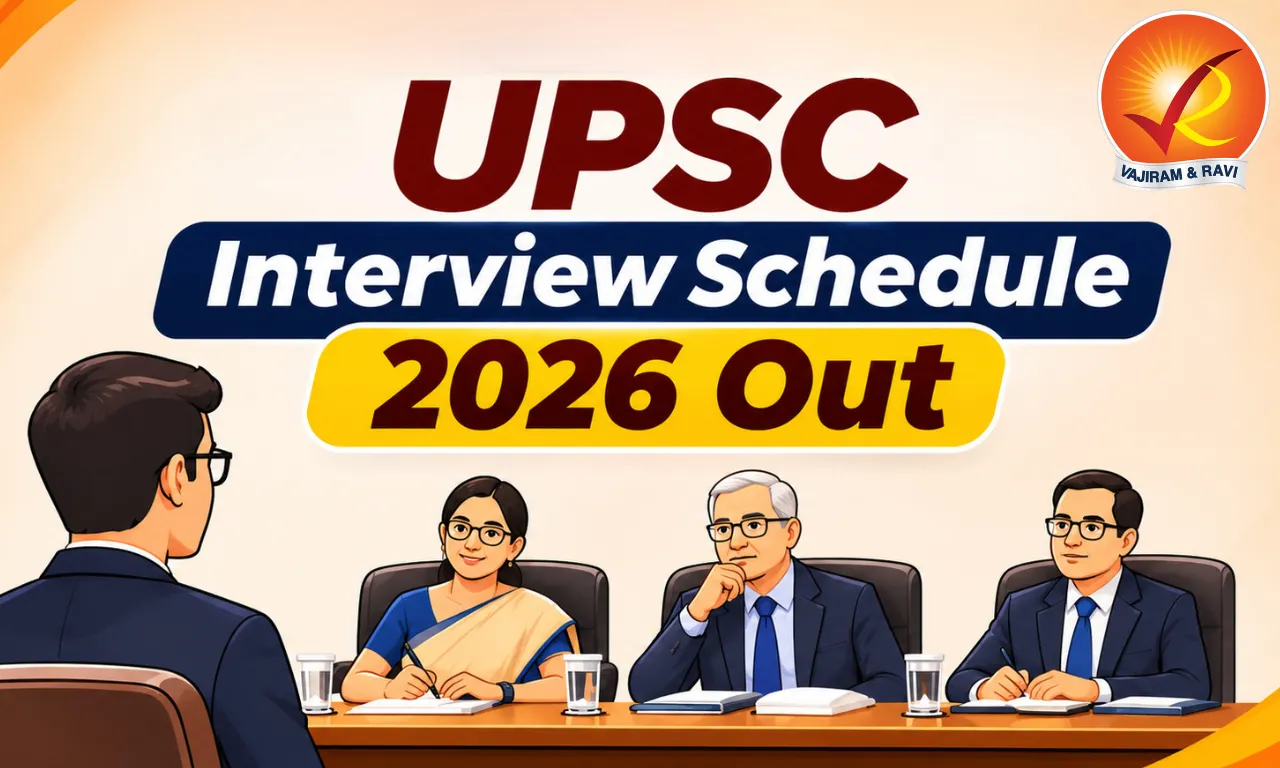
The UPSC Interview, officially known as the Personality Test, is the final stage of the Civil Services Examination. It carries 275 marks and forms part of the final merit assessment, along with the written papers of the Civil Services (Main) Examination.
Unlike the Preliminary and Main examinations, the UPSC Personality Test is not primarily a test of factual knowledge. It evaluates how candidates think, form opinions, handle unfamiliar situations and communicate their ideas. Questions can range from a candidate's hometown, education and hobbies to current affairs, governance and ethical dilemmas.
Effective UPSC Interview Preparation is therefore not about memorising model answers or trying to impress the board. It is about understanding your own background, developing informed opinions and learning to express your thoughts with clarity and confidence.
What is the UPSC Personality Test and What does it assess?
The UPSC Personality Test is an assessment of a candidate's suitability for a career in civil services. The board seeks to understand whether candidates possess the intellectual abilities, social awareness and personal qualities required to handle the responsibilities of public administration.
According to UPSC, the assessment considers a candidate's mental calibre, social traits and interest in current affairs. Some of the important qualities include:
- Mental alertness: The ability to understand questions and respond thoughtfully.
- Critical powers of assimilation: The ability to understand information, connect ideas and analyse issues.
- Clear and logical exposition: The ability to explain thoughts in an organised and understandable manner.
- Balance of judgement: The ability to consider different aspects before reaching a conclusion.
- Variety and depth of interest: The range and seriousness of a candidate's interests.
- Social cohesion and leadership: The ability to work with others and demonstrate leadership.
- Intellectual and moral integrity: Honesty, sound reasoning and consistency in one's conduct.
The Personality Test is not intended to re-examine the specialised or general knowledge already tested in the written examination. However, candidates are expected to take an intelligent interest in their academic subjects, events around them and developments in the wider world.
How to Prepare for UPSC Interview?
UPSC Interview preparation should cover more than current affairs and mock interviews. Your personal background, academic interests, communication skills and ability to handle different viewpoints are equally important.
The following eight areas can help you prepare for the Personality Test in a focused manner.
1. Prepare Your UPSC DAF Thoroughly
The Detailed Application Form (DAF) is one of the most important sources of questions in the UPSC Interview. It contains details about your education, hometown, state, hobbies, achievements, work experience and other personal information.
The board may pick up any detail from your DAF and explore it further. For example, mentioning cricket as a hobby could lead to questions about the sport, its administration in India, the role of the Board of Control for Cricket in India or the challenges faced by women cricketers.
Prepare every detail mentioned in your DAF, particularly:
- Educational background: Your graduation subject, important concepts, college and reasons for choosing your course.
- Home state and district: History, geography, economy, culture, major local issues and development challenges.
- Hobbies and interests: Their basic concepts, recent developments and your personal experiences.
- Work experience: Your responsibilities, professional challenges, achievements and lessons learnt.
- Achievements and extracurricular activities: The circumstances behind them and what you learnt from those experiences.
Do not simply collect facts about these topics. Be prepared to explain why you made particular choices and what those experiences taught you. Your answers should reflect genuine understanding.
2. Prepare a Clear Answer on Why You Want to Join Civil Services
Questions such as "Why do you want to become an IAS officer?" or "Why do you want to join the civil services?" are important because they explore your motivation and understanding of public service.
Avoid rehearsed answers about power, prestige or serving the nation without explaining what these ideas mean to you. Connect your motivation with your experiences, interests and understanding of governance.
For example, if you are interested in rural development, explain what attracts you to the subject, what challenges you have observed and how effective administration can address them.
Also understand the realities of civil services. Public administration involves working within institutional limitations, managing competing interests, implementing policies and taking decisions under pressure. Your answer should reflect an informed understanding of the responsibilities, not just the attractions of the job.
3. How to Prepare Current Affairs for UPSC Interview?
UPSC expects candidates to take an intelligent interest in events happening within and outside their state and country. Current affairs preparation should therefore focus on understanding developments rather than memorising headlines.
Cover important issues relating to:
- Indian polity and governance: Constitutional developments, judicial decisions, electoral issues and public policies.
- Economy: Economic growth, inflation, employment, fiscal issues and inclusive development.
- International relations: India's neighbourhood, major bilateral relationships and developments involving international organisations.
- Science and technology: Artificial intelligence, space technology, biotechnology and emerging technologies.
- Environment: Climate change, biodiversity, conservation and renewable energy.
- Social issues: Education, healthcare, gender equality, poverty and social justice.
For every major issue, prepare its background, key arguments, implications and the measures taken by the government. Also consider different viewpoints rather than relying on a single opinion.
For example, while studying artificial intelligence, understand its applications as well as concerns relating to employment, privacy, misinformation and regulation.
Give particular attention to developments related to your home state and district. Read newspapers consistently, but avoid trying to memorise every news item. Focus on issues that have wider public, administrative or policy significance.
4. Develop Analytical Thinking and Practise Answering Questions
The UPSC Personality Test is intended to assess a candidate's mental calibre, critical thinking and balance of judgement. Preparation should therefore include regular practice in analysing issues and explaining your views.
Consider a question such as: Should social media platforms be regulated more strictly?
Instead of immediately answering yes or no, examine the issue through different dimensions:
- Freedom of speech and expression.
- Misinformation and online safety.
- Privacy and data protection.
- Accountability of digital platforms.
- The need for proportionate regulation.
This approach helps you arrive at a reasoned conclusion instead of giving a one-sided response.
For practice, select an important issue from the newspaper every day. Try to explain its background, arguments on different sides and possible implications in your own words.
You can also practise questions related to your graduation subject, home state, hobbies and personal experiences. The aim is to improve your reasoning and expression, not to memorise a list of expected answers.
5. Improve Communication Skills and Clarity of Expression
UPSC specifically identifies clear and logical exposition as one of the qualities assessed during the Personality Test. Candidates should therefore practise expressing their thoughts in a structured and understandable manner.
Work on the following aspects:
- Listen to the complete question: Understand what the board member is asking before responding.
- Organise your answer: Begin with the central point and then explain the reasoning.
- Use simple language: Avoid complicated vocabulary when a straightforward explanation is sufficient.
- Stay relevant: Answer the question directly instead of introducing unrelated information.
- Maintain a natural speaking pace: Avoid rushing through your response.
- Practise aloud: Explain important issues and personal experiences without reading from prepared notes.
Candidates should also be familiar with the language medium they have selected for the Personality Test. UPSC provides for the choice of interview medium under the examination rules, and the candidate must indicate the medium while filling the Detailed Application Form.
6. Learn to Handle Questions You Cannot Answer
Candidates may encounter questions for which they do not know the answer. Preparation should include learning how to respond honestly rather than attempting to guess every answer.
Keep these points in mind:
- If you do not know the answer, say so politely.
- If you know only part of the answer, clearly distinguish what you know from what you are unsure about.
- If a question is unclear, seek clarification.
- If the board presents a different viewpoint, listen and respond to the argument rather than reacting defensively.
- For situational questions, identify the relevant facts and stakeholders before explaining your approach.
Do not invent facts or give an answer merely to avoid admitting a gap in knowledge. The objective is to communicate your understanding accurately.
7. Are Mock Interviews Important for UPSC Interview Preparation?
Mock interviews help candidates become familiar with the interview environment and understand how they respond under pressure. They also provide an opportunity to identify weaknesses that may not be obvious during self-study.
A good mock interview can help you assess:
- Whether your answers are clear, relevant and well-structured.
- Whether you listen carefully and respond to the actual question.
- How well you have prepared your DAF.
- How you handle unfamiliar and opinion-based questions.
- Whether your communication and body language appear natural.
However, mock interviews should be treated as practice, not as a source of ready-made answers. No coaching institute can accurately predict the questions that UPSC will ask.
Attend a few quality mock interviews, take feedback seriously and work on recurring weaknesses. Attending too many without reviewing your performance can become counterproductive.
8. Revise and Practise Consistently Before the Interview
In the final phase, focus on consolidating your preparation instead of continuously adding new material.
A practical revision plan should include:
- Revising your DAF and the details mentioned in it.
- Reviewing important national and international developments.
- Revisiting your graduation subject and major areas of interest.
- Preparing important issues related to your home state and district.
- Practising answers to questions about your career choices and experiences.
- Reviewing feedback from mock interviews.
Set aside time for speaking practice. Explaining an issue aloud often helps identify gaps in understanding and unclear arguments that may not become apparent during silent reading.


UPSC Interview Preparation Strategy Areas to Revise
Use this checklist to organise your preparation and ensure that important areas are not overlooked.
| Area | What to Prepare |
|
Personal background |
Education, hometown, family background where relevant, achievements and career choices |
|
DAF |
Every detail provided in the application form |
|
Graduation subject |
Fundamental concepts and relevant contemporary developments |
|
Home state and district |
History, geography, economy, culture and major public issues |
|
Hobbies |
Basic knowledge, important developments and personal experiences |
|
Current affairs |
Major national, international, economic, social and environmental issues |
|
Civil services |
Role and responsibilities of civil servants and challenges in public administration |
|
Communication |
Clear expression, listening and structured responses |
UPSC Interview Do's and Don'ts
The UPSC Personality Test is conducted as a natural, directed conversation rather than a strict cross-examination. Candidates should focus on answering questions thoughtfully and communicating their views clearly.
| Do's | Don'ts |
|
Listen carefully to the complete question. |
Do not interrupt the board. |
|
Give relevant and logically structured answers. |
Do not add unrelated information. |
|
Acknowledge when you do not know an answer. |
Do not invent facts or bluff. |
|
Explain your reasoning when expressing an opinion. |
Do not rely on memorised statements. |
|
Respectfully consider different viewpoints. |
Do not become argumentative. |
|
Be familiar with every detail in your DAF. |
Do not overlook your own background while preparing current affairs. |
Conclusion
The best approach to UPSC Interview Preparation is to understand your own background, remain informed about important developments and practise expressing your views logically.
Give adequate attention to your DAF, graduation subject, home state and current affairs. Use mock interviews to identify areas for improvement, but do not depend on predicted questions or memorised answers.
The UPSC Personality Test is an assessment of personal suitability for public service. Prepare to explain what you know, reason through what you are asked and communicate your views honestly.

 Last updated on Nov, 2026
→ UPSC Mains Result 2026 has been declared on 05 November 2026 at the official website at upsc.gov.in.
→ UPSC 2027 Notification will be released on 13 January 2027 at upsconline.nic.in.
→ Check Nobel Prize 2026 Winners List here.
→ Download PIB PRiSM Monthly Magazine 2026 here.
→ Check UPSC Monthly Current Affairs Magazine The Recitals here.
→ Check out the latest UPSC Syllabus here.
→ Download UPSC Model Answers for Mains 2026
→ UPSC Mains Question Paper 2026 is out now for Essay & GS Paper 1, 2, 3 & 4.
→ UPSC Calendar 2027 has been released.
→ Enroll in Vajiram & Ravi’s UPSC Mains Test Series 2027 for structured answer writing practice, expert evaluation, and exam-oriented feedback.
→ Join Vajiram & Ravi’s UPSC Mentorship Program 2027 for personalized guidance, strategy planning, and one-to-one support from experienced mentors.
→ Go through the UPSC Mains Previous Year Papers to enhance your preparation.
→ UPSC has released UPSC Toppers List 2025 with the Civil Services final result on its official website.
→ Also check Best UPSC Coaching in India
UPSC Interview Preparation Strategy 2026 FAQs
Q1. What is the UPSC Personality Test?+
Q2. How many marks does the UPSC Interview carry?+
Q3. How should I prepare my DAF for the UPSC Interview?+
Q4. Are mock interviews necessary for UPSC Personality Test preparation?+
Q5. What should I do if I do not know an answer in the UPSC Interview?+
Q6. Can I choose Hindi as the medium for the UPSC Interview?+
Tags: interview preparation strategy upsc interview upsc interview 2026 upsc interview preparation upsc interview preparation 2026 upsc personality test upsc personality test 2026 upsc personality test strategy