The Indus Valley civilization is the earliest known urban culture of the northwestern regions of the Indian subcontinent. It is one of the world’s three earliest civilisations, along with Mesopotamia and ancient Egypt. This civilisation flourished from approximately 3300 BCE to 1300 BCE. Geographical factors, including soil fertility, climate, and physical features, contributed to the development of the Indus Valley civilisation.
Most of the sites discovered earlier, Harappa and Mohenjo-Daro, are present in the Indus Valley, which gives it the name. Later sites such as Kalibangan, Lothal, Rakhigarhi, etc. revealed similar features. Harappa was the first excavated site; hence, it is also called Harappan Civilization.
Indus Valley Civilization Origin
The Indus civilization originated in the Indus River basin, evolving from villages that followed the Mesopotamian model of irrigated agriculture. The civilization can be dated between 3300 BCE and 1300 BCE with the help of Radiocarbon dating.
- Origin: The Indus Valley in the Indian subcontinent was one of the first places where humans settled down and advanced to a highly civilised lifestyle.
- Contemporary Name: Its contemporary name comes from its location in the Indus River valley, but it is also known as the Indus-Sarasvati Civilisation. Many sites were excavated later on the banks of the Ghaggar-Hakra river bed.
- Geographical Factors: The geographical conditions in the Indus Valley must have been ideal for human settlement and development. Today, this terrain is extremely dry and unsuitable for human habitation.
- The Seals of Harappan Civilization are found to have figures of a variety of plants and animals that can exist only in moderately wet conditions. Therefore, it is assumed that the climatic conditions were quite moderate.
- The vast plains along the Indus were very fertile. The floods deposited rich alluvial soil on these plains every year and irrigated the lands.
Indus Valley Civilization Discovery
The Indus Valley Civilisation was discovered in 1921 when Daya Ram Sahni excavated the site of Harappa. However, the first person to discover Harappa was Charles Masson, who identified it as an ancient city called Sangala from the time of Alexander.
- Early Identification: Harappa was first noted by Charles Masson, who initially misidentified it as the ancient city of Sangala from Alexander the Great's era.
- 1921: Daya Ram Sahni led the first formal excavations at Harappa, marking the true physical discovery of the civilisation.
- 1922: Rakhal Das Banerji discovered Mohenjo-daro shortly after.
- 1924: Sir John Marshall, Director-General of the Archaeological Survey of India (ASI), officially announced the existence of this ancient urban civilisation, initially named the Indus Valley Civilisation, to the world.
- Major Urban Centres: Later excavations uncovered major cities like Dholavira and Lothal in Gujarat, Rakhigarhi in Haryana, and Ganweriwala in Pakistan.
Indus Valley Civilization Phases
The time period of the Indus Valley Civilization can be divided into three phases - Early Harappan, Mature Harappan, and Late Harappan. It transitioned around 2600 BCE from early farming villages into planned urban centres, flourishing until 1900 BCE, before environmental shifts led to a rural return.
|
Phases |
Dates |
Important Sites |
Features |
|
Early Harappan or Regionalization |
3300- 2600 BCE |
- Harappa - Kot Diji - Amri |
- Fortification and grid planning - Development of an incipient trade network - Craft specialisation. |
|
Transitional Phase |
|
- Kunal - Dholavira - Harappa |
- Increasing level of craft specialization - Organised irrigation system - Partly standardised repertoire of pottery designs and forms. |
|
Mature Harappan or Integration |
2600- 1800 BCE |
- Mohenjo-Daro - Harappa - Kalibangan - Dholavira |
- Full-scale urbanisation - Emergence of writing - Uniformity in artefacts - Full-fledged trade. |
|
Late Harappan or Localization |
Post 1800- 1500/1300 BCE |
- Cemetery H at Harappa - Siswal - Rojdi - Rangpur |
- Decline of IVC, and abandonment of some sites - Rise of pastoral mode. |


Indus Valley Civilization Map
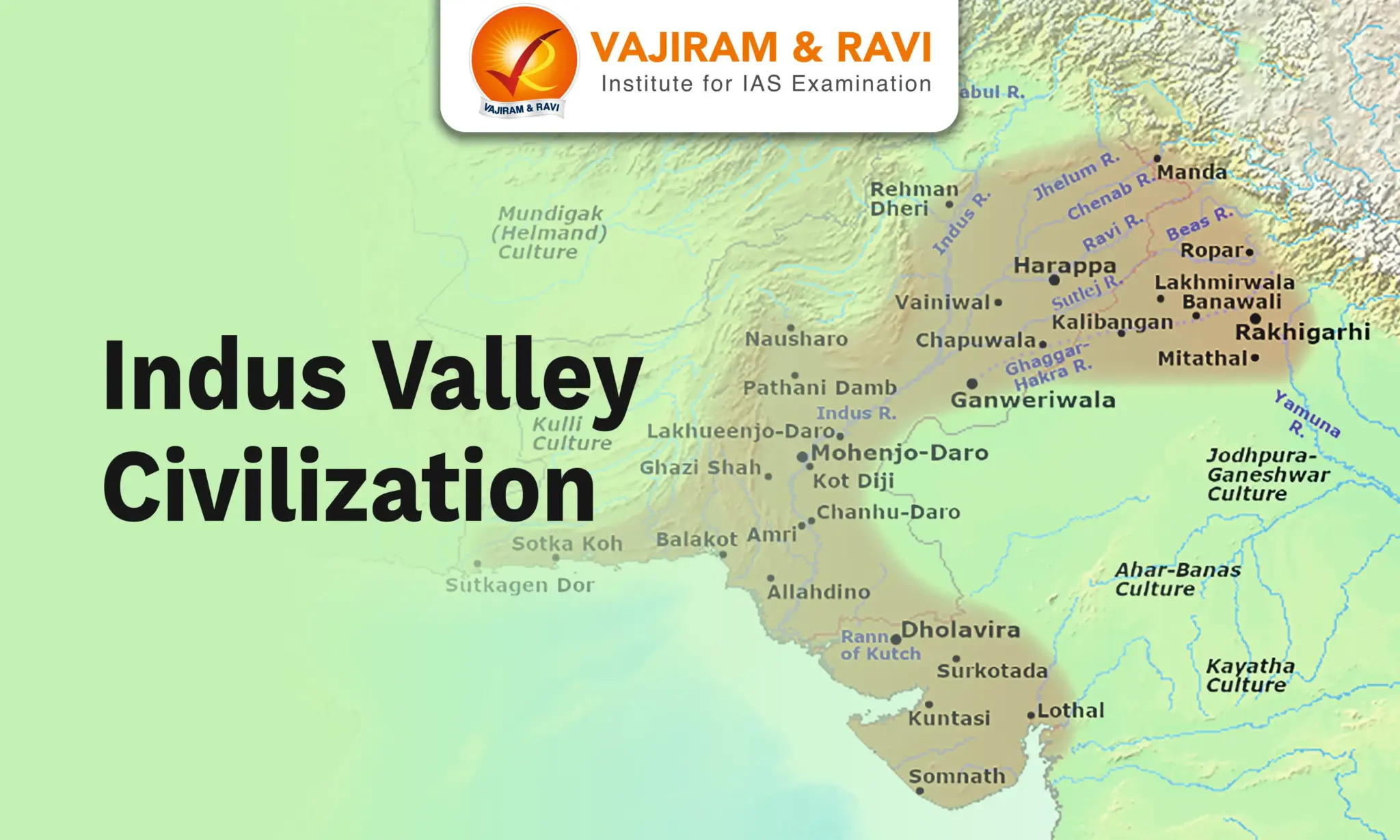
The Indus Valley Civilisation spanned the north-western region of the Indian subcontinent, covering parts of modern-day India, such as Punjab, Haryana, Rajasthan, and Gujarat, as well as Sindh and the Cholistan Desert in Pakistan. It encompassed an area of approximately 1,299,600 square km, and covered a considerably broader region than the ancient Egyptian or Mesopotamian cultures did.
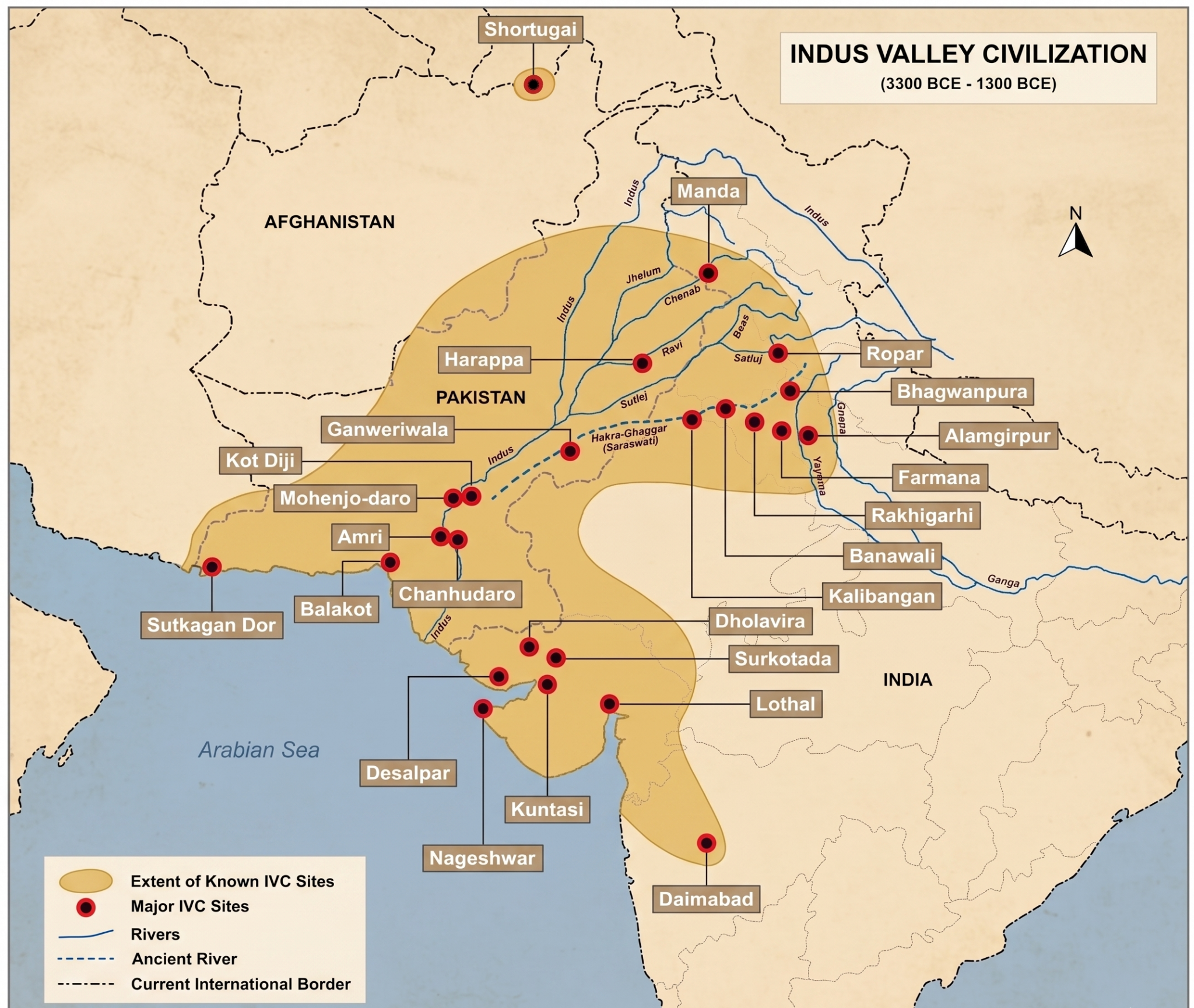
Major River Basins and Settlements
Settlements of the Indus Valley Civilisation primarily flourished along two major river systems:
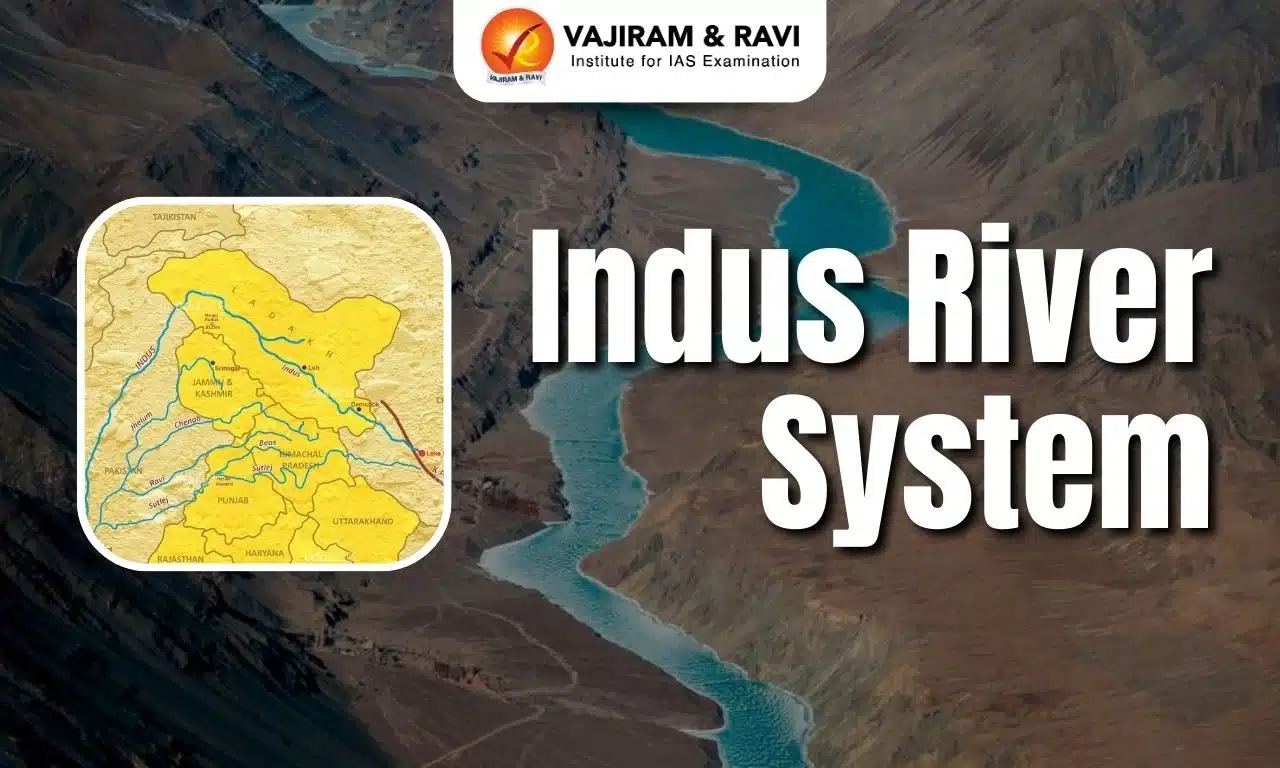
- The Indus River System: Major urban centers, including Harappa in Punjab and Mohenjo-daro in Sindh, grew along the fertile banks of the Indus River and its five tributaries.
- The Sarasvatī River Basin: Flowing east of the Indus from the Himalayan foothills down to the Gujarat and Thar region, the Sarasvatī River (represented today by the seasonal Ghaggar-Hakra riverbed) supported a remarkably high density of clustered settlements.
Indus Valley Civilisation Sites
The Indus Valley Civilization, situated in the river basins of the Indus and Ghaggar-Hakra, featured several key cities such as Mohenjo-Daro, Harappa, Kalibangan, Lothal, Rakhigarhi, Chanhudaro, Banawali, Dholavira, etc. It extended from Sutkagendor (in Balochistan, Pakistan) in the West to Alamgirpur (UP) in the East; and from Mandu (Jammu) in the North to Daimabad (Maharashtra) in the South. Major Indus Valley Civilisation sites include:
|
Major sites |
Location (Present) |
Major Findings |
|
Harappa |
Punjab province of Pakistan (Ravi River) |
- The site was discovered by Daya Ram Sahni in 1920 - The city was divided into two parts, i.e., the citadel and the lower town. - Great Granary located in the citadel - Elaborate drainage facilities made of baked bricks. - Evidence of wheel-made and baked pottery. - Evidence of coffin burial. |
|
|
Sindh Province, Pakistan (Indus River) |
- Included as a UNESCO World Heritage Site. - Mohenjo-Daro was divided into two parts: the Citadel and the Lower Town. - Great Bath ( ritual bathing site) and Great Granary. - Stone Art: Sculpture of Bearded Man - Bronze “Dancing Girl” Statue - Terracotta: Representations of bulls and buffalo and female figurines. - Complete burial - Seals: Depict animals, human figures, and even deities. Example: Pashupati seal. |
|
Hisar district, Haryana (Sarasvati River) |
- DNA analysis of skeletal remains revealed that the Harappan civilisation inhabitants had a distinct origin. - Land townships were enclosed with mud and burnt brick homes. - Efficient drainage system and proper sanitation. - The granary consisted of mud bricks and the floor was made of rammed earth plastered with mud. - A seal with an alligator symbol was discovered. |
|
|
Great Rann of Kutch, Gujarat |
- Included in the list of World Heritage Sites list of UNESCO in 2021. - Cities consisted of a citadel, a middle town, and a lower town. - Cascading series of water reservoirs, - Extensive use of stone in construction. - Special burial structures. - Black-on-red ware pottery, Redware, and Buff ware pottery. - It is renowned for its sophisticated water harvesting system and, therefore, known as a lake city or a jala durga (water fort). |
|
|
Lothal (Mound of the dead) |
Gulf of Khambhat region, Gujarat |
- A metropolis with an upper and a lower town. - A bead factory and tidal dockyard were discovered. - It is the only port town of the Indus Valley Civilization. - People worshipped the fire god. - Use of coffins in burial pits. - Redware and Blackware pottery. - Lothal has revealed the earliest evidence of rice cultivation in South Asia. |
|
Rajasthan (Ghaggar River) |
- It is made up of three mounds. - Known for its remarkable fire altars and the world's earliest attested ploughed field. - The earliest form of artificial irrigation was practised. - Different types of burials show social inequalities. - Mesopotamian pottery was discovered at the site, showing trade relations. - Burnt bricks were used only for drains at Kalibangan. |
Indus Valley Civilization Features
The mature Harappan Phase includes a diverse range of urban and non-urban rural sites that vary in size and function but are inherently identifiable as Harappan settlements due to features such as town planning, pottery, script, seals, evidence of external trade, and so on. Some of these features have been discussed here.
City Planning of Indus Valley Civilization
One of the most outstanding features of the Indus cities was their well-planned town planning. The excavations at Harappa and Mohenjo-Daro have revealed a great deal of evidence of this.
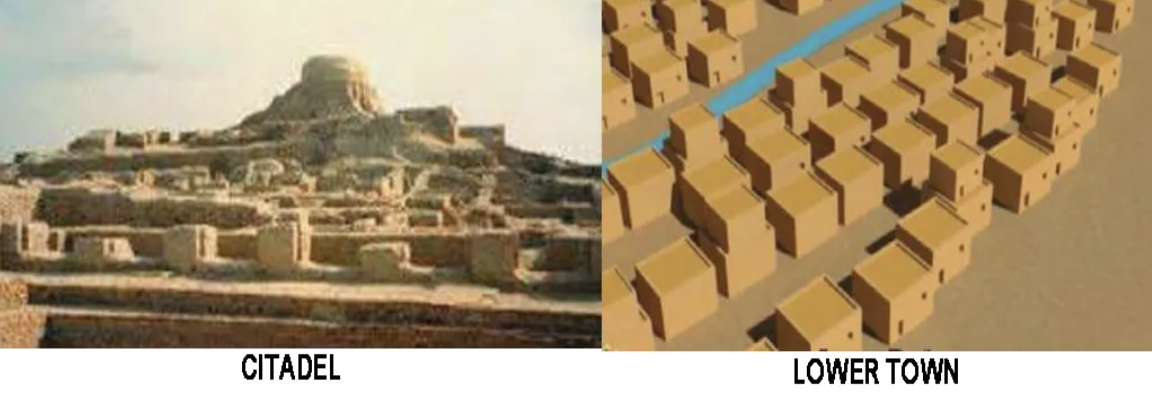
- Two parts: Generally, the cities of Harappan culture had two parts – the citadel and the outer city. The citadel was erected on an elevated site. The outlying city was on a lower level.
- Grid patterns: The IVC cities were constructed in a grid arrangement, with streets flowing north-south and east-west, resulting in a well-organised structure.
- The roadways were large and straight, cutting each other at right angles.
- Drainage System of Indus Valley Civilization: They had an excellent drainage system. The drains were built of mortar, lime, and gypsum. Each residence featured a sturdy washbasin from which water poured into the subsurface drains.
- Houses: Houses were of different types, small and large. Burnt bricks were extensively used to make houses and other structures. Houses were also provided with wells and bathrooms.
- Other Important Structures: The Great Bath and Pillared Hall at Mohenjo-Daro, the dockyard at Lothal, and the granary at Harappa.
Social Life
The social life of the Indus Valley Civilisation was systematic, peaceful, and highly urbanised. Society was divided into various occupational groups like merchants, artisans, farmers, and administrators.
- Political authority: There may have been some sort of political authority/State did exist in the Harappan civilization.
- The communication systems, standardisation of artefacts, site specialisation, use of a common system of writing, and the establishment of trading outposts like Shortughai are evidence of some kind of political authority.
- Social classes: The different types of houses indicate different social classes. Merchants appear to have formed the upper class, as trading was the primary activity. The artisans and farmers might be the common people.
- Dress: The discovery of many spindles suggests the use of cotton and woollen fabrics.
- Ornaments: A large number of ornaments like necklaces, armlets, finger-rings, bangles, etc., have been found from these sites. These were made of gold, silver, ivory, and precious stones.
- Recreation and Amusements: The people of Harappa appear to have enjoyed dance and music. They were also familiar with indoor activities such as dice.
- A great quantity of terracotta toys was discovered in Mohenjo-Daro.
Economic Conditions
The Harappan civilisation occupied a varied landscape encompassing alluvial plains, mountains, plateaus, and sea coasts. The area was rich enough to generate a surplus, which was crucial for urbanisation.
- Agriculture: Agriculture was the primary occupation of the Indus Valley people. They cultivated wheat, barley, peas, and, in some places, rice.
- They produced enough for both themselves and trade.
- They did not irrigate their land with canals.
- The annual flood provided sufficient moisture to cultivate crops.
- Fields were ploughed using a wooden ploughshare.
- Domestication of animals: Based on the Indus seals, it can be said that many animals, including goats, buffaloes, oxen, elephants, dogs, and camels, were domesticated.
- However, the Harappans do not appear to have been familiar with the horse.
- Metallurgy: Harappans were aware of copper, gold, and silver metallurgy. Copper was widely used, and it occurs in the form of weapons, agricultural tools, ornaments, etc.
- Metalcasting appears to be a continuous tradition. The late Harappan and Chalcolithic sites like Daimabad in Maharashtra yielded excellent examples of metal-cast sculptures.
- Trade: The urban culture and highly specialised manufacturing activity indicate that Harappan cities enjoyed a thriving trade. There was flourishing internal trade between the cities.
- The river Indus served as the main waterway through which most of this trade was carried out.
- They also traded with Mesopotamian cities. Many Harappan seals have been found in Mesopotamian cities.
- They exported grain, jewellery, and pottery and imported tin, copper, and precious stones.
Religious Practices
One of the first understandings of the Harappan religion was forwarded by John Marshall. He found several parallels between the Harappan religion and modern Hinduism. One of the seals was identified by him as a ‘Proto-Shiva' seal.
- This seal has a male figure seated on a dais. His heels are joined, and his toes point downward. This position is very similar to mulabandhasana in yoga.
- Figurines resembling a female deity have been found. They suggest worship of the Mother Goddess.
- No temples have been discovered at any of the Harappan sites.
- Harappans might have also venerated pipal trees. One seal depicts seven figures paying obeisance to the tree.
Art During Indus Valley Civilisation
The art of the Indus Valley Civilisation includes remarkable stone and bronze sculptures, intricate steatite seals, terracotta figurines, and polished pottery. Masterpieces like the bronze "Dancing Girl" and the stone "Priest-King" showcase advanced craftsmanship and aesthetic sophistication in early urban South Asia.
- Art: Most human figurines were handmade and made from bronze, terracotta, steatite, and faience material. The female figures were embellished with ornate jewellery and headdresses.
- Examples: the Dancing Girl statue and priest-king (male figurine).
- Faience: It is an artificial material made from quartz. Several faience items, including beads, bangles, earrings, and figurines, have been discovered in Harappan archaeological sites.
- Crafts: The Harappan people were good craftsmen. They used more copper than bronze.
- Brick-making and masonry were other important occupations.
- Spinning and weaving too were common crafts.
- Pottery made on a potter's wheel was decorated with different designs and painted red and black.
Indus Valley Civilization Script
The Indus seals are a unique source available to us to learn about the Harappan culture. They are small rectangular terracotta tablets with drawings of vegetation and animals. There is also visual text on them. Since this pictorial script has yet to be deciphered, our understanding of the Harappans is largely limited to those images. The Indus Script is boustrophedon (as an ox turns in ploughing). It is a term used for scripts that are written in both directions – left to right and right to left continuously.
Indus Valley Civilization Seals
Indus Valley seals are small, carved stone objects made mostly of steatite around 2500–1500 BCE. They feature animal figures, religious motifs, and an undeciphered writing system. People used them for trade, branding goods, and as personal identity amulets.
Indus Valley Civilization Decline
Spanning approximately a millennium, the Harappan Civilisation (or Indus Valley Civilisation) came to an end around 1300 BCE, coinciding with the arrival of the Aryans in India. While the precise causes of the decline of the Indus Valley Civilisation remain uncertain, several key factors have been proposed:
- Changes in Climatic conditions: The generally accepted view among historians is that a gradual change in climatic conditions rendered the region inhospitable and caused its decline.
- Natural Calamities: Some believe that natural calamities like floods or earthquakes might have caused its destruction.
- Decline in Trade: Extensive hydrological studies have established that the river Indus and Sarasvati changed their courses several times, maybe around 1900 BC.
- This calamity must have brought out large-scale changes or disruptions in the internal trade routes connecting the hinterland with the coast.
Indus Valley Civilization UPSC PYQs
Q1: The ancient civilisation in the Indian sub-continent differed from those of Egypt, Mesopotamia, and Greece in that its culture and traditions have been preserved without a breakdown to the present day. Comment. (UPSC Mains 2015)
Q2: To what extent has the urban planning and culture of the Indus Valley Civilization provided inputs to present-day urbanisation? Discuss. (UPSC Mains 2014)
Q3: Which one of the following ancient towns is well-known for its elaborate system of water harvesting and management by building a series of dams and channelling water into connected reservoirs? (UPSC Prelims 2021)
- Dholavira
- Kalibangan
- Rakhigarhi
- Ropar
Ans: (a)
Q4: Which one of the following is not a Harappan site? (UPSC Prelims 2019)
- Chanhudaro
- Kot Diji
- Sohgaura
- Desalpur
Ans: (c)
Q5: Which of the following characterise/characterises the people of the Indus Civilization? (UPSC Prelims 2013)
- They possessed great palaces and temples.
- They worshipped both male and female deities.
- They employed horse-drawn chariots in warfare.
Select the correct statements using the codes given below:
- 1 and 2 only
- 2 only
- 1, 2 and 3
- None of the above
Ans: (b)
| Other Related Posts | |
| Prehistoric Period | Indus Valley Civilization Sites |
| Chalcolithic Age | Rakhigarhi |
| Megalithic Culture | Lothal |
| Town Planning of Harappan Civilization | Kalibangan |

 Last updated on Oct, 2026
→ UPSC 2027 Notification will be released on 13 January 2027 at upsconline.nic.in.
→ Check Nobel Prize 2026 Winners List here.
→ Download PIB PRiSM Monthly Magazine 2026 here.
→ Check UPSC Monthly Current Affairs Magazine The Recitals here.
→ Check out the latest UPSC Syllabus here.
→ Download UPSC Model Answers for Mains 2026
→ UPSC Mains Question Paper 2026 is out now for Essay & GS Paper 1, 2, 3 & 4.
→ UPSC Calendar 2027 has been released.
→ Enroll in Vajiram & Ravi’s UPSC Mains Test Series 2027 for structured answer writing practice, expert evaluation, and exam-oriented feedback.
→ Join Vajiram & Ravi’s UPSC Mentorship Program 2027 for personalized guidance, strategy planning, and one-to-one support from experienced mentors.
→ Go through the UPSC Mains Previous Year Papers to enhance your preparation.
→ UPSC has released UPSC Toppers List 2025 with the Civil Services final result on its official website.
→ Also check Best UPSC Coaching in India
Indus Valley Civilization FAQs
Q1. What is the Indus Valley Civilisation known for?+
Q2. What was the Indus Valley Civilisation?+
Q3. What civilization lived in the Indus Valley?+
Q4. Who first called Indus Valley Civilization?+
Q5. What is the old name of Indus Valley?+
Tags: indus valley civilization quest upsc ancient history notes