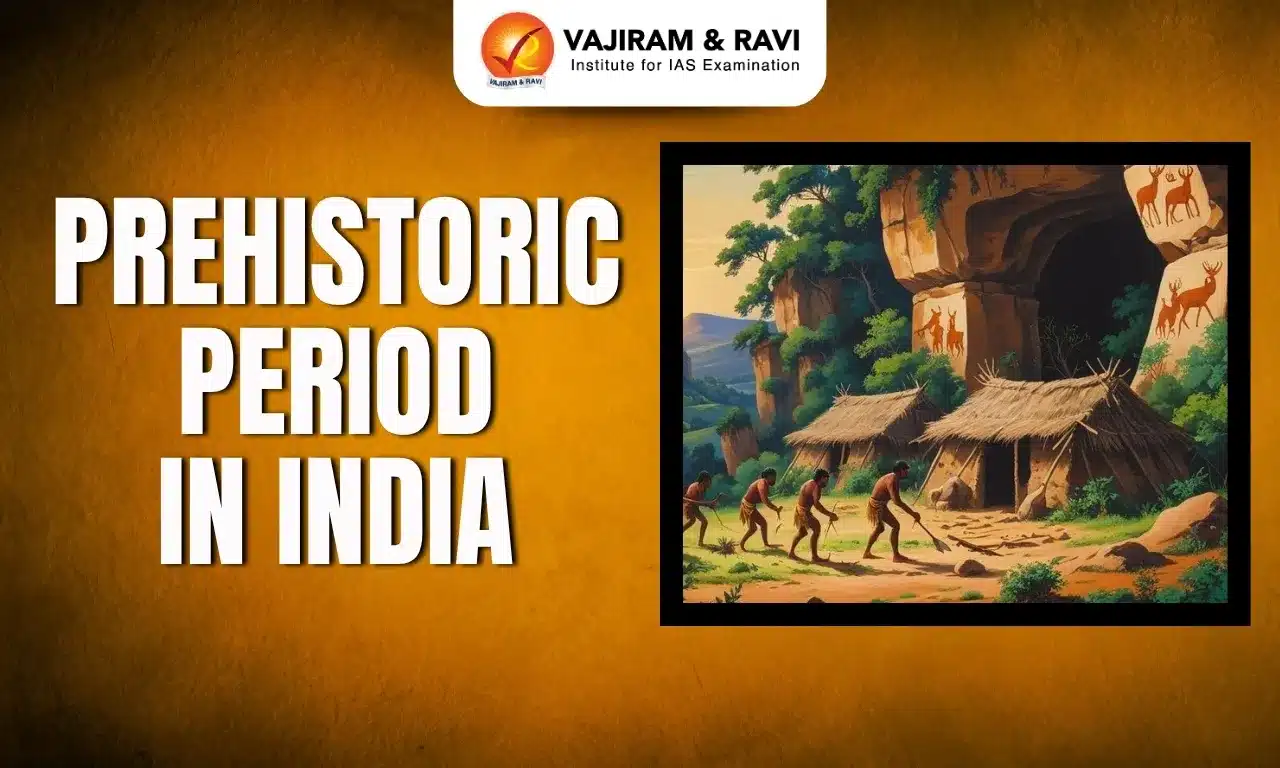
Prehistoric Period in India refers to the phase before the use of written records. Knowledge of this period comes mainly from archaeological evidence such as stone tools, pottery, animal bones, human burials, rock paintings, settlement remains, and plant remains.
The Prehistoric period in India is broadly studied through the Stone Age and the subsequent Chalcolithic Age. The Stone Age is divided into the Palaeolithic Age, Mesolithic Age, and Neolithic Age, each reflecting important changes in tools, food habits, settlement patterns, and social life.
Prehistoric Period Meaning
The term 'prehistoric period' means the period before the emergence of writing. Since written documents are unavailable, historians and archaeologists reconstruct this period through material remains found during excavations. The prehistoric period is most commonly known as the Stone Age.
- Prehistoric India forms the earliest chapter of the human past, which is broadly divided into Prehistory, Protohistory, and History.
- Prehistory covers human development before writing, often called the Stone Age due to the widespread use of stone tools. Protohistory bridges prehistory and recorded history, spanning the 3rd and 2nd millennia BCE.
- Categorised through technological evolution, the Stone, Bronze, and Iron Ages, this framework provides essential context for understanding early human life on the Indian subcontinent.
Prehistoric Period in India Timeline
The timeline of the prehistoric period in India covers the time from the first stone tools to the invention of writing (around 3,300 BCE). This era is split into the Stone Age, Bronze Age, and Iron Age, marking humanity's shift from nomadic hunter-gatherers to literate, urban civilisations.
|
Stage |
Time Period |
|
Palaeolithic Age |
Lower Paleolithic: 5,00,000- 100,000 BC Middle Paleolithic: 100,000 - 40,000 BC Upper Paleolithic: 40,000 - 10,000 BC |
|
Mesolithic Age |
10,000 - 4000 BC |
|
Neolithic Age |
7000 - 1000 BC |
|
Chalcolithic Age |
2000 - 700 BC |


Palaeolithic Age of Prehistoric Period
The Palaeolithic Age in India, also known as the Old Stone Age, marks the earliest prehistoric period in India, beginning nearly 2 million years ago. It is characterised by hunter-gatherer communities using stone tools like hand axes. This era witnessed human ancestors adapting to nature, discovering fire, and creating vibrant cave art at Bhimbetka.
- When assessing the evidence for early human settlement in India, it is observed to be later than the African region but contemporaneous with other Asian countries.
- Depending on the technology of tools used, economic activities, and other cultural features, the Palaeolithic age can be divided into: Lower Palaeolithic, Middle Palaeolithic, and Upper Palaeolithic.
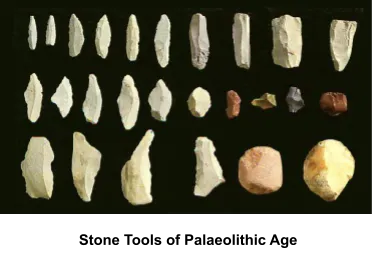
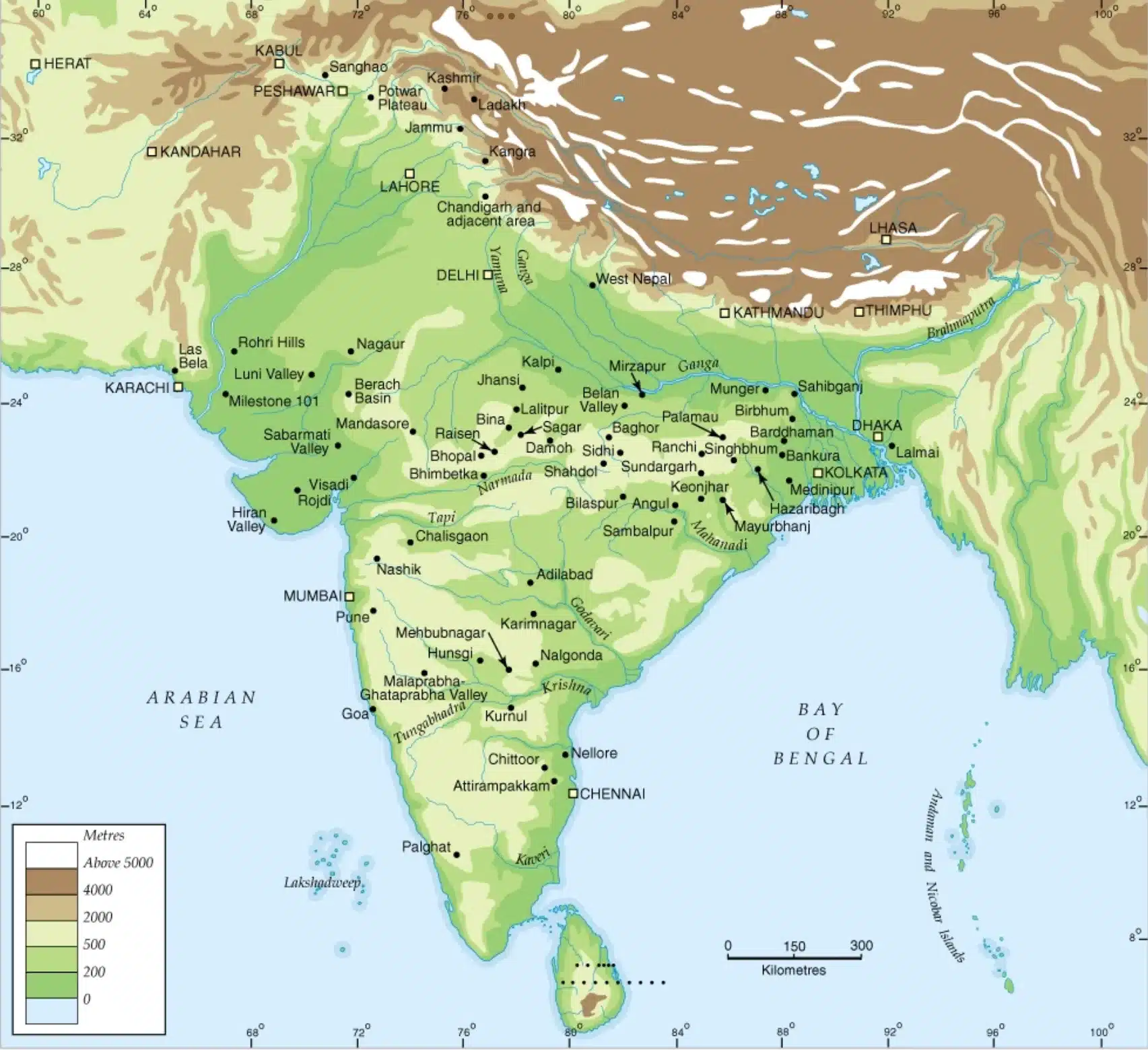
Lower Palaeolithic Age in India
The Lower Palaeolithic Age in India marks the earliest use of stone by Homo habilis and Homo erectus. People of this age were nomadic and dependent only on hunting and food gathering.
- Lower Palaeolithic Tools: Stones were used as chopping tools like hand axes, cleavers, knives, and choppers made from large pebbles or flakes.
- Two main traditions: Soanian tradition and the Acheulian Prehistoric Period tradition
- Important Sites:
- Singi Talav in Rajasthan
- Bhimbetka and Adamgarh in Madhya Pradesh
- Lalitpur, Uttar Pradesh
- Paisra, Bihar
- Chirki-Nevasa, Maharashtra
- Hunsgi and Yediyapur in Karnataka
- Attirampakkam, Tamil Nadu
Middle Palaeolithic Age in India
The Middle Palaeolithic Age in India witnessed a variety of tools made on flakes by specialised techniques, therefore referred to as the flake tool industry. Middle Palaeolithic culture in India is called Nevasian (similar to the Mousterian), after the flake tools found at Pravara, Nevasa.
- Middle Palaeolithic Tools: small and medium-sized handaxes, cleavers, scrapers, borers, knives, large borers and awls, a variety of scrapers, anvils and hammers.
- Sites:
- Didwana and Budha Pushkar in Rajasthan
- Hiran Valley in Gujarat
- Potwar Plateau between the Indus and Jhelum rivers
- Sanghao Cave in NWFP of Pakistan
- Luni river system, denoting tool industries west of the Aravallis
- Chirki Nevasa in Maharashtra
- Kalpi in Uttar Pradesh
Upper Palaeolithic Age in India
The Upper Palaeolithic industries produced side, ovate, notched, and discoid scrapers, as well as unifacial and bifacial flake points, along with flake and core tools.
- Upper Palaeolithic Tools: Blades and burins, bone tools and specialised hunting tools.
- Sites:
- Rohiri Hills in Sindh
- Chopani Mando in Belan Valley
- Baghor in Madhya Pradesh
- Paisra in Bihar
- Haora and Khowai valleys in Tripura
- Kurnool and Muchchatla Chintamanu Gavi in Andhra Pradesh
Mesolithic Age of Prehistoric Period
The Mesolithic Age of the Prehistoric Period is a transitional age between the Palaeolithic and Neolithic that occurred around 10000 BCE and ended with the introduction of agriculture (beginning of the Neolithic Age).
- Climate: The phase is of variable length, depending on climatic factors like rising temperatures, warm and dry climates, and impacts on human life and fauna.
- Economy: Through hunting and gathering, fishing gained relevance.
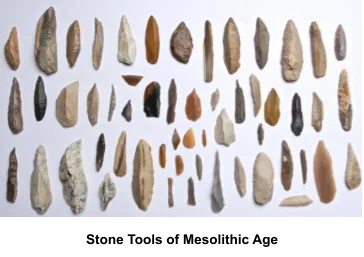
- Mesolithic Tools: Microliths were the distinctive features of this age. Macroliths, the larger tools, were also used. Bone and antler tools were also used.
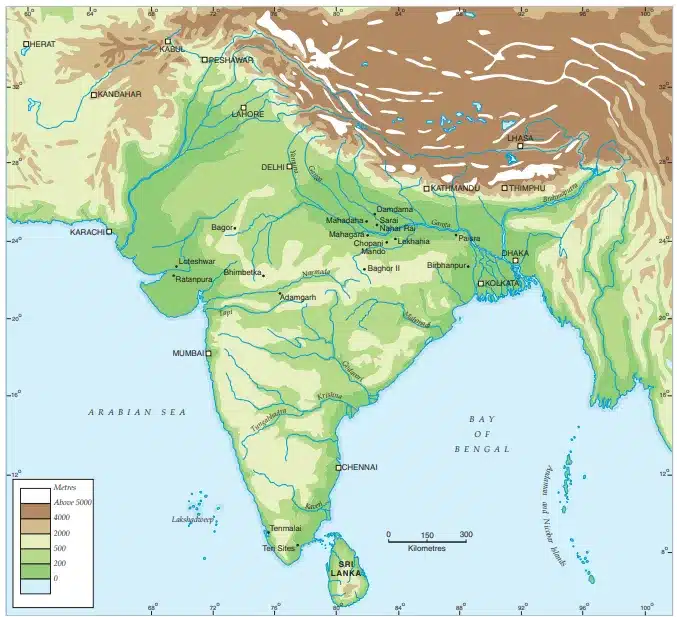
Mesolithic Age in India
The Mesolithic Age in India lasted only for 10,000 years due to the favourable climate for agriculture (for the Neolithic Age). Barring the Northeast, these sites are found throughout India.
- Mesolithic Sites:
- Mirzapur, Uttar Pradesh
- Tilwara, Bagor, Ganeshwar in Rajasthan
- Langhnaj, Akhaj, Valasana, Hirpura, Amrapur, Devnimori, Dhekvadlo, and Tarsang in Gujarat
- Patne, Pachad, Hatkhamba in Maharashtra
- Morkhana, Lekhahia, Baghai Khor, Sarai Nahar Rai, Mahadaha, Damdama, Chopani Mando, Baidha Putpurihwa in Uttar Pradesh
- Pachmarhi, Adamgarh, Putli Karar, Bhimbetka, Baghor II, Baghor III, Ghaghariain in Madhya Pradesh
- Paisra in Bihar
- Kuchai in Odisha
- Birbhanpur in West Bengal
- Muchatla Chintamanu Gavi, Gauri Gundam in Andhra Pradesh
Sanganakallu in Karnataka - Tenmalai in Kerala
Neolithic Culture in India
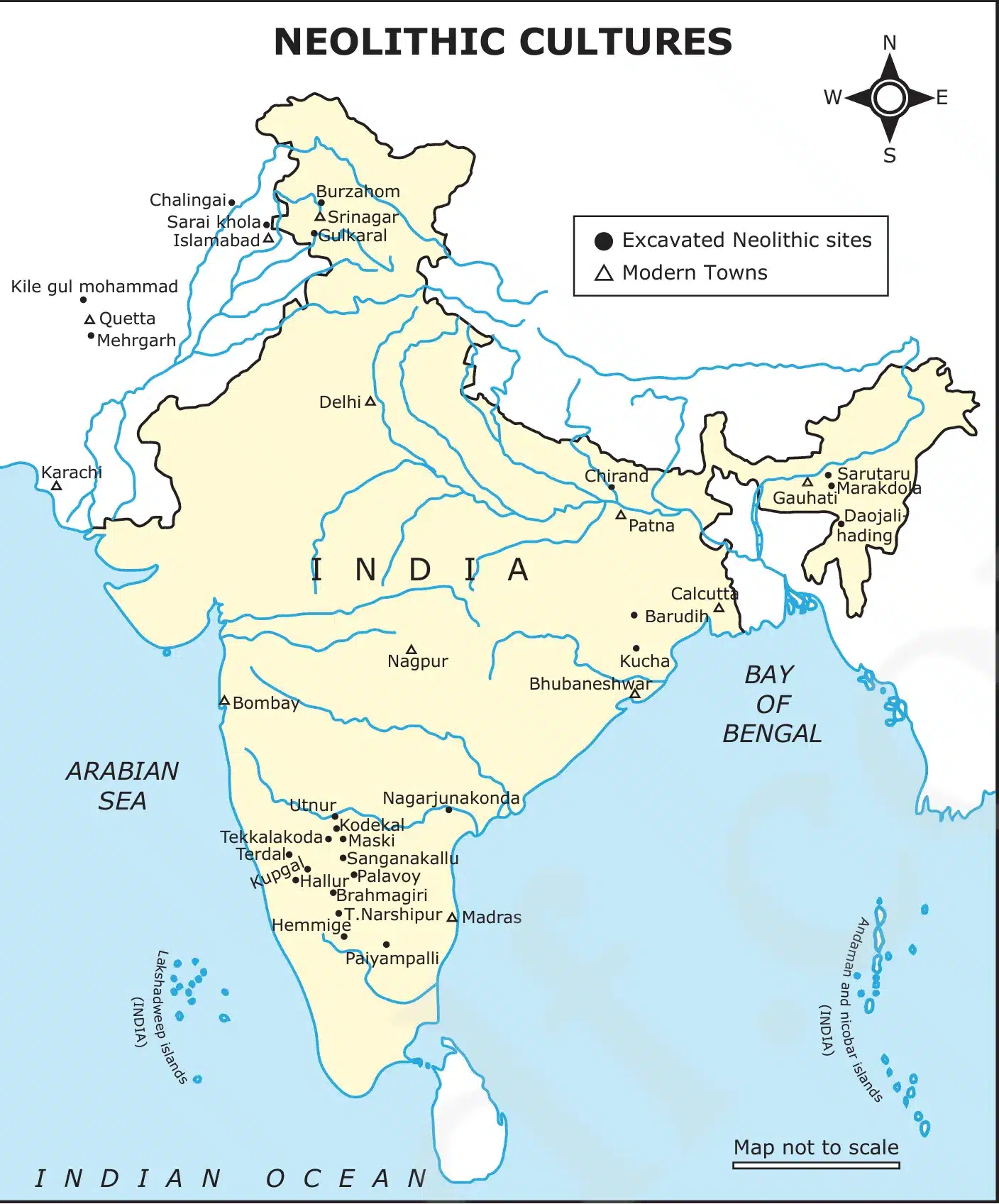
The Neolithic culture in India marked a major shift from nomadic hunting to settled farming villages, the use of polished stone tools, and pottery production.
- Neolithic Sites: Kashmir Valley, Vindhya-Ganga Valley, and Deccan and Peripheral Sites in Bihar, Jharkhand, Bengal, and Assam included the Late Neolithic Age.
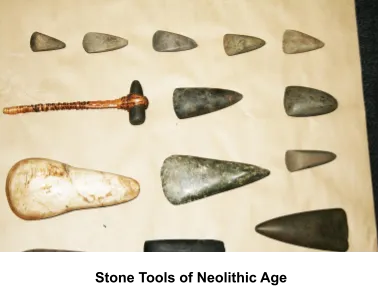
- Neolithic Tools: polished or ground stone axes, microliths, and blades.
- Pottery: Early Neolithic culture of a few sites, such as in Kashmir, Balochistan, and South India, was without any pottery. Later, earthen pots were the distinctive features.
- House: In the form of simple huts and pit dwellings
- Arts and crafts: Beads made of semi-precious stones and clay figures of animals and mother goddesses.
Chalcolithic Age in India
By the second millennium B.C., many parts of the Indian subcontinent had seen the birth of different regional cultures, which were defined by their use of metals, mainly copper and low-grade bronze. Thus, these societies are known as chalcolithic societies. Stone tools were also used.
- Chalcolithic cultures are named based on their location, such as Banas culture in Rajasthan, Kayatha culture in Madhya Pradesh and Jorwe culture in Maharashtra.
- The Chalcolithic culture, also known as the "stone-copper phase," lasted in India from approximately 2000 BC to 700 BC.
- This culture was prominent during the pre-Harappan period but was also present in various regions during the post-Harappan period.
Prehistoric Period in India PYQs
Q1: Explain the role of geographical features in shaping the early human settlements and culture in prehistoric India. (UPSC Mains 2023)
Q2: Mesolithic rock-cut architecture of India not only reflects the cultural life of the times but also a fine aesthetic sense comparable to modern painting. Critically evaluate this comment. (UPSC Mains 2015)
Q3: Which of the following pairs is/are correctly matched?(UPSC Mains 2014)
- Bhimbetka: Mesolithic site
- Burzahom: Neolithic site
- Inamgaon: Chalcolithic site
Select the correct answer using the code given below:
(a) 1 only
(b) 1 and 2 only
(c) 2 and 3 only
(d) 1, 2 and 3
Ans: (c)
| Other Related Posts | |
| Prehistoric Period | Indus Valley Civilization Sites |
| Chalcolithic Age | Rakhigarhi |
| Megalithic Culture | Lothal |
| Town Planning of Harappan Civilization | Kalibangan |

 Last updated on Oct, 2026
→ UPSC 2027 Notification will be released on 13 January 2027 at upsconline.nic.in.
→ Check Nobel Prize 2026 Winners List here.
→ Download PIB PRiSM Monthly Magazine 2026 here.
→ Check UPSC Monthly Current Affairs Magazine The Recitals here.
→ Check out the latest UPSC Syllabus here.
→ Download UPSC Model Answers for Mains 2026
→ UPSC Mains Question Paper 2026 is out now for Essay & GS Paper 1, 2, 3 & 4.
→ UPSC Calendar 2027 has been released.
→ Enroll in Vajiram & Ravi’s UPSC Mains Test Series 2027 for structured answer writing practice, expert evaluation, and exam-oriented feedback.
→ Join Vajiram & Ravi’s UPSC Mentorship Program 2027 for personalized guidance, strategy planning, and one-to-one support from experienced mentors.
→ Go through the UPSC Mains Previous Year Papers to enhance your preparation.
→ UPSC has released UPSC Toppers List 2025 with the Civil Services final result on its official website.
→ Also check Best UPSC Coaching in India
Prehistoric Period in India FAQs
Q1. Which period in history is called prehistoric?+
Q2. What are the three major periods of prehistoric time?+
Q3. What are the 4 ages of the Stone Age?+
Q4. Who lived in India 7000 years ago?+
Q5. Why is it called prehistoric?+
Tags: prehistoric period in india quest