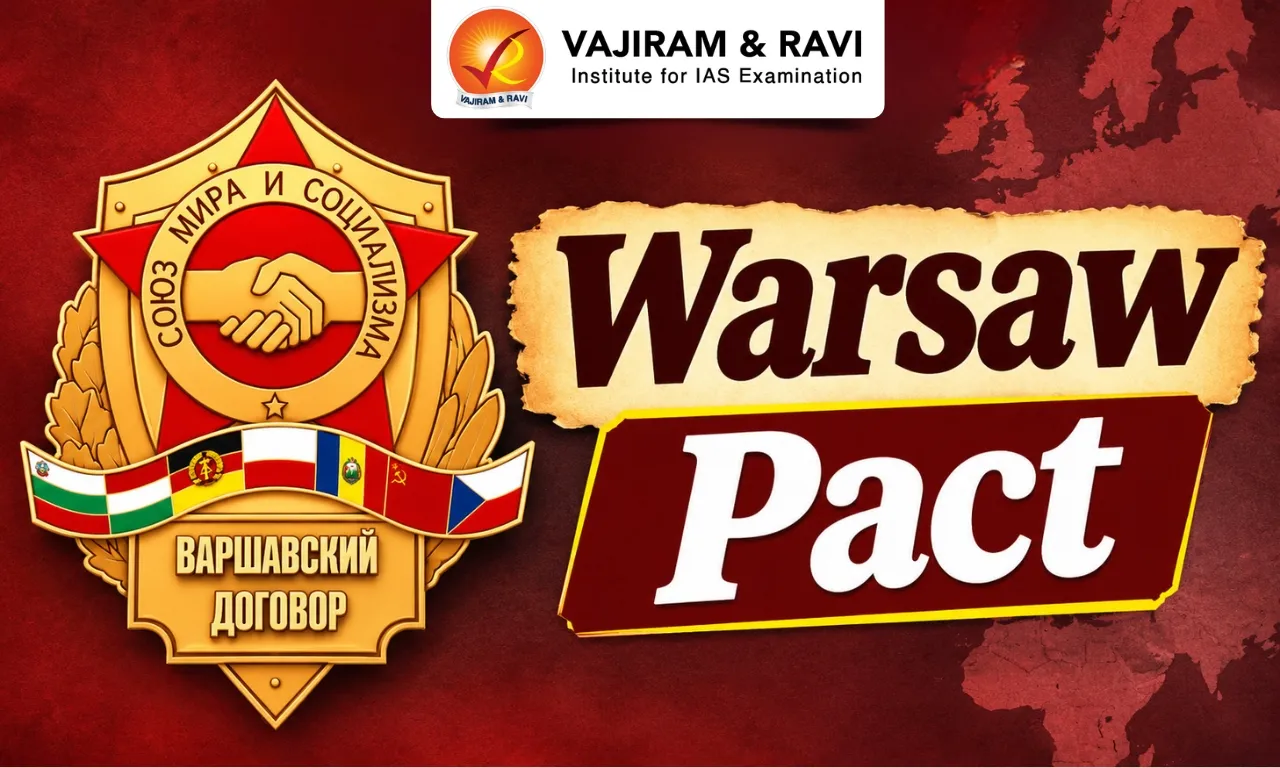
The Warsaw Pact, officially known as the Treaty of Friendship, Cooperation, and Mutual Assistance, was established on 14 May 1955 in Warsaw, Poland, as a military and political alliance between the Soviet Union and seven Eastern European states. It was formed in response to West Germany’s admission into NATO; it sought to create a unified defence system and secure Soviet influence across the communist bloc during the Cold War.
Over time, the Pact evolved beyond a defence arrangement into a mechanism of Soviet hegemony, enforcing ideological conformity, legitimising interventions, and maintaining the East–West balance of power. It symbolised the division of Europe into rival blocs, linking military coordination with economic interdependence through COMECON. The Pact’s eventual dissolution in 1991 marked not only the end of Soviet dominance in Eastern Europe but also the collapse of the Cold War’s bipolar order.
Warsaw Pact 1955 Historical Background
The Warsaw Pact emerged amid the intense geopolitical rivalry of the Cold War. In the aftermath of World War II, Europe became divided into two rival blocs — the Western capitalist bloc, led by the United States, and the Eastern communist bloc, led by the Soviet Union.
- Formation of NATO in 1949: In April 1949, the United States, Canada and ten Western European countries established the North Atlantic Treaty Organisation (NATO). The formation of NATO intensified the military and political division between the Western and Eastern blocs.
- Division of Germany: After World War II, Germany was divided into West Germany and East Germany. West Germany gradually became integrated into the Western security system, while East Germany remained under Soviet influence.
- West Germany's Entry into NATO: On 9 May 1955, West Germany officially joined NATO. The Soviet Union viewed this development as a threat to its security and influence in Eastern Europe. It also opposed the rearmament of West Germany and its integration into the Western military alliance.
Warsaw Pact Established
In response to West Germany's admission into NATO, the Soviet Union and seven Eastern European countries signed the Warsaw Treaty on 14 May 1955. The pact formally institutionalised the military cooperation between the Soviet Union and its Eastern European allies. Although it was presented as a collective defence arrangement, the Soviet Union exercised dominant influence over its military and political decisions.
Warsaw Pact Full Form
The Warsaw Pact formally stands for the Treaty of Friendship, Cooperation, and Mutual Assistance. It was also known as the Warsaw Pact Organisation (WPO) or Warsaw Treaty Organisation (WTO).
Warsaw Pact Date and Year
The Warsaw Pact was signed on 14 May 1955 in Warsaw, the capital of Poland. It remained in force until its formal dissolution on 1 July 1991. The treaty was renewed in 1985 for another 20 years, but the democratic revolutions in Eastern Europe and the collapse of communist regimes made the alliance ineffective before its formal end.


Warsaw Pact Objectives
The Warsaw Pact was created as the Soviet bloc’s counterbalance to NATO. Integrated with the Council for Mutual Economic Assistance (COMECON), it linked defence and economic systems, solidifying the Soviet sphere of influence and defining the bipolar world order of the Cold War. Major objectives of the Warsaw Pact included:
- Establish a collective defence system to deter Western aggression and safeguard member states.
- Consolidate Soviet authority in Eastern Europe by binding allies within a unified military-political framework.
- Counter NATO’s strategic dominance and maintain balance in Europe’s power structure.
- Preserve ideological unity within the communist bloc and prevent the spread of liberal or nationalist movements.
- Provide a legal basis for Soviet intervention in member states to sustain socialist regimes and political stability.
Warsaw Pact Countries
The Warsaw Pact originally consisted of eight member countries, including the Soviet Union and seven Eastern European states.
- Warsaw Pact Members: The original members of the Warsaw Pact were: Soviet Union, Albania, Bulgaria, Czechoslovakia, East Germany (German Democratic Republic), Hungary, Poland, and Romania.
- Withdrawal of Albania: Albania stopped participating in the alliance's activities following its growing ideological split with the Soviet Union. In 1968, Albania formally withdrew from the Warsaw Pact after the Soviet-led intervention in Czechoslovakia.
- Withdrawal of East Germany: East Germany withdrew from the pact ahead of German reunification.
Warsaw Pact Features
The Pact functioned as a Soviet-dominated alliance designed to secure political control, military coordination, and ideological conformity across Eastern Europe during the Cold War. It served not only as a defence pact but also as a key instrument of Soviet influence over its satellite states.
- Collective Defence: An attack on one member was deemed an attack on all, reinforcing deterrence against NATO.
- Unified Military Command: Armed forces of all member states were placed under a joint command headquartered in Moscow, led primarily by Soviet officers.
- Soviet Domination: Stationing of Soviet troops in member states guaranteed compliance and deterred dissent.
- Political Control Mechanism: The Pact legitimised Soviet interventions, as seen in Hungary (1956) and Czechoslovakia (1968), to suppress reformist movements.
- Integration and Standardisation: Common training systems, weaponry, and logistics created operational uniformity and deepened dependence on Soviet technology.
Warsaw Pact Significance
The Warsaw Pact held profound significance as both a diplomatic and strategic instrument of Soviet policy during the Cold War. Initially conceived to enhance the USSR’s leverage in European security negotiations, it soon evolved into a powerful mechanism for consolidating Soviet control, legitimising interventions, and institutionalising the bipolar balance of power with NATO.
- Diplomatic Leverage: The Pact reinforced Soviet bargaining power at the 1955 Geneva Summit by proposing a collective European security system rivalling NATO. Although a plan to dissolve both alliances failed, it highlighted Moscow’s intent to shape European security architecture.
- Political Instrument of Soviet Power: The Pact legitimised the Soviet military presence and strengthened Moscow’s regional diplomatic influence, enforcing alignment of foreign and defence policies within the communist bloc.
- Tool of Ideological Control: Functioning as a mechanism of “fraternal bloc solidarity", it enforced ideological conformity, curbing deviations from Moscow’s directives.
- Doctrine of Proletarian Internationalism: This doctrine underpinned Soviet interventions in Hungary (1956) and Czechoslovakia (1968), portraying them as obligations to protect socialism and maintain bloc unity.
- Symbol of Bloc Unity: The Pact projected collective strength while masking internal subordination, becoming a cornerstone of the Cold War order and reinforcing Soviet dominance in Eastern Europe.
Warsaw Pact Role During the Cold War
During the Cold War, the Warsaw Pact functioned as the principal military and political alliance of the Eastern Bloc, created to counterbalance NATO’s power and consolidate Soviet leadership. It served both as a defence framework and as an instrument of political and ideological coordination under Moscow’s control.
- Strategic Counterbalance: Formed in direct response to NATO and West Germany’s rearmament, the Pact unified the communist states of Eastern Europe under a collective defence system designed to deter Western aggression and ensure Soviet security.
- Military and Operational Integration: With its centralised command in Moscow, the Pact standardised military structures, training, and weapon systems across member states, creating a cohesive force that reflected Soviet doctrine and priorities.
- Instrument of Political Control: Beyond its defensive role, the Pact institutionalised Soviet dominance, enabling Moscow to intervene militarily to maintain ideological conformity and suppress political dissent within the bloc.
- Extension of Cold War Confrontation: The Pact symbolised the militarised division of Europe and aligned Eastern Europe with Soviet geopolitical ambitions. It influenced global proxy conflicts in Asia, Africa, and Latin America, embedding the Eastern alliance deeply in global Cold War politics.
Warsaw Pact Impacts
Warsaw Pact profoundly shaped Cold War geopolitics by consolidating Soviet authority in Eastern Europe, sustaining military parity with NATO, and deepening ideological confrontation. It transformed Eastern Europe into a tightly controlled political, economic, and military sphere within the Soviet orbit.
- Consolidation of Soviet Authority: It institutionalised Soviet dominance through collective defence commitments binding member states to Moscow’s leadership, suppressing independent policies.
- Military Deterrence and Strategic Balance: Mirroring NATO’s strength, it maintained power balance, deterring direct superpower conflict while perpetuating the arms race.
- Suppression of Dissent: It justified Soviet military interventions like those in Hungary (1956) and Czechoslovakia (1968), enforcing communist orthodoxy through coercion.
- Intensification of Cold War Rivalry: The Pact escalated East-West militarisation and ideological hostility, shaping decades of global tension and extending Cold War alignments.
- Economic and Structural Integration: Working alongside COMECON, it linked military cooperation with economic dependency, reinforcing political and economic subordination to the Soviet Union.
NATO vs Warsaw Pact
NATO and the Warsaw Pact were the two principal military alliances that shaped the international security architecture during the Cold War. NATO represented the Western Bloc, led by the United States, while the Warsaw Pact represented the Eastern Bloc, led by the Soviet Union.
|
Aspect |
NATO |
Warsaw Pact |
|
Formed |
1949 |
1955 |
|
Members |
Western Europe, USA, Canada |
Soviet Union and Eastern Europe |
|
Ideology |
Liberal democracy, capitalism |
Communism, socialism |
|
Command |
Decentralised, consensus-based |
Centralised under Soviet control |
|
Outcome |
Expanded after 1991 |
Dissolved in 1991 |
Warsaw Pact Decline
The decline of the Warsaw Pact began during the 1980s as the Soviet Union faced economic difficulties, political instability and growing resistance within Eastern Europe. Several developments contributed to the weakening of the alliance.
- Economic Crisis in the Soviet Union: The Soviet economy experienced stagnation during the 1970s and 1980s. High defence expenditure, inefficient central planning and declining economic productivity weakened the Soviet Union's ability to maintain its influence over Eastern Europe.
- Gorbachev's Reforms: Mikhail Gorbachev became the General Secretary of the Communist Party of the Soviet Union in 1985. He introduced two major reform policies:
- Glasnost: Promoted openness, transparency and greater freedom of expression.
- Perestroika: Aimed to restructure the Soviet political and economic system.
- Decline of Soviet Control: The Soviet Union gradually moved away from forcibly maintaining communist governments in Eastern Europe. Gorbachev's policies reduced the likelihood of Soviet military intervention against political reform movements in allied countries.
- The abandonment of the Brezhnev Doctrine marked a major shift in Soviet policy towards Eastern Europe.
- Rise of Democratic Movements: Several Eastern European countries witnessed growing opposition to communist rule. Important developments included:
- The Solidarity movement in Poland.
- Democratic protests in East Germany and German Reunification.
- Political reforms in Hungary.
- Opposition movements in Czechoslovakia.
- Withdrawal of Member Countries: By 1990–1991, countries such as Poland, Hungary and Czechoslovakia were increasingly distancing themselves from the Soviet-led alliance. The growing demand for sovereignty and independent foreign policies made the continuation of the Warsaw Pact increasingly difficult.
Warsaw Pact Dissolved
The Warsaw Pact was formally dissolved on 1 July 1991, marking the end of the Soviet-led military alliance that had shaped European geopolitics during the Cold War. Its dissolution followed the weakening of communist governments in Eastern Europe, the decline of Soviet influence and the growing demand for political independence among member states. Important events leading to dissolution:
- 1989: The fall of communist governments across Eastern Europe began.
- 9 November 1989: The Berlin Wall fell, symbolising the weakening of the Cold War division.
- 3 October 1990: East and West Germany were reunified.
- 24 September 1990: East Germany formally withdrew from the Warsaw Pact.
- February–March 1991: The alliance's military command structures and military cooperation mechanisms were dismantled.
- 1 July 1991: The remaining political structure of the Warsaw Pact was formally dissolved in Prague, Czechoslovakia.

 Last updated on Nov, 2026
→ UPSC Mains Result 2026 has been declared on 05 November 2026 at the official website at upsc.gov.in.
→ UPSC 2027 Notification will be released on 13 January 2027 at upsconline.nic.in.
→ Check Nobel Prize 2026 Winners List here.
→ Download PIB PRiSM Monthly Magazine 2026 here.
→ Check UPSC Monthly Current Affairs Magazine The Recitals here.
→ Check out the latest UPSC Syllabus here.
→ Download UPSC Model Answers for Mains 2026
→ UPSC Mains Question Paper 2026 is out now for Essay & GS Paper 1, 2, 3 & 4.
→ UPSC Calendar 2027 has been released.
→ Enroll in Vajiram & Ravi’s UPSC Mains Test Series 2027 for structured answer writing practice, expert evaluation, and exam-oriented feedback.
→ Join Vajiram & Ravi’s UPSC Mentorship Program 2027 for personalized guidance, strategy planning, and one-to-one support from experienced mentors.
→ Go through the UPSC Mains Previous Year Papers to enhance your preparation.
→ UPSC has released UPSC Toppers List 2025 with the Civil Services final result on its official website.
→ Also check Best UPSC Coaching in India
Warsaw Pact FAQs
Q1. What is warsaw pact?+
Q2. When was the Warsaw Pact dissolved?+
Q3. What is the Warsaw Pact and why was it important?+
Q4. Which came first, NATO or the Warsaw Pact?+
Q5. Did the USSR try to join NATO?+
Tags: quest UPSC World History Notes warsaw pact