The Cabinet Mission Plan of 1946 was a turning point in India's struggle for independence. The mission aimed to devise a plan for the peaceful transfer of power while addressing the competing demands of the Indian National Congress and the Muslim League. Headed by Lord Pethick-Lawrence, it sought to maintain the unity of India while offering a constitutional framework for self-governance.
The mission proposed the creation of a Constituent Assembly, a federal union with autonomy for provinces, and a complex grouping of provinces. Despite its efforts, the mission failed to reconcile the conflicting visions of the Congress and the Muslim League, setting the stage for India's eventual partition and independence in 1947.
Cabinet Mission Plan 1946
The Cabinet Mission Plan 1946 was announced on 16 May 1946 by the Cabinet Mission and Viceroy Lord Wavell. It provided a framework for India’s constitutional future and rejected both a strong unitary Centre and an immediate sovereign Pakistan.
- Announcement Date: On 19 February 1946, British Prime Minister Clement Attlee announced the dispatch of the Cabinet Mission to India.
- Arrival in India: The Cabinet Mission arrived in India on March 24, 1946, and announced its official proposals (the Cabinet Mission Plan) on May 16, 1946.
Cabinet Mission Background
The background for the Cabinet Mission (1946) can be understood in the context of the political developments following the Second World War.
- Intensification for Independence: After the Labour Party came to power in Britain in 1945, the British Government expressed its intention to facilitate the framing of a new Constitution for India. By 1946, political pressure for Indian independence had reached its peak. It was evident that British rule in India was nearing its end.
- Failure of Cripps Mission: Following the failure of the Cripps Mission 1942, there was little left to offer in terms of conciliation, except full freedom.
- Growing Discontent: The growing discontent within the military (as evident in the Royal Indian Navy or RIN Mutiny), with soldiers showing solidarity with nationalist movements, created fears of the unreliability of the armed forces in suppressing another large-scale rebellion like the Quit India Movement of 1942.
- Realisation: The British government recognised the urgent need for a political settlement to avoid another mass uprising and ensure favourable future relations with an independent India.
- Keeping these things in mind, the Cabinet Mission was sent to India with the primary aim of ensuring a united India.


Cabinet Mission Members
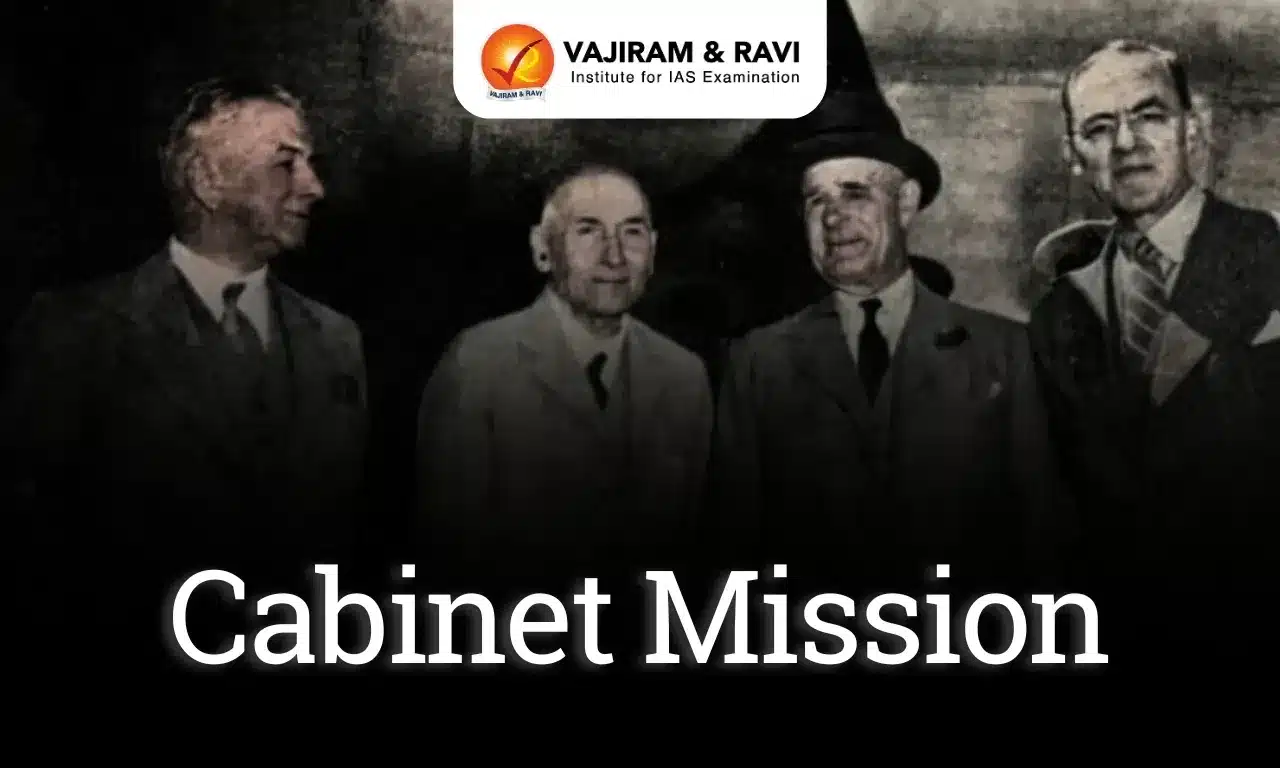
There were a total of three members in the Mission: Lord Pethick-Lawrence (Secretary of State for India), Sir Stafford Cripps (President of the Board of Trade), and A V Alexander (First Lord of the Admiralty). Cabinet Mission Plan 1946 was headed by Lord Pethick-Lawrence.
Cabinet Mission Proposals
The Cabinet Mission arrived in Delhi on March 24, 1946, and engaged in extended discussions with leaders of various political groups, focusing on two key issues: the formation of an interim government and the principles for drafting a new constitution to grant India independence. Since the Indian National Congress and the Muslim League could not agree on the critical question of whether India should remain united or be partitioned, the mission eventually proposed its own solution to the constitutional deadlock in May 1946. The main proposals of the Cabinet Mission Plan are the following:
- Rejection of Pakistan: The Mission outright rejected the Muslim League's demand for a separate, full-fledged Pakistan. The mission believed that partition would lead to serious economic, political, and administrative challenges.
- Grouping of Provincial Assemblies: The existing provincial assemblies were to be organised into three sections:
- Section A: Hindu-majority provinces (Madras, Bombay, Central Provinces, United Provinces, Bihar, and Orissa).
- Section B: Muslim-majority provinces (Punjab, North-West Frontier Province, and Sindh).
- Section C: Bengal and Assam, which also had significant Muslim populations.
- Three-Tier Government Structure: A three-tier executive and legislative framework was proposed at the provincial, section, and union levels.
- Constituent Assembly Formation: A constituent assembly would be elected by the provincial assemblies using proportional representation, with voting in three groups: General, Muslims, and Sikhs.
- This assembly would consist of 389 members, 292 from provincial assemblies, 4 from chief commissioner’s provinces, and 93 from princely states.
- In the Constituent Assembly, representatives from groups A, B, and C would convene separately to discuss provincial constitutions.
- Later, all the groups would meet collectively to frame the Union Constitution.
- Common Centre Authority: A central authority would manage defence, communication, and external affairs within a federal framework for India.
- Decision-Making in Central Legislature: Communal issues in the central legislature would be resolved by a simple majority vote from both communities present.
- Provincial Autonomy: Provinces were to enjoy full autonomy and retain residual powers.
- Princely State Independence: Princely states would no longer be under British paramountcy and could negotiate arrangements with successor governments or the British government.
- Formation of Interim Government: Meanwhile, an interim government was to be established from the constituent assembly.
Cabinet Mission Reactions
The Mission was met with a mixed response from Indian political leaders and parties. The lack of consensus between the Indian National Congress and the Muslim League further complicated the situation, as both parties had differing views on the mission's recommendations.
- Indian National Congress: The Congress initially welcomed the idea of a Constituent Assembly and a unified India. However, it objected to the proposal of grouping provinces, especially when it seemed to grant Muslim-majority areas significant autonomy.
- Muslim League: The League initially accepted the plan, particularly because it allowed for Muslim-majority provinces to group together.
- However, they later rejected the mission after Congress opposed the idea of mandatory grouping, seeing it as a betrayal of Muslim interests and their demand for Pakistan.
Cabinet Mission Failure
The Cabinet Mission failed primarily due to conflicting interpretations of the plan and the inability of Congress and the Muslim League to agree on the nature of the future Indian Union. Major reasons for the failure of the Cabinet Mission include the following:
- Different Interpretations of Grouping: The Muslim League considered grouping essential because it created Muslim-majority blocks in the north-west and east. The Congress believed provinces should have the freedom to opt out of groups.
- Congress–League Rivalry: The Congress claimed to represent all Indians, including Muslims. The Muslim League claimed to be the sole representative of Indian Muslims.
- This conflict over political representation prevented the formation of a stable coalition government.
- Demand for Pakistan: The Muslim League’s central political objective was the creation of Pakistan. The Cabinet Mission rejected a sovereign Pakistan because it considered partition administratively, economically, and militarily impractical.
- The League accepted the plan temporarily but returned to the Pakistan demand after political negotiations broke down and called for Direct Action to press its demand for Pakistan.
- Weakness of British Mediation: The British government could not enforce a common interpretation of the plan. Its inability to reconcile Congress and League positions weakened the proposal and accelerated the movement towards partition.
Formation of Interim Government
Amid concerns over potential mass mobilization by the Congress, an Interim Government dominated by Congress was established, with Jawaharlal Nehru sworn in as its head on September 2, 1946. Despite his leadership role, Nehru maintained his party's strong opposition to the mandatory grouping of provinces proposed by the Cabinet Mission. On October 26, 1946, Lord Wavell discreetly integrated the Muslim League into the Interim Government, attempting to foster a sense of collaboration among the major political factions in India.
Cabinet Mission Significance
The Cabinet Mission of 1946 marked a watershed moment in India's struggle for independence. Its primary significance lies in laying the groundwork for independent India's Constituent Assembly and facilitating the peaceful transfer of power, even though its ultimate goal of preventing India's partition was not achieved.
- Constituent Assembly: The Cabinet Mission Plan proposed a Constituent Assembly to draft India's Constitution, establishing the institutional foundation for constitution-making and shaping the framework of independent India's governance.
- Rejection of Pakistan: The Mission rejected the Muslim League's demand for a separate Pakistan, favouring a united India with grouped provinces and substantial autonomy for Muslim-majority regions.
- Formation of the Interim Government: The Cabinet Mission facilitated the formation of an Interim Government under Jawaharlal Nehru, enabling Indian leaders to gain administrative experience before the British withdrawal.
- Final Path to Independence: The failure of the Cabinet Mission Plan intensified political divisions, eventually prompting Britain to accelerate its withdrawal and paving the way for the Mountbatten Plan and partition.
Cabinet Mission UPSC PYQs
Q1: Assess the role of British imperial power in complicating the process of transfer of power during the 1940s. (UPSC Mains 2019)
Q2: In what ways did the naval mutiny prove to be the last nail in the coffin of British colonial aspirations in India? (UPSC Mains 2014)
Q3: With reference to the Cabinet Mission, which of the following statements is/are correct? (UPSC Prelims 2014)
- It recommended a federal government.
- It enlarged the powers of the Indian courts.
- It provided for more Indians in the ICS.
Select the correct answer using the code given below.
(a) 1 only
(b) 2 and 3
(c) 1 and 3
(d) None
Ans: (a)

 Last updated on Oct, 2026
→ UPSC 2027 Notification will be released on 13 January 2027 at upsconline.nic.in.
→ Check Nobel Prize 2026 Winners List here.
→ Download PIB PRiSM Monthly Magazine 2026 here.
→ Check UPSC Monthly Current Affairs Magazine The Recitals here.
→ Check out the latest UPSC Syllabus here.
→ Download UPSC Model Answers for Mains 2026
→ UPSC Mains Question Paper 2026 is out now for Essay & GS Paper 1, 2, 3 & 4.
→ UPSC Calendar 2027 has been released.
→ Enroll in Vajiram & Ravi’s UPSC Mains Test Series 2027 for structured answer writing practice, expert evaluation, and exam-oriented feedback.
→ Join Vajiram & Ravi’s UPSC Mentorship Program 2027 for personalized guidance, strategy planning, and one-to-one support from experienced mentors.
→ Go through the UPSC Mains Previous Year Papers to enhance your preparation.
→ UPSC has released UPSC Toppers List 2025 with the Civil Services final result on its official website.
→ Also check Best UPSC Coaching in India
Cabinet Mission FAQs
Q1. What is the Cabinet Mission Plan of India?+
Q2. Who was the chairman of the Cabinet Mission in 1946?+
Q3. Is the Cabinet Mission and Cripps Mission the same?+
Q4. How many members were in the Cabinet Mission to India in 1946?+
Q5. Who rejected the Cabinet Mission proposal?+
Tags: cabinet mission quest upsc modern indian history notes