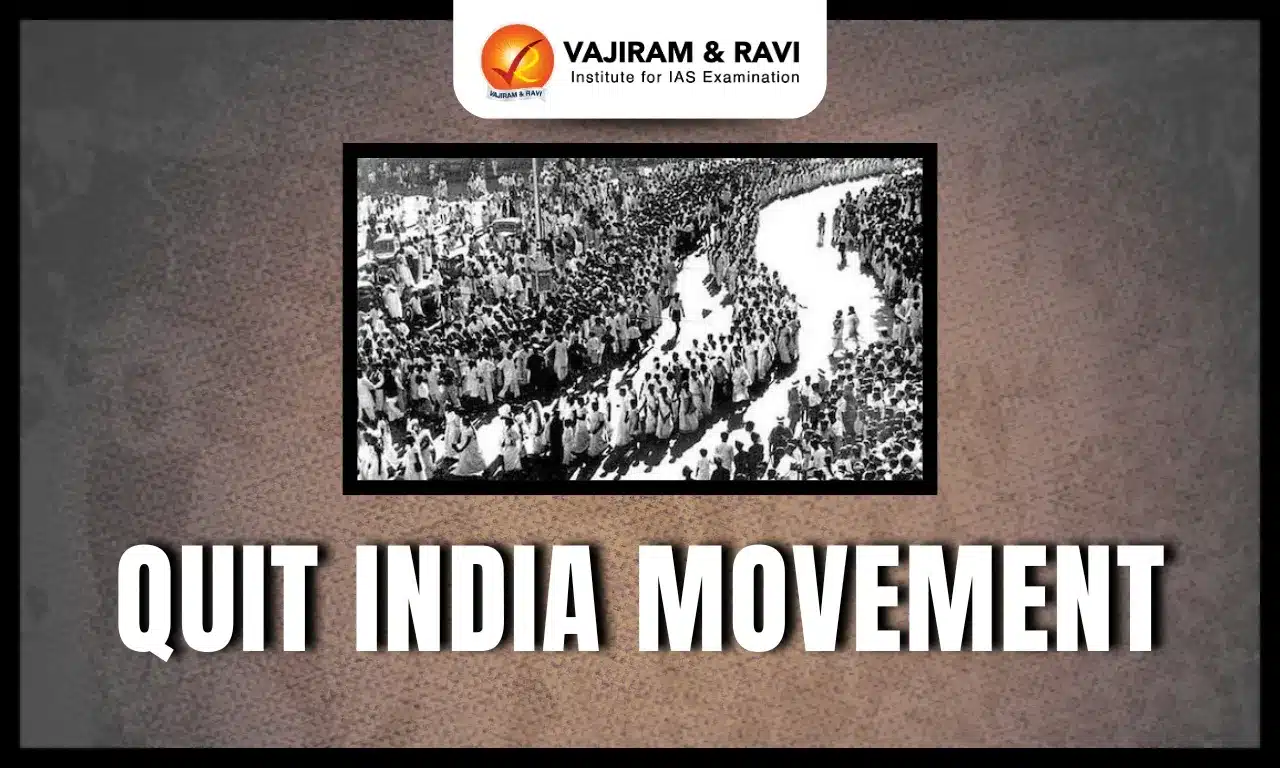
Quit India Movement in India, launched on August 8, 1942, under Mahatma Gandhi's leadership, was a significant anti-colonial struggle. Gandhi's slogan, "Do or Die," marked a decisive call for ending British rule. Initially a civil disobedience movement, it soon turned violent, aiming to dismantle the colonial regime.
Also called the "August Kranti Movement," Quit India Movement represented a firm rejection of British rule rather than traditional Satyagraha and set the stage for transformative events in Indian history over the next five years.
Quit India Movement in India 1942
The Quit India Movement (Bharat Chhod Andolan), popularly known as the August Kranti Movement, was a mass civil disobedience campaign initiated by the Indian National Congress (INC) to demand the immediate withdrawal of British rule from India. The Quit India Movement was launched in response to the failure of the Cripps Mission and the British refusal to grant India immediate independence during World War II.
Quit India Movement Date
The Quit India Movement was officially launched on August 8, 1942. Initiated by Mahatma Gandhi during the All India Congress Committee session in Bombay, it marked the beginning of a mass civil disobedience campaign demanding an immediate end to British rule in India.
Quit India Movement 1942 Background
The background of the Quit India Movement lies in the failure of the Cripps Mission, economic hardships during World War II, and rising nationalist sentiments from earlier movements like Civil Disobedience and the demand for Purna Swaraj. With Britain weakened by the war, Gandhi launched the movement in 1942, urging Indians to "Do or Die" for independence.


Quit India Movement 1942 Causes
The causes of Quit India Movement were the culmination of years of Indian disillusionment with British rule, with the immediate causes being the failure of Cripps mission, the hardships caused during World War II and the Japanese knocking at the doors of Indian borders. Some of the major causes of the Quit India Movement are as follows:
Attitude of the British Government
The Indian people had grown increasingly disillusioned with the British government's failure to fulfil its promises regarding India's self-rule. The British, although they gained Indian support in World War II, did not want to transfer power easily.
- The August offer and Cripps' mission failed to satisfy the demands of the nationalists.
- Further, the British support for the demand of Pakistan by the Muslim League was infuriating the Indian nationalists (particularly Gandhi).
Growing Nationalism
By 1942, India's struggle for independence had been ongoing for several decades. The nationalistic sentiments were at their peak, and people grew increasingly impatient with British rule. The extent and activities of the people during the Quit India Movement also reflect this sentiment.
- Widespread Participation: They had participated wholeheartedly in the Individual Satyagraha movements of 1940. Further, along with the Kisan Sabha movements, it had prepared the ground for the final battle against the imperialist forces.
- Congress Rule in Provinces: They had already tasted the sweetness of self-rule through the Congress rule in the period of 1937-39. Therefore, now the people wanted to drive out the British from India.
Socio-Economic factors
India's participation in World War 2 placed significant economic burdens and restrictions on the country. The war effort led to rising prices, shortages of essential goods, and increased taxation, causing immense hardships for the Indian population. The shortage of supply of essential goods and the export of rice caused large-scale deprivation and death, ultimately resulting in the Bengal Famine of 1943.
Defeat of the British in World War II
Defeat of the British in World War II in Southeast Asia and the advancement of Japanese troops towards the borders of India increased the popular discontent among the people. The retreat of the British troops from Burma further enhanced this fear.
Quit India Movement 1942 Launch
Congress Working Committee of the Indian National Congress met at Wardha on July 14, 1942, and decided to launch a mass civil disobedience movement under the leadership of Gandhi. The All India Congress Committee met at Gowalia Tank, Bombay, on 8 August 1942 and passed the famous Quit India Resolution. Gandhi sloganed his 'Do or Die' call on the same day.
- Demands: Quit India Resolution demanded an end to British rule in India with immediate effect, the formation of a provisional government after the war and the declaration of free India.
- Government’s Response: On the 8th and 9th of August 1942, the government arrested all the prominent leaders of Congress. Mahatma Gandhi was imprisoned in Poona. Jawaharlal Nehru, Abul Kalam Azad, and other leaders were imprisoned in the Ahmednagar Fort.
Quit India Movement 1942 Features
The features of Quit India Movement included a massive uprising, a clear demand for complete independence, acceptance of violence, leaderless resistance, underground activities, student participation, and parallel governments.
- Different from Earlier Movements: The Non-Cooperation movement of 1920-22 and the Civil Disobedience Movement of 1930-34 were conceived as peaceful resistance to British rule, and the social base expanded slowly to accommodate wider participation of people.
- On the contrary, the Quit India Movement was a massive uprising from the very beginning to compel the British to quit India.
- Ends Justifying Means: The British attitude towards Indians and their endorsement of Jinnah’s communal polity frustrated Gandhi.
- Knowing the mood of the Indians, especially in the limited but symbolic Individual Satyagrahas, he even believed that the masses could adopt a violent path in self-defence against a well-equipped and strong aggressor. It was reflected in his article in ‘The Harijan’ in March 1942.
- He opined that every individual must consider himself free and should act for himself to attain freedom. Thus, he was more concerned for the ends (freedom) than the means (methods).
- Clear Goal and Objectives: The 1942 Movement’s goal was less ambiguous in its objectives, as it was launched to make the complete withdrawal of the British from India. It had four main features:
- Accommodative of violence against the state,
- Aimed at destroying British rule, involving anybody believing in complete independence instead of trained satyagrahis,
- Students were called to play a major role and should lead the Movement after the arrest of senior Congress leaders.
- Total defiance of government authority.
- Leaderless Movement: Once the main leaders were arrested on 9 August, the Movement took a radical turn, often cited as the most ‘un-Gandhian’ method of the freedom movement.
- As Gandhi had already sanctioned violence and the role of the younger generations, the movement developed at the grassroots level.
- Underground Activities: The movement saw the emergence of underground radical activities. The purpose of such underground activities was to maintain popular morale, establish a line of command, provide guidance, and distribute arms and ammunition.
- Key personalities: Rammanohar Lohia, Jayaprakash Narayan, Aruna Asaf Ali, Usha Mehta, Biju Patnaik, Chhotubhai Puranik, Achyut Patwardhan, Sucheta Kripalani, and R.P. Goenka. Usha Mehta established an underground radio station in Bombay.
- Parallel Governments: The movement also saw the emergence of parallel governments in certain parts of India to replace British rule in India.
- For example, in Satara, Maharashtra, the Prati Sarkar successfully ran its own courts, collected taxes, and maintained order for two years.
Quit India Movement 1942 Phases
Quit India Movement had two phases: the mass movement phase (August to September 1942), and the quasi-guerrilla insurgency phase (afterwards). The people started burning and destroying anything that symbolised British authority, such as post offices, police stations, government buildings, Railways and telegraph lines. The scale of participation in Bihar and eastern UP was unparalleled.
Quit India Movement 1942 Participation
The Quit India Movement saw widespread participation from various sections of Indian society. Among others, the following sections of society participated in the movement:
- Students: Workers, students and middle-class radicals were involved in most parts of the country, and the movement spread to the villages. Bihar and eastern Uttar Pradesh witnessed the unprecedented participation of the students.
- Peasants: The extent of the peasants’ participation was limited as the Quit India Movement was focused more on nationalism than anything else. Still, in Bihar and Eastern UP, they were more active.
- Tribals: In Bengal and Orissa, they participated in the struggle.
- Government officials: Government employees, particularly those from lower ranks of the police and administration, took part, which decreased people's devotion to the government. Some government officials, including police, passed on secret information to the activists.
- Women: Women's participation was remarkable during the Quit India Movement. They actively took part in protests, strikes, and demonstrations and played a significant role in organising and mobilising local communities.
Regional Participation of Quit India Movement
The Quit India Movement saw vibrant participation across various regions of India. The following table illustrates some notable examples:
|
Region |
Activities |
|
Bihar |
- Students, peasants, and workers played a significant role. - Underground activities disrupted law and order, with severe organisations and dacoit gangs linked to Jayprakash Narayan and the Congress Socialist Party. - Jayprakash Narayan and Rammanohar Lohia established a parallel government near the Nepal border until 1944. - The socialist group Azad Dastas conducted underground activities. |
|
UP |
- Armed villagers targeted police posts and local courts and engaged in looting. - There were strikes in Kanpur, Lucknow and Nagpur and violent clashes with striking millworkers in Delhi. |
|
Bengal |
- Movement primarily occurred in towns and cities, where protests, acts of sabotage, and damage to essential services took place. - In many parts of Bengal, the worker, tribal and peasant movements picked up momentum by linking up with the Quit India movement. |
|
Western India |
- In districts like East Khandesh, Satara, Broach, and Surat, peasants engaged in guerrilla attacks on government property, communication lines, and British sympathisers. - Gujarat saw the establishment of the "Azad Government" in Ahmedabad. - Bombay was influenced by underground publications like the Bombay Provincial Bulletin, Do or Die News-sheet, Free India |
|
South India |
- K.T. Bhashyam, a Bangalore-based Congress leader who was active in trade unions and organised strikes. |
Parallel Government
During the 1942 Quit India Movement, local nationalists overthrew British colonial rule and established independent "parallel governments" (Prati Sarkar) in several regions. These shadow administrations maintained law and order, ran people's courts (Nyayadan Mandals), collected taxes, and provided welfare services like cyclone relief and grain distribution.
|
Region |
Associated leader |
Significant activities |
|
Ballia (August 1942) |
Chittu Pandey |
- Released many Congress leaders |
|
Tamluk (1942 -1944) |
Satish Chandra Samanta |
- Jatiya Sarkar undertook cyclone relief work. - Sanctioned grants to schools. - The rich supplied paddy to the poor. - Organised Vidyut Vahinis (electricity units). |
|
Satara (1943 to 1945) |
Y.B. Chavan, Nana Patil |
- Named "Prati Sarkar" (Parallel Government). - Organised village libraries and Nyayadan Mandals (justice forums). - Carried out prohibition campaigns. - Organised "Gandhi marriages" (marriages following Gandhi's principles). |
Quit India Movement 1942 British Response
The British responded to the Quit India Movement with swift repression, arresting key Congress leaders like Gandhi, Nehru, and Patel, detaining over 100,000 people, and declaring the Congress unlawful. Violent clashes led to significant casualties, with deaths ranging from 1,028 to over 10,000.
- Suppression: The British colonial government, backed by the Viceroy's Council, All-India Muslim League, Hindu Mahasabha, princely states, Indian Civil Service, Indian Imperial Police and British Indian Army, launched widespread repression against the Quit India Movement through mass arrests, police firing, raids and military force.
Quit India Movement Limitations
The major causes of failure of the Quit India Movement were British repression, the early arrest of Congress leaders, the movement’s decentralised nature, and inadequate support from some political and social groups.
- Failed to Meet Objectives: The movement did not immediately lead to freedom, and it took more years of struggle and negotiations before independence was achieved.
- Lack of Central Leadership: This hindered effective coordination and decision-making, leading to confusion and fragmentation within the movement.
- No Consensus: Some political parties and leaders opposed the Quit India Movement. Muslim League, the Communist Party of India, and the Hindu Mahasabha were against the Movement.
- Bureaucracy was also against the Movement. B. R. Ambedkar and Periyar were also against the Movement.
- Communal Divide: Muslim participation in the movement was even lower than the CDM. Jinnah appealed to Muslims to join the armed forces. The Muslim League used this time period to mobilise the masses, which strengthened its demand for a separate state, ultimately resulting in the Partition of India.
Quit India Movement Significance
The Quit India Movement, active until 1944, was ultimately suppressed by the British. Although it did not immediately achieve its goal of driving out the British, it was a defining phase in India’s struggle for independence.
- A Radical and Widespread Movement: The Quit India Movement was marked by unprecedented enthusiasm, surpassing earlier movements like the Non-Cooperation Movement (NCM) and the Civil Disobedience Movement (CDM).
- Unlike the urban-focused NCM and broader CDM, it was the most radical and violent, driven largely by the poor and labour classes, who were severely affected by wartime inflation.
- Mass Participation and Grassroots Leadership: Despite the absence of central leadership, it witnessed massive participation from diverse groups, including younger generations, peasants, tribals, and women.
- The movement had a grassroots character, with a bottom-up approach led by the subaltern classes, making it a true people's movement.
- Role of Emerging Leaders: Leaders of the Congress Socialist Party, such as Jayaprakash Narayan and Ram Manohar Lohia, played a crucial role in mobilising the masses. The movement also saw the rise of new leaders like Aruna Asaf Ali, who became an enduring symbol of resistance.
- Impact on the British Rule: While it did not force an immediate British exit, the movement weakened their authority and control.
- It set the tone for subsequent protests, including the public response during the INA Trials, and created momentum contributing to India’s eventual independence.
Quit India Movement UPSC PYQs
Q1: With reference to 8th August 1942 in Indian history, which one of the following statements is correct? (UPSC Prelims 2021)
- The Quit India Resolution was adopted by the AICC.
- The Viceroy’s Executive Council was expanded to include more Indians.
- The Congress ministries resigned in seven provinces.
- Cripps proposed an Indian Union with full Dominion status once the Second World War was over.
Ans: (a)
Q2: With reference to the Indian freedom struggle, consider the following events: (UPSC Prelims 2017)
- Mutiny in Royal Indian Navy
- Quit India Movement launched
- Second Round Table Conference
What is the correct chronological sequence of the above events?
- 1 – 2– 3
- 2 – 1 – 3
- 3 – 2 – 1
- 3 – 1 – 2
Ans: (c)
Q3: Quit India Movement was launched in response to (UPSC Prelims 2013)
- Cabinet Mission Plan
- Cripps Proposals
- Simon Commission Report
- Wavell Plan
Ans: (b)

 Last updated on Oct, 2026
→ UPSC 2027 Notification will be released on 13 January 2027 at upsconline.nic.in.
→ Check Nobel Prize 2026 Winners List here.
→ Download PIB PRiSM Monthly Magazine 2026 here.
→ Check UPSC Monthly Current Affairs Magazine The Recitals here.
→ Check out the latest UPSC Syllabus here.
→ Download UPSC Model Answers for Mains 2026
→ UPSC Mains Question Paper 2026 is out now for Essay & GS Paper 1, 2, 3 & 4.
→ UPSC Calendar 2027 has been released.
→ Enroll in Vajiram & Ravi’s UPSC Mains Test Series 2027 for structured answer writing practice, expert evaluation, and exam-oriented feedback.
→ Join Vajiram & Ravi’s UPSC Mentorship Program 2027 for personalized guidance, strategy planning, and one-to-one support from experienced mentors.
→ Go through the UPSC Mains Previous Year Papers to enhance your preparation.
→ UPSC has released UPSC Toppers List 2025 with the Civil Services final result on its official website.
→ Also check Best UPSC Coaching in India
Quit India Movement FAQs
Q1. What was Quit India Movement?+
Q2. Who gave the Quit India slogan?+
Q3. Who participated in Quit India?+
Q4. Who opposed the Quit India Movement?+
Q5. Who headed the Quit India Movement?+
Tags: quest quit india movement upsc modern history