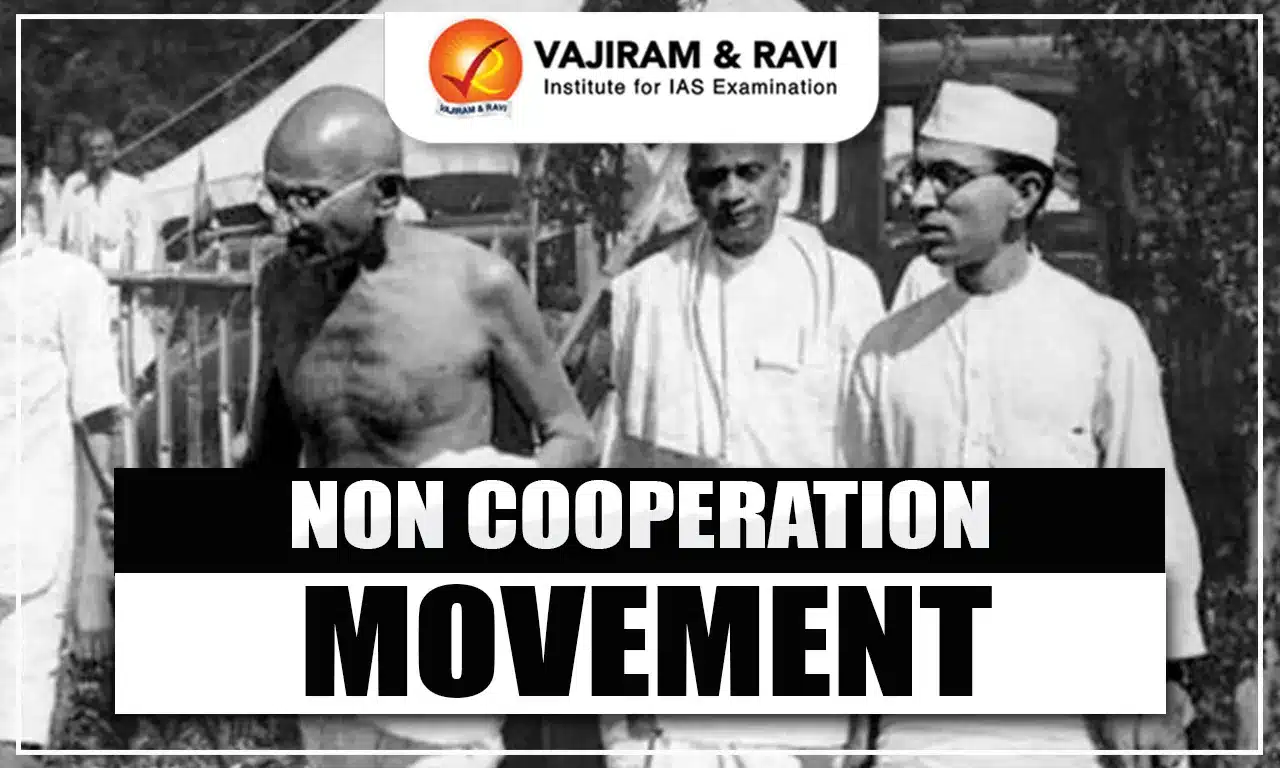
The Non Cooperation Movement (NCM) was the first nationwide movement launched by Gandhiji in 1920 during British rule. It emerged as a powerful and fervent response to a culmination of grievances and disillusionment that had been building up among the Indian populace. The Rowlatt Act and the brutal Jallianwala Bagh Massacre were the immediate causes for launching the movement.
Congress, at its special session of Calcutta in September 1920, approved the Non-Cooperation Movement, which was later endorsed by the Nagpur session of Congress in December 1920. The movement saw tremendous participation of the masses throughout the country. However, the movement was called off by Gandhi on February 11, 1922, following the Chauri Chaura incident in the Gorakhpur district of Uttar Pradesh.
Non-Cooperation Movement About
The Non-Cooperation Movement was launched by Mahatma Gandhi in 1920 to mobilise the Indian masses to peacefully resist British rule through non-cooperation with British institutions, laws, and policies. This marked a new phase of mass politics and mobilisation for the Indian National Movement during the years 1920–21, as two mass movements, Khilafat and Non-Cooperation, were formed to oppose British rule. By the end of the summer of 1920, both Mahatma Gandhi's Non-Cooperation Movement and the Khilafat Movement saw a convergence.
Through his earlier localised satyagrahas in Champaran, Kheda, and Ahmedabad, Gandhi built widespread trust and national recognition. This grassroots connection enabled him to rally the entire country, seamlessly transitioning the freedom struggle into a new era of nationwide mass politics.
Non-Cooperation Movement Causes
The causes of the Non-Cooperation Movement were multifaceted. The impact of the First World War, the Rowlatt Act, the Jallianwala Bagh Massacre, and the Montagu-Chelmsford Reforms provided the immediate context for the movement.
- Simmering dissent: The economic exploitation of India by the British colonial rulers had already impoverished the masses. The economic and political situation of the country during and after World War 1 (1914-1918) was further aggravated by rising inflation, heavy taxation, and forced cultivation of cash crops.
- First World War: The British government backtracked on its promises to consider nationalist demands in exchange for Indian support in the War, which shattered the political optimism of the War years.
- Montagu-Chelmsford reforms: The reforms introduced by the British government through the Montagu-Chelmsford reforms in the form of the Government of India Act 1919 fell short of Indian aspirations for self-governance and responsible government. The vast majority of leaders called it "disappointing and unsatisfactory".
- Rowlatt Act: The Rowlatt Act was passed in 1919 and allowed for the arrest and detention of Indians without trial. Its primary goal was to imprison nationalists without allowing them to defend themselves. This infuriated the nationalists and other leaders. Gandhi decided to use Satyagraha to oppose it.
- Jallianwala Bagh Massacre: The Jallianwala Bagh Massacre in Amritsar, in which British troops opened fire on a peaceful gathering of Indians, killing hundreds, shocked and enraged the Indian population.


Non-Cooperation Movement Launch
The launch of the Non-Cooperation Movement was announced by Mahatma Gandhi as a direct response to the Rowlatt Act, the Jallianwala Bagh massacre, and the Khilafat issue. At a special session in Calcutta in September 1920, Congress approved a Non-Cooperation Movement until the Punjab and Khilafat wrongs were corrected and Swaraj was established. The programme of non-cooperation was accepted and endorsed without opposition in the Nagpur INC Session of December 1920.
Non-Cooperation Movement Date
The Non-Cooperation Movement took place from August 1, 1920, to February 11, 1922, marked by key dates including its formal launch by Mahatma Gandhi, congressional approval in September 1920, and its abrupt end following the Chauri Chaura incident.
Non-Cooperation Movement Spread
The spread of the Non-Cooperation Movement was marked by massive responses from various parts of India in the form of boycotts, no tax campaigns, etc against the British Raj. However, in most places, the movement was shaped by local conditions.
- Bengal: Birendranath Sasmal organised the anti-union board agitation in the Contai and Tamluk sub-divisions of Midnapore.
- Assam: J.M. Sengupta organised strikes in tea plantations, steamer services, and Assam-Bengal Railways.
- United Province: Under Baba Ram Chandra's leadership, agrarian riots erupted in Rae Bareli, Pratapgarh, Fyzabad, and Sultanpur.
- A peasant outburst of the 'Eka movement' arose under the leadership of Madari Pasi.
- In Awadh, the Kisan Sabha movement was prominent.
- Punjab: The Akali movement for Gurdwara reform and control became closely associated with non-cooperation. It demonstrated remarkable communal unity among Sikhs, Muslims, and Hindus.
- Rajasthan: The peasants protested against cesses and begar. The Bijolia Movement in Mewar and the Bhil Movement under Motilal Tejawat were significant movements against the exploitation by the British and Jagirs.
- Gujarat: Vallabh Patel spread the movement and regarded non-cooperation as a feasible alternative to revolutionary terrorism to fight against a colonial government.
- Karnataka: Karnataka areas were largely unaffected by the movement, and the initial reaction of upper and middle-class professional groups in several areas of the Madras presidency was limited.
- Workers at the Buckingham and Carnatic textile mills went on strike. Local non-cooperation leaders offered them moral support.
- Andhra: In Andhra, tribal and other peasant grievances against forest laws were linked to the Non-Cooperation Movement. The peasants refused to pay taxes to the zamindars, and the entire population of Chirala-Perala refused to pay taxes and vacated the town. Alluri Sitaram Raju organised the tribals and combined their demands with those of the Non-Cooperation Movement.
- Tamil Nadu: Leaders like C. Rajagopalachari, S. Satyamurthy and Periyar E.V.R. mobilised the public to boycott foreign goods, reject government titles, and protest British rule peacefully.
- Kerala: Peasants organised anti-Jemni struggles. The Mopillah revolt was very intense during this period.
Non Cooperation Movement and Khilafat Movement
The Non-Cooperation Movement coincided with the Khilafat Movement, led by the Ali brothers, to protect the Ottoman Caliphate after World War I. Gandhi supported the Khilafat cause to foster Hindu-Muslim unity, making it the first nationwide mass movement against British rule and significantly expanding public participation in India's freedom struggle.
Non-Cooperation Movement Features
Features of the Non-Cooperation Movement included non-violent resistance; boycott of foreign goods, elections and government institutions; promotion of Swadeshi and Khadi; establishment of national institutions; mass participation; and Hindu-Muslim unity under Gandhi's leadership.
- Adherence to Non-Violence and Civil Resistance: The NCM movement strictly emphasised peaceful protests, civil disobedience, and the maintenance of Hindu-Muslim unity as fundamental principles of mass struggle.
- Surrender of British Titles and Positions: Citizens demonstrated defiance by surrendering officially conferred honorary titles, resigning from government jobs, and stepping down from local administrative bodies.
- Boycott of Foreign Goods and Promotion of Swadeshi: People boycotted British textiles and products, publicly burning foreign cloth while actively promoting hand spinning through the Charkha and Khadi.
- Boycott of Elections: Indians were asked to boycott elections held in accordance with the provisions of the 1919 Act, as well as legislative councils (though there were differences over this boycott).
- Establishment of Indigenous National Institutions: Alternative national educational centres were set up across the country, including prominent bodies like Jamia Millia Islamia, Kashi Vidyapeeth, and Bihar Vidyapeeth.
- Refusal to Serve in the British Army: People were encouraged not to serve in the British Army.
- Non-payment of Taxes: If the above steps did not yield results, people were prepared to refuse to pay taxes.
- Boycott Movement Against Liquor and Toddy Shops: The boycott extended to liquor and toddy shops.
- Mass Mobilisation: Volunteers actively picketed liquor shops, participated in the Jail Bharo Andolan, and raised funds through the Tilak Swaraj Fund to aid constructive work.
- Unity of Congress and Muslim League: The movement saw a rare unity between the Indian National Congress and the Muslim League.
Non-Cooperation Movement Withdrawal
Non-Cooperation Movement withdrawal was abruptly decided by Mahatma Gandhi despite the campaign being one of the most powerful mass struggles in India's freedom movement, driven by several key factors:
- Chauri-Chaura Incident: In Chauri-Chaura, Uttar Pradesh, a group of protestors attacked and set fire to a police station, resulting in the death of several police officers. Gandhi felt that the incident violated the principle of non-violence, and as a result, he called off the movement in February 1922.
- Lack of Discipline and Violence: Mahatma Gandhi realised that the Indian masses were not fully prepared for a nationwide struggle of civil disobedience and non-cooperation. There were instances of indiscipline and violence by some participants. For instance, the Moplah Rebellion in Kerala turned violent.
- Abolishment of Caliphate: Khilafat, one of the non-cooperation movement's issues, lost its relevance. Turks themselves, under the leadership of Mustafa Kemal, first abolished the Ottoman sultanate in 1922 and then did away with the office of the Khalifa in 1924.
- Rise of Militancy: Towards the later stages of the movements, there was a gradual shift towards more radical and militant approaches. This led to a loss of popular support and alienation of certain sections of society.
- Issue of Class Revolution: The Non-Cooperation Movement was gradually turning into a no-rent movement against the Zamindars. However, the Congress leadership had no intention of undermining the Zamindars' legal rights.
- Gandhi's goal was a "controlled mass movement" involving various Indian classes rather than a class revolution. As a result, he was opposed to the continuation of this movement, which could lead to a class revolution.
- Government Repression: The British colonial government had responded to the Non-Cooperation Movement with harsh measures. The government seemed in no mood for negotiations. Volunteer corps were declared illegal, public meetings were forbidden, the press was silenced, and most leaders of the Congress were arrested.
Role of Gandhi in the Non-Cooperation Movement
Mahatma Gandhi played a pivotal role in transforming the Non-Cooperation Movement into India's first nationwide mass movement against British rule in India.
- New Methods: He introduced the principles of Satyagraha, non-violence (Ahimsa), and mass mobilisation, making the freedom struggle inclusive by encouraging the participation of students, peasants, workers, women, and the middle class.
- Withdrawal of Cooperation: Gandhi believed that British authority depended on the cooperation of Indians; therefore, withdrawing cooperation through the boycott of government institutions, foreign goods, and titles would weaken colonial rule.
- Promoted Discipline and Self-Sacrifice: He stressed discipline, self-sacrifice, and peaceful resistance, ensuring the movement remained non-violent. His leadership united diverse sections of society and gave Indian nationalism a broad-based, mass character.
Non-Cooperation Movement Significance
Non-cooperation movement did not succeed and was suddenly called off, but it had a significant impact on the Indian freedom struggle. It played a significant role in generating and spreading anti-imperialist consciousness among Indian people.
- Hindu-Muslim unity: Gandhi opined that the realisation of Swarajya lies in the proper resolution of the Mahomedan question. This effort led to an unprecedented Hindu-Muslim unity, reflected in the ensuing mass mobilisations against colonial rule. It also paved the way for Gandhi to become the main protagonist of secularism.
- Issue of Social Justice: The non-cooperation movement introduced the issue of caste discrimination and untouchability to national politics and made Gandhi an important leader for social justice.
- Mass Participation: The movement achieved true mass mobilisation by uniting diverse groups—including peasants, workers, students, professionals, and notably women through non-violence—giving voice to deep-seated grievances against British rule.
- National Consciousness: The most significant success of the movement was the creation of political and social consciousness and nationalism in Indians.
- Inspiration for Subsequent Movements: The success and impact of these movements paved the way for subsequent movements such as the Civil Disobedience Movement and the Quit India Movement.
Non-Cooperation Movement Limitations
Non-Cooperation Movement limitations and regional challenges ultimately restricted the campaign’s effectiveness, despite its standing as a watershed moment in the Indian national movement.
- Merger of Khilafat Issue: The cause of the Khilafat movement was exclusively on the religious line, and then the convergence of NCM and Khilafat proved to be less useful for secular politics in India in the long term.
- Limited Reach: While the Non-Cooperation Movement garnered substantial support, especially in urban areas, it did not have universal backing across India. The rural population had limited awareness of these movements and often remained detached.
- Lack of a Clear Goal: The movements didn't have a well-defined roadmap beyond non-cooperation with the British for achieving independence or addressing broader socio-economic issues.
- Differences: There were differences in strategies, ideologies, and priorities that led to fragmentation and weakened the overall effectiveness of the movements. For example, there were differences regarding the boycott of legislative councils. Some leaders, such as C.R. Das, were unwilling to include a council boycott.
Non-Cooperation Movement UPSC PYQs
Q1: Bring out the constructive programmes of Mahatma Gandhi during the Non-Cooperation Movement and Civil Disobedience Movement. (UPSC Mains 2021)
Q2: Since the decade of the 1920s, the national movement acquired various ideological strands and thereby expanded its social base. Discuss. (UPSC Mains 2020)
Q3: Many voices had strengthened and enriched the nationalist movement during the Gandhian phase. Elaborate (UPSC Mains 2019)
Q4: Consider the following statements in respect of the Non-Cooperation Movement: (UPSC Prelims 2025)
- The Congress declared the attainment of 'Swaraj' by all legitimate and peaceful means to be its objective.
- It was to be implemented in stages with civil disobedience and non-payment of taxes for the next stage only if 'Swaraj' did not come within a year and the Government resorted to repression.
Which of the statements given above is/are correct?
- 1 only
- 2 only
- Both 1 and 2
- Neither 1 nor 2
Ans: (c)
Q5: Consider the following subjects with regard to Non-Cooperation Programme: (UPSC Prelims 2025)
- Boycott of law-courts and foreign cloth
- Observance of strict non-violence
- Retention of titles and honours without using them in public
- Establishment of Panchayats for settling disputes
How many of the above were parts of Non-Cooperation Programme?
- Only one
- Only two
- Only three
- All the four
Ans: (c)

 Last updated on Oct, 2026
→ UPSC 2027 Notification will be released on 13 January 2027 at upsconline.nic.in.
→ Check Nobel Prize 2026 Winners List here.
→ Download PIB PRiSM Monthly Magazine 2026 here.
→ Check UPSC Monthly Current Affairs Magazine The Recitals here.
→ Check out the latest UPSC Syllabus here.
→ Download UPSC Model Answers for Mains 2026
→ UPSC Mains Question Paper 2026 is out now for Essay & GS Paper 1, 2, 3 & 4.
→ UPSC Calendar 2027 has been released.
→ Enroll in Vajiram & Ravi’s UPSC Mains Test Series 2027 for structured answer writing practice, expert evaluation, and exam-oriented feedback.
→ Join Vajiram & Ravi’s UPSC Mentorship Program 2027 for personalized guidance, strategy planning, and one-to-one support from experienced mentors.
→ Go through the UPSC Mains Previous Year Papers to enhance your preparation.
→ UPSC has released UPSC Toppers List 2025 with the Civil Services final result on its official website.
→ Also check Best UPSC Coaching in India
Non-Cooperation Movement FAQs
Q1. What was the Non-Cooperation Movement?+
Q2. Why did Gandhiji call off non-cooperation?+
Q3. Why did the Non-Cooperation Movement start?+
Q4. What are the three causes of the Non-Cooperation Movement?+
Q5. What was Gandhiji's first Non-Cooperation Movement?+
Tags: non-cooperation movement quest upsc modern history notes