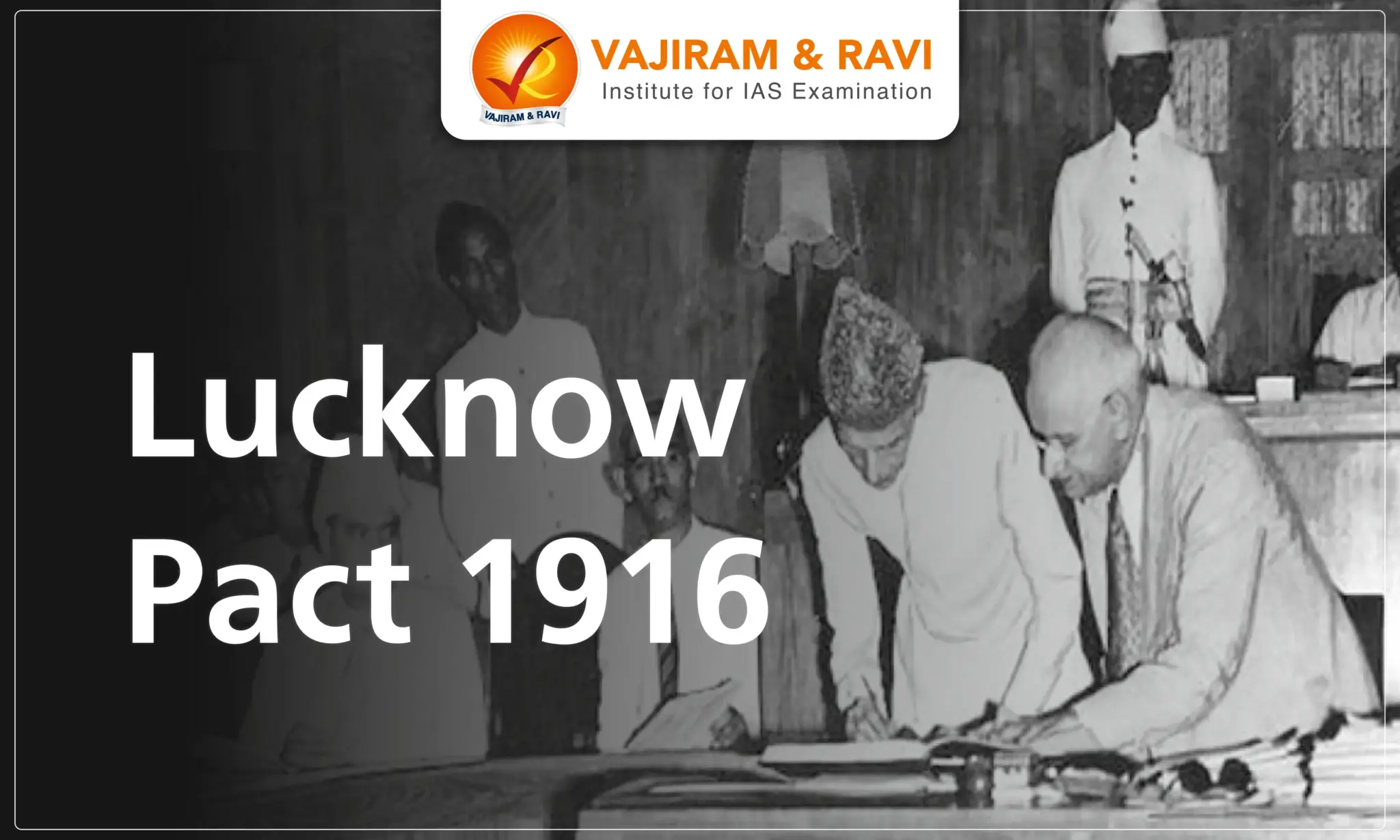
The Lucknow Pact of 1916 was an agreement between the Indian National Congress (INC) and the All-India Muslim League (AIML). It was reached during the Lucknow sessions of the two organisations in December 1916 and marked an important phase of cooperation between the Congress and the Muslim League in the Indian national movement.
The Pact was significant because Congress and the Muslim League agreed on a common set of constitutional demands to be presented to the British government. It also marked the temporary reunion of the Moderates and Extremists within the Congress and demonstrated a phase of Hindu-Muslim political cooperation.
Lucknow Pact 1916 About
The Lucknow Pact was a pivotal agreement between the Indian National Congress and the All-India Muslim League, signed at a joint assembly in Lucknow in 1916. It was orchestrated by Muhammad Ali Jinnah, who, as a member of both the Congress and the League, played a pivotal role in persuading both parties to unite.
- Prominent leader Bal Gangadhar Tilak represented the Congress, and Jinnah and Mahatma Gandhi were present during the negotiations.
- Sarojini Naidu called Jinnah the “Ambassador of Hindu-Muslim Unity” for his efforts in bringing the two political groups together.
Lucknow Pact Causes
By 1916, the Muslim League, traditionally aligned with conservative political goals, was experiencing a shift in ideology. Younger, more militant nationalists within the League became increasingly anti-imperialist. This change in attitude was driven by several factors:
- Surat Split and Congress Reconciliation: The Congress had experienced a major division between the Moderates and Extremists at Surat in 1907. By 1916, efforts were underway to bring the two groups together.
- The Lucknow Congress provided an opportunity for this reconciliation.
- British Policies: Britain’s refusal to assist Turkey in the Balkan Wars (1912-1913) and the Italo-Turkish War (1911) angered many Indian Muslims.
- The annulment of the Partition of Bengal in 1911 disappointed sections of Muslims who had supported the division.
- Changing Position of the Muslim League: The Muslim League, founded in 1906, had initially adopted a more cautious approach towards the colonial government.
- Over time, sections of the League increasingly supported constitutional reforms and greater Indian participation in government.
- The British government’s refusal to establish a university in Aligarh with the power to affiliate colleges across India alienated many Muslims.
- First World War: British repression during World War I further inflamed nationalist sentiments. Newspapers like Maulana Azad’s Al Hilal and Mohammad Ali’s Comrade were suppressed, and prominent leaders, including the Ali brothers, faced internment.
- Home Rule Movement: The Home Rule Movement of 1916, associated particularly with Bal Gangadhar Tilak and Annie Besant, generated wider political mobilisation around the demand for self-government.


Lucknow Pact Events
In 1916, the extremist and moderate factions of the INC, along with members of the All-India Muslim League, met in Bombay to discuss Hindu-Muslim unity and constitutional reforms. In October 1916, elected representatives from both parties jointly approached the Viceroy to propose revisions that would enhance Indian participation in governance.
- These proposals were reviewed and accepted by the leaders of the INC and Muslim League during a Calcutta meeting in November 1916.
- It led to the final agreement on the Lucknow Pact at the annual sessions of the INC and AIML in Lucknow in December 1916.
Role of Bal Gangadhar Tilak
After his release from prison in 1914, Bal Gangadhar Tilak worked to promote Hindu-Muslim unity, which was critical for the Lucknow Pact. His efforts led to the unification of the extremists and the moderate faction of the INC, along with the All India Muslim League agreeing to collaborate at the Lucknow session of the Congress in 1916.
Lucknow Pact Provisions
The Lucknow Pact contained several significant provisions that addressed the concerns of both the Indian National Congress and the All-India Muslim League. These provisions were aimed at ensuring a cooperative framework for political representation and governance.
- Separate Electorates for Muslims: The INC, which had previously opposed separate electorates granted to Muslims under the Morley-Minto Reforms (Indian Councils Act of 1909), agreed to this demand as part of the Lucknow Pact.
- This allowed Muslims to elect their own representatives to both the Imperial and Provincial Legislative Councils.
- Proportional Representation: Muslims were granted a fixed proportion of seats in legislative bodies, at both the provincial and national levels. This proportionality was based on the Muslim population in each province.
Demands Presented Before the British
The Lucknow Pact emphasised broader constitutional reforms aimed at increasing Indian participation in governance. Both the INC and AIML agreed to present joint constitutional demands to the British government. These joint demands were critical in signalling a shift towards self-governance and reflected the aspirations of both Hindu and Muslim communities for greater control over Indian affairs. The key demands were:
- The British government should declare its intention to grant self-governance to India at an early date.
- The central and provincial legislative assemblies should be expanded, with elected members forming a majority.
- The legislative councils should have a five-year tenure.
- The salary of the Secretary of State for India should be paid by the British government rather than using Indian funds.
- At least half of the members of the Viceroy’s Executive Council and Provincial Governors' Councils should be Indians.
Lucknow Pact Significance
The Lucknow Pact marked an important phase of cooperation between the Indian National Congress and the Muslim League, creating a temporary basis for joint constitutional demands against British rule.
- Hindu-Muslim Unity: It brought the Congress and the Muslim League together on a common political platform and strengthened the demand for greater Indian participation in governance.
- Moderates and Extremists Together: The Lucknow Congress session also witnessed the reunion of the Moderates and Extremists, strengthening the organisational unity of the Congress.
- Congress-League Cooperation: The Pact represented a rare period of joint political action between the two major organisations of Indian nationalism.
- Strengthened Constitutional Demands: Both organisations agreed on a common set of demands for constitutional reforms and greater Indian representation in legislative councils.
- Acceptance of Separate Electorates: Congress accepted the Muslim League's demand for separate electorates for Muslims, giving the League greater political legitimacy.
Drawbacks of Lucknow Pact
The Lucknow Pact created an important phase of Congress–Muslim League cooperation, but its provisions also had limitations that affected the long-term development of Indian nationalism.
- Temporary Political Unity: The agreement did not create lasting Congress–League cooperation. It was a temporary arrangement, after which the Muslim League retained its separate political identity.
- Communal Representation: The Pact formally accepted separate electorates for Muslims, institutionalising communal representation in the political system.
- Communalisation of Politics: By recognising separate political representation, the Pact contributed to the growth of communal politics in subsequent years.
- Political Bargain: The agreement involved compromises over Muslim representation in different provinces, with representation differing significantly from Muslim population shares in some provinces.
Lucknow Pact Aftermath
The Lucknow Pact created a temporary phase of Congress–Muslim League cooperation, but its longer-term consequences were mixed. It influenced constitutional reforms and helped create the political conditions for later Hindu–Muslim cooperation during the Khilafat and Non-Cooperation movements.
- August Declaration: The united nationalist demands after the Pact contributed to greater British recognition of the need for constitutional progress and self-government.
- Government of India Act 1919: Several constitutional proposals associated with the Pact were reflected in the later reforms, like increasing Indian participation in governance and addressing some demands for self-rule.

 Last updated on Oct, 2026
→ UPSC 2027 Notification will be released on 13 January 2027 at upsconline.nic.in.
→ Check Nobel Prize 2026 Winners List here.
→ Download PIB PRiSM Monthly Magazine 2026 here.
→ Check UPSC Monthly Current Affairs Magazine The Recitals here.
→ Check out the latest UPSC Syllabus here.
→ Download UPSC Model Answers for Mains 2026
→ UPSC Mains Question Paper 2026 is out now for Essay & GS Paper 1, 2, 3 & 4.
→ UPSC Calendar 2027 has been released.
→ Enroll in Vajiram & Ravi’s UPSC Mains Test Series 2027 for structured answer writing practice, expert evaluation, and exam-oriented feedback.
→ Join Vajiram & Ravi’s UPSC Mentorship Program 2027 for personalized guidance, strategy planning, and one-to-one support from experienced mentors.
→ Go through the UPSC Mains Previous Year Papers to enhance your preparation.
→ UPSC has released UPSC Toppers List 2025 with the Civil Services final result on its official website.
→ Also check Best UPSC Coaching in India
Lucknow Pact FAQs
Q1. What was the Lucknow Pact?+
Q2. What was the purpose of the Lucknow Pact?+
Q3. Who presided over the Lucknow Pact in 1916?+
Q4. What were the three main features of the Lucknow Pact?+
Q5. What were the results of the Lucknow Pact?+
Tags: lucknow pact quest upsc modern history notes