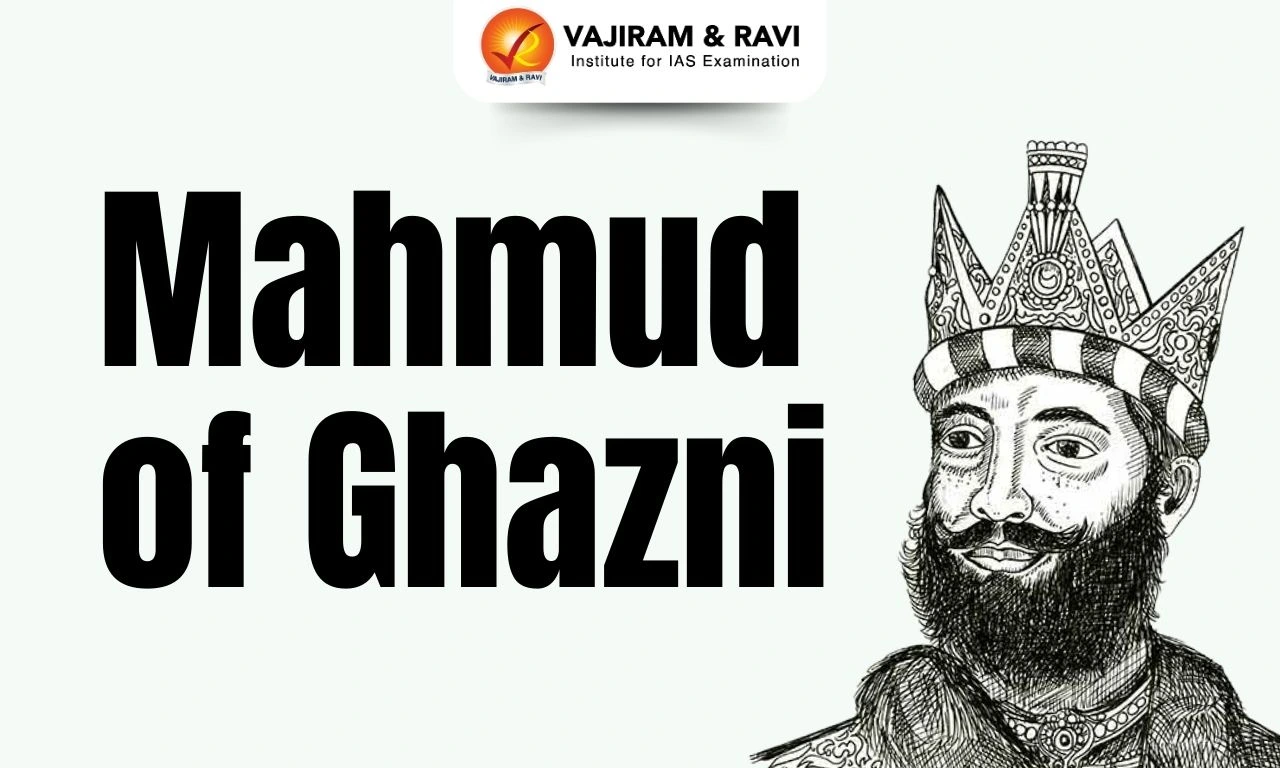
Mahmud of Ghazni was one of the most influential rulers of the medieval period, whose conquests and patronage of art and culture had a profound impact on the political and social landscape of the Indian subcontinent. Mahmud rose to power as the Sultan of the Ghaznavid Empire, ruling from 998 to 1030 AD.
His reign was marked by a series of military campaigns into the Indian subcontinent, which not only expanded his empire's boundaries but also facilitated the spread of Islamic culture and Persian influences in the region.
Mahmud of Ghazni History
Mahmud of Ghazni was born in 971 AD in the city of Ghazni (present-day Afghanistan) to a Turkish slave father (Sabuktigin, the founder of the Ghaznavid dynasty & Turkish slave commander). He belonged to the Ghaznavid dynasty, which had roots in the Persian region of Zabulistan. Mahmud ruled the Ghaznavid Empire from 998 to 1030 AD.
- Mahmud’s early conquests expanded the Ghaznavid rule to roughly the same footprint as the ancient Kushan Empire.
- He used typical Central Asian military techniques, relying primarily on highly mobile, horse-mounted cavalry armed with compound bows.
- By 1001 CE, Mahmud turned his attention to the fertile lands of the Punjab, now in India, which lay southeast of his empire.
Mahmud of Ghazni’s Invasions of India
Mahmud of Ghazni invaded India around 17 times between 1000 and 1027 AD, with the primary objective of plundering its wealth. His expeditions into India were focused on accumulating wealth, especially from temples, rather than imposing Islam on the Indian population. His major expeditions included conflicts with the Hindu Shahis, campaigns in the Gangetic Plain, and the famous Somnath expedition of 1025 CE.
|
Year (AD) |
Event |
|
1000 |
Mahmud of Ghazni attacked modern Afghanistan and Pakistan for the first time, defeating the Hindu ruler Jaya Pala (who later committed suicide and was succeeded by his son Anandpala). |
|
1006 |
Ghazni invaded Multan; Anandpala launched an attack against him during this invasion. |
|
1007 |
Mahmud of Ghazni attacked and crushed Sukha Pala, ruler of Bhatinda. |
|
1011 |
Ghazni attacked Nagarkot in the Punjab hills. |
|
1013 |
Mahmud defeated Anandpala and the Shahi kingdom in the Battle of Waihind, near Peshawar. |
|
1018 |
He attacked Mathura and defeated a coalition of rulers, including Chandra Pala. |
|
1021 |
Mahmud conquered Kanauj by defeating the Kannauj King Chandella Gauda. |
|
1025 |
He attacked the Somnath temple to loot its amassed wealth. |
|
1027 |
He conducted his final punitive raid against the Jats of Sindh who had harassed his army on the return from Somnath |
Fight with Hindu Shahi kingdom
In 1001 CE, Mahmud of Ghazni fought Jayapala, the ruler of the Hindu Shahi kingdom, near Waihind/Peshawar. Jayapala was defeated, captured and later released after paying a ransom. The defeat severely weakened the Hindu Shahi kingdom and opened the route for further Ghaznavid invasions into Punjab.
- Jayapala was later succeeded by his son Anandapala (Anantapala), who continued resistance against Mahmud.
- In 1006 CE, Mahmud defeated Anandapala and strengthened his control over the upper Indus region. Mahmud was consequently able to consolidate his position in north-western India.
Annexation of Lahore and Multan
Mahmud gradually extended his authority across Punjab and Multan. Multan, ruled by a Muslim ruler, was attacked and brought under Ghaznavid control.
- By 1015 CE, Mahmud had extended his influence to Lahore, further consolidating his position in Punjab.
- The conquest of Punjab provided Mahmud with a strategic base for subsequent expeditions into northern India.
- His Indian territories were primarily concentrated in the north-west rather than being incorporated into a vast empire extending deep into India.
Expedition to the Gangetic Plain
After establishing control over Punjab, Mahmud undertook several raids into the Gangetic Plain. He conducted important campaigns in 1018–1019 CE and again around 1021 CE.
- The Rajput ruler of Baran (modern Bulandshahr) was among those defeated during his campaigns.
- The rulers of Gwalior and the Chandelas were also drawn into conflicts associated with his northern campaigns.
- These expeditions were primarily raids for wealth rather than attempts to establish permanent political control over the Gangetic heartland.
Somnath Expedition of Mahmud of Ghazni
The Somnath expedition of 1025 CE was Mahmud's most famous raid in India. The temple was an important religious centre and was reputed for its considerable wealth. Mahmud plundered the temple and carried away a large amount of wealth. The Somnath raid became particularly famous in later historical accounts and contributed greatly to Mahmud's reputation as a temple-raider.
Kashmir Expedition
Mahmud attempted to invade Kashmir in 1015 CE. His campaign was unsuccessful, partly because of difficult terrain and adverse weather conditions. It was one of the significant setbacks faced by Mahmud during his Indian campaigns.


Impact of Mahmud of Ghazni’s Invasions
Mahmud of Ghazni's reign left a mark on the socio-political and cultural landscape of the Indian subcontinent, shaping the course of history in multiple ways. By dismantling frontier buffer states, extracting massive wealth, and fostering Persianate cultural patronage, his invasions paved the way for future Turkish conquests.
- Expansion of Empire: Mahmud, after swiftly conquering Khorasan, Sistan, and Ghur, turned his attention to India.
- He conducted 17 invasions over 25 years, expanding the Ghazni Empire and leaving India’s borders unprotected by destroying the Hindu Shahi Kingdom.
- Weakness of Rajputs exposed: The invasions revealed the shortcomings of the Rajput kings’ war strategies.
- It became evident that there was no political unity in India, leaving it vulnerable to further attacks.
- A Gateway to Further Invasions: Mahmud’s conquests paved the way for Muslim rulers (Turks and Afghans) to make deeper incursions into India, particularly into the Gangetic Valley.
- Drain of Resources: Ghazni drained the immense resources of India through his repeated raids, which adversely affected the political future of India.
- Patronage of Art and Learning: Mahmud was a patron of art, literature, and scholarship. His court attracted prominent figures such as:
- Firdausi, the poet and author of the epic Shahnameh or “The Book of Kings”.
- Al-Biruni was a philosopher, mathematician, scholar, and author of the epic Kitab-ul-Hind.
- Exchange of ideas and Cultural influences: Despite the destruction, Mahmud’s invasions facilitated the exchange of ideas, knowledge, and cultural influences between the Islamic world and India.
- Muslim scholars, artists, and intellectuals brought new perspectives, contributing to the cross-pollination of ideas.
- Persian culture began to influence Indian art, literature, and architecture.
Mahmud of Ghazni Death
Mahmud of Ghazni acquired malaria during one of his expeditions in April 1030, when he was 58 years old. He later contracted tuberculosis, which caused his death in his capital city of Ghazni (modern-day Afghanistan).
Mahmud of Ghazni UPSC PYQs
Q1: Evaluate the contribution of Al-Biruni's Kitab-ul-Hind in understanding the social, cultural, and scientific conditions of North India on the eve of the Turkish invasions. (UPSC Mains 2014)

 Last updated on Oct, 2026
→ UPSC 2027 Notification will be released on 13 January 2027 at upsconline.nic.in.
→ Check Nobel Prize 2026 Winners List here.
→ Download PIB PRiSM Monthly Magazine 2026 here.
→ Check UPSC Monthly Current Affairs Magazine The Recitals here.
→ Check out the latest UPSC Syllabus here.
→ Download UPSC Model Answers for Mains 2026
→ UPSC Mains Question Paper 2026 is out now for Essay & GS Paper 1, 2, 3 & 4.
→ UPSC Calendar 2027 has been released.
→ Enroll in Vajiram & Ravi’s UPSC Mains Test Series 2027 for structured answer writing practice, expert evaluation, and exam-oriented feedback.
→ Join Vajiram & Ravi’s UPSC Mentorship Program 2027 for personalized guidance, strategy planning, and one-to-one support from experienced mentors.
→ Go through the UPSC Mains Previous Year Papers to enhance your preparation.
→ UPSC has released UPSC Toppers List 2025 with the Civil Services final result on its official website.
→ Also check Best UPSC Coaching in India
Mahmud of Ghazni FAQs
Q1. Who was Mahmud of Ghazni?+
Q2. What is Mahmud of Ghazni famous for and why?+
Q3. Who invaded India 17 times?+
Q4. Was Mahmud of Ghazni a Turk or Afghan?+
Q5. How did Mahmud of Ghazni die?+
Tags: mahmud of ghazni quest UPSC Medieval History Notes