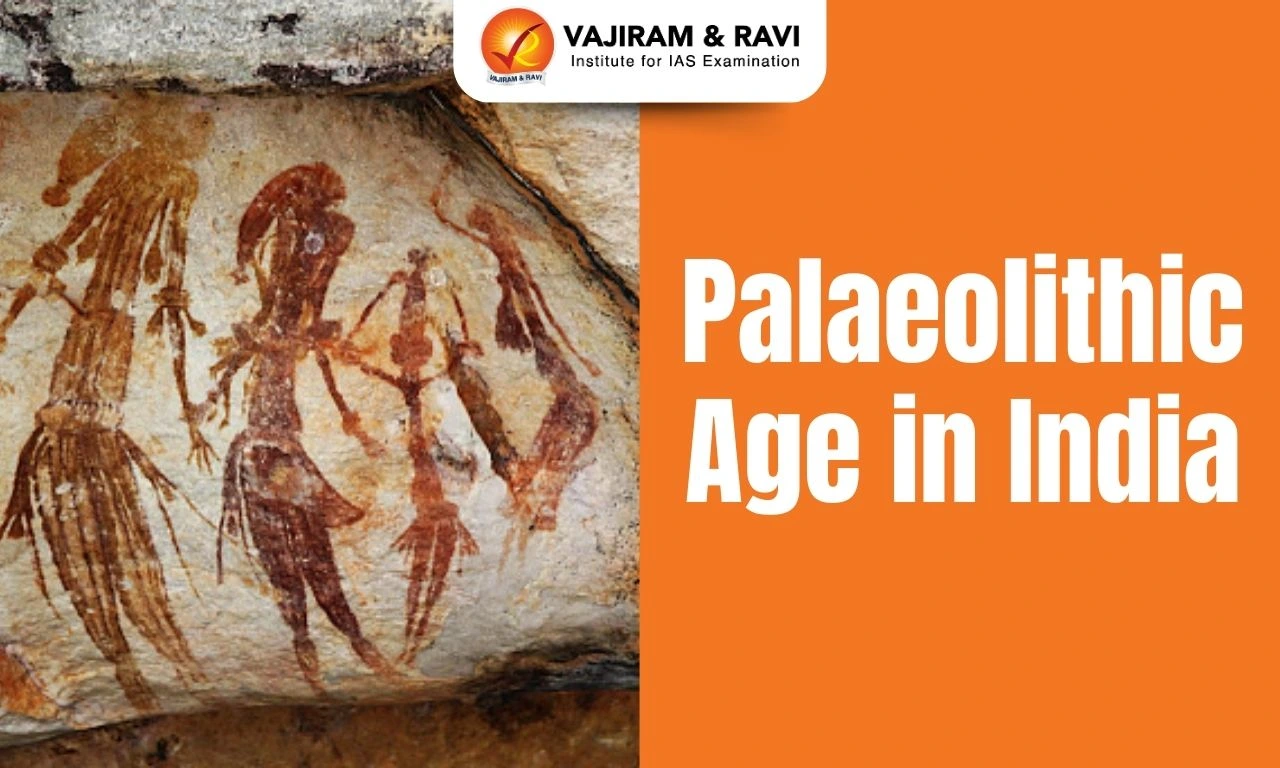
The Palaeolithic Age in India is the earliest and longest phase of human prehistory. It is commonly called the Old Stone Age because early humans mainly used stone tools for hunting, cutting, scraping, digging, and processing animal or plant material.
Palaeolithic communities were largely hunter-gatherers. They did not practise agriculture, domesticate animals on a regular basis, use pottery, or live in permanent villages. Archaeological evidence from stone tools, animal remains, rock shelters, and habitation sites helps historians reconstruct their lives. In India, the Palaeolithic period is generally divided into the Lower, Middle, and Upper Palaeolithic phases.
Palaeolithic Age Meaning
The term 'Palaeolithic' comes from two Greek words: 'palaios', meaning 'old', and 'lithos', meaning 'stone'. Therefore, the Palaeolithic Age literally means the Old Stone Age. It is the earliest phase of the Stone Age and prehistoric period and is characterised by a hunting-and-gathering economy and the extensive use of chipped stone tools.
Palaeolithic Age in India
The Palaeolithic period represents the earliest and longest phase of the Stone Age in India, broadly spanning from about 2 million years ago to around 10,000 BCE. Humans lived mainly as hunter-gatherers and relied on naturally available resources.
- The period is marked by the development of stone-tool technology, use of fire and gradual adaptation to different environments.
- Archaeological evidence from sites such as Attirampakkam, Hunsgi, Bhimbetka and the Narmada Valley helps reconstruct the technological, ecological and cultural evolution of early humans in the Indian subcontinent.
Palaeolithic Age Time Period in India
In India, the Palaeolithic (Old Stone Age) period is thought to have lasted between 500,000 and 10,000 BCE. However, contemporary archaeological dating at some sites indicates that early human tool use may have existed as early as 2 million years ago.
- Lower Palaeolithic (500,000 – 100,000 BCE)
- Middle Palaeolithic (100,000 – 40,000 BCE)
- Upper Palaeolithic (40,000 – 10,000 BCE)
Palaeolithic Age Characteristics
The Palaeolithic Age was marked by hunting, gathering, mobility, simple technology, and close dependence on nature, with stone tools shaping everyday survival.
- Hunter-gatherer Economy: People lived off wild animals, fish, fruits, roots, seeds, nuts, and edible plants.
- Nomadic Life: Nomadic life involved communities moving from one location to another in search of food, water, and shelter. People probably lived in tiny groups based on kinship and cooperation.
- No Agriculture: There was no stable agricultural or organised food production. Pottery did not exist at the time. The most significant technological innovation was the use of stone tools.
- Fire use: Evidence from some later prehistoric contexts suggests that fire was regulated and used for warmth, protection, and food processing.
- Dependence on Nature: Human survival was strongly reliant on local weather, vegetation, animal abundance, and water resources.


Palaeolithic Age Tools
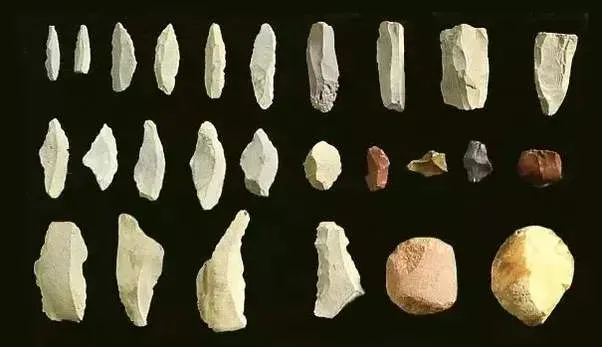
Palaeolithic tools were mainly made by striking one stone against another to remove flakes. The remaining stone core or the detached flake was shaped into a useful implement. The nature of tools changed over time:
|
Phase |
Main Tools |
Examples |
|
Lower Palaeolithic |
Core tools |
Handaxes, cleavers, choppers, chopping tools |
|
Middle Palaeolithic |
Flake tools |
Scrapers, borers, points, denticulates |
|
Upper Palaeolithic |
Blade tools |
Blades, burins, points, bone tools |
Palaeolithic Age Map and Sites
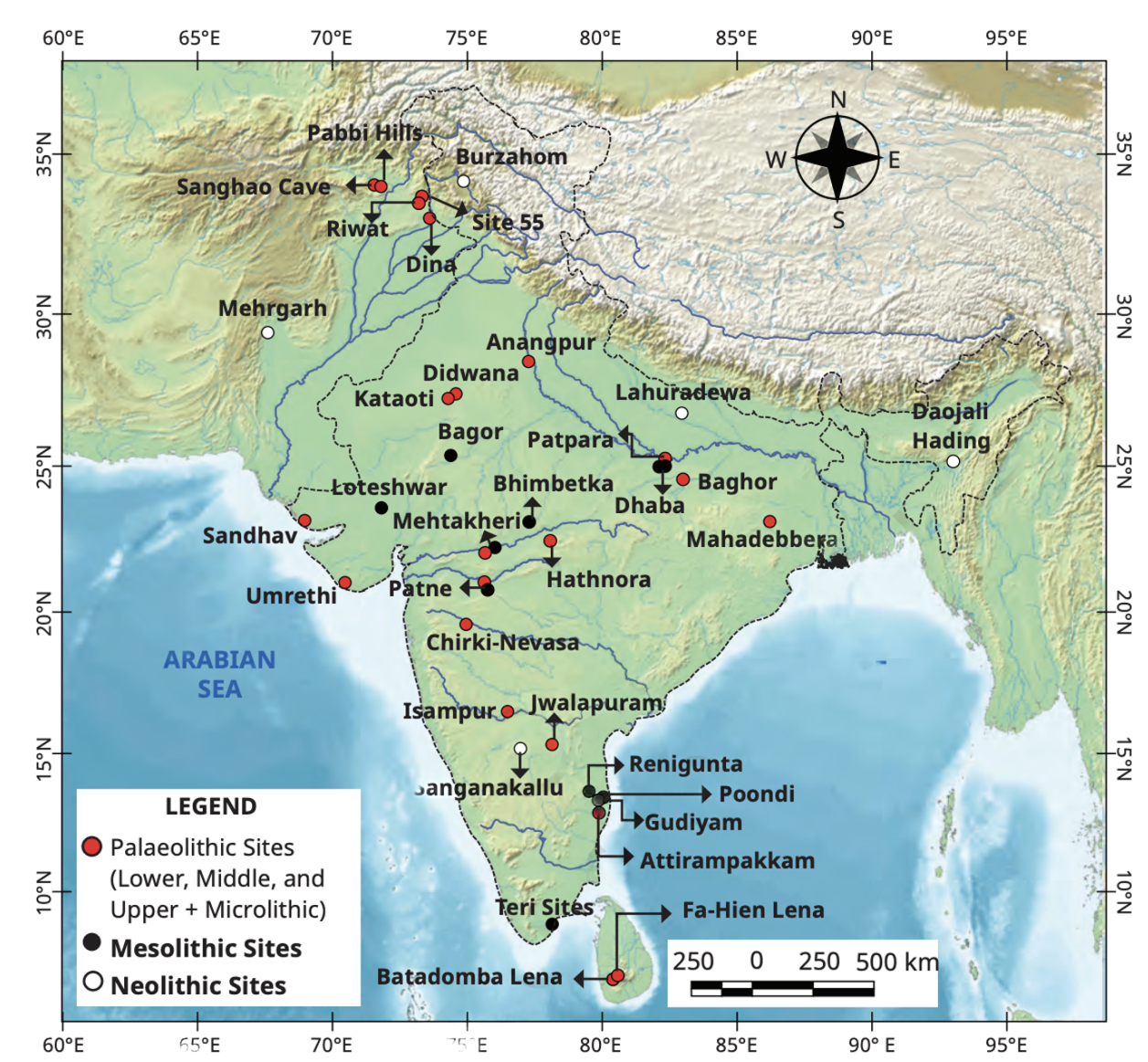
Palaeolithic sites across India provide evidence of stone-tool technology, early human habitation and adaptation to different ecological settings.
- Attirampakkam, Tamil Nadu: One of India’s most important Lower Palaeolithic sites, known for its Acheulian stone tools. Evidence from the site has helped establish the very early antiquity of Acheulian technology in the Indian subcontinent.
- Bhimbetka, Madhya Pradesh: A major prehistoric site with numerous rock shelters and Stone Age remains. It provides evidence of human occupation from the Palaeolithic to later periods, making it important for understanding long-term cultural development.
- Hunsgi Valley, Karnataka: A rich Lower Palaeolithic landscape containing handaxes, cleavers and other Acheulian tools. The availability of suitable quartzite helped early humans manufacture tools locally.
- Narmada Valley, Madhya Pradesh: Important for both Palaeolithic tools and hominin fossil evidence. The Hathnora fossil, discovered in the valley, is among the significant early human fossil finds in South Asia.
Palaeolithic Age in India Phases
The Palaeolithic period in India is classified into three major phases based on the evolution of stone tool technology and environmental changes: the Lower, Middle, and Upper Palaeolithic.
Lower Palaeolithic Age in India
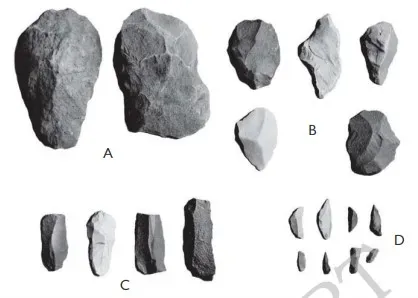
The earliest use of stone tools started in the Lower Palaeolithic Age (5,00,000- 1,00,000 BC) by Homo habilis and Homo erectus. People of this age were nomadic and depended only on hunting and food gathering.
- Tools: Stone tools were used for chopping, like hand axes, cleavers, knives, and choppers made from large pebbles or flakes.
- Two Main Traditions:
- Soanian tradition, which is a part of the East and Southeast Asian chopper-chopping tool tradition.
- The Acheulian prehistoric period tradition, which is well-known from the western half of the Old World (Africa, western Europe, and West and South Asia), is represented by the handaxe-cleaver or biface assemblages.
- Way of Life: The people from the Lower Palaeolithic culture hunted animals and collected roots, nuts, and fruits.
- They consumed the meat and bones of animals.
- They lived in open air, river valleys, caves, and rock shelters, as evident from Bhimbetka in Madhya Pradesh and Gudiyam in Tamil Nadu.
- The pre-historic human ancestors, who belonged to the species Homo erectus, did not have a complex language culture like us, the Homo sapiens.
- They may have expressed a few sounds or words and used sign language.
- They were intelligent enough to select stones as raw material and used hammer stones to carefully flake the rocks and design tools.
- Important Sites:
- Singi Talav (Didvana) in Rajasthan
- Bhimbetka and Adamgarh in Madhya Pradesh
- Lalitpur, Uttar Pradesh
- Paisra, Bihar
- Chirki-Nevasa, Maharashtra
- Hunsgi and Yediyapur in Karnataka
- Attirampakkam, Tamil Nadu
Middle Palaeolithic Age in India (1,00,000- 40,000 BC)
Middle Palaeolithic culture in India is called Nevasian (similar to Mousterian), as flake tools were found at Pravara, Nevasa. Early Homo sapiens lived in the Middle Paleolithic Age, marked by the evolution of modern language, the systematic burial of the dead with rituals, and the use of more sophisticated tools. This age witnessed a variety of tools made on flakes, produced by specialised techniques. Therefore, it is widely referred to as the flake tool industry.
- Flake Production: Flakes that are produced by striking them out of pebbles or cobbles are used to make tools.
- Tool Types: Small and medium-sized handaxes, cleavers, scrapers, borers, and knives are examples of different types of tools. Raw materials, shapes, and sizes vary depending on the region.
- Large Borers and Awls: Large borers or awls worked with steep retouch on thick flakes are present.
- Variety of Scrapers: Scrapers come in several kinds, such as straight, concave, and convex-sided.
- Anvils and Hammers are also found at some of the manufacturing sites.
- Way of Life: The Middle Palaeolithic people lived in rock shelters, caverns, and open spaces. It was a hunter-gatherer society. The following are some of the primary characteristics of the Indian Middle Palaeolithic period:
- The tools became smaller.
- There was a decrease in the use of hand axes compared to other tools.
- The core preparation techniques were used in the stone tool production.
- The raw materials used were chert, jasper, chalcedony, and quartz.
- Sites:
- Didwana and Budha Pushkar are in Rajasthan
- Hiran Valley in Gujarat
- Potwar Plateau situated between the Indus and Jhelum rivers
- Sanghao Cave in NWFP of Pakistan
- Luni river system, denoting tool industries west of the Aravallis
- Chirki Nevasa in Maharashtra
- Kalpi in Uttar Pradesh
Upper Palaeolithic Age in India (40,000-10,000 BC)
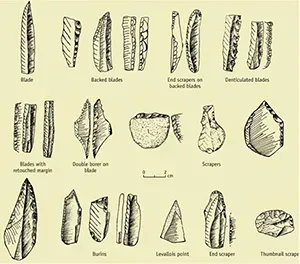
This is the phase when modern man (Homo sapiens sapiens) first emerged around 50,000 years ago and developed new tool-making technologies in the form of blades and burins.
- Upper Palaeolithic cultures flourished in the Upper Pleistocene, often called the Late Pleistocene.
- Along with flake and core tools, the Upper Palaeolithic industries produced side scrapers, ovate scrapers, notched scrapers, discoid scrapers, and unifacial and bifacial flake points.
- This is the period when humans were involved in cave art.
- Tools:
- The sites in Rallakalava and Gunjuna valleys in the southern Eastern Ghats give the best-known evidence of the blade-and-burin industries in India.
- Bone tools, except in Kurnool caves in Andhra Pradesh, were not found in India.
- The manufacture of specialised hunting tools for both big-game hunting and small-game hunting, as well as fishing, is indicated by the Upper Palaeolithic tools.
- Way of Life: The people who lived during this time utilised both open spaces and caves for housing.
- Paintings from the Upper Palaeolithic era provide evidence of artistic creations.
- This era's beads and decorations have also been discovered.
- During this time, the lithic blade industry developed.
- Based on style and archaeological evidence, some of the green-colored paintings by Bhimbetka are dated to the Upper Palaeolithic period.
- Sites:
- Rohiri Hills in Sindh
- Chopani Mando in Belan Valley
- Baghor in Madhya Pradesh
- Paisra in Bihar
- Haora and Khowai valleys in Tripura
- Kurnool and Muchchatla Chintamanu Gavi in Andhra Pradesh
Palaeolithic Age in India UPSC PYQs
Q1: “Highlight the differences between the Paleolithic and Neolithic cultures.” (UPSC Mains 2016).

 Last updated on Oct, 2026
→ UPSC 2027 Notification will be released on 13 January 2027 at upsconline.nic.in.
→ Check Nobel Prize 2026 Winners List here.
→ Download PIB PRiSM Monthly Magazine 2026 here.
→ Check UPSC Monthly Current Affairs Magazine The Recitals here.
→ Check out the latest UPSC Syllabus here.
→ Download UPSC Model Answers for Mains 2026
→ UPSC Mains Question Paper 2026 is out now for Essay & GS Paper 1, 2, 3 & 4.
→ UPSC Calendar 2027 has been released.
→ Enroll in Vajiram & Ravi’s UPSC Mains Test Series 2027 for structured answer writing practice, expert evaluation, and exam-oriented feedback.
→ Join Vajiram & Ravi’s UPSC Mentorship Program 2027 for personalized guidance, strategy planning, and one-to-one support from experienced mentors.
→ Go through the UPSC Mains Previous Year Papers to enhance your preparation.
→ UPSC has released UPSC Toppers List 2025 with the Civil Services final result on its official website.
→ Also check Best UPSC Coaching in India
Palaeolithic Age FAQs
Q1. What is the Paleolithic era also known as?+
Q2. What are the three stone ages in order?+
Q3. What are 5 facts about the Paleolithic Age?+
Q4. What is Palaeolithic Age and Neolithic Age?+
Q5. Who named the Paleolithic Age?+
Tags: palaeolithic age in india quest upsc ancient history notes