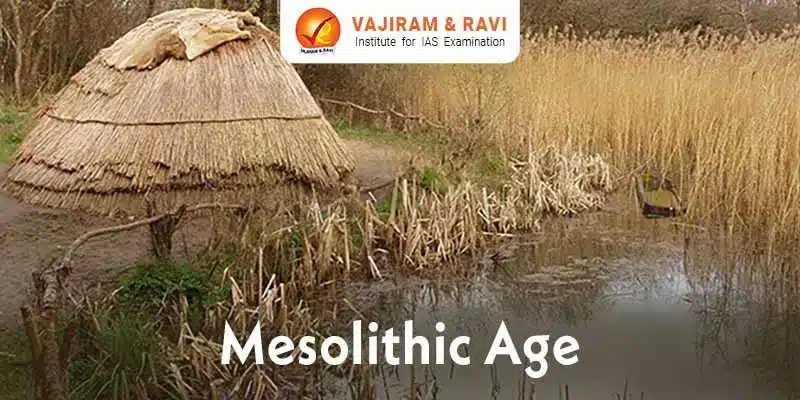
The Mesolithic Age, also known as the Middle Stone Age, was a transitional phase between the Palaeolithic Age and the Neolithic Age. It is associated with important changes in human life, including the widespread use of microlithic tools, greater dependence on fishing and small-game hunting, seasonal settlements, and gradual changes in subsistence practices.
In the Indian subcontinent, the Mesolithic period is particularly important because archaeological sites provide evidence of hunter-gatherer communities, burials, rock paintings, animal domestication and early food production.
Mesolithic Age History
The Mesolithic Age emerged after the Palaeolithic period as environmental conditions changed following the end of the last Ice Age. Around 10,000 years ago, the Pleistocene geological era gave way to the Holocene, giving way to the Mesolithic Age. During this transition, many environmental changes occurred, and specific climate profiles exist for some subcontinent regions.
- Microliths are extremely small tools that people began to make and use, according to prehistorians. This Mesolithic Age of the Prehistoric Period ended with the introduction of agriculture (the beginning of the Neolithic Age).
- Climate: The phase is of variable length, depending on climatic factors like rising temperatures, warm and dry climates, and impacts on human life and fauna.
Mesolithic Age Time Period
The Mesolithic Age, or Middle Stone Age, broadly dates to 10,000 BCE–6,000 BCE in many parts of the world. In India, Mesolithic cultures broadly emerged around 10,000 BCE, but their duration varied considerably across regions, and some microlithic traditions continued much later.
Mesolithic Age Tools
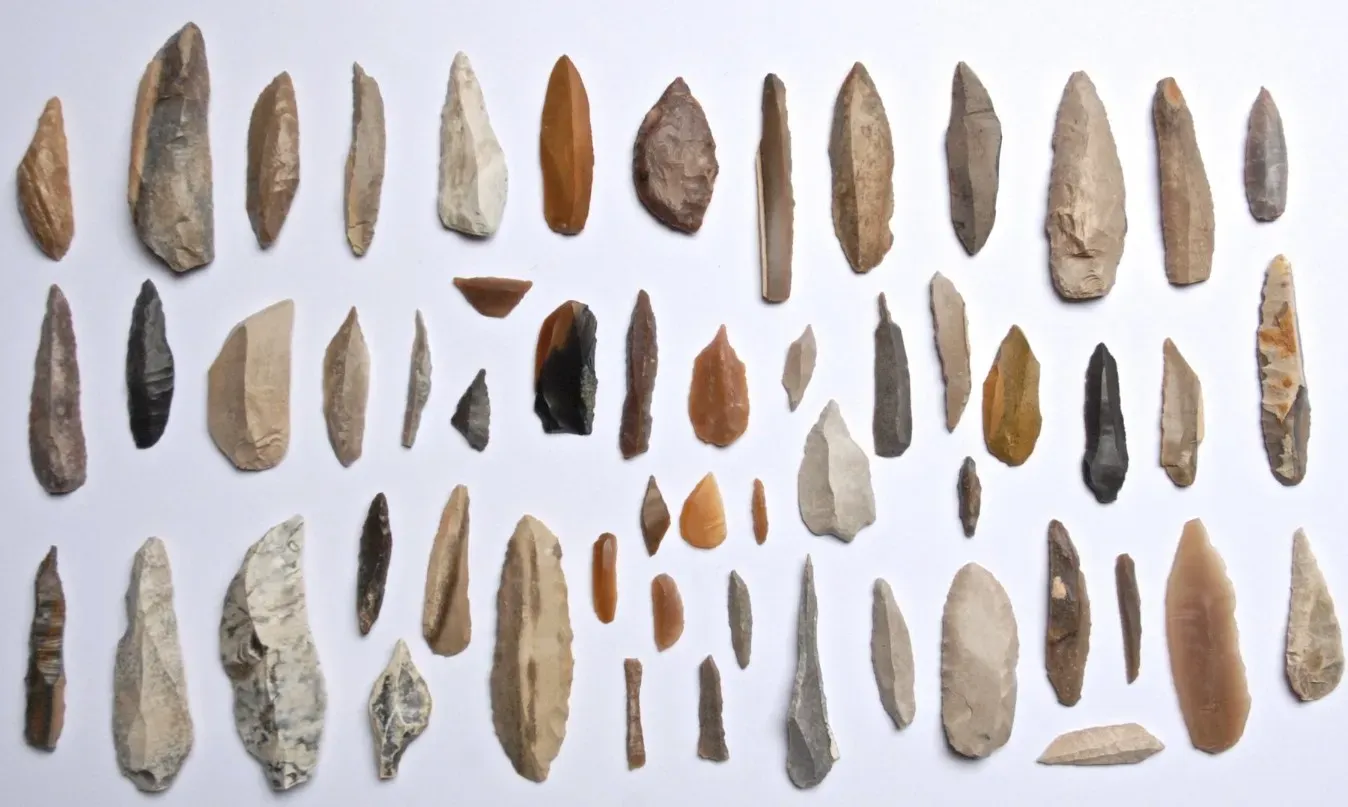
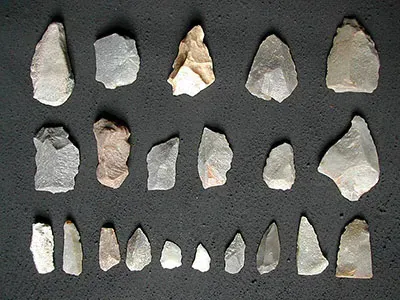
Microliths were the distinctive features of this age. They were called so because the tools used were chipped stone tools with a length of under 1 cm to 5 cm.
- The technique to make microliths was punching and pressing on harder materials like agate, chalcedony, flint, carnelian, etc.
- Microliths were geometric (trapeze, triangle, lunate, or crescent) as well as non-geometric shapes.
- Microliths also include small versions of some Upper Palaeolithic tools, such as burins, points, and scrapers.
- Their small size indicates that they were used as composite tools and were made of wood or bone.
- Macroliths, the larger tools, were also used. These were in the form of axes and picks and were a continuation of the Upper Palaeolithic tools, such as scrapers.
- Bone and antler tools were also used.


Mesolithic Age Lifestyle
Mesolithic communities followed a semi-nomadic lifestyle, combining hunting, gathering and fishing with emerging practices of animal domestication and more stable settlement. Their way of life reflected growing adaptation to diverse environments.
- Camps and houses: The Mesolithic people were migratory in nature. They migrated in pursuit of food from plants and animals.
- In addition to using caves and rock shelters, they constructed makeshift huts.
- There has been the discovery of circular huts with potholes as well as burnt clay lumps bearing reed impressions.
- There are paintings inside a lot of caves and shelters.
- Images of circular huts can be found on rocks.
- Perishable materials were used to construct the makeshift huts.
- There are traces of circular and oval huts, as well as what may be wattle and daub, in Bagor and Tilwara in Rajasthan and Chopani Mando and Damdama in Uttar Pradesh.
- Burials: The fact that the Mesolithic people buried their dead suggests something about their beliefs and human relationships.
- In the Indian states of Mahadaha, Damdama, and Sarai Nahar Rai, skeletons of people have been discovered. A male and a female were buried together at Mahadaha.
Mesolithic Age Economy
The Mesolithic people continued to survive through hunting and gathering, but there occurred a change in the pattern of hunting from big animals in the Palaeolithic period to smaller animals that could be taken out with the aid of bows and arrows.
- Hunting: Hunting remained an important economic activity, with microliths being used as arrowheads and other hunting implements.
- Food Gathering: Communities collected wild fruits, roots, tubers, seeds and other plant resources, supplementing animal foods.
- Fishing: The exploitation of fish and other aquatic resources became increasingly important, particularly near rivers, lakes and other water bodies.
- Animal Domestication: Evidence from sites such as Bagor suggests the beginnings of animal domestication and herding during the later Mesolithic phase.
- Seasonal Mobility: Many communities remained semi-nomadic, moving between locations according to the availability of water, animals and plant resources.
Mesolithic Age India
In India, Mesolithic cultures started around 10,000 BCE. In some parts of India, such as Kerala and Tamil Nadu, Mesolithic culture continued up to 1000 BCE, until the beginning of the Iron Age. Barring the Northeast, Mesolithic sites are found throughout India.
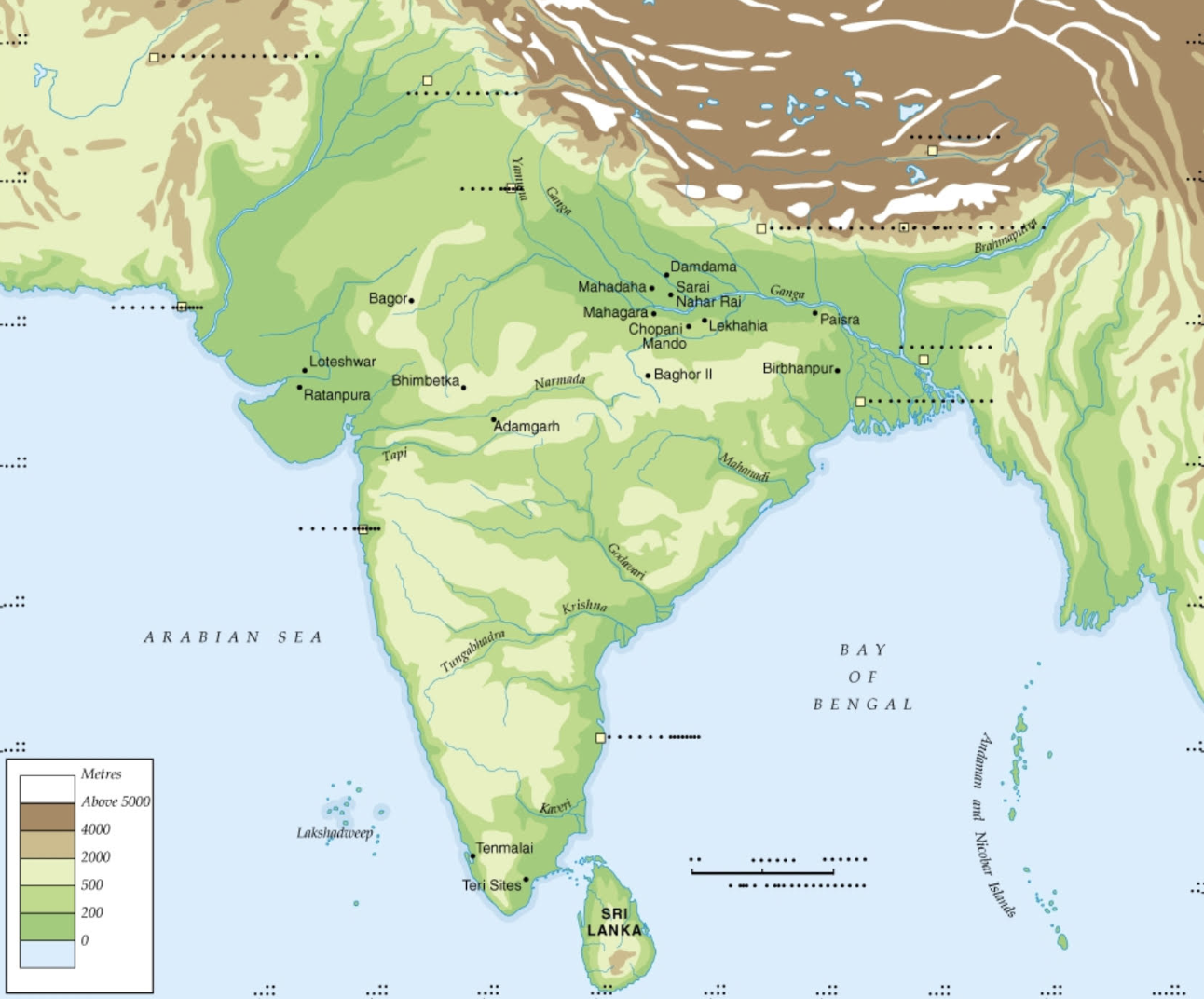
- Sites: Rock shelters in Mirzapur were the first excavated Mesolithic sites. Major excavated sites in India are:
- Tilwara, Bagor, and Ganeshwar in Rajasthan
- Langhnaj, Akhaj, Valasana, Hirpura, Amrapur, Devnimori, Dhekvadlo, and Tarsang in Gujarat
- Patne, Pachad, Hatkhamba in Maharashtra
- Morkhana, Lekhahia, Baghai Khor, Sarai Nahar Rai, Mahadaha, Damdama, Chopani Mando, Baidha Putpurihwa in Uttar Pradesh
- Pachmarhi, Adamgarh, Putli Karar, Bhimbetka, Baghor II, Baghor III, Ghaghari in Madhya Pradesh
- Paisra in Bihar
- Kuchai in Odisha
- Birbhanpur, West Bengal
- Muchatla Chintamanu Gavi and Gauri Gundam in Andhra Pradesh
- Sanganakallu in Karnataka
- Tenmalai in Kerala
Mesolithic Age Paintings
Mesolithic rock paintings provide valuable evidence of the economic, social and cultural life of prehistoric communities. Major evidence comes from Bhimbetka, Adamgarh, Pachmarhi and Mirzapur.
- Hunting Scenes: Hunting is the dominant theme, with paintings showing individuals and groups hunting animals using bows, arrows, spears and traps.
- Animal Depictions: Animals form the most frequent subject, including deer, wild boar, elephants and other wildlife, reflecting the importance of hunting and the natural environment.
- Social Activities: Paintings portray dancing, communal activities, gathering and eating, providing glimpses into the social life of Mesolithic communities.
- Geographical Distribution: Important Mesolithic rock-art sites are concentrated in Central India, particularly around Bhimbetka, Adamgarh, Pachmarhi and the Mirzapur region.
- Painting Techniques: Artists used natural mineral pigments, with red, white and other colours appearing in the paintings. Different styles and phases can be identified through superimposition.
Mesolithic Age to Neolithic Age
The transition from the Mesolithic to the Neolithic was a gradual process marked by a shift from a predominantly hunting-gathering economy towards food production, domestication, settled life and new technologies. The pace and nature of this transition varied across regions.
- Food Production: Communities gradually moved from exclusive dependence on hunting and gathering towards cultivation of plants and production of food.
- Animal Domestication: The domestication and management of animals became increasingly important, laying the foundation for pastoral activities.
- Sedentary Settlements: Greater dependence on agriculture and domesticated animals encouraged people to establish more permanent settlements.
- Improved Tools: The use of ground and polished stone tools, including axes and celts, became characteristic of Neolithic technology.
- Pottery: The increasing need for storage and processing of food encouraged the wider use of pottery in Neolithic communities.
- Changing Economy: The economy gradually shifted from a food-collecting economy to a food-producing economy, although hunting and gathering continued in many areas.
Mesolithic Age UPSC PYQs
Q1: Mesolithic rock-cut architecture of India not only reflects the cultural life of the times but also a fine aesthetic sense comparable to modern painting. Critically evaluate this comment. (UPSC Mains 2015)

 Last updated on Oct, 2026
→ UPSC 2027 Notification will be released on 13 January 2027 at upsconline.nic.in.
→ Check Nobel Prize 2026 Winners List here.
→ Download PIB PRiSM Monthly Magazine 2026 here.
→ Check UPSC Monthly Current Affairs Magazine The Recitals here.
→ Check out the latest UPSC Syllabus here.
→ Download UPSC Model Answers for Mains 2026
→ UPSC Mains Question Paper 2026 is out now for Essay & GS Paper 1, 2, 3 & 4.
→ UPSC Calendar 2027 has been released.
→ Enroll in Vajiram & Ravi’s UPSC Mains Test Series 2027 for structured answer writing practice, expert evaluation, and exam-oriented feedback.
→ Join Vajiram & Ravi’s UPSC Mentorship Program 2027 for personalized guidance, strategy planning, and one-to-one support from experienced mentors.
→ Go through the UPSC Mains Previous Year Papers to enhance your preparation.
→ UPSC has released UPSC Toppers List 2025 with the Civil Services final result on its official website.
→ Also check Best UPSC Coaching in India
Mesolithic Age FAQs
Q1. What is the Mesolithic Age?+
Q2. What are the three stone ages in order?+
Q3. What are the three main characteristics of the Mesolithic Age?+
Q4. What is the difference between the Paleolithic Age and Mesolithic Age?+
Q5. Who named the Mesolithic Age?+
Tags: mesolithic age in india quest upsc ancient history notes