The Chalcolithic Age in India (2000–700 BC) marked the use of both copper and stone, bridging the Neolithic and Iron Ages. Key cultures include Ahar-Banas (noted for copper supply), Kayatha (with early horse evidence), Malwa (multi-roomed homes, pottery), and Jorwe (dry farming, burial practices, lime-making industry). The Chalcolithic Age is also known as the Copper Age or the Stone-Copper Age
Other cultures include the OCP (Ochre Coloured Pottery) linked with copper hoards, and the PGW (Painted Grey Ware) culture, known for fine pottery and early iron tools. These cultures developed regional identities with advanced agriculture, tools, and religious practices, laying the foundation for urbanisation and the Second Urbanisation phase.
Chalcolithic Age Overview
The Chalcolithic Age, also known as the "stone-copper phase", was characterised by the utilisation of copper and stone. This period followed the Neolithic Age and marked the emergence of metal usage, particularly copper and low-grade bronze. This culture was prominent during the pre-Harappan period but was also present in various regions during the post-Harappan period.
Chalcolithic Age Time Period
The Chalcolithic Age, or Copper Age, marked the transitional phase between the Neolithic and Bronze Age. Globally, it broadly spanned 4000–1000 BCE, while in India, Chalcolithic cultures generally flourished between 2000 and 700 BCE, varying considerably across different regions.
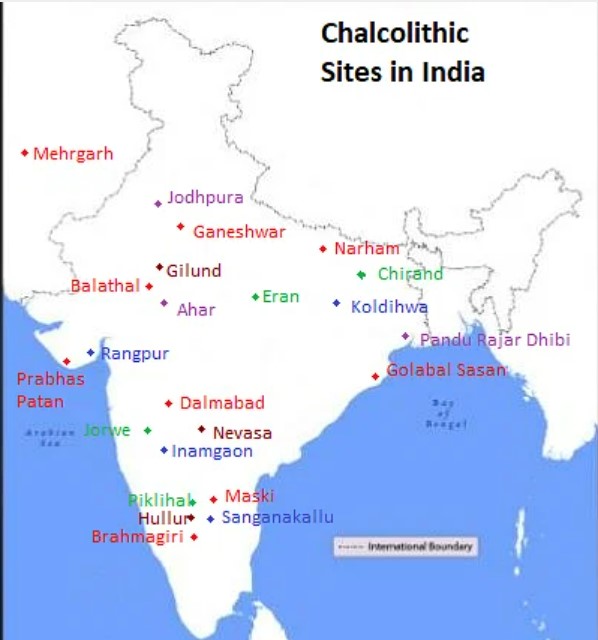
Chalcolithic Age Features
The Chalcolithic Period marked a transitional phase between the Neolithic and Iron Age, characterised by copper-stone technology, settled agriculture, distinctive pottery, village communities, craft specialisation, and regional cultural diversity.
- Use of Copper and Stone: People used copper alongside stone tools and weapons. However, copper technology remained limited, and stone tools continued to be important in daily activities.
- Agricultural Economy: Agriculture formed the economic foundation, with communities cultivating crops such as wheat, barley, pulses and millets, depending on regional environmental conditions and available water.
- Settled Village Life: Most Chalcolithic communities lived in permanent or semi-permanent settlements, generally consisting of houses made from mud, mud-bricks, wattle-and-daub, or locally available materials.
- Distinctive Pottery Traditions: Pottery became an important cultural marker, with different regional traditions such as Black-and-Red Ware, Ochre-Coloured Pottery and painted ceramics showing considerable stylistic variation.
- Pastoralism and Animal Husbandry: Alongside agriculture, people practised cattle, sheep, goat and other animal husbandry. Hunting and gathering also supplemented subsistence, particularly in regions with suitable natural resources.
- Regional Cultural Diversity: The Chalcolithic period was not a single uniform culture; distinct regional cultures developed across India, including Ahar-Banas, Malwa, Jorwe and Kayatha traditions.
Chalcolithic Age Tools
The Chalcolithic Age, or Copper-Stone Age, is characterised by the simultaneous use of copper and stone tools. The type and variety of tools varied across different Chalcolithic cultures and regions.
- Copper Tools: Copper was used to make flat axes, chisels, knives, spearheads, arrowheads and fishhooks, as well as ornaments.
- Microliths: Small stone tools made from chert, chalcedony and quartz continued to be widely used for cutting, hunting and other activities.
- Grinding Tools: Stone querns, mullers and grinding stones were used for processing grains and other food materials.
- Scrapers & Borers: Stone scrapers and borers were used for various household and craft activities.


Chalcolithic Age Regional Cultures in India
The Chalcolithic Age, marked by the use of copper and stone tools, represents a transitional phase between the Neolithic Age and the Early Iron Age in India. This period saw the emergence of region-specific cultures like Ahar-Banas, Kayatha, Malwa, Jorwe, and OCP, each with distinct settlement patterns, subsistence strategies, material culture, and religious practices.
Ahar-Banas Culture
It is one of the earliest Chalcolithic cultures in India. Most sites of this culture are located in the Banas Valley in southeastern Rajasthan, known as Mewar.
- Mineral Deposits and Copper Supply: Sites are found to be rich in mineral deposits and were believed to supply copper to the Harappan sites.
- Sites and Excavations: Over sixty Ahar culture chalcolithic sites have been discovered. Important among them are Balathal, Gilund, Ojiyana, Pachamta, etc.
- Settlement Patterns and Industrial Activities: Stone, mud, and mud-brick houses were built, and fortified enclosures were present at some sites.
- Mass production of ceramics, metalworking, and bead industries developed during this phase.
- Agriculture: Rice cultivation along with wheat, barley, millet, bajra, and jawar.
- Economy: Mixed economy of cultivation and hunting-gathering, with domesticated animals and hunting of wild species.
- Cultural Aspects: Bull figurines appearing in large numbers during the mature Ahar phase have symbolic significance.
Kayatha Culture
The culture is named after the Chalcolithic site Kayatha, located in Ujjain district, Madhya Pradesh. Most of these settlements are situated along the tributaries of the Chambal River. Its ancient name is Kapitthaka, the birthplace of Varaha, a celebrated astronomer.
- Ceramics: The pottery types of bowls, high- and short-necked storage jars with a globular profile, and basins, as well as chocolate slipped ware, were distinctive. The majority of pottery consisted of coarse, handmade red/grey ware.
- Tools and Ornaments: Both copper and stone tools were used by the Kayatha culture. Ornaments, such as two bead necklaces made from semi-precious stones, were discovered.
- Economy: The inhabitants resided in small huts with thatched roofs, well-rammed floors, and wattle and daub walls. A mixed economy was practised, evident from the evidence of subsistence farming, stock raising, hunting, and fishing.
- Crops like barley and wheat were cultivated.
- Domesticated animals included cattle and sheep/goats.
- Notably, horse remains were found at the Chalcolithic level in Kayatha.
Malwa Culture
It is a prominent Chalcolithic culture in central India and widely distributed throughout the Malwa region, flourishing between 1900-1400 BC. First identified by the excavations at Maheshwar (on the bank of the Narmada), which is the ancient Mahishmati. Malwa culture sites flourished mostly on the banks of the tributaries of the Narmada.
- Sites and Excavations: The sites consist of numerous small villages and a few larger villages. Notable Malwa culture chalcolithic sites (villages) include Navdatoli, Nagda, Kayatha and Eran.
- Structures and Artefacts: Houses were multi-roomed with well-rammed floors and thatched roofs.
- Pottery: Various pottery types were discovered, including the distinctive Malwa ware, cream slipware, and red/grey ware.
- Tools: Copper tools and exquisitely made copper axes were found, along with a specialised blade industry.
- Ornaments: Bead necklaces made from semi-precious stones were also unearthed.
- Expansion: The Malwa culture spread into Maharashtra, with extensive sites identified in the Tapi, Godavari, and Bhima valleys.
- Chalcolithic diet: It included carbonised grains of wheat, barley, jawar, rice, legumes, oilseeds, and fruits, providing insights into subsistence practices and diet.
- Animal flesh was also part of the Chalcolithic diet.
- Material culture: Malwa ware, mainly Ceramic types, formed the material culture. Other material assemblages include blade tools, copper artefacts, and beads.
- Religious beliefs: Evidence of terracotta female figures, Terracotta bull figures, painted male figures, and fire altars has been found.
Jorwe culture
It is the most important Chalcolithic culture of Maharashtra, spanning almost all of the state except for the coastal strip and Vidarbha.
- Regional Centres: Prakash (Tapi valley), Daimabad (Godavari-Pravara valley), and Inamgaon (Bhima valley). Inamgaon excavation reveals structures like a granary and diversion channels.
- Types of Sites: Jorwe sites were classified as regional centres, villages, hamlets, farmsteads, and camps.
- Subsistence Patterns: Dry farming was the mainstay of Jorwe culture, with stock raising, hunting, and fishing serving as ancillary pursuits.
- Crop rotation and a variety of crops were practised, including barley, wheat, jowar, rice, and pulses.
- Material Culture: Stone blade/flake industry and ceramic technology were significant aspects.
- Painted pottery was wheel-made and well-fired, featuring forms like spouted jars and carinated bowls. Metal technology was rudimentary, and lime-making was a flourishing industry.
- Burial Practices and Religious Beliefs: Child burials were found in urns, while adult burials had the portion below the ankles chopped off.
- Unique burials, such as a four-legged urn burial with an adult skeleton, were discovered at Inamgaon. Terracotta figurines provided insights into religious beliefs.
Ochre-Coloured Pottery (OCP) Culture
The Ochre Coloured Pottery (OCP) Culture was a prominent rural Chalcolithic horizon that flourished in Northern India, primarily across the upper Ganga-Yamuna Doab, Rajasthan, and western Uttar Pradesh. It is characterized by its fragile, ill-fired, and red-to-ochre-washed ceramics. This culture marks an essential transitional phase following the decline of the Harappan Civilisation.
- Development of OCP: OCP from the upper Ganga basin shows similarities with pre-Harappan and Early Harappan artefacts from the Indus and Yamuna valleys.
- Association with Copper Hoards: The association of OCP with Copper Hoards is found in different parts of northern and eastern India.
- Major Sites & Distribution:
- Ahichchhatra & Jodhpura: OCP pottery with larger fragments has been discovered in the upper Ganga-Yamuna Doab; these are the only sites where habitational deposits of OCP have been found.
- Hastinapura: Located in Uttar Pradesh; OCP layers were identified at the lowest stratigraphic levels.
- Atranjikhera: A key site in Uttar Pradesh showing a clear stratigraphic transition.
- Jodhpura & Ganeshwar: Important sites in Rajasthan showing deep antiquity overlapping with mature Harappan phases.
- Alamgirpur: A late Harappan site showing direct OCP linkages.
Painted Grey Ware Pottery (PGW) Culture
Painted Grey Ware (PGW) is a high-quality grey pottery with a thin fabric and sophisticated firing techniques.
- Major Sites & Distribution: PGW sites extend from the Bahawalpur region of Pakistan to Kaushambi near Allahabad in Uttar Pradesh, with sporadic findings in places like Vaishali, Lakhiyopur, and Ujjain.
- Culture and practices: Burials have been found at some PGW sites, and human skeletons were discovered in the Late Harappa-PGW interlocking stage at Bhagwanpura.
- The subsistence base of PGW culture involved the cultivation of rice, wheat, and barley, with a possible practice of double cropping.
- Iron and Second Urbanisation: Iron objects are not universally present at PGW sites, but they are found in the Ganga-Yamuna doab region.
- Iron artefacts primarily include weapons like arrowheads, spearheads, blades, and daggers.
- Mature PGW phases have provided evidence of iron implements used in agriculture, such as sickles, ploughshares, and hoes.
Chalcolithic Age Limitations
The Chalcolithic Age marked the transition to metal use, primarily copper. However, despite technological progress, these early farming communities faced several socio-economic and technological constraints that prevented them from evolving into urban, complex civilisations.
- High Infant Mortality: Large numbers of child burials in western Maharashtra reflect high infant mortality rates and a socio-economic pattern that failed to promote longevity.
- Rural Economy: The culture remained essentially rural, lacking urban development, complex administrative structures, or city life.
- Metallurgical Constraints: Supply of copper was limited. Lack of knowledge in alloying copper with tin to produce stronger bronze, a key technological driver behind civilisations in Egypt, Crete, and Mesopotamia.
- Absence of Literacy: The Chalcolithic people did not develop the art of writing or script-based communication.
- Decline: Severe climatic deterioration, widespread aridity, and drying up of rivers around 1200–700 BCE severely impacted agriculture, forcing many rural settlements to be abandoned and giving way to the Iron Age.
Chalcolithic Age UPSC PYQs
Q1: Consider the following information: (UPSC Prelims 2024)
- Archaeological Site: Chandraketugarh, State: Odisha, Description: Trading Port town
- Archaeological Site: Inamgaon, State: Maharashtra, Description: Chalcolithic site
- Archaeological Site: Mangadu, State: Kerala, Description: Megalithic site
- Archaeological Site: Salihundam, State: Andhra Pradesh, Description: Rock-cut cave shrines
In which of the above rows is the given information correctly matched ?
(a) 1 and 2
(b) 2 and 3
(c) 3 and 4
(d) 1 and 4
Ans: (b)
Q2: Consider the following pairs: (UPSC Prelims 2021)
(Historical place) (Well-known for)
- Burzahom: Rock-cut shrines
- Chandraketugarh: Terracotta art
- Ganeshwar: Copper artefacts
Which of the pairs given above is/are correctly matched?
(a) 1 only
(b) 1 and 2
(c) 3 only
(d) 2 and 3
Ans: (d)
| Other Related Posts | |
| Prehistoric Period | Indus Valley Civilization Sites |
| Chalcolithic Age | Rakhigarhi |
| Megalithic Culture | Lothal |
| Town Planning of Harappan Civilization | Kalibangan |

 Last updated on Oct, 2026
→ UPSC 2027 Notification will be released on 13 January 2027 at upsconline.nic.in.
→ Check Nobel Prize 2026 Winners List here.
→ Download PIB PRiSM Monthly Magazine 2026 here.
→ Check UPSC Monthly Current Affairs Magazine The Recitals here.
→ Check out the latest UPSC Syllabus here.
→ Download UPSC Model Answers for Mains 2026
→ UPSC Mains Question Paper 2026 is out now for Essay & GS Paper 1, 2, 3 & 4.
→ UPSC Calendar 2027 has been released.
→ Enroll in Vajiram & Ravi’s UPSC Mains Test Series 2027 for structured answer writing practice, expert evaluation, and exam-oriented feedback.
→ Join Vajiram & Ravi’s UPSC Mentorship Program 2027 for personalized guidance, strategy planning, and one-to-one support from experienced mentors.
→ Go through the UPSC Mains Previous Year Papers to enhance your preparation.
→ UPSC has released UPSC Toppers List 2025 with the Civil Services final result on its official website.
→ Also check Best UPSC Coaching in India
Chalcolithic Age FAQs
Q1. Which age is known as the Chalcolithic Age?+
Q2. What is the difference between Chalcolithic Age and Neolithic Age?+
Q3. How is Bronze Age different from Chalcolithic Age?+
Q4. When did the Chalcolithic start?+
Q5. What is another name for Chalcolithic?+
Tags: chalcolithic age in india quest upsc modern history notes