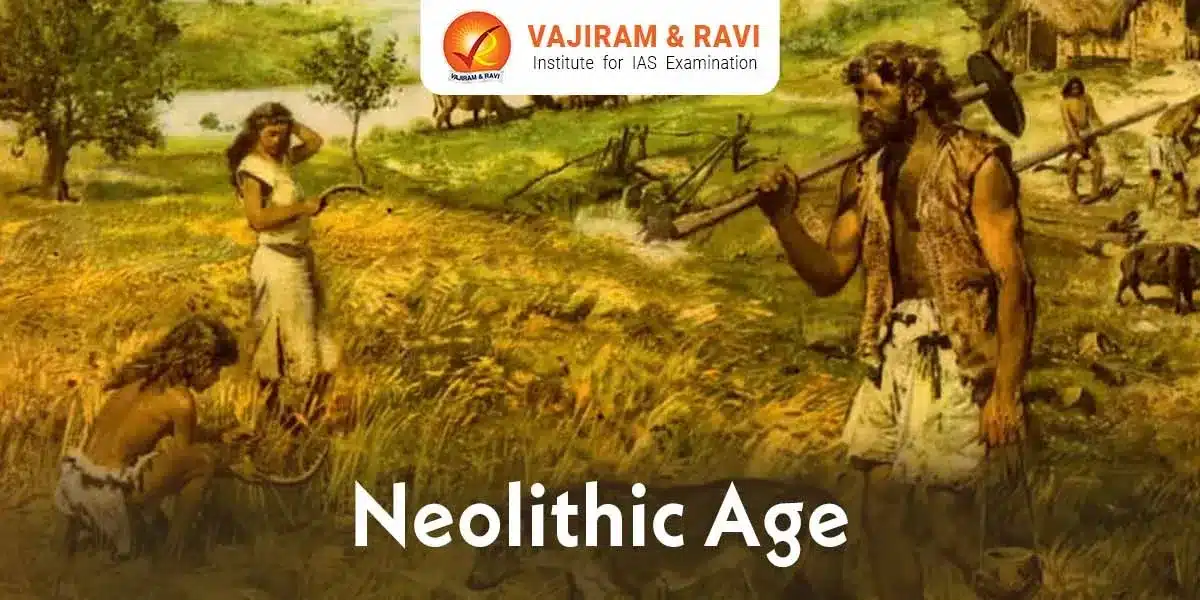
The Neolithic age is the final stage of the Stone Age, after the Palaeolithic and Mesolithic. It is also known as the New Stone Age, characterised by the Neolithic Revolution. It is distinguished by several novel cultural features, such as the use of new technology to create stone tools, new means of subsistence, new patterns of housing, etc. Animal domestication and agriculture began during the Neolithic era.
The Fertile Crescent region of the Levant and Mesopotamia, the Nile region, the Indus region, and the Ganges valley of India and China all contain early Neolithic cultural evidence. In these areas, agriculture first appeared between 10,000 and 5,000 BCE, which started several cultural advancements.
Neolithic Age Meaning
The Neolithic Age, or New Stone Age, marked a major transition from hunting and gathering to settled agriculture and animal domestication. This new stone age developed in the Holocene epoch, preceded by the Mesolithic age. This prehistoric period was characterised by the development of agriculture, pottery, and permanent settlement, thus marking the beginning of the first human civilisation, often termed the Neolithic Revolution.
Neolithic Age Time Period
The time period of the Neolithic Period, or New Stone Age, lasted from about 10,000 BCE to 3,000 BCE globally, though the exact dates vary greatly by region. In India, the time period spanned roughly from 7,000 BCE to 1,000 BCE (with early farming sites like Mehrgarh appearing around 7000 BCE). The Neolithic period was characterised by the Neolithic Revolution. Man progressed from being a seeker of the natural world to its master.
Neolithic Revolution
The Neolithic Revolution was a monumental transition in human history beginning roughly 12,000 years ago. It transformed societies from nomadic hunter-gatherer bands to settled, food-producing communities through systematic agriculture and animal domestication, establishing the foundation for modern civilisation.
- Crafts & Tools Advancement: The Neolithic period is associated with the advancement in stone tool technology, particularly the making of ground, pecked, and polished stone tools, and the advent of food production.
- Changes in the stone tools were in line with the changes in subsistence strategies.
- Sedentary Living: The emergence of small and relatively self-sufficient village communities, as well as a division of labour based on sex, resulted in a sedentary life for the first time in human history.
- Food production by artificial means: In the Neolithic age, humans started using artificial means to produce food for the first time.
- Similarly, early crops included wild varieties of paddy (especially in Asia), wheat, barley, etc.
- Agriculture proved to be such a significant invention that a small portion of society was able to provide the entire community with food.
- Animal Domestication: Some wild animal species, like goats, sheep, and cattle, were domesticated and were used for transportation and agriculture.
- Agriculture and the domestication of animals were the two novel practices that developed at this time.
- Pottery: Neolithic pottery was pioneering and made by hand at first, then using wheels.
- Weaving and spinning were also invented in this age.
- Gradual Spread: The revolution occurred independently and progressively across diverse regions, creating varied societal features.
- The Neolithic Age opened an entirely new way of life and sowed the seeds of civilisation. That is why this phase is called the Neolithic Revolution to highlight the enormous significance of these changes.
Neolithic Age and Beginning of Food Production
The domestication of plants and animals was the outcome of a long series of collective experiments spanning several generations of men, women, and children, stretching out over possibly thousands of years.
- It involved taking plants and animals out of their natural habitat and selectively breeding and raising them in controlled artificial environments for human benefit.
- The balance of subsistence strategies can be gradually observed to have shifted from hunting and gathering to agriculture and animal husbandry.
- The next stage was that of incipient (early) agriculture, which, over time, led to the stage of developed agriculture.
- Over time, these changes were linked to advancements in technology, increased food availability, population growth, an increase in the quantity and size of human settlements, and more intricate social and political structures.


Neolithic Age Features
The Neolithic age in the Indian subcontinent marked a pivotal transition from a hunting-gathering lifestyle to settled food production. Characterised by regional variations, this era witnessed significant technological advancements in tool-making, ceramic development, artistic expressions, structural housing, and the emergence of early socio-religious organization and territorial ownership.
Tools in Neolithic Age
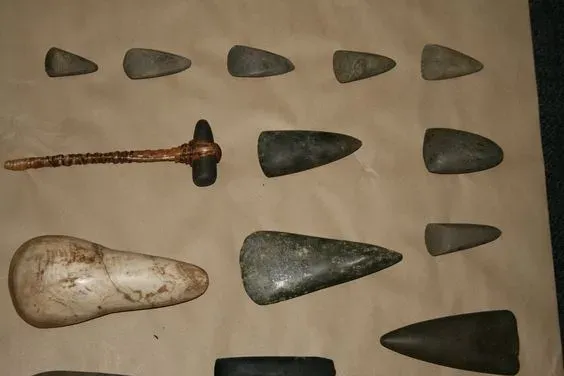
Neolithic communities across Indian sites relied heavily on ground and polished stone axes, which were crucial for agricultural activities and land clearing. All Indian sites possessed polished or ground stone axes. They also included earlier tools such as microliths and blades.
Neolithic Age Pottery
The Neolithic Age Pottery in India evolved gradually over time. The early Neolithic culture of a few sites, such as in Kashmir, Balochistan, and South India, was without any pottery. Later, earthen pots were a distinctive feature. Eventually, hand-crafted and wheel-made earthen pots became a distinctive feature, playing an indispensable role in storing surplus food grains, carrying water, and daily food preparation.
Neolithic Age Arts and Crafts
Beads made of semi-precious stones and clay figures of animals are notable items. Artistic expression during this era highlighted notable improvements in material culture and personal adornment. Additionally, artisans crafted detailed terracotta figurines, particularly small clay images of cattle and mother goddesses, which served both aesthetic purposes and symbolic roles in early regional spiritual traditions.
Neolithic Age Social Organisation
People started to live in sedentary and semi-sedentary settlements in the form of simple huts (across India) and pit dwellings (in Kashmir and the Deccan).
- They probably had a tribal level of social organisation.
- As they domesticated plants and animals, the concept of land and plant ownership developed.
- The presence of small houses may suggest the presence of nuclear families.
- The dead were buried within the houses, and animal burials are sometimes found. This suggests the adoption of specific rituals and the worship of the dead.
- They may have worshipped the natural forces.
Neolithic Age Sites in India
India's Neolithic cultures can be broken down into a number of regional groups, each of which had its own prosperous time. It started very early in the northwest regions of Pakistan and India. The Neolithic cultures emerged in northeastern India towards the beginning of recorded history, which is a very late date.

| Neolithic Sites of North-Western Region and Features | |
| Mehrgarh (Kacchi Plains of Balochistan, Pakistan) |
- On the Bolan river bank. - Evidence of pre-pottery Neolithic culture - Settlement of semi-nomadic pastoral groups - People used polished stone axes, querns, microliths, and bone tools; however, they did not use pottery. - Cultivation of six-row barley, emmer, and einkorn wheat. Barley is likely to be the most important crop. - Domestication of sheep, goats, and cattle - Seeds of plum, dates, and jujube were found at this site, suggesting the gathering activities of the inhabitants. - The bones of gazelles, swamp deer, and antelopes indicate that they hunted wild animals too. Goat bones are also found. - They built their houses with mud and buried the dead in between the houses. - People used sea shells, limestone, turquoise beads, lapis lazuli, and sandstone as ornaments.
- Grinding stones and blades have been found. Evidence of bitumen in blades suggests the use of hafting. - Presence of a handmade female figurine. - Significance of Mehrgarh: The site provides the earliest evidence of the transition from hunting-gathering to animal domestication and agriculture. |
| Kashmir Valley Neolithic Sites and Features | |
| Burzahom |
- Pit houses to protect from the cold weather of the region - Coarse handmade pottery - From this place, a stone with an engraved picture of a hunting scene, the sun, and a dog has been discovered. - Evidence of grain storage has been found. - A perforated harvester with decoration has been found at Burzahom. - agate and carnelian beads - A wild dog bone and antler horn were found at the burial place - Seeds of wheat, barley, common pea, and lentils have been recovered - The domesticated animals include cattle, sheep, goats, pigs, dogs and fowl. |
| Gufkral |
- Evidence of pit dwellings. - Bones of sheep, goats, deer, ibex, wolf and bears suggest their dependence on pastoralism and hunting. - Material culture: As revealed from polished stone tools, querns, horn tools and steatite beads - The site dates back to 1300 BCE. |
| Neolithic Sites of Vindhya-Ganga Valley and Features | |
| Belan River Valley (modern Uttar Pradesh and Madhya Pradesh) |
- It witnessed one of the earliest Neolithic occupations in India. - Here, there is a noticeable shift from food gathering to food production. |
| Chopani Mando, Koldihwa, and Lehuradeva all in Uttar Pradesh |
- Evidence of wattle and daub houses, post-holes, microlithic tools, querns, pestles, and underfired hand-made ceramics. - The important ware was ‘corded ware’ or cord impressed ware including bowls and storage jars. - People engaged in farming and animal husbandry. - Bones of cattle, sheep, goats, deer, turtles, and fish have also been recovered. - At Mahagara, evidence of domesticated rice has been found. |
| Chirand, Chechar, Senuwar, and Taradih all in Bihar |
- Senuwar: evidence of cultivated rice, barley, field pea, lentil and millets. - Chirand: Evidence of mud floors, pottery, microliths, polished stone axes and terracotta human figurines.
|
| Other features |
- Sohagaura, Imlidih Khurd, Chirand, Chechar, and Senuwar give evidence of a Chalcolithic transition - In this region, copper seems to have been introduced sometime during the second half of the third millennium BCE. |
| Other Region Neolithic Sites and Features | |
| Eastern Region Sites |
- Birbhanpur (West Bengal) is an important Neolithic site in this region, along with Kuchai, Golbaisasan, and Sankarjang. - Evidence of shouldered axes, pointed-butt celts, and chisels - Similarities to East and Southeast Asian Neolithic Complexes - Mace heads, pounders, coarse red ware, cord-impressed pottery, floors, postholes and bones have been found. - Pandu Rajar Dhibi (West Bengal): suggests Neolithic culture had emerged from the Mesolithic context. |
| South India |
- Within South India's Neolithic complex, over 200 Neolithic sites have been identified. - Karnataka:Brahamgiri, Hallur, Kopagal, Maski, Piklihal, Tekkalkotta and Snagankallu. - Andhra Pradesh: Uttanur, Rampuan, Palvaya, and Nagarjunakonda. - Tamil Nadu: Paiyampalli. - Ashmounds: are a distinctive feature of this region. |

 Last updated on Oct, 2026
→ UPSC 2027 Notification will be released on 13 January 2027 at upsconline.nic.in.
→ Check Nobel Prize 2026 Winners List here.
→ Download PIB PRiSM Monthly Magazine 2026 here.
→ Check UPSC Monthly Current Affairs Magazine The Recitals here.
→ Check out the latest UPSC Syllabus here.
→ Download UPSC Model Answers for Mains 2026
→ UPSC Mains Question Paper 2026 is out now for Essay & GS Paper 1, 2, 3 & 4.
→ UPSC Calendar 2027 has been released.
→ Enroll in Vajiram & Ravi’s UPSC Mains Test Series 2027 for structured answer writing practice, expert evaluation, and exam-oriented feedback.
→ Join Vajiram & Ravi’s UPSC Mentorship Program 2027 for personalized guidance, strategy planning, and one-to-one support from experienced mentors.
→ Go through the UPSC Mains Previous Year Papers to enhance your preparation.
→ UPSC has released UPSC Toppers List 2025 with the Civil Services final result on its official website.
→ Also check Best UPSC Coaching in India
Neolithic Age FAQs
Q1. What is the Neolithic Age?+
Q2. What is the difference between Paleolithic and Neolithic Age?+
Q3. Why is it called Neolithic?+
Q4. Who is the father of the Neolithic Age?+
Q5. What are 5 facts about the Neolithic Age?+
Tags: neolithic age quest upsc ancient history notes