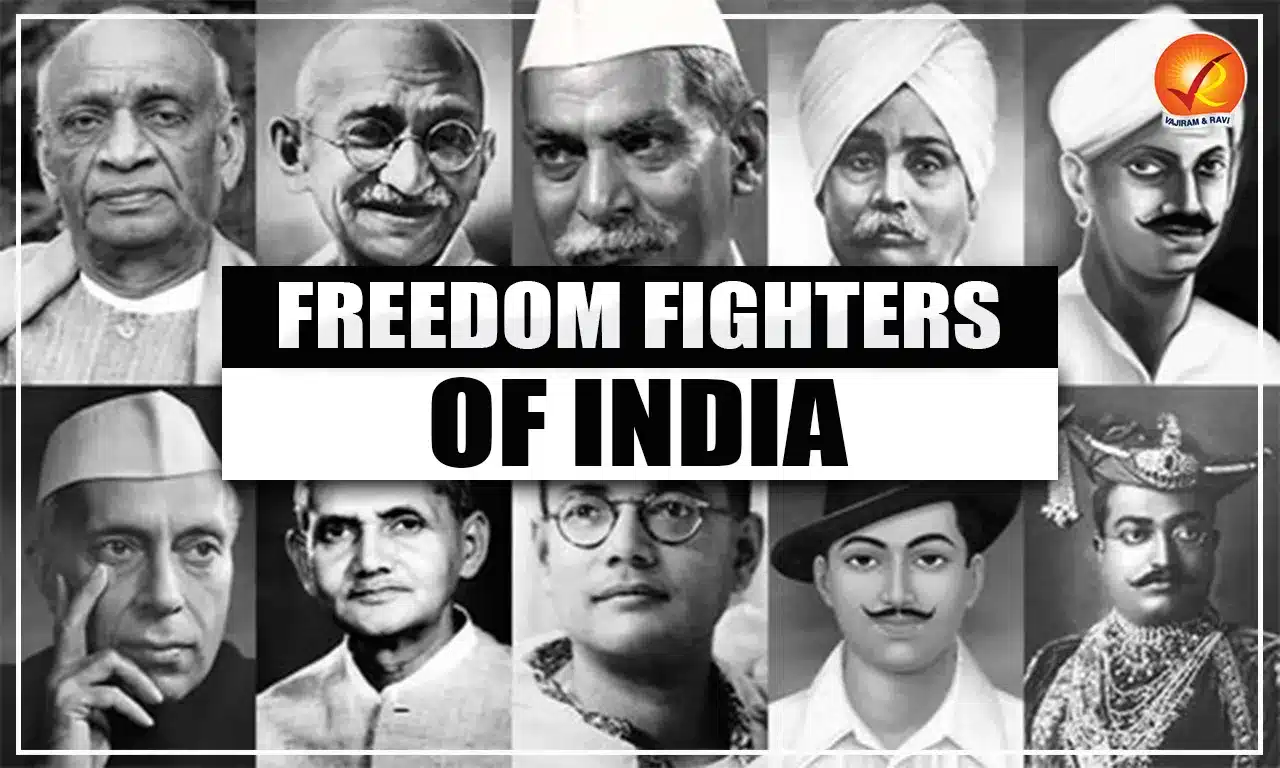
The freedom fighters of India played a significant role in the country's struggle against British colonial rule. Through mass movements, revolutionary activities, political organisations, social reforms and intellectual resistance, they helped shape the movement that ultimately led to India's independence on 15 August 1947.
The Indian freedom struggle involved people from different regions, religions, castes, communities and social backgrounds. The indian freedom fighters of India, including famous personalities such as Mahatma Gandhi, Jawaharlal Nehru, Subhas Chandra Bose, Bhagat Singh and Sardar Vallabhbhai Patel, made important contributions, while women such as Rani Lakshmibai, Sarojini Naidu, Aruna Asaf Ali and Madam Bhikaji Cama challenged colonial authority in different ways.
Freedom Struggle Timeline
India's Freedom struggle for independence from British rule was a century-long journey marked by major events and the efforts of many influential leaders. The timeline highlighting key events and freedom fighters of India from 1857 to 1947 is as follows:
| Year | Events | Personalities |
| 1857 | Revolt of 1857: The First War of Independence against British rule, marked by uprisings across northern India. | Mangal Pandey, Rani Lakshmibai, Nana Sahib, Tantia Tope |
| 1885 | Formation of the Indian National Congress (INC): A platform for political dialogue and demands for greater Indian participation in governance. | A.O. Hume, Dadabhai Naoroji |
| 1905 | Partition of Bengal: Divided Bengal into Hindu and Muslim-majority regions, leading to widespread protests. | Bal Gangadhar Tilak, Bipin Chandra Pal |
| 1906 | Formation of the Muslim League: Represented Muslim interests in the struggle for independence. | Aga Khan, Mohammad Ali Jinnah |
| 1916 | Lucknow Pact: Agreement between INC and Muslim League for joint action against British rule. | Bal Gangadhar Tilak, Mohammad Ali Jinnah |
| 1917 | Champaran Satyagraha: Gandhi's first active involvement in Indian politics, addressing farmers' grievances against oppressive plantation systems. | Mahatma Gandhi |
| 1919 | Rowlatt Act: Passed to suppress dissent; led to widespread protests and the Jallianwala Bagh Massacre. | General Dyer (British) |
| 1920-22 | Non-Cooperation Movement: Gandhi called for nonviolent resistance against British goods and institutions. | Mahatma Gandhi, Jawaharlal Nehru, Sardar Vallabhbhai Patel |
| 1928 | Nehru Report: Demands for constitutional reforms presented by the INC; led to the formation of the Simon Commission. | Motilal Nehru, Jawaharlal Nehru |
| 1930 | Salt March (Dandi March): Gandhi led a march to produce salt in defiance of British laws, symbolizing civil disobedience. | Mahatma Gandhi, Sarojini Naidu |
| 1931 | Gandhi-Irwin Pact: The agreement allowing Gandhi to attend Round Table talks in London; marked a temporary truce. | Mahatma Gandhi, Lord Irwin |
| 1935 | Government of India Act 1935: Introduced limited self-governance but fell short of full independence demands. | - |
| 1942 | Quit India Movement: Launched by Gandhi demanding an end to British rule; faced severe repression but galvanized national sentiment. | Mahatma Gandhi, Jawaharlal Nehru, Sardar Vallabhbhai Patel, Subhas Chandra Bose |
| 1946 | Cabinet Mission Plan: Proposed a framework for Indian self-governance; communal tensions escalated during this period. | Lord Pethick-Lawrence, Jawaharlal Nehru |
| June 1947 | Mountbatten Plan: Outlined the partition of India into two independent nations, India and Pakistan. | Lord Mountbatten, Jawaharlal Nehru, Muhammad Ali Jinnah |
| August 15, 1947 | India gained independence from British rule; marked by celebrations and communal violence due to partition. | - |
Freedom Fighters of India List
The following list includes prominent leaders, revolutionaries, social reformers and other personalities associated with India's struggle for freedom. Their methods and political beliefs differed, but their activities contributed in different ways to the history of Indian nationalism.
| Freedom Fighter | Major Contribution |
|---|---|
| Mahatma Gandhi | Led mass movements based on non-violence and satyagraha. |
| Jawaharlal Nehru | Prominent Congress leader and advocate of complete independence. |
| Sardar Vallabhbhai Patel | Organised the Bardoli Satyagraha and became a major nationalist leader. |
| Subhas Chandra Bose | Led the Indian National Army and established the Azad Hind government. |
| Bhagat Singh | Revolutionary nationalist who opposed colonial rule and imperialism. |
| Rani Lakshmibai | Led resistance against the British during the Revolt of 1857. |
| Sarojini Naidu | Nationalist leader, poet and women's rights advocate. |
| Madam Bhikaji Cama | Promoted Indian independence internationally. |
| Bal Gangadhar Tilak | Popularised assertive nationalism and the slogan "Swaraj is my birthright, and I shall have it." |
| Lala Lajpat Rai | Prominent nationalist associated with the Swadeshi movement and opposition to the Simon Commission. |
| Bipin Chandra Pal | Important advocate of Swadeshi and assertive nationalism. |
| Dadabhai Naoroji | Developed the economic critique of British colonial exploitation known as the Drain Theory. |
| Gopal Krishna Gokhale | Moderate nationalist and founder of the Servants of India Society. |
| Surendranath Banerjee | Early nationalist leader and co-founder of the Indian Association. |
| Rabindranath Tagore | Criticised colonial injustice and contributed to national consciousness through literature and public engagement. |
| Pingali Venkayya | Associated with the design of the Indian national flag that formed the basis of the flag adopted in 1931. |
| Madan Mohan Malaviya | Nationalist leader, educationist and co-founder of Banaras Hindu University. |
| Aurobindo Ghosh | Participated in early nationalist politics before developing into a major spiritual philosopher. |
| Acharya Vinoba Bhave | Gandhian social reformer associated with the Bhoodan Movement and constructive work. |
| Dr B. R. Ambedkar | Fought caste oppression and shaped constitutional safeguards for equality and fundamental rights. |
| Mangal Pandey | Associated with the events that preceded the Revolt of 1857. |
| Tatya Tope | Military leader during the Revolt of 1857. |
| Begum Hazrat Mahal | Led resistance against British rule in Awadh during the Revolt of 1857. |
| Chandrashekhar Azad | Revolutionary leader who resisted British colonial rule. |
| Ram Prasad Bismil | Revolutionary associated with the Kakori train action. |
| Ashfaqulla Khan | Revolutionary and participant in the Kakori train action. |
| Sukhdev Thapar | Revolutionary associated with the HSRA and the Lahore conspiracy case. |
| Rajguru | Revolutionary who participated in the struggle against British colonial rule. |
| Khudiram Bose | Young revolutionary executed by the British in 1908. |
| Udham Singh | Assassinated Michael O'Dwyer in 1940 in retaliation for the Jallianwala Bagh massacre and its aftermath. |
| Maulana Abul Kalam Azad | Congress president and prominent nationalist who opposed colonial rule. |
| Khan Abdul Ghaffar Khan | Led the non-violent Khudai Khidmatgar movement in the North-West Frontier region. |
| Maulana Hasrat Mohani | Nationalist leader associated with the demand for complete independence. |
| Hakim Ajmal Khan | Physician, educationist and nationalist who supported the Khilafat and Non-Cooperation movements. |
| Alluri Sitarama Raju | Led the Rampa Rebellion against British authority in the Madras Presidency. |
| Birsa Munda | Tribal leader who led the Ulgulan movement against colonial and exploitative structures. |
| Sidhu Murmu and Kanhu Murmu | Leaders of the Santhal Rebellion of 1855–1856. |
| Rani Gaidinliu | Naga spiritual and political leader who resisted British rule. |
| Aruna Asaf Ali | Prominent leader of the Quit India Movement. |
| Usha Mehta | Organised the underground Congress Radio during the Quit India Movement. |


Top 10 Freedom Fighters of India
There is no official ranking of the top 10 freedom fighters of India. Selecting the top 10 freedom fighters of India is subjective because the independence movement involved numerous leaders who made different contributions. The following list highlights ten widely recognised personalities and their major roles.
| No. | Freedom Fighter | Major Contribution |
|---|---|---|
| 1 | Mahatma Gandhi | Led nationwide non-violent movements, including Non-Cooperation, Civil Disobedience and Quit India. |
| 2 | Subhas Chandra Bose | Mobilised the Indian National Army and led the Azad Hind government. |
| 3 | Jawaharlal Nehru | Advocated complete independence and became a leading Congress figure. |
| 4 | Sardar Vallabhbhai Patel | Organised the Bardoli Satyagraha and played a major role in the national movement. |
| 5 | Bhagat Singh | Became a prominent symbol of revolutionary nationalism and anti-imperialism. |
| 6 | Bal Gangadhar Tilak | Popularised assertive nationalism and the demand for Swaraj. |
| 7 | Rani Lakshmibai | Led armed resistance during the Revolt of 1857. |
| 8 | Maulana Abul Kalam Azad | Prominent nationalist leader and advocate of Hindu-Muslim unity. |
| 9 | Sarojini Naidu | Mobilised people through political activism and civil disobedience. |
| 10 | Dadabhai Naoroji | Exposed the economic consequences of British colonial rule through the Drain Theory. |
Women Freedom Fighters of India (Female Freedom Fighters of India)
Women freedom fighters of India participated as organisers, political leaders, underground activists, soldiers, and communicators. Their work extended beyond supporting male leaders: many independently organised resistance and challenged restrictions on women’s public participation.
| Name | Major Contribution |
|---|---|
| Rani Lakshmibai | Led resistance against the British during the Revolt of 1857. |
| Begum Hazrat Mahal | Organised resistance against British rule in Awadh in 1857. |
| Sarojini Naidu | Participated in the Civil Disobedience Movement and became the first Indian woman president of the Indian National Congress. |
| Madam Bhikaji Cama | Promoted Indian independence abroad and displayed an early version of an Indian nationalist flag at Stuttgart in 1907. |
| Annie Besant | Supported Indian self-government and launched the Home Rule League in 1916. |
| Kasturba Gandhi | Participated in nationalist campaigns and supported civil resistance. |
| Kamala Nehru | Participated in the Non-Cooperation and Civil Disobedience movements. |
| Aruna Asaf Ali | Hoisted the Congress flag at Gowalia Tank Maidan during the Quit India Movement in 1942. |
| Usha Mehta | Helped operate the underground Congress Radio during the Quit India Movement. |
| Captain Lakshmi Sahgal | Led the Rani of Jhansi Regiment of the Indian National Army. |
| Matangini Hazra | Participated in the Quit India Movement and was killed during a protest in 1942. |
| Kanaklata Barua | Participated in the Quit India Movement in Assam and was killed while attempting to hoist the national flag. |
| Pritilata Waddedar | Revolutionary associated with the 1932 attack on the Pahartali European Club. |
| Kalpana Datta | Participated in revolutionary activities associated with the Chittagong Armoury Raid movement. |
| Durgawati Devi (Durga Bhabhi) | Assisted revolutionary networks associated with Bhagat Singh and the HSRA. |
| Rani Gaidinliu | Led resistance to British rule in the Naga region. |
| Velu Nachiyar | Eighteenth-century ruler who fought against the East India Company in the Sivaganga region. |
| Tara Rani Srivastava | Participated in the Quit India Movement in Bihar. |
| Sucheta Kripalani | Participated in the freedom movement and worked with underground networks during the Quit India Movement. |
| Parbati Giri | Participated in the freedom movement in Odisha and later became a social worker. |
Muslim Freedom Fighters of India
Muslim freedom fighters of India played important roles in India's struggle against British colonial rule. They participated in the Revolt of 1857, revolutionary organisations, constitutional politics, mass movements and campaigns for national independence. Their contributions also reflected different political perspectives, including non-violent resistance, revolutionary nationalism, anti-colonial activism and support for Hindu-Muslim unity.
| Name | Major Contribution |
|---|---|
| Maulana Abul Kalam Azad | Senior Congress leader who opposed British rule and supported national unity. |
| Ashfaqulla Khan | Revolutionary associated with the Kakori train action of 1925. |
| Khan Abdul Ghaffar Khan | Founded the Khudai Khidmatgar movement, which promoted non-violent resistance. |
| Maulana Hasrat Mohani | Nationalist and poet associated with the demand for complete independence. |
| Bahadur Shah Zafar | Last Mughal emperor and a symbolic leader of the Revolt of 1857. |
| Begum Hazrat Mahal | Led resistance against the British in Awadh during the Revolt of 1857. |
| Hakim Ajmal Khan | Nationalist leader who supported the Khilafat and Non-Cooperation movements. |
| Syed Shah Rahmat | Indian revolutionary associated with the Ghadar movement and executed by the French in 1915. |
| Abdul Hafiz Mohamed Barakatullah | Revolutionary nationalist who worked internationally for Indian independence and was associated with the Ghadar movement. |
| Saifuddin Kitchlew | Nationalist leader who opposed the Rowlatt Act and was associated with the events preceding the Jallianwala Bagh massacre. |
| Dr. Mukhtar Ahmad Ansari | Nationalist leader who participated in the Khilafat and Non-Cooperation movements. |
| Rafi Ahmed Kidwai | Congress leader who participated in the national movement and later served in independent India's government. |
| Umar Sobani | Nationalist and industrialist who supported the freedom movement and Congress activities. |
| Khan Abdul Jabbar Khan | Political leader in the North-West Frontier region who opposed British colonial rule. |
| Allah Bux Soomro | The Premier of Sindh who strongly opposed the Muslim League's two-nation theory and supported the Quit India Movement |
| Abbas Ali & Shah Nawaz Khan | Officers of Subhas Chandra Bose's Azad Hind Fauj (Indian National Army - INA) who fought militarily against British colonial rule. |
Freedom Fighters of India Images with Names
The following image contains the images of the most prominent and famous freedom fighters of India:

Famous Freedom Fighters of India and Contributions
The Freedom Fighters of India were brave men and women who fought against British rule to win independence for the country. List of prominent freedom fighters and leaders of India's independence movement:
Mahatma Gandhi
Mahatma Gandhi (1869-1948) returned to India in 1915, promoting inclusive nationalism. He led the Champaran Satyagraha (1917) against the tinkathia system, the Ahmedabad Mill Strike (1918) for workers' wages, and supported Kheda peasants (1918) for tax relief. Gandhi's Satyagraha against the Rowlatt Act in 1919 gained mass support, while the Non-Cooperation Movement (1920-22) followed the Jallianwala Bagh massacre. The Civil Disobedience Movement (1930-34) included the Salt March, and the Quit India Movement (1942) demanded immediate British withdrawal, ultimately leading to India’s independence.
Jawaharlal Nehru
Jawaharlal Nehru (1889-1964) was central to movements like Non-Cooperation, Salt March, Quit India, and the INA Trials. As Congress President, he championed full independence and socialist policies. As Prime Minister, Nehru focused on industrialization, land reforms, and education. His non-alignment policy made India a leader during the Cold War. His writings, like The Discovery of India, reflect his deep understanding of India’s history and culture.
Sardar Vallabhbhai Patel
Sardar Vallabhbhai Patel (1875–1950), the "Iron Man of India," was a key leader in India’s freedom struggle and post-independence unification. Known for his leadership in movements like Kheda and Bardoli Satyagrahas, he also integrated over 560 princely states into the Indian Union as Deputy Prime Minister. Patel’s vision shaped the All India Services, strengthening India’s administrative framework. His legacy of unity is honoured through the Statue of Unity.
Subhas Chandra Bose
Subhas Chandra Bose (1897-1945) revived the Indian National Army (INA) in 1943 to fight for India’s independence, famously declaring, “Give me blood, and I shall give you freedom.” As Congress President in 1938, he pushed for full independence. He formed the Rani Jhansi Regiment, India’s first women’s military unit, sought support from Axis powers during WWII, established the Free India Centre in Berlin, and launched Azad Hind Radio. Imprisoned eleven times during 1920-1941, his resilience is celebrated annually on January 23 as Prakram Day.
Dr Bhimrao Ambedkar
Dr. B.R. Ambedkar (1891-1956) was a fierce advocate for Dalit rights, leading movements like the Mahad Satyagraha and founding the Bahishkrit Hitakarini Sabha for Dalit empowerment. As Chairman of the Drafting Committee, he played a pivotal role in shaping the Indian Constitution, ensuring provisions for social justice. India’s first Law Minister, he introduced significant reforms, including the Hindu Code Bill, and in 1956, converted to Buddhism, inspiring millions of Dalits to embrace it as a path to equality.
Sarojini Naidu
Sarojini Naidu (1879-1949) was a renowned poet, freedom fighter, and the first Indian woman to lead the INC and serve as a state governor. Known as the "Nightingale of India," she played a significant role in the Salt March and Quit India Movement. A champion of women's rights, she co-founded the Women's Indian Association and advocated for education and legal reforms. Her works like The Golden Threshold and The Gift of India reflect her patriotism and poetic brilliance, with her contributions commemorated on National Women’s Day (13 February).
Madam Bhikaji Cama
Madam Bhikaji Cama (1861-1936) was a pioneering freedom fighter known as the "Mother of the Indian Revolution." She raised the "Flag of Indian Independence" in Stuttgart in 1907, co-founded the Paris Indian Society, and published revolutionary papers like Bande Mataram.
Pingali Venkayya
Pingali Venkayya (1876-1963), also known as "Patti Venkayya" (Cotton Venkayya), is celebrated for designing the Indian national flag, adopted in 1931. A staunch supporter of Mahatma Gandhi, he actively participated in Vande Mataram and Home Rule Movement. Honoured as the "Father of the Tiranga," Venkayya was recognised with a commemorative stamp in 2009 and a statue in Guntur in 2021.
Madan Mohan Malviya
Madan Mohan Malaviya (1861-1946) was a prominent freedom fighter, educator, and social reformer. He co-founded Banaras Hindu University (BHU) in 1916 and advocated for social justice, including the abolition of untouchability. Malaviya was an influential journalist, founded The Leader and Hindustan Times. He opposed the Simon Commission and separate electorates for Muslims, contributing significantly to India's independence movement.
Dadabhai Naoroji
Dadabhai Naoroji (1825-1917), a prominent leader and reformer founded the East India Association and played a key role in the Indian National Congress, serving as its president three times. Naoroji was the first British Indian elected to the UK Parliament in 1902. His "Drain of Wealth" theory exposed the economic exploitation of India by Britain. A social reformer, he advocated for women's education and equal rights, leaving a lasting legacy in India's fight for self-rule.
Gopal Krishna Gokhale
Gopal Krishna Gokhale (1866-1915) was a key social reformer and political leader, advocating for self-governance, free primary education, and local self-governance. He worked on land revenue reforms and influenced the Morley-Minto Reforms, expanding Indian representation. Gokhale campaigned against the exploitative indentured labour system and mentored Mahatma Gandhi. He founded the Servants of India Society to promote education and social change, leaving a lasting impact on India’s struggle for self-rule and justice.
Surendranath Banerjee
Surendranath Banerjee (1848- 1925) was a prominent nationalist and a key figure in India’s early freedom movement. After passing the ICS exam in 1869, he was dismissed in 1874 due to a technicality. He later became a professor and co-founded the Indian National Association in 1876, which merged with the Indian National Congress in 1886. Banerjee opposed the 1905 Bengal partition, supported the Swadeshi movement, and advocated for reforms like the Morley-Minto and Montagu-Chelmsford Reforms.
Rabindranath Tagore
Rabindranath Tagore (1861-1941) was a poet, philosopher, and educator who reshaped Bengali literature and global culture. His Nobel-winning Gitanjali and other works made him a literary icon. Tagore founded Visva-Bharati University in Shantiniketan, promoting creative, nature-based education. A supporter of India's independence, he critiqued extreme nationalism and advocated for unity. His songs, including Jana Gana Mana, became national anthems, and his legacy endures in literature, education, and humanism.
Bipin Chandra Pal
Bipin Chandra Pal (1858–1932) was a prominent leader in the Indian independence movement, known for advocating Swaraj through direct action. Initially a moderate in the INC, he later joined the extremist faction, supporting the Swadeshi Movement and opposing the Partition of Bengal. Pal promoted social reforms, including the boycott of British goods, and opposed Gandhi’s non-violent approach.
Lala Lajpat Rai
Lala Lajpat Rai (1865–1928) was a prominent leader in India’s freedom struggle and a key figure in the Swadeshi and Home Rule Movement. A member of the INC, he advocated for Swaraj, Swadeshi, and the boycott of British goods. Lala Lajpat Rai led protests against the Simon Commission in 1928, where police injured him and later died. He was also a social reformer, supporting education, women’s rights, and the fight against caste discrimination, while authoring influential works like Young India and Unhappy India.
Bal Gangadhar Tilak
Bal Gangadhar Tilak (1856-1920) was a prominent nationalist leader, known as "Lokmanya." He joined the Indian National Congress in 1890 and strongly advocated for self-rule, leading the Swadeshi movement and founding the Home Rule League in 1916. Through his newspapers, Kesari and Mahratta, he promoted nationalist ideas. Tilak faced multiple sedition charges and prison sentences but remained a key figure in India's freedom struggle.
Aurobindo Ghosh
Aurobindo Ghosh (1872-1950) was a prominent freedom fighter and spiritual leader. After studying in England, he joined the Swadeshi Movement and was imprisoned in the Alipore Bomb Case. Later, he focused on spirituality, developing Integral Yoga in Pondicherry and founding the Sri Aurobindo Ashram in 1926. His major works include Savitri and The Life Divine, where he combined philosophy, spirituality, and human evolution.
Bhagat Singh
Bhagat Singh, born on September 27, 1907, in Punjab, was inspired by his family’s role in the freedom struggle. He founded the Naujawan Bharat Sabha and joined the Hindustan Socialist Republican Association, advocating armed resistance. To avenge Lala Lajpat Rai’s death, he killed British officer John Saunders and later protested colonial laws through the Central Assembly bombing. Executed on March 23, 1931, at just 23, his legacy of socialism, rationalism, and sacrifice endures, with Shaheed Diwas observed annually in his honour.
Rani Lakshmibai
Rani Lakshmibai (1828-1858) born Manikarnika Tambe became the Queen of Jhansi in 1842. After her husband's death and Jhansi's annexation under the Doctrine of Lapse, she led the 1857 Revolt with unparalleled bravery, famously declaring, “Main apni Jhansi nahin doongi.” Rani Lakshmibai remains a symbol of courage and patriotism in India's freedom struggle.
Acharya Vinoba Bhave
Acharya Vinoba Bhave (1895–1982), inspired by Mahatma Gandhi, was a key figure in India’s independence movement and a pioneer of social reform. He participated in the Individual Satyagraha and was a strong advocate for non-violence and justice. Bhave’s Bhoodan Movement (1951) encouraged landowners to donate land to the landless, significantly impacting land reform in India. He also promoted the Sarvodaya philosophy, focusing on welfare for all and self-sufficiency.
Freedom Fighters of India UPSC PYQs
Q1: Highlight the difference in the approach of Subhash Chandra Bose and Mahatma Gandhi in the struggle for freedom. (UPSC Mains 2016)
Q2: Mahatma Gandhi and Dr. B. R. Ambedkar, despite having divergent approaches and strategies, had a common goal of amelioration of the downtrodden. Elucidate. (UPSC Mains 2015)
Q3: Critically discuss the objectives of Bhoodan and Gramdan movements initiated by Acharya Vinoba Bhave and their success. (UPSC Mains 2013)
Q4: He wrote biographies of Mazzini, Garibaldi, Shivaji, and Shrikrishna; stayed in America for some time; and was also elected to the Central Assembly. He was (UPSC Prelims 2018)
(a) Aurobindo Ghosh
(b) Bipin Chandra Pal
(c) Lala Lajpat Rai
(d) Motilal Nehru
Ans: (c)
Q5: Who of the following was/were economic critic/ critics of colonialism in India? (UPSC Prelims 2015)
- Dadabhai Naoroji
- G. Subramania Iyer
- R. C. Dutt
Select the correct answer using the code given below.
(a) 1 only
(b) 1 and 2 only
(c) 2 and 3 only
(d) 1, 2 and 3
Ans: (d)

 Last updated on Nov, 2026
→ UPSC 2027 Notification will be released on 13 January 2027 at upsconline.nic.in.
→ Check Nobel Prize 2026 Winners List here.
→ Download PIB PRiSM Monthly Magazine 2026 here.
→ Check UPSC Monthly Current Affairs Magazine The Recitals here.
→ Check out the latest UPSC Syllabus here.
→ Download UPSC Model Answers for Mains 2026
→ UPSC Mains Question Paper 2026 is out now for Essay & GS Paper 1, 2, 3 & 4.
→ UPSC Calendar 2027 has been released.
→ Enroll in Vajiram & Ravi’s UPSC Mains Test Series 2027 for structured answer writing practice, expert evaluation, and exam-oriented feedback.
→ Join Vajiram & Ravi’s UPSC Mentorship Program 2027 for personalized guidance, strategy planning, and one-to-one support from experienced mentors.
→ Go through the UPSC Mains Previous Year Papers to enhance your preparation.
→ UPSC has released UPSC Toppers List 2025 with the Civil Services final result on its official website.
→ Also check Best UPSC Coaching in India
Freedom Fighters of India FAQs
Q1. Who are the top 10 freedom fighters of India?+
Q2. Who are 20 famous freedom fighters from India?+
Q3. Who are the 50 Indian freedom fighters?+
Q4. Who were 100 famous freedom fighters in India?+
Q5. Who is the most loved freedom fighter?+
Tags: freedom fighters of india quest upsc modern history notes