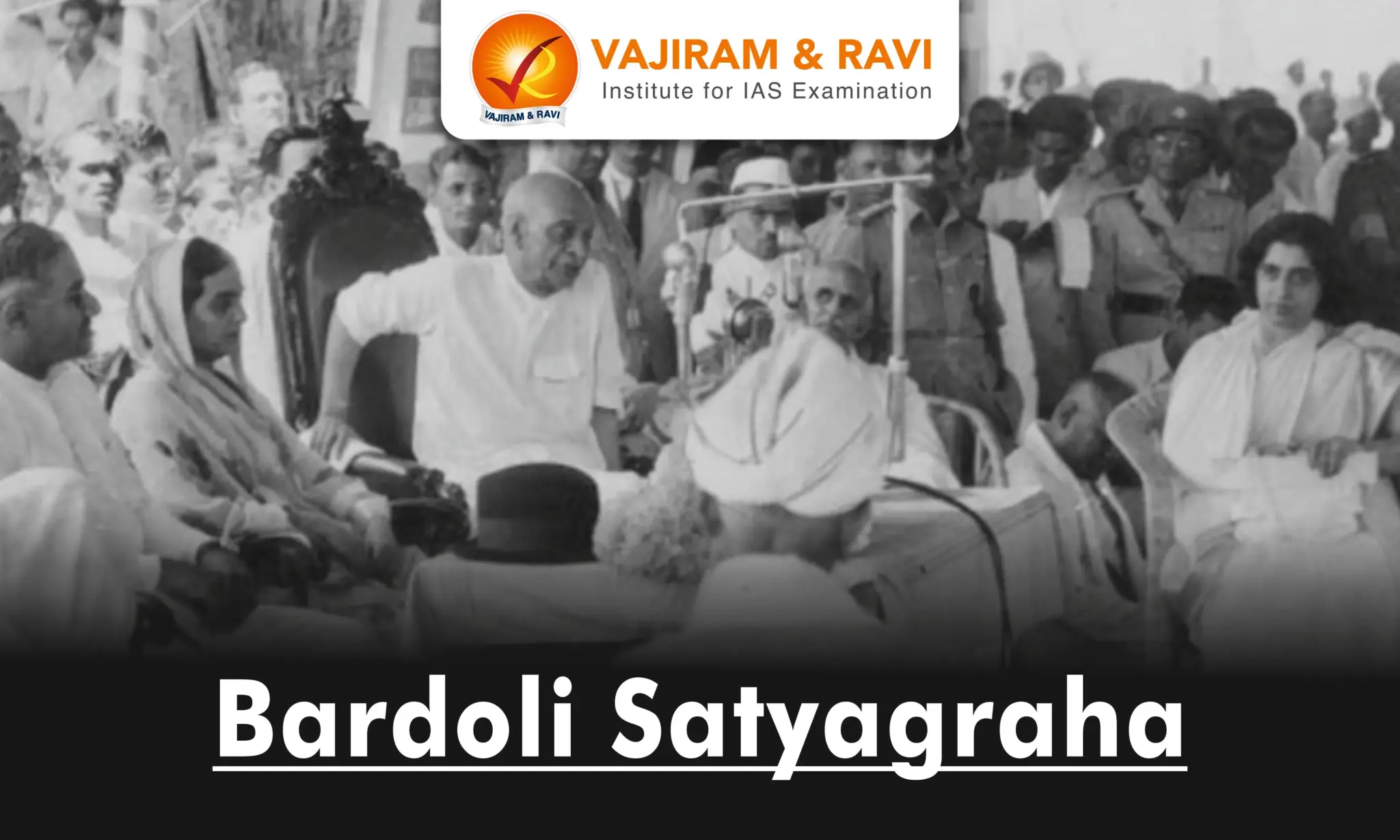
The Bardoli Satyagraha was an important peasant movement against the British colonial government in 1928. It was organised in the Bardoli taluka of Surat district in the Bombay Presidency, in present-day Gujarat, against an increase in land revenue. Vallabhbhai Patel led the movement using non-violent methods and organised the peasants to resist the enhanced assessment.
The movement became an important episode in India's freedom struggle and strengthened Patel's position as a national leader. Women participants in the movement gave him the title “Sardar”, which subsequently became closely associated with him.
Bardoli Satyagraha Background
The Bardoli Satyagraha took place in 1928 in Bardoli taluka, located in the Surat district of Gujarat. This region was predominantly agrarian, with most of the population engaged in farming. The roots of the Satyagraha can be traced back to the oppressive tax policies imposed by the British colonial government, which disproportionately affected the farmers of Bardoli.
- In 1927, despite severe famine and reduced agricultural productivity, the British government raised land revenue by 22%, worsening farmers' distress.
- With pleas for relief ignored, this sparked the Bardoli Satyagraha, where peasants launched a non-violent protest against British authority.
Bardoli Satyagraha Causes
The primary cause of the Bardoli Satyagraha was the unjust increase in land revenue assessment by the British government. However, several other factors contributed to the unrest among the farmers:
- Economic Hardships: Bardoli farmers were already struggling due to crop failures and famine in 1925. The increased tax burden worsened their financial plight.
- Lack of Redressal Mechanisms: Farmers' appeals for tax reduction were ignored by British authorities, heightening resentment and anger.
- Injustice and Oppression: Enforcing higher taxes despite hardships was seen as unjust, creating a sense of betrayal among farmers who had previously supported the British in World War I.


Bardoli Satyagraha Date and Year
The Bardoli Satyagraha officially began in 1928, when the farmers of Bardoli were under the leadership of Sardar Vallabhbhai Patel. The Satyagraha unfolded in several stages, each marked by a series of events that collectively shaped the course of the movement:
- Beginning: On June 12, 1928, Bardoli farmers, led by Sardar Vallabhbhai Patel, unitedly launched Satyagraha, pledging non-payment of unjust taxes as a collective resistance against British authorities.
- Establishment of Volunteer Network: Patel created a disciplined volunteer network to ensure non-violence and spread awareness, urging peasants to refuse tax payments and boycott government services, enhancing movement coordination and solidarity.
- British Response: In response, British authorities seized properties, auctioned lands of resisting farmers, and used intimidation and violence to suppress the Satyagraha, aiming to weaken the agitators' resolve.
Bardoli Resolution
The Bardoli Resolution was a formal declaration made by the farmers of Bardoli after the Satyagraha. It marked the successful resolution of the tax issue and laid down the principles of nonviolent resistance that would guide future movements. The resolution expressed the grievances of the farmers and called for the following:
- Withdrawing the 22% tax increase on farmers in the Bombay Presidency
- Restoring stolen lands and properties
- Cancelling the year's revenue payment
- Lowering the revenue demand to 6.03%
- Treating the farming community fairly
Bardoli Satyagraha Leader
Vallabhbhai Patel was the principal leader of the Bardoli Satyagraha. He emerged as the central figure in the Bardoli Satyagraha, earning the title of "Sardar" (leader) for his leadership during the movement. He ensured that the farmers were committed to nonviolence and prepared for the consequences, including property confiscation and imprisonment. Patel's role in the Satyagraha can be summarised as follows:
- Organisational Skills: Patel divided Bardoli into zones, each led by local leaders and volunteers, ensuring smooth coordination and communication. Patel’s leadership emphasised non-violence and discipline, keeping the movement focused and morally grounded.
- Use of Media: Patel used leaflets, public meetings, and the "Bardoli booklet" to rally support, encouraging unity and persistence in tax refusal, which helped sustain the Satyagraha’s momentum.
- Negotiation and Resolution: Patel’s negotiation skills led to a successful resolution, securing a settlement with the British that rolled back the unfair tax increases, concluding the Satyagraha victoriously.
Bardoli Satyagraha Strategy
The Bardoli Satyagraha adopted a disciplined, non-violent and collective strategy, combining tax refusal, volunteer networks, public mobilisation, social pressure, night-time coordination and effective communication to sustain the peasant movement.
- No-Tax Pledge: Peasants collectively pledged to withhold the increased land revenue until the government withdrew the enhanced assessment or agreed to an impartial inquiry.
- Camp-Based Organisation: Sardar Vallabhbhai Patel divided Bardoli into different organisational camps and established a strong volunteer network. Volunteers from different communities, including Hindus, Muslims and Parsis, participated in the campaign.
- Participatory Resistance: Patel ensured that villagers understood the consequences of the struggle and were repeatedly consulted about their willingness to face hardships. This encouraged active participation and collective responsibility.
- Social Boycott and Non-Violence: The Satyagrahis maintained strict non-violence and unity. Those who assisted the authorities in revenue collection could face social boycott, creating community pressure against cooperation with the government.
- Information and Communication: Volunteers used newsletters, pamphlets, public meetings and door-to-door communication to spread information, maintain morale, communicate instructions and highlight instances of government action.
Bardoli Satyagraha Features
The Bardoli Satyagraha of 1928 was a significant nonviolent resistance movement led by Sardar Vallabhbhai Patel in the Bardoli Taluka of Gujarat, India. It was a pivotal event in the Indian struggle for independence, particularly within the broader Civil Disobedience Movement. Below are the detailed features of the Bardoli Satyagraha:
- Nature of the Bardoli Satyagraha: The Bardoli Satyagraha was a nonviolent resistance movement based on the principles of Satyagraha (truth and nonviolence) advocated by Mahatma Gandhi. The movement was marked by its disciplined and organised approach, which focused on maintaining peace and order throughout the agitation.
- Leadership of Bardoli Satyagraha: The movement was led by Sardar Vallabhbhai Patel, his leadership was instrumental in maintaining the farmers' unity and morale.
- He was assisted by several local leaders and volunteers who ensured that the movement remained focused and non-violent.
- Bardoli Satyagraha Participation: The Bardoli Satyagraha saw widespread participation from the farmers of Bardoli, who displayed remarkable courage and determination in the face of adversity.
- Women also played a significant role in the movement, participating in protests, spreading awareness, and supporting the male agitators.
Bardoli Satyagraha Outcomes
The Bardoli Satyagraha of 1928 had a profound impact on India's struggle for independence and the socio-political landscape of the time that extended beyond the immediate resolution of the tax issue. The following are the critical impacts of Bardoli Satyagraha:
- Victory as a Peasant Movement: Under mounting pressure and fearing a larger movement, the British reduced the tax to 6.03%, returned confiscated properties to farmers, and cancelled the auctions.
- Shift in British Policies: The movement compelled British authorities to reconsider and retract their harsh tax policies. The Maxwell-Broomfield Commission was set up, leading to a reduction in the tax hike and the return of confiscated lands to the farmers.
- International Recognition: The Bardoli Satyagraha gained international attention, exposing British colonial oppression and earning global sympathy.
- The UK Parliament even debated the issues raised, highlighting India’s struggle.
- Rise of Sardar Patel: Demonstrating top-tier organising ability, Vallabhbhai Patel earned the title "Sardar" (Chief) from local women and supporters for his decisive guidance.
- Proof of Peaceful Protest: The victory confirmed that strategic, non-violent mass resistance could shatter harsh colonial mandates without resorting to force.
- Boost to National Morale: Defeating the British tax hike restored public confidence across India, creating momentum for larger anti-colonial movements that followed.
Bardoli Satyagraha Criticism
The Bardoli Satyagraha (1928) is widely celebrated as a triumph of non-violent resistance. However, it is criticised for its narrow focus on landowning farmers, which left underlying agrarian inequalities and labour exploitation largely unaddressed.
- Landowner Bias: The campaign primarily championed the interests of wealthy and middle-class property owners, marginalising the plight of poor peasants and landless agricultural workers.
- Ignored Bonded Labour: It failed to challenge Hali Pratha, the prevalent and deeply coercive system of bonded labour in the region.
- Instrumental Strategy: Critics contend the movement was leveraged as a practical testing ground for Gandhian Satyagraha tactics to advance the national freedom movement, rather than to fix local agrarian structures.
- Unresolved Core Exploitation: The final settlement left systemic rural grievances, including chronic indebtedness, low wages, and landlessness, completely untouched.
Bardoli Satyagraha Significance
The Bardoli Satyagraha of 1928 was a significant movement in India's struggle for independence, marked by its profound impact on both the local and national levels. It is significant for several reasons:
- Symbol of Non-Violent Resistance: The Satyagraha became a powerful symbol of non-violent resistance against colonial rule, demonstrating Satyagraha's effectiveness in fostering social and political change through truth and non-violence.
- Empowerment of Peasants: The movement empowered Bardoli's peasants and inspired agrarian activism across India, emphasising the need to address rural grievances and promoting fair governance.
- Legacy of Unity and Discipline: The movement's success stemmed from the unity and discipline of its participants, creating a lasting legacy of collective action that influenced future independence movements in India.
- The Turning Point: Following the Non-Cooperation Movement, Bardoli emerged as a hub for initiatives like khadi production, active involvement of women, aiding disadvantaged communities, and preparing the masses for further agitation.
Bardoli Satyagraha UPSC PYQs
Q1: Many voices had strengthened and enriched the nationalist movement during the Gandhian phase. Elaborate. (UPSC Mains 2019)
Q2: The leader of the Bardoli Satyagraha (1928) was (UPSC Prelims 2003)
(a) Sardar Vallabhbhai Patel
(b) Mahatma Gandhi
(c) Vithalbhai J Patel
(d) Mahadev Desai
Ans: (a)
| Other Related Posts | |
| Indigo Revolt | Peasant Movements in India |
| Pabna Revolt | Eka Movement |
| Deccan Riots | Bardoli Satyagraha |
| All India Kisan Sabha | Tebhaga Movement |
| Telangana Movement | |

 Last updated on Oct, 2026
→ UPSC 2027 Notification will be released on 13 January 2027 at upsconline.nic.in.
→ Check Nobel Prize 2026 Winners List here.
→ Download PIB PRiSM Monthly Magazine 2026 here.
→ Check UPSC Monthly Current Affairs Magazine The Recitals here.
→ Check out the latest UPSC Syllabus here.
→ Download UPSC Model Answers for Mains 2026
→ UPSC Mains Question Paper 2026 is out now for Essay & GS Paper 1, 2, 3 & 4.
→ UPSC Calendar 2027 has been released.
→ Enroll in Vajiram & Ravi’s UPSC Mains Test Series 2027 for structured answer writing practice, expert evaluation, and exam-oriented feedback.
→ Join Vajiram & Ravi’s UPSC Mentorship Program 2027 for personalized guidance, strategy planning, and one-to-one support from experienced mentors.
→ Go through the UPSC Mains Previous Year Papers to enhance your preparation.
→ UPSC has released UPSC Toppers List 2025 with the Civil Services final result on its official website.
→ Also check Best UPSC Coaching in India
Bardoli Satyagraha FAQs
Q1. Who started Bardoli Satyagraha and when?+
Q2. Who led the Bardoli Satyagraha in 1928, a successful farmers' movement against increased land revenue?+
Q3. Who among the following led the peasant movement in Bardoli in 1928?+
Q4. Who gave Sardar title to Patel?+
Q5. Why was Bardoli Satyagraha organised in 1928?+
Tags: bardoli satyagraha quest upsc modern history notes