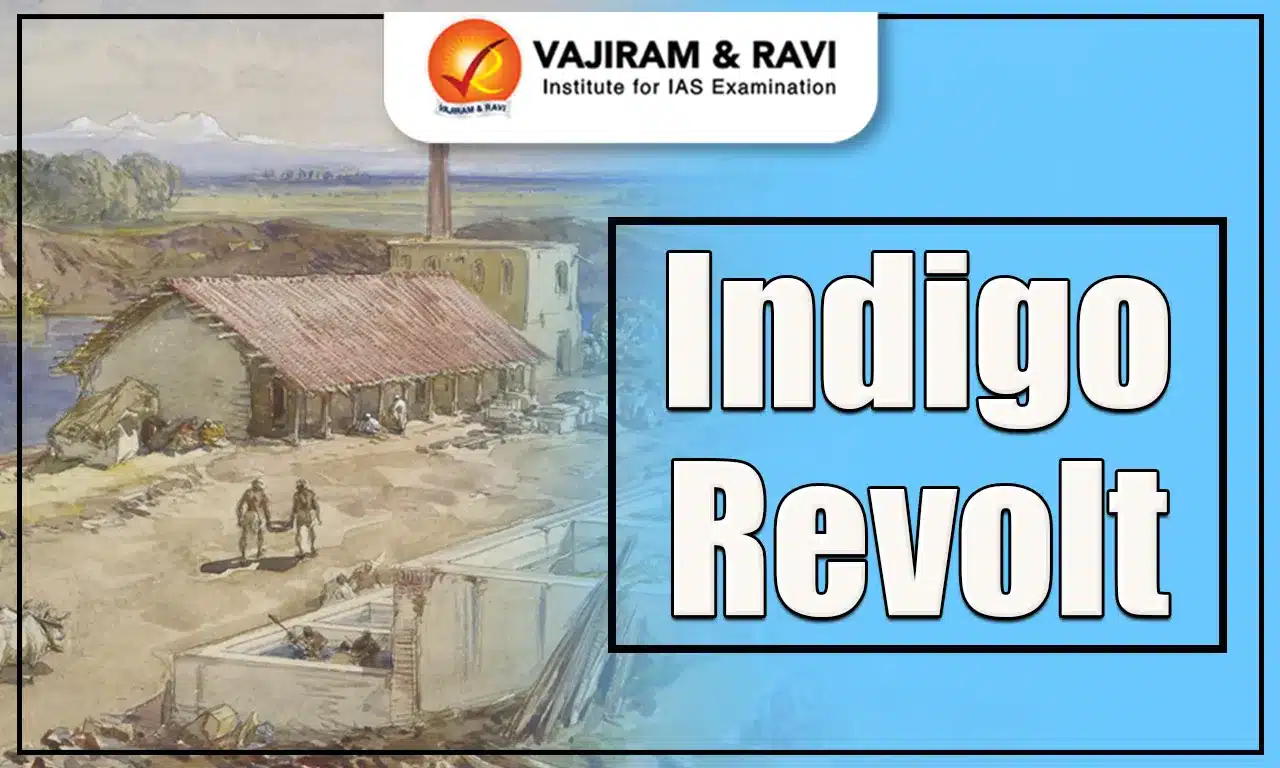
The Indigo Revolt, or Neel Bidroha of 1859, also known as the Indigo Rebellion of Bengal was one of the first major peasant uprisings in India during British rule. British planters saw Bengal, with its fertile soil, as an ideal region for indigo cultivation. They coerced Indian farmers into cultivating indigo under the tinkathia system, where peasants were forced to use a significant portion of their land (typically three out of every twenty parts) for indigo, often against their will.
This rebellion took place in the Bengal region between 1859 and 1860, primarily against oppressive practices by European indigo planters. It laid the foundation for future resistance movements against British colonial exploitation and served as a key precursor to India's freedom struggle.
Indigo Revolt Background
The backdrop of the Indigo Revolt can be traced to the introduction of indigo plantations in Bengal by British planters. Indigo, a valuable dye extracted from the indigo plant, was in high demand in Europe.
- The British East India Company, recognising its economic potential, encouraged the cultivation of indigo in Bengal during the late 18th and early 19th centuries.
- The British planters, often with the backing of the colonial administration, coerced the local peasants, known as ryots, to grow indigo instead of food crops.
- The terms of indigo cultivation were highly exploitative, with peasants being forced to sell their produce at prices far below the market rate.
- This created widespread discontent among the ryots, who were left impoverished and burdened with debt.
Nij and Ryoti Forms of Indigo Cultivation
Indigo cultivation had two forms: Nij, where planters controlled land and hired labourers, and Ryoti, where planters forced peasants to sign contracts and provide indigo, often pressuring village headmen and offering cash advances at low interest.
- Nij Cultivation: Planters directly controlled the land, either by purchasing or renting it, and employed hired labourers to grow indigo.
- Expansion was challenging due to limited fertile land and difficulties in mobilizing labour, as peasants were busy with rice cultivation.
- Additionally, the high costs of maintaining ploughs and bullocks made large-scale cultivation problematic.
- Ryoti Cultivation: Planters forced peasants to sign contracts(sattas) to grow indigo, often securing their compliance through village headmen.
- Peasants received cash advances but were obligated to cultivate indigo on at least 25% of their land.
- This led to a cycle of debt, as new loans were given each time indigo was harvested.
- The system exploited peasants, paid them low prices, and depleted soil quality, making it unsuitable for rice cultivation afterwards.
Indigo Revolt Causes
The Indigo Revolt was a major peasant movement in India after 1857 caused by economic exploitation and forced indigo cultivation, with peasants facing coercion, debt, and legal unfairness. Some of the causes were as follows:
- Economic Exploitation: The primary cause of the revolt was the economic exploitation of peasants by British planters. Coercive methods such as threats, violence, and legal manipulation were employed to force indigo cultivation.
- Loans (dadan) with exorbitant interest rates trapped peasants in perpetual debt.
- Forced Cultivation: Peasants were compelled to use the most fertile land for indigo, leaving little for food crops. Indigo cultivation exhausted the soil, worsening food scarcity and further hardship.
- Legal Inequities: The planters had the colonial administration's backing, leaving peasants with minimal legal recourse. Courts, dominated by Europeans, consistently ruled in favour of the planters, worsening the peasants' situation.
- Social Oppression: European planters held immense power, imposed arbitrary taxes, and further deepened peasants' economic struggles. The rigid social hierarchy added to their exploitation.
- Inspiration from Other Revolts: The success of the Santhal Rebellion (1855-56) and the Revolt of 1857 inspired indigo cultivators to resist their oppressors, offering hope for change.


Indigo Revolt Leaders
The Indigo Revolt took place in Bengal against oppressive European indigo planters. Lacking a single central leader, it relied on dedicated regional figures alongside supportive intelligentsia to drive the movement.
- Digambar Biswas & Bishnu Charan Biswas: The Biswas brothers organised local peasants into an active resistance force in the Nadia district.
- Rafique Mondal spearheaded the movement across Malda district.
- Kader Molla led the rebellious farmers in Pabna district.
- Dinabandhu Mitra wrote the famous play Nil Darpan, vividly portraying the exploitation of indigo farmers.
- Rev. James Long translated Nil Darpan into English to publicise the cause internationally, resulting in his brief imprisonment for libel.
Indigo Revolt Course
The Indigo Revolt began in 1859 in the Nadia district of Bengal, when a group of peasants, led by Digambar Biswas, refused to plant indigo for British planters. The rebellion soon spread to other districts, including Jessore, Pabna, and Khulna.
- Peasants organised non-violent resistance by refusing tax payments, boycotting indigo cultivation, and in some cases, attacking planter properties.
- As the revolt grew, it gained support from various sections of society, including intellectuals, journalists, and sections of the middle class.
- Bengali newspapers, particularly Hindu Patriot under Harish Chandra Mukherjee, played a crucial role in spreading news of the uprising, generating public sympathy, and bringing the issue to the attention of British authorities in India and Britain.
- The revolt spread widely across Bengal, prompting the colonial administration to use both repressive and conciliatory measures.
- Initially, the colonial authorities deployed police and military forces to maintain order and protect planter interests.
Indigo Revolt Features
The Indigo Revolt was a largely non-violent peasant uprising driven by economic and social grievances, with decentralised local leadership and widespread participation. It was characterised by several unique features as follows:
- Nature of the Revolt: The Indigo Revolt was a peasant uprising focused on economic hardship and social injustice. Unlike the 1857 Revolt, it was non-violent, using non-cooperation and civil disobedience as key strategies.
- Leadership: The revolt had no central leader, but local figures like the Biswas Brothers of Nadia, Kader Molla of Pabna, and Rafique Mondal of Maida led the resistance in different areas. This decentralised leadership made it harder for the British to suppress.
- Participation: The Indigo revolt involved various groups, including peasants, local landlords, moneylenders, and parts of the rural middle class. This broad support gave the revolt a mass character and made it difficult for authorities to isolate the rebels.
- Role of the Media: Newspapers like the Hindu Patriot played a key role in spreading awareness, which highlighted the mistreatment of peasants by indigo planters, helping to garner public support.
- Role of Literature: Dinabandhu Mitra's famous 1859 play Nil Darpan vividly portrayed the brutal oppression by planters and galvanised public opinion.
Indigo Revolt Outcomes
The Indigo Rebellion resulted in the end of forced indigo cultivation in Bengal and the appointment of the official Indigo Commission in 1860 and the 1862 Indigo Act. The movement holds immense historical weight for unifying Hindu and Muslim peasants, inspiring future agrarian uprisings, and shaping early Indian nationalist consciousness.
- Abolition of Forced Indigo Cultivation: The revolt led to the end of forced indigo cultivation in Bengal. Reforms were introduced, and planters had to sign contracts with peasants, ensuring fair wages and better working conditions.
- Establishment of the Indigo Commission: In 1860, the British set up the Indigo Commission, which confirmed the exploitation by planters. The Indigo Act of 1862 was passed, although not all recommendations were implemented.
- Strengthening of Peasant Movements: The Indigo revolt inspired future peasant movements, showing the strength of collective action and serving as a model for later uprisings like the Deccan Riots of 1875 and Champaran Satyagraha of 1917.
- Impact on Indian Nationalism: The revolt highlighted peasant exploitation and helped advance Indian nationalism, with intellectuals and media fostering a sense of national awareness.
- Change in British Policy: The Indigo revolt led to a shift in British policy, with land reforms and cooperatives introduced to address peasant issues, although these measures were only partially successful.
- Communal Harmony: The uprising demonstrated powerful solidarity between Hindu and Muslim farmers, who joined forces to oppose economic oppression.
Indigo Revolt UPSC PYQs
Q1: Indigo cultivation in India declined by the beginning of the 20th century because of (UPSC Prelims 2020)
(a) Peasant resistance to the oppressive conduct of planters
(b) Its unprofitability in the world market because of new inventions
(c) National leaders’ opposition to the cultivation of indigo
(d) Government control over the planters
Ans: (b)
Q2: Economically, one of the results of the British rule in India in the 19th century was the (UPSC Prelims 2018)
(a) increase in the export of Indian handicrafts
(b) growth in the number of Indian owned factories
(c) commercialization of Indian agriculture
(d) rapid increase in the urban population
Ans: (c)
| Other Related Posts | |
| Indigo Revolt | Peasant Movements in India |
| Pabna Revolt | Eka Movement |
| Deccan Riots | Bardoli Satyagraha |
| All India Kisan Sabha | Tebhaga Movement |
| Telangana Movement | |

 Last updated on Oct, 2026
→ UPSC 2027 Notification will be released on 13 January 2027 at upsconline.nic.in.
→ Check Nobel Prize 2026 Winners List here.
→ Download PIB PRiSM Monthly Magazine 2026 here.
→ Check UPSC Monthly Current Affairs Magazine The Recitals here.
→ Check out the latest UPSC Syllabus here.
→ Download UPSC Model Answers for Mains 2026
→ UPSC Mains Question Paper 2026 is out now for Essay & GS Paper 1, 2, 3 & 4.
→ UPSC Calendar 2027 has been released.
→ Enroll in Vajiram & Ravi’s UPSC Mains Test Series 2027 for structured answer writing practice, expert evaluation, and exam-oriented feedback.
→ Join Vajiram & Ravi’s UPSC Mentorship Program 2027 for personalized guidance, strategy planning, and one-to-one support from experienced mentors.
→ Go through the UPSC Mains Previous Year Papers to enhance your preparation.
→ UPSC has released UPSC Toppers List 2025 with the Civil Services final result on its official website.
→ Also check Best UPSC Coaching in India
Indigo Revolt FAQs
Q1. Who were the founders of the Indigo Revolt?+
Q2. Why were Indians forced to grow indigo?+
Q3. In which district of Bengal did the Indigo Revolt begin?+
Q4. What is another name of the Indigo Revolt?+
Q5. What was the main reason for the Indigo Revolt?+
Tags: indigo revolt quest