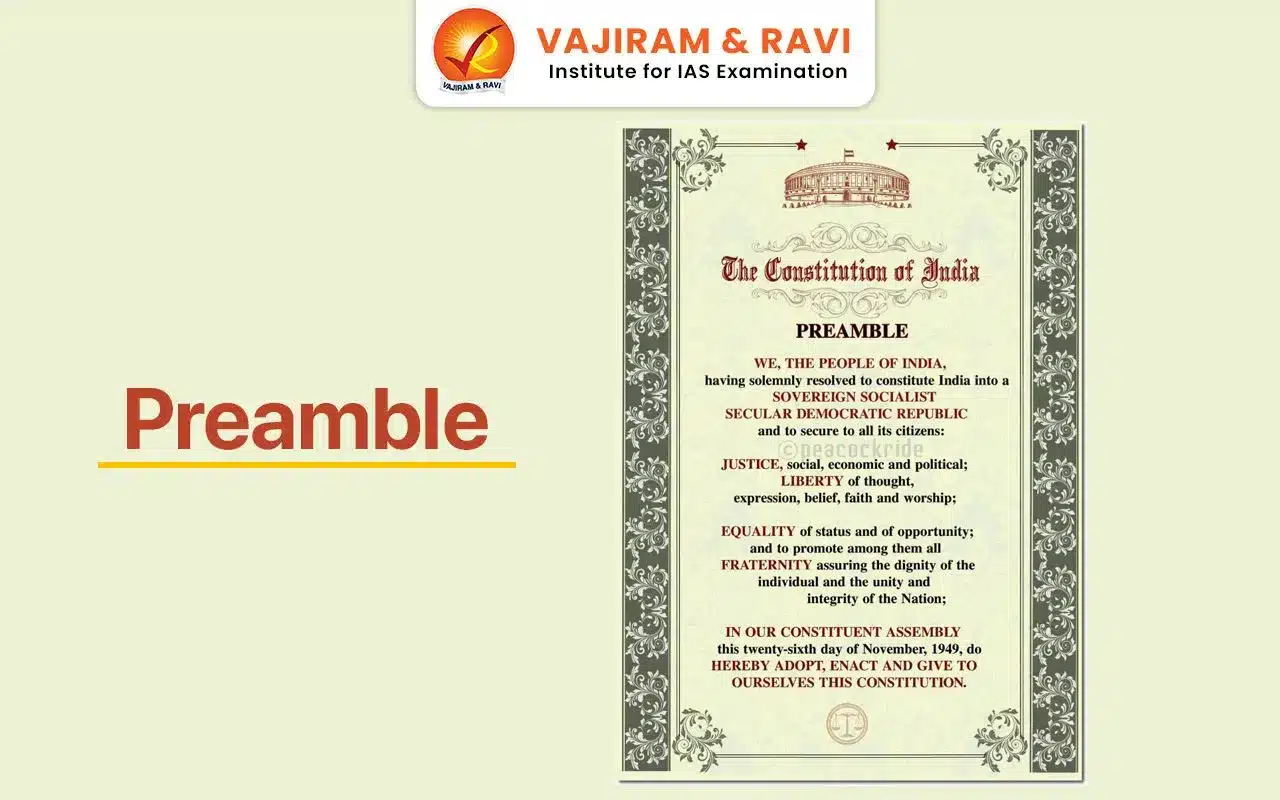
The Preamble of Indian Constitution is the reflection of the core values, philosophy, and objectives that embody the Constitution. It declares India to be a Sovereign, Socialist, Secular, Democratic Republic committed to Justice, Equality, and Liberty for the people. Although it does not grant substantive rights to the people and is not enforceable in court, it serves as a guiding light in interpreting the Constitution. It was introduced through the Objectives Resolution by Jawaharlal Nehru and adopted on November 26, 1949.
The Supreme Court, through various judgments, has held that the Preamble is a part of the Constitution. The opening and last keywords of the Preamble -“We, the people…adopt, enact and give to ourselves this Constitution” imply that sovereignty lies with the people of India. The philosophy behind the Preamble of the Indian Constitution is rooted in popular sovereignty, securing justice, liberty, equality, and fraternity to ensure democracy empowers citizens to build a unified nation. Thus, it is the soul of the Constitution.
Preamble of Indian Constitution Evolution
The journey of the Preamble of Indian Constitution began with the Objectives Resolution, introduced by Jawaharlal Nehru on December 13, 1946, in the Constituent Assembly of India. This resolution laid the groundwork for the core principles and objectives that would guide the drafting of the Constitution.
- Objectives Resolution:
- It declared India an independent sovereign republic governed by the Constitution.
- It stated that all territories of India, including those under British rule, would form the ‘Union of India’.
- These territories would be autonomous units with powers derived from the people of the sovereign.
- It guaranteed justice, social, economic, and political equality, along with freedom of thought, expression, belief, faith, worship, vocation, association, and action (subject to law and public morality).
- It also provided safeguards for minorities, depressed and backward classes, and tribal areas.
- Drafting of the Preamble: B.N. Rau drafted a version of the Preamble, stating, “We, the people of India, seeking to promote the common good, do hereby, through our chosen representatives, enact, adopt and give to ourselves this Constitution”.
- This draft was presented to the Constituent Assembly on July 4, 1947.
- Date of Adoption of Preamble: The Preamble of Indian Constitution was adopted on November 26, 1949 (Constitution Day).
Preamble of Indian Constitution Sources
The preamble of Indian Constitution is borrowed from multiple sources while remaining deeply rooted in domestic democratic ideals, serving as the foundational philosophy and guiding spirit of the nation.
- United States: The Indian Constitution borrowed the concept of a Preamble and its opening phrase "We, the People" from the American Constitution.
- France: The Preamble borrowed the core values of Liberty, Equality, and Fraternity, as well as the Republican character, from the French Revolution.
- USSR: The commitment to securing Justice across social, economic, and political dimensions was derived from the Soviet Union's constitutional framework.
- Objectives Resolution: The Preamble was crafted based on Jawaharlal Nehru's Objectives Resolution, which was introduced in the Constituent Assembly in 1946.
- 42nd Constitutional Amendment Act (1976): Parliament expanded the Preamble's scope by incorporating the key terms ‘Socialist’, ‘Secular’, and ‘Integrity’.


Preamble of Indian Constitution Components
The Preamble of Indian Constitution consists of several key components that collectively define the nature of the Indian state and the aspirations of its people. These components are:
- Source of Power/Sovereignty: The Preamble begins with the iconic phrase: “We, the people of India,” establishing the foundational principle that the power and sovereignty of the state derive from the will of the people.
- It underscores the democratic nature of the Indian polity, where the government is a creation of the people and exercises its authority on their behalf.
- Ideals of the Constitution: The Preamble of Indian Constitution boldly declares India to be a “Sovereign, Socialist, Secular, Democratic Republic.”
- Aspirations of the People: The Preamble articulates the key objectives and aspirations that the Constitution seeks to fulfil Justice, upholding Liberty, ensuring Equality and assuring Fraternity.
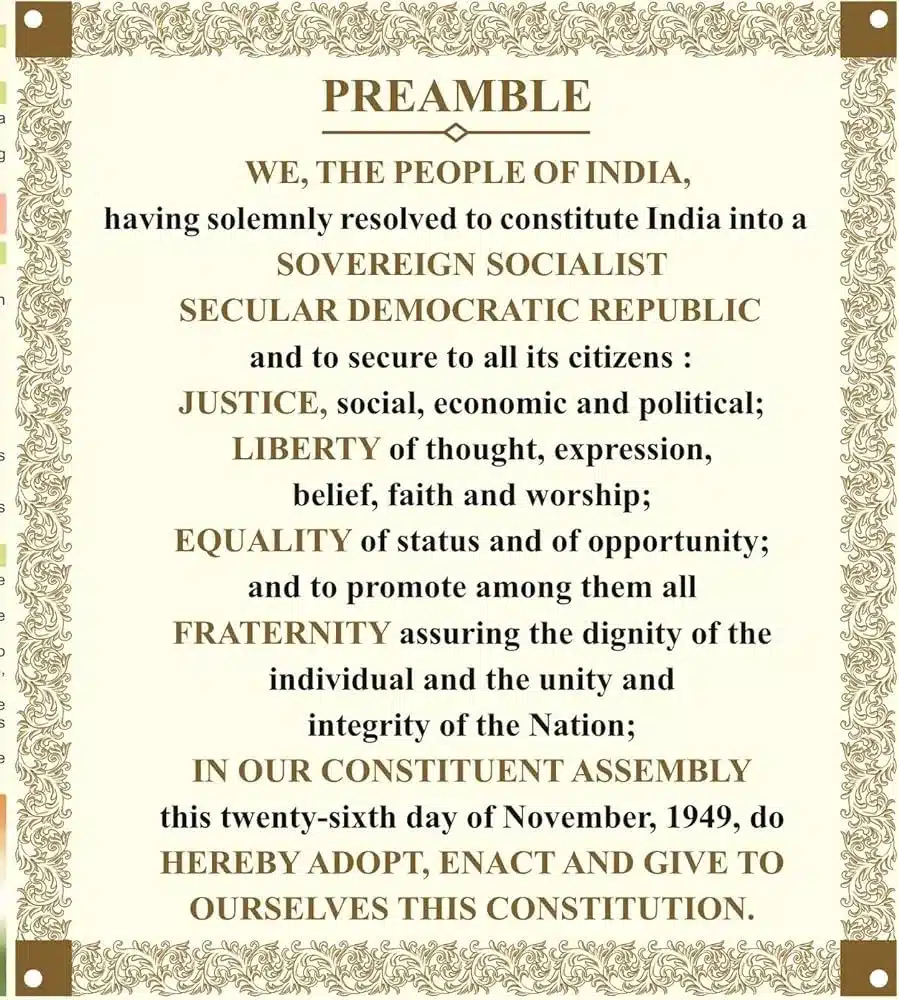
Ideals of the State in Preamble of the Indian Constitution
The Preamble's declaration of India as a "Sovereign, Socialist, Secular, Democratic Republic" encapsulates the fundamental principles that shape the nature and functioning of the Indian state.
- Sovereignty: The term “Sovereign” signifies the independent and supreme authority of the Indian state.
- Internally, it means that the Indian government has the ultimate decision-making power within its territorial boundaries.
- Externally, it implies that India is not subject to control or interference by any external power.
- Socialism: The addition of “Socialist” through the 42nd Amendment in 1976 reflects India’s commitment to achieving social and economic equality.
- The government plays a crucial role in ensuring the equitable distribution of resources and providing basic amenities to all citizens, regardless of their social or economic status.
- It is reflected in the Directive Principles of State Policy of the Constitution.
- Secularism: The declaration of India as a “Secular” state in the Preamble emphasises that the state does not have an official religion. It ensures that all religions are treated with equal respect.
- Citizens have the freedom of conscience and the right to profess, practice, and propagate their religion without discrimination.
- Democracy: The characterisation of India as a “Democratic” republic underscores the principle of government by the people, for the people, and of the people.
- Regular, free and fair elections allow citizens to actively participate in the political process.
- Every citizen has an equal right to vote and choose their representatives.
- Republic: The term “Republic” signifies that the head of the state (the President) is an elected official, not a hereditary monarch.
- This form of government ensures that the power and authority of the state are derived from the people’s mandate.
Aspirations of the People in Preamble of the Indian Constitution
The Preamble of Indian Constitution articulates the fundamental aspirations and objectives that the Constitution seeks to fulfill on behalf of the Indian people. These aspirations are:
- Justice: The Preamble commits to securing for all citizens "justice, social, economic and political."
- This encompasses the provision of equal opportunities, the fair and equitable distribution of resources, and the protection of the rights and interests of all individuals, irrespective of their social or economic status.
- Fundamental Rights provide political justice, whereas the Directive Principles of State Policy aim to achieve socio-economic justice.
- Liberty: The Preamble guarantees the "liberty of thought, expression, belief, faith and worship" to all citizens.
- Various provisions of the Fundamental Rights provide liberty to the people.
- Equality: The Preamble assures the "equality of status and opportunity" to all citizens.
- This is reflected in the two broad perspectives of equality in Article 14 (equality) and Article 16 (equality of opportunity) of the Fundamental Rights, promoting both negative and positive equality (affirmative action).
- The positive equality underscores the state's commitment to ensure equal access to political, social, and economic opportunities.
- Fraternity: The Preamble's inclusion of the term "fraternity" reflects the aspiration to strengthen a sense of unity and brotherhood among the diverse peoples of India.
- It aims to promote the dignity of the individual and the integrity of the nation, thereby strengthening the nation's social fabric.
Preamble of the Indian Constitution Amendment
The Preamble of Indian Constitution, as a part of the Constitution, can be amended under Article 368, provided that no Indian Constitution Amendment can destroy or alter the Basic Structure of the Constitution (Kesavananda Bharati v. State of Kerala Case, 1973). The Preamble has been amended only once by the 42nd Constitutional Amendment Act of 1976.
- The 42nd Constitutional Amendment Act of 1976 was based on the recommendations of the Sardar Swaran Singh Committee.
- It introduced three significant changes to the Preamble: “Socialist”, “Secular” and “Integrity”.
- The keywords “Socialist” and “Secular” were inserted; the description of India changed from a "Sovereign Democratic Republic" to a "Sovereign Socialist Secular Democratic Republic".
- The phrase " unity of the Nation " was changed to "unity and integrity of the Nation".
- This amendment was passed during the Emergency period under the government led by Prime Minister Indira Gandhi.
Preamble of Indian Constitution as a Part of the Constitution
The question of whether the Preamble is an integral part of the Indian Constitution has been the subject of extensive debate and judicial interpretation.
- The Berubari Union Case (1960): In this case, the Supreme Court initially held that the Preamble is not a part of the Constitution and cannot be used to interpret the provisions of the Constitution.
- The Court relied on American jurisprudence, which viewed the Preamble as a mere introductory statement and not a source of power.
- Kesavananda Bharati Case (1973): The Supreme Court reversed the Berubari Union Case verdict and recognised the Preamble as an integral part of the Constitution.
- The Court held that the Preamble is not the source of any substantive powers but is a key to interpreting the Constitution's provisions.
- The components of the Preamble intrinsically form the "basic structure" of the Constitution, which cannot be abolished or violated through the amendment process.
- LIC of India Case (1995): The Court reiterated that the Preamble is an integral part of the Constitution.
- However, it clarified that the Preamble cannot be directly enforced in court as a standalone provision.
- Amendment to the Preamble: The Court in the Kesavananda Bharati Case also ruled that the Preamble can be amended under Article 368 of the Constitution, provided that the Basic Structure Doctrine of the Constitution, as reflected in the Preamble, is not altered or destroyed.
Preamble of Indian Constitution Significance
The Preamble to Indian Constitution holds immense significance as it acts as the soul and identity card of the Constitution that sets out the core values, guiding principles, and basic philosophy of the nation. It outlines the guiding principles and aspirations that shape the Indian state and society.
- Guiding principles: The Preamble serves as the moral compass of the Indian Constitution. It provides the guiding principles that help interpret the provisions of the Constitution.
- For instance, the principle of ‘Secularism’ in the Preamble guides the interpretation of laws related to religious practices, ensuring that the state maintains neutrality in matters of religion.
- Philosophy of the Indian Constitution as per the Preamble: The Constitution of India derives its ultimate authority from "We, the people of India," establishing that citizens shape their own destiny through the instrument of democracy.
- Unity in Diversity: The Preamble emphasises the principle of ‘Fraternity’, promoting unity among India’s diverse cultural, linguistic, religious, and social groups.
- For example, the term ‘Fraternity’ in the Preamble underscores the need for harmony among various linguistic groups in states like Kerala, Punjab, and Assam, each with its unique language and culture.
- Constitutional identity: The Preamble defines the essential identity of the Indian Constitution. It sets the tone for the entire legal framework and the subsequent articles and provisions in the Constitution.
- For instance, the term ‘Sovereign’ in the Preamble signifies that India is free from external control, which is reflected in India’s foreign policy decisions.
- International influence: The Preamble reflects the influence of international ideals and principles. Words like ‘Justice’, ‘Liberty’, and ‘Equality’ highlight India’s commitment to global values of human rights, social justice, and equality.
- For example, the term ‘Equality’ aligns with Article 14 of the Universal Declaration of Human Rights, which states that everyone is equal before the law.
- Reflection of Historical Struggles: The Preamble pays homage to the sacrifices and struggles of the Indian people in their fight for independence and justice.
- It encapsulates the spirit of the freedom movement and the principles for which the freedom fighters fought.
- For instance, the term ‘Justice’ in the Preamble reflects the long-standing struggle against colonial rule and the aspiration for a just and equitable society.
Preamble of Indian Constitution UPSC PYQs
Q1: Discuss each adjective attached to the word ‘Republic’ in the Preamble. Are they defendable in the present circumstances? (UPSC Mains 2016)
Q2: The Preamble to the Constitution of India is (UPSC Prelims 2020)
(a) A part of the Constitution but has no legal effect
(b) Not a part of the Constitution and has no legal effect either
(c) Part of the Constitution and has the same legal effect as any other part
(d) A part of the Constitution but has no legal effect independently of other parts
Ans: (d)
Q3: Which one of the following objectives is not embodied in the Preamble to the Constitution of India? (UPSC Prelims 2017)
(a) Liberty of thought
(b) Economic liberty
(c) Liberty of expression
(d) Liberty of belief
Ans: (b)
Q4: The mind of the makers of the Constitution of India is reflected in which of the following? (UPSC Prelims 2017)
(a) The Preamble
(b) The Fundamental Rights
(c) The Directive Principles of State Policy
(d) The Fundamental Duties
Ans: (a)
Q5: ‘Economic Justice’ the objective of the Constitution has been one of the Indian provided in (UPSC Prelims 2013)
(a) The Preamble and Fundamental Rights
(b) The Preamble and the Directive Principles of State Policy
(c) The Fundamental Rights and the Directive Principles of State Policy
(d) None of the above
Ans: (b)
| Other Related Posts | |
| Important Articles of Indian Constitution | 9th Schedule |
| Schedules of Indian Constitution | Anti Defection Law |
| 5th Schedule | Preamble of the Indian Constitution |
| 6th Schedule | |

 Last updated on Oct, 2026
→ UPSC 2027 Notification will be released on 13 January 2027 at upsconline.nic.in.
→ Check Nobel Prize 2026 Winners List here.
→ Download PIB PRiSM Monthly Magazine 2026 here.
→ Check UPSC Monthly Current Affairs Magazine The Recitals here.
→ Check out the latest UPSC Syllabus here.
→ Download UPSC Model Answers for Mains 2026
→ UPSC Mains Question Paper 2026 is out now for Essay & GS Paper 1, 2, 3 & 4.
→ UPSC Calendar 2027 has been released.
→ Enroll in Vajiram & Ravi’s UPSC Mains Test Series 2027 for structured answer writing practice, expert evaluation, and exam-oriented feedback.
→ Join Vajiram & Ravi’s UPSC Mentorship Program 2027 for personalized guidance, strategy planning, and one-to-one support from experienced mentors.
→ Go through the UPSC Mains Previous Year Papers to enhance your preparation.
→ UPSC has released UPSC Toppers List 2025 with the Civil Services final result on its official website.
→ Also check Best UPSC Coaching in India
Preamble of Indian Constitution FAQs
Q1. What is the Preamble of the Indian Constitution?+
Q2. Who wrote the Preamble of the Indian Constitution?+
Q3. What is the full Preamble of the Constitution?+
Q4. What are the 5 main points of the Preamble?+
Q5. How many preambles are there in the Indian constitution?+
Tags: preamble of the indian constitution quest UPSC Polity Notes