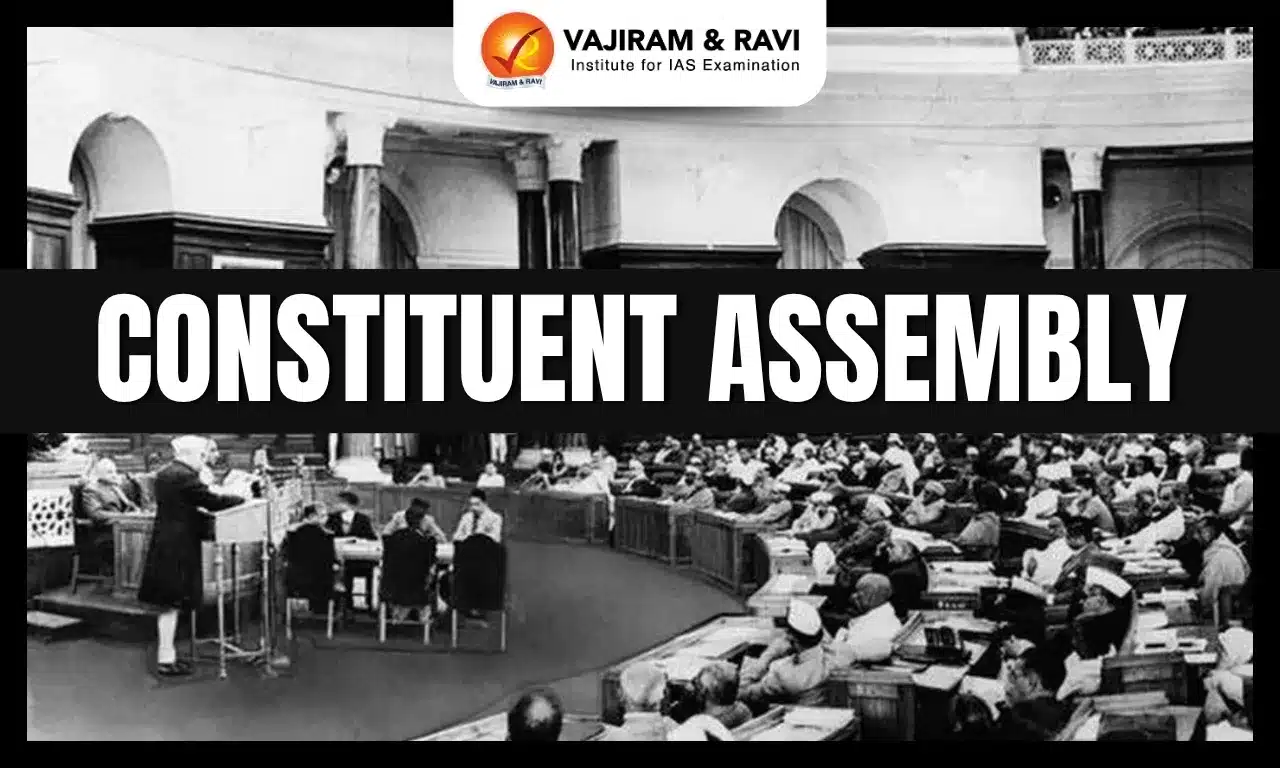
Constituent Assembly of India was a special body formed in November 1946 under the Cabinet Mission Plan to draft the Constitution of India. It held its first meeting on December 9, 1946, and completed its historic work in two years, eleven months, and seventeen days.
Constituent Assembly of India played a crucial role in drafting the Indian Constitution, ensuring it reflected the nation's diverse cultural, social, and political fabric. Led by prominent figures like Jawaharlal Nehru, Dr. B.R. Ambedkar, and Sardar Vallabhbhai Patel, the Assembly engaged in comprehensive debates on federalism, fundamental rights, and governance, shaping the document's core principles.
Constituent Assembly About
The Constituent Assembly of India is an institution specifically conceived to design or amend a Constitution, with the authority to establish the norms that govern the political and social framework of a territory. In India, the Constituent Assembly was formed in November 1946 under the Cabinet Mission Plan (1946) as a partly elected and partly nominated body.
- First Meeting: It convened for the first time on December 9, 1946, to draft and formulate the Constitution of India, seen as essential for implementing self-determination.
- Provisional Parliament: After its final session on January 24, 1950, the Constituent Assembly served as the provisional Parliament from January 26, 1950, until the first general elections in 1951-52 established the new Parliament.
Constituent Assembly of India Background
The Constituent Assembly of India was born out of the national demand for self-determination and freedom from British rule in India. Colonial frameworks, such as the Government of India Act of 1919 and the Government of India Act of 1935, offered limited self-governance while keeping key powers, like defense, finance, and foreign affairs, under British control.
Widespread dissatisfaction with these restrictive laws strengthened the call for full sovereignty. Leaders like Mahatma Gandhi, Jawaharlal Nehru, and Dr. B.R. Ambedkar emphasised that only a Constitution drafted by Indians could truly reflect the nation's diverse social, cultural, and political reality.
Constituent Assembly Timeline
This timeline traces the evolution of the Constituent Assembly, showing how the demand for self-determination culminated in the framing of India’s Constitution and the dawn of complete independence.
|
1934 |
The idea of a Constituent Assembly for India was put forward for the first time by M.N.Roy, a pioneer of the communist movement in India. |
|
1935 |
Indian National Congress first demanded a Constituent Assembly to frame the Constitution of India. |
|
1938 |
J.L. Nehru declared that the Constitution of free India must be framed, without outside interference, by a Constituent Assembly elected based on Adult Franchise. |
|
1940 |
First time in principle, the demand for a Constituent Assembly was accepted by the British in the August offer 1940. |
|
1942 |
Cripps Mission, headed by Sir Stafford Cripps, came to India with a draft proposal to frame an independent Constitution, which was rejected by the Muslim League. |
|
1946 |
Cabinet Mission was sent to India, which rejected the idea of two Constituent Assemblies. Hence, Elections were held as per the Cabinet Mission plan of 1946 to establish the Constituent Assembly. |


Constituent Assembly Members and Composition
The Constituent Assembly of India was formed in November 1946 under the Cabinet Mission Plan to draft a Constitution for independent India, though post-partition its strength dropped to 299 members (229 provinces, 70 princely states) after Pakistan's separation.
- Initial Strength: The Assembly initially comprised 389 members, including 296 representatives from British India and 93 from the Princely States.
- Seat Ratio: Seats were allotted in proportion to the population, roughly representing one seat for every million people.
- Community Quotas: Seats assigned to British Indian provinces were divided among three major categories: Muslims, Sikhs, and General.
- Provinces (296): Members from the provinces were indirectly elected by provincial legislative assemblies using the single transferable vote system.
- Princely States (93): Representatives from the Princely States were directly nominated by the heads or rulers of those respective states.
Chairman of Constituent Assembly of india
The Chairman of the Constituent Assembly of India (president or constituent assembly) was Dr Rajendra Prasad. He was elected as the permanent Chairman (President) of the Constituent Assembly on 11 December 1946. Under his leadership, the Assembly conducted debates and discussions for drafting the Constitution. Notably, Dr Sachchidananda Sinha served as the temporary chairman for the first meeting on December 9, 1946, and Dr B.R. Ambedkar chaired the separate Drafting Committee.
Working of Constituent Assembly of India
The Constituent Assembly drafted the Constitution of India. Formed under the provisions of the Cabinet Mission of May 1946, it took 2 years, 11 months, and 18 days to complete the Indian Constitution.
- 9 December 1946: The Constituent Assembly sat for the first time.
- 11 December 1946: Rajendra Prasad as President, Harendra Coomar Mookerjee and V.T. Krishnamachari as the Vice Presidents were elected, and B. N. Rau as Constitutional legal advisor was appointed.
- 13 December 1946: Jawaharlal Nehru introduced the famous "Objective Resolution" in the Assembly, which laid down the philosophy of the Constitution of India.
- It is geared toward fostering economic and political security in India through a written Constitution and declaring India a Sovereign, Democratic Republic.
- It fostered the formulation of a federal system with the even-handed distribution of powers between the Centre and the states.
- It strives to secure equality, justice, and freedom of thought, expression, belief, faith, association, and associated action for each subject of the country.
- It is geared toward providing necessary protection to the minority and backward sections of society.
- It strives to secure the integrity of the territory of the Indian Republic and follow the law of any civilised nation to secure rights on land, sea, and air.
- 22 January 1947: The Resolution was unanimously adopted by the Assembly.
- July 1947- Indian Independence Act, 1947:
- The Assembly was given complete autonomy and the power to draft any Constitution it chose.
- The Act gave the Assembly the authority to annul or amend any law passed by the British Parliament regarding India.
- The Assembly was also given legislative authority. As a result, the Assembly was elected as India's first free Parliament (Dominion Legislature). Dr. Rajendra Prasad presided over meetings of the Assembly as the Constituent body, and G.V. Mavlankar presided over those of the Assembly as the Legislative body.
- July - October 1947: Preparation of the first draft by the Constitutional Advisor. The Constitutional Advisor started putting together the first draft of the Constitution by aligning the reports already discussed and adopted.
- 22 July 1947: The Constituent Assembly adopted the National flag.
- October 1947- February 1948: Deliberations in Drafting Committee and resultant draft Constitution. The Drafting Committee produced the draft Constitution by February 21, 1948, which contained 315 Articles and 8 Schedules.
- 4 November 1948 - 9 November 1948 (First reading): The Drafting Committee published the draft Constitution of India in February 1948. The draft was introduced in the Assembly in November 1948.
- 15 November 1948 – 17 October 1949 (Second reading): Clause-by-clause draft discussion was conducted in the Assembly.
- May 1949: The Constituent Assembly accepted and approved India's membership of the British Commonwealth.
- 14 November 1949 - 26 November 1949 (Third reading): The Assembly finished the third reading.
- 26 November 1949: The Constituent Assembly passed and adopted the Constitution of India.
- 24 January 1950: The Constituent Assembly elected Dr. Rajendra Prasad as the first President of India and adopted the National Anthem and National Song.
Enforcement of the Constitution
As per the provisions in the Constitution, it formally commenced on January 1950, bringing it into force in its entirety. This date was chosen to commemorate the declaration of ‘Poorna Swaraj’ by J.L. Nehru at an annual session of the Congress in Lahore in 1929.
- Some of the Constitution's provisions, included in Articles 5, 6, 7, 8, 9, 60, 324, 366, 367, 379, 380, 388, 391, 392, and 393, relating to citizenship, elections, a provisional parliament, temporary and transitional laws, and short titles, came into effect on November 26, 1949.
- The remaining provisions of the Constitution took effect on January 26, 1950, and the entire Constitution was enforced. This day is celebrated as Republic Day.
Constituent Assembly Committees
Committees of the Constituent Assembly were specialised bodies formed to draft, deliberate, and finalise different aspects of India’s Constitution and to conduct preliminary research and deliberations within smaller groups.
Drafting Committee of the Constituent Assembly
The Drafting Committee was established on August 29, 1947, under the chairmanship of Dr. B.R. Ambedkar to frame the new Constitution. It served as the central body of the Constituent Assembly, responsible for drafting the Constitution of India by integrating reports and proposals from all other committees. Sitting for 141 days, it prepared the first draft by February 1948 and the second by October 1948, completing its task in under six months. The seven members of the Drafting Committee were:
- Dr. B.R. Ambedkar (Chairman)
- N. Gopalaswamy Ayyangar
- Alladi Krishnaswami Ayyar
- Dr. K.M. Munshi
- Syed Mohammad Saadullah
- N. Madhava Rau
- T.T. Krishnamachari
- Major Committees
The Constituent Assembly appointed 8 Major Committees to handle core constitutional frameworks. Key leaders chaired these bodies to address fundamental governance, federal structure, and rights:
|
Committee |
Chairman |
Description |
|
Drafting Committee |
Dr. B.R. Ambedkar |
Scrutinized and prepared the official draft of the Constitution. |
|
Union Power Committee |
Jawaharlal Nehru |
Defined powers and subjects under central jurisdiction. |
|
Union Constitution Committee |
Jawaharlal Nehru |
Framed the structure and principles of the Central Government. |
|
States Committee |
Jawaharlal Nehru |
Handled integration and negotiation with Princely States. |
|
Provincial Constitution Committee |
Sardar Vallabhbhai Patel |
Designed the governance model for provinces. |
|
Advisory Committee on Fundamental Rights, Minorities and Tribal and Excluded Areas |
Sardar Vallabhbhai Patel |
Oversaw protection of citizen rights and tribal/minority safeguards. |
|
Rules of Procedure Committee |
Dr. Rajendra Prasad |
Formulated rules governing Assembly debates and proceedings. |
|
Steering Committee |
Dr. Rajendra Prasad |
Managed the day-to-day order of business and agenda. |
Minor Committees
Constituent Assembly Minor Committees played crucial procedural, administrative, and specialised advisory roles to support the Major Committees in efficiently drafting and finalising India's Constitution.
- Key Operational & Finance Committees
- Finance and Staff Committee: Dr. Rajendra Prasad
- House Committee: B. Pattabhi Sitaramayya
- Business Order Committee: Dr. K.M. Munshi
- Press Gallery Committee: Usha Nath Sen
- Legal & Administrative Bodies
- Committee on the Functions of the Constituent Assembly: G.V. Mavlankar (handled legislative affairs when the Assembly met as a parliament)
- Ad-hoc Committee on the National Flag: Dr. Rajendra Prasad
- Special Committee to Examine the Draft Constitution: Alladi Krishnaswami Ayyar
- Credentials Committee: Alladi Krishnaswami Ayyar
- Judicial & Territorial Panels
- Ad-hoc Committee on the Supreme Court: S. Varadachari (non-member)
- Committee on Chief Commissioners' Provinces: B. Pattabhi Sitaramayya
- Expert Committee on Financial Provisions of the Union Constitution: N.L. Sarkar (non-member).
Constituent Assembly of India Criticism
The Constituent Assembly has been criticised by several scholars and Constitutional experts on various grounds. These are as follows:
- Not a Representative Body: Its members were not directly elected based on the universal adult franchise.
- Not a Sovereign Body: It was created by the British proposals, and its sessions were held with the permission of the British Government.
- Time-Consuming: It took an unduly long time to frame the Constitution; on the other hand, the American Constitution was formed in 4 months.
- Dominated by Congress: Granville Austin commented that “The Constituent Assembly was a one-party body in an essentially one-party country. The Assembly was the Congress, and the Congress was India."
- Lawyer-Politician Domination: Scholars maintain that they dominated the Constituent Assembly and are not representative of other sections.
- Dominated by Hindus: Winston Churchill commented that the Constituent Assembly represents "Only one major community in India".
Constituent Assembly of India UPSC PYQs
Q1. What was the exact Constitutional status of India on 26th January 1950? (UPSC Prelims 2020)
- A Democratic Republic
- A Sovereign Democratic Republic
- A Sovereign Secular Democratic Republic
- A Sovereign Socialist Secular Democratic Republic
Ans: (b)
Q2. With reference to Indian National Movement, consider the following pairs: (UPSC Prelims 2019)
|
Person |
Position Held |
|
1. Sir Tej Bahadur Sapru |
President, All India Liberal Federation |
|
2. K. C. Neogy |
Member, The Constituent Assembly |
|
3. P. C. Joshi |
General Secretary, Communist Party of India |
Which of the pairs given above is/are correctly matched?
- 1 only
- 1 and 2 only
- 3 only
- 1, 2 and 3
Ans: (d)
Q3. Who among the following was the chairman of the Union Constitution Committee of the Constituent Assembly? (UPSC Prelims 2005)
- B.R. Ambedkar
- J. B. Kripalani
- Jawaharlal Nehru
- Alladi Krishnaswami Ayyar
Ans: (a)

 Last updated on Oct, 2026
→ UPSC 2027 Notification will be released on 13 January 2027 at upsconline.nic.in.
→ Check Nobel Prize 2026 Winners List here.
→ Download PIB PRiSM Monthly Magazine 2026 here.
→ Check UPSC Monthly Current Affairs Magazine The Recitals here.
→ Check out the latest UPSC Syllabus here.
→ Download UPSC Model Answers for Mains 2026
→ UPSC Mains Question Paper 2026 is out now for Essay & GS Paper 1, 2, 3 & 4.
→ UPSC Calendar 2027 has been released.
→ Enroll in Vajiram & Ravi’s UPSC Mains Test Series 2027 for structured answer writing practice, expert evaluation, and exam-oriented feedback.
→ Join Vajiram & Ravi’s UPSC Mentorship Program 2027 for personalized guidance, strategy planning, and one-to-one support from experienced mentors.
→ Go through the UPSC Mains Previous Year Papers to enhance your preparation.
→ UPSC has released UPSC Toppers List 2025 with the Civil Services final result on its official website.
→ Also check Best UPSC Coaching in India
Constituent Assembly of India FAQs
Q1. What is meant by a Constituent Assembly?+
Q2. Who was the chairman of constituent assembly of india?+
Q3. When was the constituent assembly of india formed?+
Q4. Who is called the father of the Constituent Assembly?+
Q5. How many members are in the Constituent Assembly?+
Tags: constituent assembly constituent assembly of india quest UPSC Polity Notes