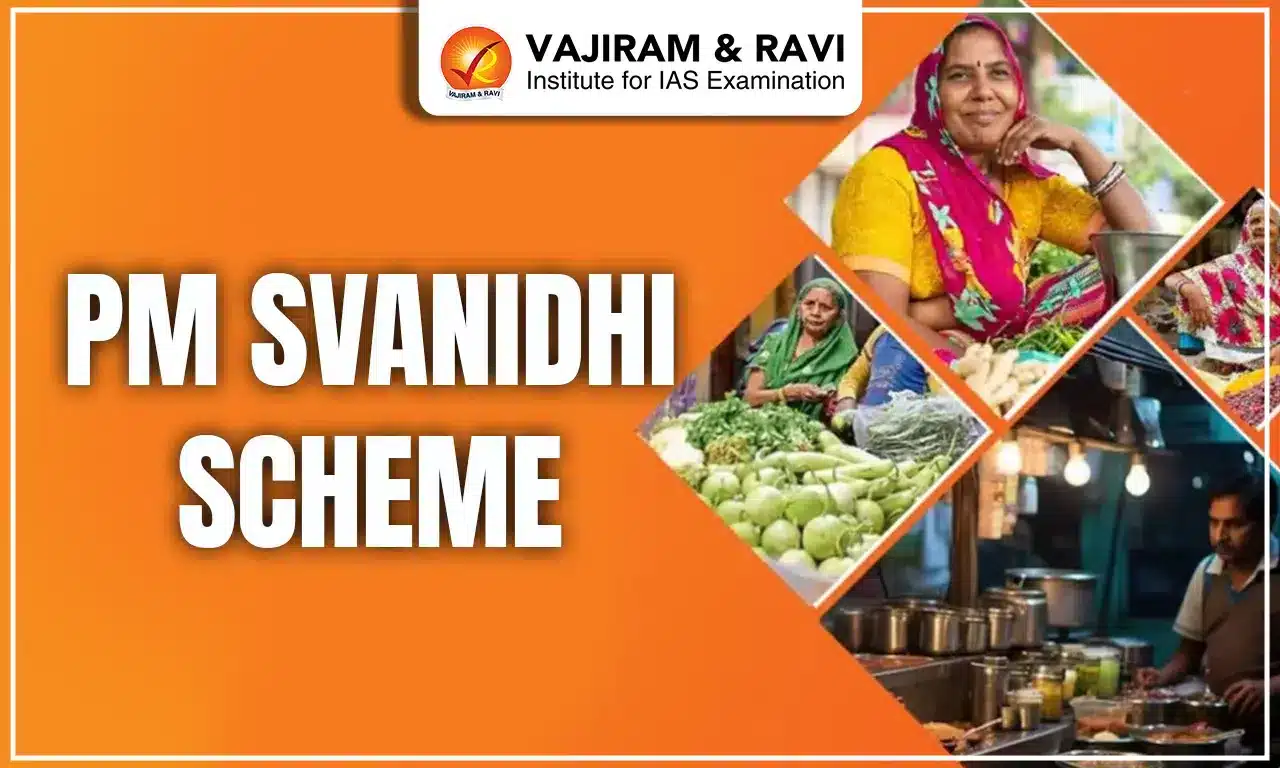
The PM SVANidhi Scheme (Pradhan Mantri Street Vendor’s AtmaNirbhar Nidhi) is a Central Sector Scheme launched on 1 June 2020 by the Ministry of Housing and Urban Affairs to provide collateral-free working capital loans to street vendors. The scheme promotes financial inclusion, digital payments, entrepreneurship and social security benefits, helping vendors move towards sustainable micro-enterprises.
Following restructuring of the PM SVANidhi Scheme in August 2025, the lending period has been extended until 31 March 2030, with a ₹7,332 crore outlay. Loan support is now available in three tranches of up to ₹15,000, ₹25,000 and ₹50,000, along with interest subsidy and digital cashback incentives. UPI-linked RuPay Credit Cards and expanded coverage to census towns and peri-urban areas strengthen the scheme.
PM SVANidhi Scheme Features
The PM SVANidhi Scheme provides comprehensive financial and institutional support to street vendors through affordable credit, digital inclusion, capacity building, and convergence with social welfare schemes.
- Introduction: The PM SVANidhi Scheme was introduced during the COVID-19 pandemic to help street vendors restart businesses disrupted by the lockdowns.
- Collateral-Free Working Capital Loans: The scheme provides collateral-free working capital loans in three progressive tranches of ₹15,000, ₹25,000, and ₹50,000, along with interest subsidy and credit guarantee support.
- The loans are progressive, with access to subsequent tranches linked to repayment performance.
- UPI-linked RuPay Credit Card: Vendors who successfully repay the second loan tranche become eligible for a Unified Payments Interface (UPI)-linked RuPay Credit Card with a credit limit of up to ₹30,000.
- Promotion of Digital Payments: The scheme encourages digital transactions by providing cashback incentives of up to ₹1,600, promoting financial inclusion and digital literacy among street vendors.
- SVANidhi se Samriddhi (SSS): It links beneficiaries and their families with selected Central Government welfare schemes through socio-economic profiling, strengthening their social security.
- Capacity Building: The scheme provides training in financial literacy, digital literacy, entrepreneurship, and food safety & hygiene, in collaboration with organisations such as FSSAI, to improve business sustainability and income generation.
PM SVANidhi Scheme Impact
The PM SVANidhi Scheme has emerged as a transformative scheme for street vendors by promoting financial inclusion, digital empowerment, and livelihood security. Independent impact assessments conducted in 2023 and 2025 highlight its significant socio-economic benefits.
- Large-Scale Financial Inclusion: Since the scheme's inception till 12th July 2026, 76.95 lakh street vendors have availed more than 1.15 crore collateral-free loans amounting to ₹18,475 crore, providing timely working capital to street vendors.
- First-Time Access to Formal Credit: Nearly 95% of beneficiaries accessed formal institutional credit for the first time, bringing previously excluded vendors into the formal financial system.
- Improved Creditworthiness: Around 30% of beneficiaries subsequently accessed additional credit beyond the PM SVANidhi Scheme, reflecting improved financial discipline and creditworthiness.
- Higher Incomes: PM SVANidhi Scheme beneficiaries recorded an average annual income increase of nearly 20%, contributing to stronger and more sustainable micro-enterprises.
- Digital Financial Inclusion: More than 55 lakh street vendors have been digitally onboarded, facilitating over 875 crore digital transactions worth over ₹9 lakh crore.
- Improved Household Welfare: Increased incomes have translated into better housing stability and improved access to nutrition, healthcare, and education for beneficiary families.
- Inclusive Social Empowerment: The scheme has promoted inclusive growth, with 46% of beneficiaries being women and around 70% belonging to marginalised communities.


PM SVANidhi Scheme Challenges
The PM SVANidhi Scheme has transformed the lives of street vendors through improved financial inclusion; however, implementation and structural challenges persist.
- Bureaucratic and Procedural Delays: Many vendors still face multiple visits to banks, lengthy documentation requirements, and delays in loan sanction and disbursement. In some cases, banks also insist on credit/CIBIL scores, contrary to the scheme's intended design.
- Lack of Formal Urban Integration: Street vendors are not adequately integrated into urban planning frameworks, resulting in inadequate vending spaces, frequent evictions, and limited access to organised markets despite having the Street Vendors (Protection of Livelihood and Regulation of Street Vending) Act, 2014.
- Low Financial and Digital Literacy: Many beneficiaries have limited awareness of formal banking procedures, digital payments, and credit management, reducing their ability to fully utilise scheme benefits.
- Awareness and Outreach Gaps: Several eligible vendors, particularly in peri-urban and newly covered areas, remain unaware of the scheme, its eligibility criteria, and procedures for loan renewal or higher loan tranches.
- Limited Access to Social Protection: Despite the SVANidhi se Samriddhi initiative, convergence with welfare schemes remains uneven, and many vendors are yet to receive the full range of social security benefits.
- Limited Enterprise Development Support: While the scheme provides working capital, many vendors still require business mentoring, market linkages, and enterprise development support to sustainably expand their businesses beyond micro-credit.
PM SVANidhi Scheme Way Forward
The PM SVANidhi Scheme has achieved significant success in promoting financial inclusion among street vendors. However, addressing implementation gaps and strengthening institutional support will be crucial to maximise the scheme's long-term impact.
- Accelerate Loan Processing: Expedite the identification of eligible vendors, early disposal of returned applications, and faster sanction and disbursement of loans through coordinated efforts of States, Union Territories, banks, and Urban Local Bodies.
- Strengthen Awareness and Outreach: Conduct targeted awareness campaigns, particularly in low-registration States and newly covered Census Towns and peri-urban areas, to ensure greater enrolment of eligible vendors.
- Enhance Banking Participation: Encourage cooperative, regional rural, and private banks to actively participate alongside public sector banks, expanding access to formal credit for street vendors.
- Deepen Digital and Social Security Integration: Expand SVANidhi se Samriddhi by strengthening family profiling and convergence with welfare schemes, ensuring wider access to social security benefits.
- Strengthen Capacity Building: Scale up financial literacy, digital literacy, entrepreneurship, and business development training to improve enterprise sustainability and facilitate business expansion.
- Improve Monitoring and Governance: Strengthen outcome-based monitoring, periodic evaluation, and accountability mechanisms to ensure efficient implementation and sustained impact of the scheme.

 Last updated on Oct, 2026
→ UPSC 2027 Notification will be released on 13 January 2027 at upsconline.nic.in.
→ Check Nobel Prize 2026 Winners List here.
→ Download PIB PRiSM Monthly Magazine 2026 here.
→ Check UPSC Monthly Current Affairs Magazine The Recitals here.
→ Check out the latest UPSC Syllabus here.
→ Download UPSC Model Answers for Mains 2026
→ UPSC Mains Question Paper 2026 is out now for Essay & GS Paper 1, 2, 3 & 4.
→ UPSC Calendar 2027 has been released.
→ Enroll in Vajiram & Ravi’s UPSC Mains Test Series 2027 for structured answer writing practice, expert evaluation, and exam-oriented feedback.
→ Join Vajiram & Ravi’s UPSC Mentorship Program 2027 for personalized guidance, strategy planning, and one-to-one support from experienced mentors.
→ Go through the UPSC Mains Previous Year Papers to enhance your preparation.
→ UPSC has released UPSC Toppers List 2025 with the Civil Services final result on its official website.
→ Also check Best UPSC Coaching in India
PM SVANidhi Scheme FAQs
Q1. What is the PM SVANidhi scheme?+
Q2. PM SVANidhi scheme under which ministry?+
Q3. Is the PM SVANidhi scheme extended up to 2030?+
Q4. Who is eligible for the PM SVANidhi scheme?+
Q5. When did the PM SVANidhi scheme start?+
Tags: pm svanidhi scheme quest upsc economy notes