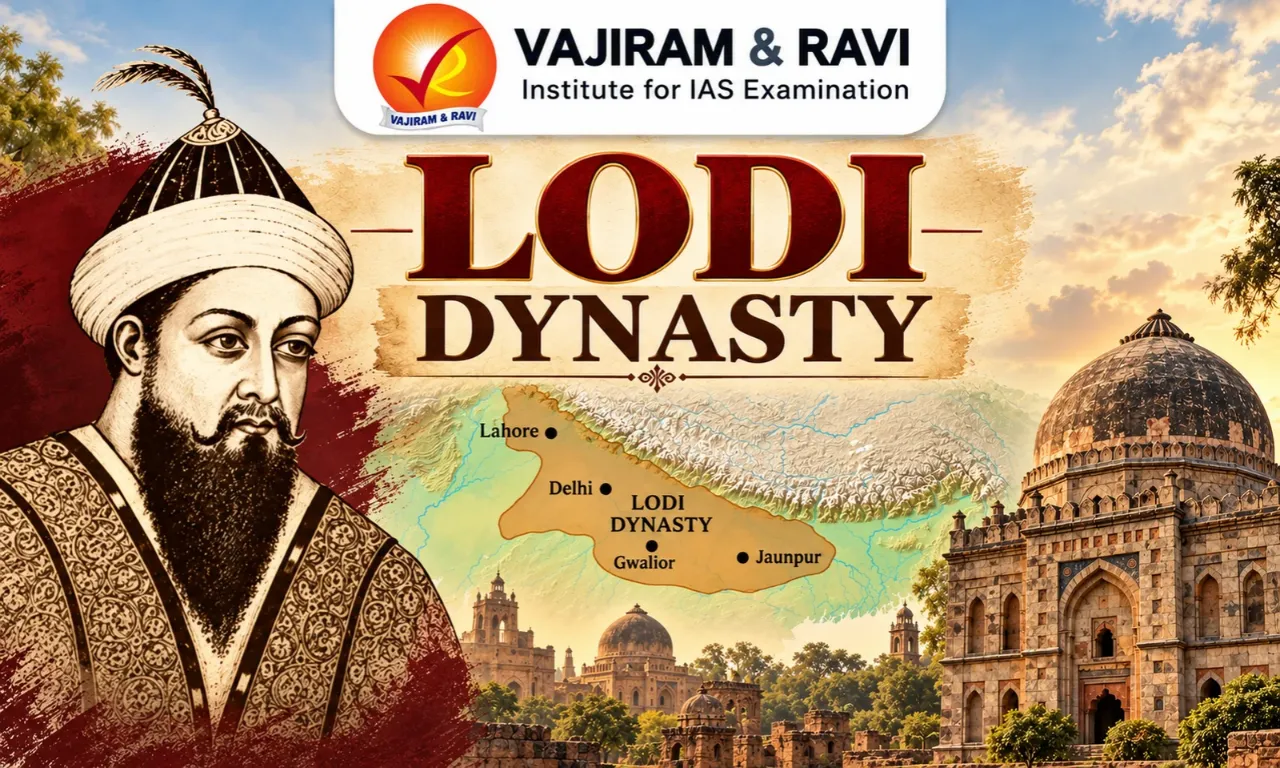
The Lodi Dynasty (1451–1526 CE) was the fifth and final dynasty of the Delhi Sultanate. Established by Bahlul Lodi in 1451, it was the first Afghan dynasty to rule the Delhi Sultanate. The Lodi rulers played an important role in consolidating the Sultanate, expanding its territories and developing Indo-Islamic architecture.
The dynasty had three major rulers: Bahlul Lodi, Sikandar Lodi and Ibrahim Lodi. Sikandar Lodi strengthened the administration and established Agra as an important political centre. However, conflicts between Ibrahim Lodi and the Afghan nobility weakened the kingdom. The dynasty ultimately ended when Babur defeated Ibrahim Lodi in the First Battle of Panipat in 1526, marking the beginning of Mughal rule in India.
Lodi Dynasty About
Lodis ruled the Delhi Sultanate from 1451 to 1526 CE. It emerged after the decline of the Sayyid Dynasty and represented the final phase of the Delhi Sultanate before the establishment of the Mughal Empire. The Lodis belonged to an Afghan ruling family associated with the Lodi tribe. Their rise marked a significant transition from the earlier Turkish-dominated ruling houses of the Delhi Sultanate to Afghan political leadership.
Lodi Dynasty Founder
The Lodi Dynasty was founded by Bahlul Lodi in 1451 after replacing the last Sayyid ruler, Alam Shah. Before becoming Sultan, he had established himself as a powerful Afghan chief in the Punjab region.
Lodi Dynasty Capital
Delhi was the principal capital of the Lodi Dynasty. However, Sikandar Lodi established Agra as an important administrative and political centre in 1504. The development of Agra helped the Sultanate exercise greater control over the Gangetic plains. Its strategic location also made it useful for military campaigns and the administration of newly consolidated territories.
Lodi Dynasty Time Period
The Lodi Dynasty ruled for approximately 75 years, from 1451 to 1526 CE. It was the fifth and final dynasty of the Delhi Sultanate and the first of Afghan origin. It ended when Babur defeated Ibrahim Lodi at the First Battle of Panipat.
Lodi Dynasty Map
The Lodi Dynasty initially controlled Delhi and parts of Punjab. Under Bahlul Lodi and Sikandar Lodi, the Sultanate expanded its influence across substantial parts of northern India. At its height, Lodi authority extended across Punjab and much of the upper Gangetic plains, with territories reaching towards Bihar. The kingdom's boundaries changed over time because of military campaigns, regional resistance and political conflicts.


Lodi Dynasty Rulers
The Lodi Dynasty had three principal rulers. Their reigns show a gradual movement from accommodation with Afghan chiefs towards stronger royal centralisation. Conflicts over this relationship contributed to the dynasty’s decline.
Bahlol Lodhi (1451-1488)
Bahlol Lodhi laid the foundation of the Lodi dynasty, whose rulers were Afghans. To gain the help and support of Afghan nobles, he publicly declared that he considered himself one of the Afghan peers and not the king.
- He successfully suppressed the revolts in Mewat and Doab. In AD 1476, he defeated the Sultan of Jaunpur and annexed it to Delhi Sultanate
- He also brought the ruler of Kalpi and Dholpur under the suzerainty of Delhi. He annexed the Sharqui dynasty and introduced Bahlol copper coins.
Sikandar Lodhi (1489-1517)
He was the most powerful and dignified of the three Lodhi monarchs. He showed little tolerance towards the non-muslims. He re-imposed Jizya on non-muslims
- Unlike his predecessor, Sikandar Lodi believed in the superior position of the Sultan vis-a-vis the nobles.
- In 1504 CE, he founded Agra and authored Persian songs under the pen name 'Gulrakhi.'
- He was an excellent administrator. Roads were built, and irrigation systems were installed for the benefit of the peasants.
- He introduced a new measurement yardstick, the Gazz-i- Sikandari, and a system of auditing accounts.
Ibrahim Lodhi (1517-26) - Last Ruler of Lodi Dynasty
After the death of Sikandar Lodi in AD 1517, his nobles helped Ibrahim Lodi to become Sultan. His reign proved a period of revolts. Bihar declared its independence.
- Daulat Khan, the governor of Punjab, also rebelled. Sultan’s behaviour caused much dissatisfaction.
- Daulat Khan sent an invitation to Babur in Kabul to invade India. Babur defeated Sultan Ibrahim Lodi in AD 1526 in the First Battle of Panipat.

Lodi Dynasty Administration
The Lodi Dynasty followed the administrative framework of the Delhi Sultanate, with officials responsible for revenue collection, military affairs and provincial governance. The administration was organised into different departments and territorial units.
- Sultan’s Authority: The ruler directed military campaigns, appointments, and major political decisions.
- Provincial Administration: During the Lodi dynasty, provinces were divided into Shiqs and administered by Shiqdars. The provinces were divided into Parganas (groups of hundred villages) led by Chaudhary. The village was the smallest administrative entity.
- Wazir (Chief Minister): Headed the revenue administration, maintained financial records and regulated government expenditure. The department was known as Diwan-i-Wizarat.
- Account Auditing: The Mushrif-i-Mamalik maintained accounts, while the Mustaufi-i-Mamalik audited financial records.
- Military Department: The Lodi rulers depended on cavalry, infantry and contingents maintained by nobles and provincial authorities. Diwan-i-Arz, headed by the Ariz-i-Mamalik, managed troop recruitment, inspection and payment.
- Royal Correspondence: Diwan-i-Insha, supervised by the Dabir-i-Insha, handled official correspondence.
Lodi Dynasty Economy
The economy of the Lodhi dynasty was heavily centred on agriculture, regional trade, and a unique monetary system marked by an abundance of grain and a scarcity of precious metals.
- Agriculture as the Foundation: Land revenue and agricultural production served as the state's primary sources of wealth.
- Land Measurement Reform: Sikandar Lodi implemented the Gaz-i-Sikandiri (a 32-digit measuring rod) to standardise land measurement and provide a more accurate estimate of crop production.
- Farmers' Relief: Sikandar Lodi eliminated food grain taxes to relieve financial burdens and boost agricultural output.
- Scarcity of Gold and Silver: Unlike earlier times of the Delhi Sultanate, which relied on huge gold and silver influxes from military raids or coastal tributes (such as Gujarat and Bengal), the Lodi era had a precious metal shortage. This resulted in the widespread use of indigenous coins such as the bahloli and a reliance on in-kind transactions.
Lodi Dynasty Religion
The Lodi rulers followed Sunni Islam and governed a religiously diverse population consisting of Muslims, Hindus and other communities. Islam influenced the political legitimacy of the rulers, court culture, religious institutions and architectural patronage. At the same time, Hindu religious traditions, regional devotional movements and Sufi networks remained important features of society.
Lodi Dynasty Architecture & Culture
The Lodi dynasty made notable contributions to art, architecture, and literature during their reign. However, the Lodhi phase is the last phase in Indo-Persian Architecture.
- Lodi Style Architecture: The Lodis developed a distinct architectural style known as the "Lodi style" or "Pathan style". This style combined elements of the pre-existing Indo-Islamic architecture with influences from Central Asia and Persia. It emphasised simplicity with the use of sturdy materials like stone and brick.
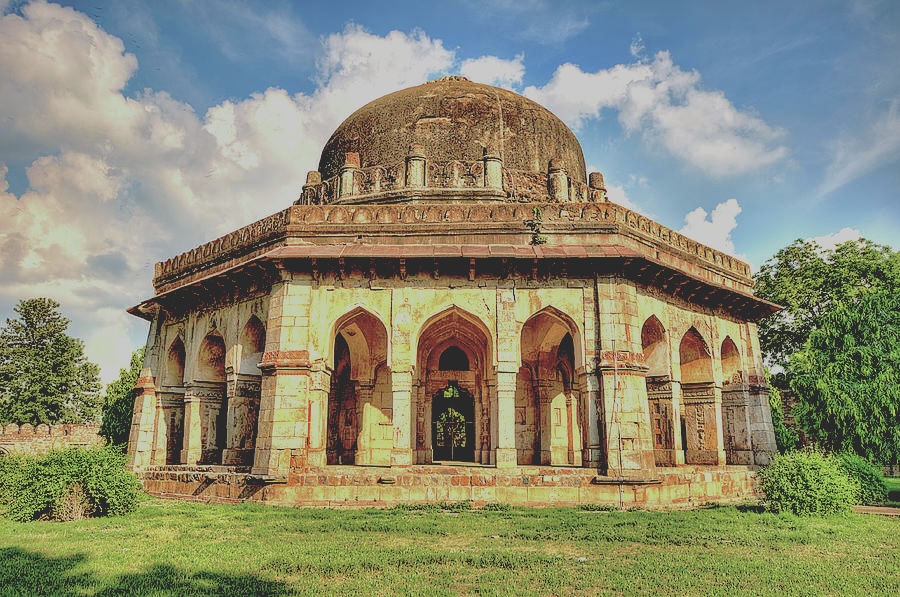
- Double domes: During their rule, they introduced a new form of Islamic architecture that featured double domes. Double domes are built of two layers, with the inner layer providing a ceiling to the interior of the building and the outer layer crowning the building. This technique enabled the ceiling inside to be placed lower and in better relation to the interior space it covers.
- Example: The tomb of Sikandar Lodi, which is located in Lodhi Gardens in Delhi.
- Lodi Garden: It spans an area of 90 acres. The park is named after the Lodi dynasty, which ruled over the Delhi Sultanate from 1451 to 1526.
- It is believed that the gardens were originally commissioned by Sultan Sikander Lodi in the late 15th century.
- It is home to several architectural structures from the Sayyid and Lodi dynasties. The most prominent structures include the tomb of Sikander Lodi, the tomb of Muhammad Shah Sayyid, and the Sheesh Gumbad (Glass Dome)
- Tombs and Mausoleums: The Lodi rulers are particularly known for constructing elaborate tombs and mausoleums for themselves and their nobles.
- These structures were often built in large enclosed gardens or complexes.
- The tomb of Sikandar Lodi in Delhi and the tomb of Ibrahim Lodi in Panipat are significant examples of Lodi architecture.
- Blend of Architectural Influences: The Lodi architecture exhibited a blend of Indian, Persian, and Islamic architectural elements. It incorporated features such as domes, arches, and intricate stone carvings, showcasing the cultural syncretism of the period.


Lodhi Dynasty Literature and Cultural Life
Persian remained important in courtly and administrative culture. Regional languages and literary traditions also developed within the wider cultural environment of northern India.
- Development of the Hindi Language: It witnessed the development and promotion of the Hindi language, which became an important literary medium during this period.
- Poetry and Sufi Literature: The Lodi era saw the emergence of notable poets and Sufi scholars who produced significant literary works.
- Patronage of Scholars: The Lodi rulers patronised scholars and intellectuals, providing them with support and encouragement.
Lodi Dynasty End
The reign of Ibrahim Lodi proved a period of revolts. His own brother Jalal Khan rebelled; Sultan Ibrahim Lodi had him murdered. Bihar declared its independence. Daulat Khan, the governor of Punjab, also rebelled. The Sultan's behaviour caused much dissatisfaction. In the rebellion, Daulat Khan sent an invitation to Babur in Kabul to invade India. Babur defeated Sultan Ibrahim Lodi in AD 1526 in the battle at Panipat.

 Last updated on Oct, 2026
→ UPSC 2027 Notification will be released on 13 January 2027 at upsconline.nic.in.
→ Check Nobel Prize 2026 Winners List here.
→ Download PIB PRiSM Monthly Magazine 2026 here.
→ Check UPSC Monthly Current Affairs Magazine The Recitals here.
→ Check out the latest UPSC Syllabus here.
→ Download UPSC Model Answers for Mains 2026
→ UPSC Mains Question Paper 2026 is out now for Essay & GS Paper 1, 2, 3 & 4.
→ UPSC Calendar 2027 has been released.
→ Enroll in Vajiram & Ravi’s UPSC Mains Test Series 2027 for structured answer writing practice, expert evaluation, and exam-oriented feedback.
→ Join Vajiram & Ravi’s UPSC Mentorship Program 2027 for personalized guidance, strategy planning, and one-to-one support from experienced mentors.
→ Go through the UPSC Mains Previous Year Papers to enhance your preparation.
→ UPSC has released UPSC Toppers List 2025 with the Civil Services final result on its official website.
→ Also check Best UPSC Coaching in India
Lodi Dynasty FAQs
Q1. Who founded the Lodi Dynasty in 1451?+
Q2. Who is the founder of the Lodi Dynasty?+
Q3. Who ruled India before the Lodis?+
Q4. Who defeated the Lodi Dynasty?+
Q5. Were the Lodis Muslims?+
Tags: lodi dynasty quest UPSC Medieval History Notes