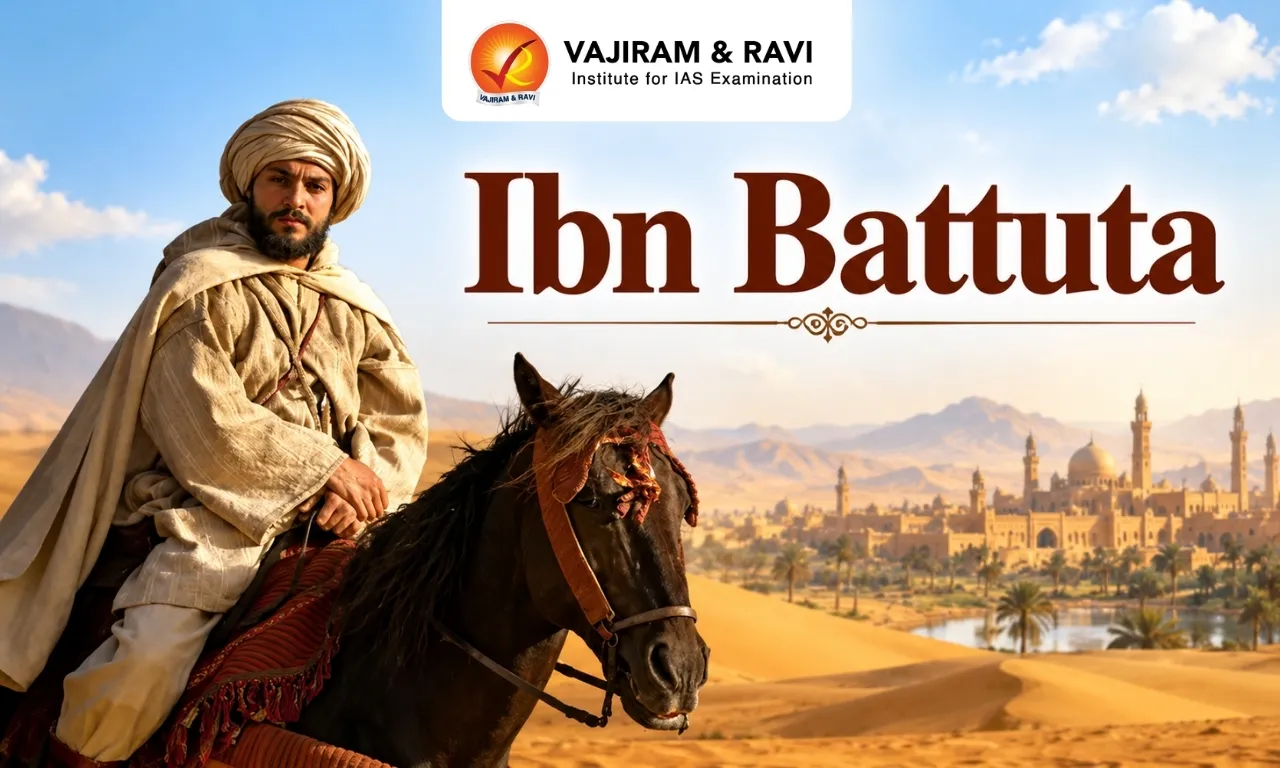
Ibn Battuta was a traveller from Morocco, jurist, and scholar who began his journeys in 1325 CE and travelled across North Africa, West Asia, Africa, Central Asia, and the Indian subcontinent. He reached India in 1333 CE during Muhammad bin Tughlaq’s reign and served as the Qadi of Delhi.
His famous travel account, 'The Rihla', provides valuable insights into medieval administration, judiciary, cities, trade, agriculture, social customs and court life. As a foreign traveller who visited India, his observations offer an important perspective on 14th-century Indian society, though some accounts require critical evaluation and corroboration.
Ibn Battuta About
Ibn Battuta was a Moroccan traveller, jurist, and scholar from Tangier. Associated with the Maliki school of Islamic law, he began his travels in 1325 CE, initially undertaking the pilgrimage to Mecca.
- His extensive journeys across the medieval world made him an important travel writer and one of the notable foreign travellers who visited India during the medieval period.
- Among Ibn Battuta's books, his most famous work is the Rihla (“The Journey”), which records his observations of administration, judiciary, cities, trade, agriculture, social customs, and court life, making it a valuable source for understanding 14th-century India.
Ibn Battuta Early Life
Ibn Battuta was born in 1304 CE at Tangier, Morocco, into a family associated with Islamic scholarship and the judicial profession. His early training in Islamic law shaped his career as a jurist and developed his interest in scholars, judges, and religious figures.
- Family background: He belonged to the Berber community and came from an established family of Islamic legal scholars and judges (qazis), placing him within the educated religious elite.
- Education: He received training in Islamic law (fiqh) and religious sciences, following the Maliki school of Islamic jurisprudence.
- Career Preparation: His legal education equipped him for judicial service, which later enabled him to serve as a qazi under Delhi Sultan Muhammad bin Tughlaq.
- Beginning of Travels: In 1325 CE, at approximately 21 years of age, he left Tangier to undertake the Hajj pilgrimage to Mecca. This journey marked the beginning of nearly three decades of travel across Africa and Asia.


Ibn Battuta Travels
Ibn Battuta set out from Tangier in 1325 CE for the Hajj pilgrimage to Mecca. The journey gradually expanded into an extensive exploration of different regions, driven by his interest in people, rulers, scholars, religious centres and diverse societies.
- Early Travels (1325-1333): He travelled through North Africa, Egypt, Syria, Arabia, Iraq, Persia, East Africa, Anatolia and Central Asia, visiting important centres such as Cairo, Mecca, Damascus and Baghdad.
- Arrival in India (1333): He entered India through the north-western route, crossed the Indus Valley and reached Delhi, where Sultan Muhammad bin Tughlaq appointed him as a qazi (judge).
- Service at Delhi (1334-1341): He spent approximately eight years in the Sultan's service, observing court ceremonies, administration, judicial proceedings, royal expeditions and the treatment of officials. He also witnessed political rebellions and was briefly imprisoned following suspicion arising from his association with a Sufi saint.
- Journey to the Indian Ocean and China (1341-1346): He was appointed as an ambassador to China, he travelled through India's western coast, the Maldives, Sri Lanka, Bengal, Assam and Sumatra, eventually reaching the Chinese port of Zaitun (modern Quanzhou).
- Return and Further Travels (1346-1351): He travelled back towards Morocco through Southeast Asia and the Middle East, subsequently visiting al-Andalus (Muslim-ruled Spain) and the Mali Empire in West Africa.
Ibn Battuta in India
Ibn Battuta reached Sind in 1333 after travelling overland through Central Asia and Afghanistan. Attracted by Muhammad bin Tughluq’s reputation for generosity towards scholars, he proceeded towards Delhi through Multan and Uch. His long stay in the Delhi Sultanate gave him an opportunity to experience its administration and society closely, both as an official and as a traveller.
- Appointment as Qazi: Impressed by his scholarship, Muhammad bin Tughlaq appointed Ibn Battuta as the qazi (judge) of Delhi. He served for several years, gaining firsthand knowledge of judicial proceedings and court life.
- Imprisonment and Restoration: Ibn Battuta fell out of favour with the Sultan and was imprisoned for a period. After the misunderstanding was resolved, he returned to royal service.
- Mission to China: In 1342 CE, the Sultan appointed him as an envoy to China. During his journey, Ibn Battuta travelled through central India towards the Malabar coast and subsequently visited the Maldives, Sri Lanka, Bengal, Assam and Sumatra before proceeding to China.
The Rihla – The Travels of Ibn Battuta
The Rihla, meaning “journey” or “travel”, is the most famous Ibn Battuta book and a valuable account of his extensive travels. It provides information about the political, social, economic, and cultural life of the regions he visited, particularly the Delhi Sultanate.
- India-related content: It contains descriptions of Delhi, the Sultan’s court, administration, the judiciary, cities, and society.
- Social observations: He recorded details about food, dress, agriculture, customs, and everyday life.
- Administrative information: His account discusses the postal and intelligence systems, royal appointments, and the functioning of the court.
- Distinctive feature: His writing is often detailed and vivid, including aspects of everyday life that may not receive much attention in formal court histories.
Ibn Battuta Accounts in India
In his travelogue, the Rihla, Ibn Battuta recorded his observations of Indian cities, administration, trade, agriculture and social customs. His account provides valuable insights into fourteenth-century Indian society and its connections with the wider world.
- Delhi and Daulatabad: He described Delhi as one of India's largest cities and Daulatabad, in present-day Maharashtra, as a city that rivalled it in size.
- Delhi had 28 gates, including the Budaun Darwaza, the largest; Mandwi Darwaza, near a grain market; and Gul Darwaza, near an orchard. Its ramparts were 11 cubits wide, with stone in the lower portion, brickwork above, closely spaced towers, and storage facilities for food grains, ammunition, ballistas, and siege machines.
- He also described cemeteries with domed or arched graves and flowers such as jasmine, tuberose and wild rose.
- Royal Court and Administration: Ibn Battuta recorded court ceremonies, lavish meals, judicial proceedings, military arrangements, fortresses, mints, weights and measures, and musical instruments.
- He described royal camps as moving cities, containing tents, bazaars, offices, officials, servants, women and children. He also mentioned chowdhris and the Sultanate’s intelligence network.
- Markets and Cultural Life: Bazaars served as centres of commerce and social interaction; many contained mosques and temples, while some hosted musical and dance performances.
- At Tarababad in Daulatabad, a famous market for male and female singers, shops were decorated with carpets, and female performers sat on swings attended by other women.
- Agriculture and Trade: Fertile soil enabled farmers to cultivate two crops annually. Ibn Battuta described various crops and fruits, particularly coconut and betel leaf.
- Indian manufactures-including cotton cloth, fine muslin, silk, brocade and satin-were in high demand in West Asia and Southeast Asia. Some varieties of fine muslin were so expensive that only nobles and wealthy people could afford them.
- Historians have used his account to suggest that urban prosperity was partly sustained by the appropriation of agricultural surplus from villages.
- Coconut and Paan: To explain unfamiliar produce to his readers, Ibn Battuta compared the coconut tree to a date palm and the coconut to a human head, with eyes, a mouth, brain-like flesh and hair-like fibres.
- He noted that coconut fibre was used to stitch ships instead of iron nails and to make ropes and cables. He also discussed paan, although the supplied passage does not include his detailed description of it.
- Food and Social Customs: He recorded foods such as chapatis, parathas, samosas (called sambusak) and seekh kebabs. His account described the veneration of cows by Hindus and severe punishments for cow slaughter.
- He also noted restrictions on sharing houses and utensils between Hindus and Muslims, while observing that certain saints were revered by both communities. He praised Hindu charitable practices.
- Postal and Intelligence Systems: Ibn Battuta described two forms of postal communication: the horse-post (uluq), with royal horses stationed approximately every four miles, and the foot-post (dawa), with three stations per mile.
- Foot couriers carried rods fitted with copper bells and relayed letters between stations. The foot-post was faster than the horse-post and facilitated the transmission of information, transfer of credit, and rapid dispatch of goods, including prized fruits from Khurasan.
- Although travel from Sind to Delhi took approximately 50 days, intelligence reports could reach the Sultan in just five days.
Ibn Batuta’s Account Limitations
Although the Rihla is an important source for understanding medieval India, its observations need to be evaluated critically. Ibn Battuta was primarily a traveller rather than a systematic historian, and some information in his account came from second-hand reports rather than direct observation.
- Chronological Inaccuracies: Ibn Battuta often provided incomplete dates and inconsistent durations of stay. For instance, he mentioned staying in Multan for 60 days without specifying the months, making the chronology of his travels difficult to establish.
- Incorrect Place Names and Routes: He occasionally recorded towns in the wrong sequence or misidentified places, creating difficulties in reconstructing his exact travel routes.
- Literary Embellishments: Although Ibn Battuta claimed to report truthfully, some descriptions contain exaggerations. Moreover, Ibn Juzayy, who compiled the Rihla at the request of Sultan Abu Inan, may have modified or embellished portions in accordance with contemporary literary conventions.
- Religious and Cultural Bias: Trained in Islamic theology and law, Ibn Battuta interpreted unfamiliar customs through an Islamic framework. His descriptions of Hindu practices, religious traditions, and social restrictions, therefore, reflect his own cultural and religious perspective.
- Limitations of Travel-Based Evidence: While his account contains extensive firsthand observations, not every detail can automatically be treated as personally witnessed or independently verified. Historians must distinguish direct observations from reported information and literary conventions.
Ibn Battuta’s Account Legacy
Ibn Battuta was one of the most remarkable travellers of the medieval world, whose extensive journeys across Asia, Africa and Europe provided valuable insights into diverse societies. His travelogue, the Rihla, remains an important source for reconstructing the social, cultural and political history of the fourteenth century.
- Extensive Travels: Ibn Battuta travelled approximately 75,000 miles, visiting almost all Muslim countries and several neighbouring non-Muslim regions. His journeys were among the most extensive undertaken before the age of steam power.
- Historical Significance: Although he discovered no new lands and contributed little to scientific geography, his Rihla remains a valuable historical document, particularly for societies often overlooked in official chronicles.
- Documentary Value: He met at least 60 rulers and mentioned more than 2,000 individuals in his account. Many are identifiable through independent sources, and his descriptions contain relatively few errors in names and dates.
- Insights into Diverse Societies: His accounts of Asia Minor, East and West Africa, the Maldives, India and the Middle East provide detailed information about everyday life, customs, political institutions and cultural practices.
- Personal and Cultural Insights: The Rihla reveals his curiosity about different societies and provides insights into the outlook of a fourteenth-century Muslim. It reflects his commitment to orthodox Islam alongside an interest in mysticism, preserving a personal account of his experiences and times.

 Last updated on Oct, 2026
→ UPSC 2027 Notification will be released on 13 January 2027 at upsconline.nic.in.
→ Check Nobel Prize 2026 Winners List here.
→ Download PIB PRiSM Monthly Magazine 2026 here.
→ Check UPSC Monthly Current Affairs Magazine The Recitals here.
→ Check out the latest UPSC Syllabus here.
→ Download UPSC Model Answers for Mains 2026
→ UPSC Mains Question Paper 2026 is out now for Essay & GS Paper 1, 2, 3 & 4.
→ UPSC Calendar 2027 has been released.
→ Enroll in Vajiram & Ravi’s UPSC Mains Test Series 2027 for structured answer writing practice, expert evaluation, and exam-oriented feedback.
→ Join Vajiram & Ravi’s UPSC Mentorship Program 2027 for personalized guidance, strategy planning, and one-to-one support from experienced mentors.
→ Go through the UPSC Mains Previous Year Papers to enhance your preparation.
→ UPSC has released UPSC Toppers List 2025 with the Civil Services final result on its official website.
→ Also check Best UPSC Coaching in India
Ibn Battuta FAQs
Q1. Who is Ibn Battuta?+
Q2. What is Ibn Battuta most famous for?+
Q3. Who did Ibn Battuta meet in India?+
Q4. Which book was written by Ibn Battuta on India?+
Q5. What did Ibn Battuta say about India?+
Tags: ibn battuta quest upsc ancient history notes