The Atal Mission for Rejuvenation and Urban Transformation, or AMRUT Scheme, was launched by the Government of India on 25 June 2015 to improve basic urban infrastructure and enhance the quality of life in cities. Initially covering 500 selected cities and towns, the mission focused on water supply, sewerage, septage management, stormwater drainage, green spaces and parks.
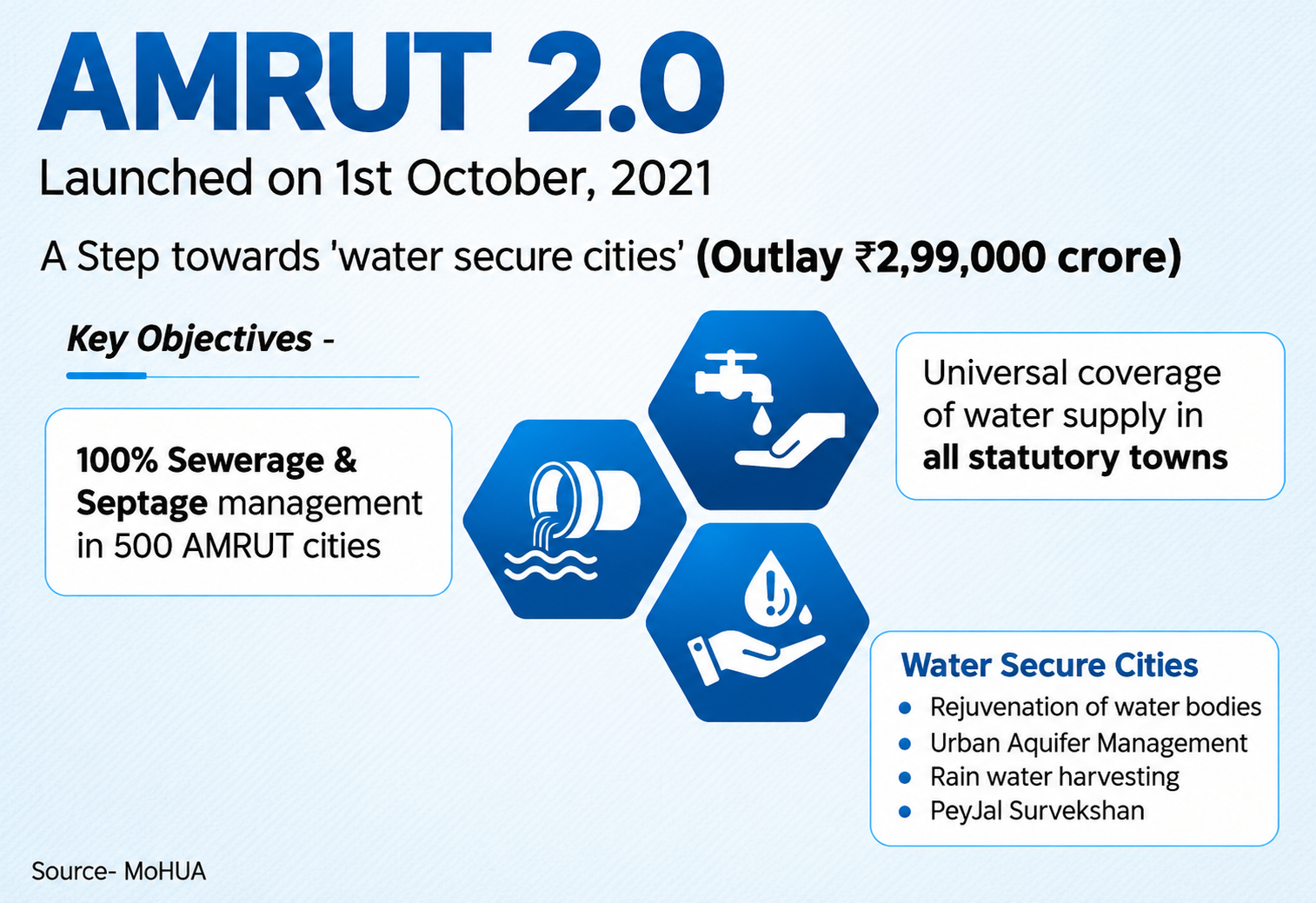
AMRUT 2.0, launched on 1 October 2021, expanded this approach, intending to make Indian cities water-secure. It aims to provide functional household tap connections in all statutory towns, improve sewerage and septage management in 500 AMRUT cities, promote wastewater recycling and rejuvenate urban water bodies. The mission also emphasises urban reforms, technology and community participation.
AMRUT Scheme Overview
The AMRUT Scheme seeks to improve urban liveability by addressing gaps in basic infrastructure. It combines infrastructure development with urban reforms, capacity building and greater involvement of states and urban local bodies.
- Nodal ministry: Ministry of Housing and Urban Affairs (MoHUA).
- Launch of AMRUT 1.0: 25 June 2015; initially covered 500 selected cities and towns.
- Launch of AMRUT 2.0: 1 October 2021, for the period FY 2021-22 to FY 2025-26.
- The mission has since been granted a 1-year extension through March 31, 2027 (FY 2026–27) by the Department of Expenditure, Ministry of Finance, to complete ongoing projects within the existing financial outlay.
- Core focus: Water supply, sewerage and septage management, stormwater drainage, green spaces and parks, and non-motorised urban transport under AMRUT 1.0.
- AMRUT 2.0 focus: Universal water supply coverage across statutory towns, sewerage and septage management in 500 AMRUT cities, and a circular economy of water.
AMRUT Scheme Features
The AMRUT Scheme aims to make urban areas more liveable by improving essential services and strengthening the capacity of urban local bodies to plan, finance and manage infrastructure.
- Water access: Focused on providing reliable household water tap connections and upgrading basic municipal water infrastructure across 500 selected cities.
- Sewerage and septage management: Expand household sewer connections and improve the management and treatment of wastewater in the 500 cities.
- Water conservation: Promote water-source conservation, rainwater harvesting, and the rejuvenation of water bodies and wells.
- Reuse of treated wastewater: Encourage recycling and reuse of treated wastewater to reduce pressure on freshwater sources and support a circular water economy.
- Improved urban liveability: Develop green spaces and parks while improving the reliability and reach of essential urban services.
- Stronger urban governance: Promote urban reforms, capacity building, improved municipal finance and efficient infrastructure management.


AMRUT Scheme and AMRUT 2.0 Objectives
The AMRUT Scheme combines infrastructure investment with administrative reforms. AMRUT 2.0 adds water conservation, digital monitoring, outcome-based funding and community participation to improve long-term urban water security.
- Infrastructure-led development: AMRUT 1.0 supports water supply, sewerage and septage management, stormwater drainage, green spaces and parks, and non-motorised urban transport.
- Universal household water coverage: AMRUT 2.0 aims to extend functional tap connections to all households in statutory towns.
- City Water Balance Plans (CWBPs): Cities assess water sources, demand, supply and infrastructure gaps to identify priority projects.
- City and State Water Action Plans: City Water Action Plans (CWAPs) identify priority projects, while State Water Action Plans (SWAPs) consolidate proposals for implementation.
- Outcome-based funding: Funding under AMRUT 2.0 is linked to outcomes, with evidence-based evaluation and online monitoring of project progress.
- Technology Sub-Mission: Encourages innovative water-sector technologies, start-ups and low-cost indigenous solutions.
- Pey Jal Survekshan: Assesses water-service quality, quantity and coverage, wastewater reuse and water-body conservation, while encouraging healthy competition among cities.
- Community participation: Women’s self-help groups can contribute to water-demand management, water-quality testing and infrastructure operations; citizens and youth can provide feedback.
- Public-private partnerships (PPPs): AMRUT 2.0 mandates PPP projects in million-plus cities, with at least 10% of total city-level project allocation committed to PPP projects in such cities.
AMRUT 2.0
AMRUT 2.0 broadens the mission from improving selected urban services to building water-secure cities. Its operational guidelines set measurable targets for household access, wastewater management and efficient water use.
- Water connections: AMRUT 2.0 targets approximately 2.68 crore new household tap connections across about 4,800 statutory towns.
- Sewerage and septage: AMRUT 2.0 targets approximately 2.64 crore new sewer connections or equivalent septage coverage in the 500 AMRUT cities.
- Treated-water reuse: The reform agenda targets meeting at least 20% of total city water demand through recycled water, with a separate target of 40% of industrial water demand at the state level.
- Reduction in water losses: AMRUT 2.0’s reform agenda seeks to reduce non-revenue water to below 20%.
- Continuous water supply: The guidelines encourage a 24×7 water supply and improved service quality.
- Water-body rejuvenation: Conservation and rejuvenation of water bodies, wells and urban wetlands form part of the mission’s water-security approach.
- Funding pattern: AMRUT 2.0 follows a cost-sharing arrangement among the Centre, States/UTs and urban local bodies. The central share varies by category, with different provisions for Union Territories, North-Eastern and Himalayan States, and other urban local bodies.
- Jal Hi AMRIT: Launched by MoHUA under AMRUT 2.0 reforms, it incentivises States and UTs to improve sewage treatment plant performance and ensure sustained compliance with environmental standards for treated wastewater.
- It builds capacity and promotes water reuse.
- Water Resource Recovery Cells (WRRCs) have been established in 25 states/UTs to plan, monitor and scale resource recovery initiatives.
AMRUT 1.0 vs AMRUT 2.0
Both phases seek better urban services, but AMRUT 2.0 places greater emphasis on universal coverage, water conservation, recycling and measurable outcomes.
| Basis | AMRUT 1.0 | AMRUT 2.0 |
|
Launch |
25 June 2015 |
1 October 2021 |
|
Coverage |
500 selected cities and towns |
All statutory towns for water supply; 500 AMRUT cities for sewerage/septage coverage |
|
Primary focus |
Basic urban infrastructure, including water supply, sewerage/septage, stormwater drainage, green spaces and parks, and non-motorised transport |
Water-secure cities, universal household tap connections, sewerage/septage management, water-body rejuvenation, and reuse of treated water |
|
Approach |
Project-based urban infrastructure development |
City Water Balance Plans, circular economy, outcome-based funding, technology, and community participation |
|
Key targets |
Improve water supply and sewerage/septage infrastructure in selected cities. |
Functional tap connections for all households in statutory towns and sewerage/septage coverage in 500 AMRUT cities |
|
Mission period |
Launched in 2015; central assistance for ongoing projects continued through 31 March 2023. |
FY 2021-22 to FY 2025-26, extended by a year till March 2027. |
|
Indicative outlay |
Approved State Annual Action Plans (SAAPs) worth ₹77,640 crore, including committed central assistance of ₹35,990 crore |
₹2.99 lakh crore, including central outlay of ₹76,760 crore |
AMRUT Scheme Achievements
AMRUT Scheme achievements reflect improvements in urban water supply, sewerage infrastructure and water conservation. Recent government updates report progress under both AMRUT 1.0 and AMRUT 2.0.
- Investment and project completion: Projects worth approx. ₹2.79 lakh crore had been sanctioned under AMRUT and AMRUT 2.0 between 2015 and 2026. More than 7,943 urban infrastructure projects had been completed.
- Household connections: More than 2.53 crore tap-water connections and 1.50 crore sewer connections had been provided under AMRUT, AMRUT 2.0 and associated convergence initiatives.
- Sewage-treatment infrastructure: Under AMRUT 2.0, 583 projects had been approved, expected to add 6,649 million litres per day (MLD) of sewage-treatment capacity.
- Treated-water reuse and community participation: From 1 January to 22 December 2025, the Ministry reported 6,000 MLD of treated water being reused across states and union territories. More than 38,000 women’s Self-Help Group members were engaged through AMRUT Mitra in water-demand management, water-quality monitoring, billing, collection and maintenance activities.
- Water-body rejuvenation and green spaces: During the same 2025 reporting period, 7,480 acres of waterbody area were rejuvenated and 2,704 acres of green space were developed.
- A July 2026 government update further reported ongoing rejuvenation across nearly 1.21 lakh acres of water bodies and green-space projects spanning 12,750 acres. These July figures describe areas being revitalised, not necessarily completed.
- Groundwater management: By July 2026, the Shallow Aquifer Management Programme under AMRUT 2.0 had mapped 870 sites and prepared 539 Detailed Project Reports (DPRs) worth over ₹28 crore, supporting groundwater-recharge interventions in 75 urban local bodies.
AMRUT Scheme Challenges
The supplied government documents define targets and implementation mechanisms but do not provide a comprehensive, current assessment of all implementation challenges. The following issues are therefore framed as key implementation risks arising from the mission’s design.
- Project completion: Recent figures showed that some projects remained at different implementation stages, highlighting the need for timely execution and monitoring.
- Financial sustainability: Urban local bodies need adequate revenue, effective property-tax administration and appropriate user charges to sustain water infrastructure and services.
- Water losses: Achieving the target of reducing non-revenue water below 20% requires improvements in distribution systems, monitoring and water management.
- Coordination across institutions: Implementation involves the Centre, states, Union Territories and urban local bodies. Coordinating plans, financing and responsibilities is essential for achieving outcomes.
- Wastewater reuse: Meeting the treated-water reuse targets requires adequate treatment infrastructure and systems for recycling and supplying treated water to users.
- Monitoring and accountability: Outcome-based funding depends on reliable data, credible evidence of completed work and effective digital monitoring.
- Community participation: Involving residents and women’s self-help groups meaningfully in water management, quality testing and infrastructure operations requires sustained capacity building.
AMRUT Scheme Way Forward
AMRUT’s objectives require more than the creation of infrastructure. The operational guidelines emphasise effective planning, financial sustainability, water conservation, institutional capacity and community involvement to secure lasting results.
- Prioritise functional outcomes: Evaluate projects by reliable household water access, effective wastewater management and improved service delivery-not merely expenditure or infrastructure created.
- Strengthen municipal finances: Improve property-tax administration, user-charge collection, accounting and access to municipal finance to support long-term operation and maintenance.
- Promote a circular water economy: Expand wastewater recycling, rainwater harvesting, source conservation and the rejuvenation of water bodies and wells.
- Improve project planning: Use City Water Balance Plans to identify service gaps and prioritise projects according to local water needs.
- Strengthen monitoring: Use digital project tracking, evidence-based evaluation and citizen feedback to improve transparency and accountability.
- Build local capacity: Train municipal officials, plant operators, contractors, citizens and women’s self-help groups in water management and service delivery.
- Encourage innovation and partnerships: Support appropriate water technologies, indigenous solutions and public-private partnerships where they improve implementation and service outcomes.

 Last updated on Oct, 2026
→ UPSC 2027 Notification will be released on 13 January 2027 at upsconline.nic.in.
→ Check Nobel Prize 2026 Winners List here.
→ Download PIB PRiSM Monthly Magazine 2026 here.
→ Check UPSC Monthly Current Affairs Magazine The Recitals here.
→ Check out the latest UPSC Syllabus here.
→ Download UPSC Model Answers for Mains 2026
→ UPSC Mains Question Paper 2026 is out now for Essay & GS Paper 1, 2, 3 & 4.
→ UPSC Calendar 2027 has been released.
→ Enroll in Vajiram & Ravi’s UPSC Mains Test Series 2027 for structured answer writing practice, expert evaluation, and exam-oriented feedback.
→ Join Vajiram & Ravi’s UPSC Mentorship Program 2027 for personalized guidance, strategy planning, and one-to-one support from experienced mentors.
→ Go through the UPSC Mains Previous Year Papers to enhance your preparation.
→ UPSC has released UPSC Toppers List 2025 with the Civil Services final result on its official website.
→ Also check Best UPSC Coaching in India
AMRUT Scheme FAQs
Q1. What is the full form of the AMRUT scheme?+
Q2. AMRUT scheme is implemented by which ministry?+
Q3. What is the launch date of AMRUT and AMRUT 2.0?+
Q4. What is the main objective of AMRUT 2.0?+
Q5. What is Pey Jal Survekshan?+
Tags: amrut scheme quest UPSC Indian Society Notes