Wetlands are vital ecosystems defined under the Ramsar Convention as areas of marsh, fen, peatland, or water that may be natural or artificial, permanent or temporary, with static or flowing fresh, brackish, or saline water. They support biodiversity, water regulation, carbon sequestration, livelihoods, and disaster mitigation and include diverse inland, coastal, and human-made types.
Wetlands in India are protected by initiatives such as the National Wildlife Action Plan, Amrit Dharohar Scheme, and Wetlands Rejuvenation Programme to support their conservation and sustainable management through national policies, legal frameworks, and international cooperation.
Wetlands Meaning
Wetlands, according to the Ramsar Convention, are areas of marsh, fen, peatland, or water, whether natural or artificial, permanent or temporary, with static or flowing, fresh, brackish, or salt water. They also include marine waters up to six metres deep at low tide.
Status of Wetlands
Since 1970, the world has lost approximately 22% of its wetlands (roughly 411 million hectares), with the remaining areas disappearing faster than any other ecosystem.
- Global Status and Extent: Wetlands cover over 1,800 million hectares worldwide, encompassing inland freshwater, coastal, and marine ecosystems. Wetlands are declining at an average annual rate of 0.52%.
- Ecological Condition: Approximately 25% of remaining wetlands are in poor ecological condition, with regions such as Africa, Latin America, and the Caribbean experiencing the greatest degradation.
- Economic value: Healthy global wetlands provide up to $39 trillion per year in essential ecosystem services such as water filtration, carbon storage, and flood protection.
- Status in India: India has 101 Ramsar sites, totalling nearly 1.39 million hectares. Wetlands cover approximately 4.7% of India's total geographical area, but natural wetlands have shrunk significantly over the last four decades due to urbanisation, pollution, and agricultural expansion.


Wetlands Types
Types of Wetlands, under the Ramsar Convention, include marshes, fens, peatlands, and natural or artificial water bodies that may be permanent or temporary, fresh, brackish, or saline. The definition also covers certain marine areas up to 6 metres deep at low tide, along with adjacent riparian and coastal zones.
- Human-Made Wetlands: They are created for specific purposes such as irrigation, drinking water, fisheries, or recreation. Examples include reservoirs, aquaculture ponds, salt pans, dams, barrages, and impoundments.
- Lakes: Inland freshwater lentic systems comprising lakes and ponds that provide important habitats and resources for aquatic and terrestrial organisms.
- River Floodplains: Areas adjacent to rivers or streams that are periodically inundated when water overtops the river channel.
- Example: Yamuna floodplains are a primary source of water for Delhi.
- Oxbow Lakes: Crescent-shaped water bodies formed when a river meander is cut off due to silt deposition or a change in the river’s course. The Ganga and Brahmaputra basins contain numerous oxbows.
- Example: Ansupa Lake in the Mahanadi Delta of Odisha.
- Marshes: They are dominated by herbaceous plants, sustained by sources such as surface runoff, groundwater, or tidal flow, rather than direct rainfall alone.
- Example: Kanwar Jheel (Kabar Tal) in the floodplains of the Burhi Gandak, Bihar.
- Estuaries: Partially enclosed coastal bodies of brackish water with rivers or streams flowing into them and a free connection to the open sea. They form a transition between riverine and marine environments. Coastal lagoons are a type of bar-built estuary.
- Example: Chilika, a coastal lagoon in Odisha, is separated from the Bay of Bengal by a long sand berm.
- Swamps: They are dominated by trees, characterised by poor drainage and sufficiently waterlogged conditions. Mangroves are coastal swamps commonly found along major deltas.
- Example: The Sundarbans, spread across India and Bangladesh, are the world’s largest single contiguous mangrove swamp.
Wetlands Significance
Wetlands are highly productive ecosystems that provide a wide range of ecological, economic, and social services. They support biodiversity, regulate water and climate, sustain livelihoods, and strengthen resilience against floods and other disasters.
- Biodiversity Conservation: They provide habitats, breeding grounds, nurseries, and stopover sites for diverse species, including migratory birds.
- Example: Chilika Lake, Sultanpur, and Mangalajodi support significant populations of migratory birds during winter.
- Water Purification: They act as natural filters by trapping sediments, nutrients, and pollutants, thereby improving water quality and supporting downstream ecosystems.
- Flood Regulation: They act as natural sponges, absorbing excess rainfall, slowing water flow, and gradually releasing stored water, thereby reducing flood intensity.
- Carbon Sequestration: They function as important carbon sinks, storing carbon in vegetation and soils.
- Example: Sundarbans mangroves store substantial carbon in their biomass and soil.
- Food and Livelihood Security: They support fisheries, agriculture, and other livelihood activities, particularly for communities dependent on aquatic resources. Globally, more than one billion people depend on wetlands for their livelihoods.
- Fisheries: They provide breeding and nursery grounds for fish and contribute to inland fish production. Floodplain wetlands have an estimated fish yield of 400–800 kg/ha/year, compared with a production potential of 1,500–2,500 kg/ha/year.
- Tourism and Local Livelihoods: They support ecotourism and sustainable livelihood opportunities while creating incentives for conservation.
- Example: Amrit Dharohar Scheme promotes conservation of Ramsar sites in India through ecotourism, livelihood opportunities, ecosystem enhancement, and assessment of carbon-storage potential.
Wetlands and Disaster Mitigation
Wetlands act as natural buffers against disasters by regulating water flows, reducing flood risks, recharging groundwater, and protecting coastlines. They therefore strengthen climate resilience and adaptation to floods, storms, erosion, and sea-level rise.
- Biodrainage: They reduce the volume of water entering rivers and streams through evapotranspiration, helping regulate water flows.
- Groundwater Recharge: They slow water movement and facilitate infiltration, allowing groundwater recharge and reducing surface-water accumulation and flood risks.
- Shoreline Protection: Coastal wetlands, particularly mangroves, absorb wave energy and reduce coastal erosion and storm impacts, thereby protecting coastal communities from extreme weather and sea-level rise.
Wetlands in India Threats
Wetlands in India face multiple threats including climate change, unregulated tourism, invasive species, pollution, and catchment degradation. These pressures disrupt biodiversity, alter hydrological cycles, and compromise ecological balance and sustainability.
- Climate change: Rising temperatures, erratic rainfall patterns, and sea-level rise alter the ecological balance of coastal and high-altitude wetlands.
- Around 84% of India's coastal wetlands face submergence risks from a 1-meter sea-level rise, with inland wetlands impacted by eutrophication and algal blooms.
- Examples: Chilika Lake (Odisha), Bhitarkanika Mangroves (Odisha), and Chandertal Wetland (Himachal Pradesh) are among the wetlands vulnerable to climate-induced threats.
- Unregulated Tourism: Unplanned real estate expansion converts natural water bodies into concrete zones, leading to severe urban flooding in major cities.
- Examples: The backwaters of Kerala are visited by over one million tourists annually. Accordingly, the tourism industry ensures the livelihoods of over 85,000 households.
- Invasive species: They pose a major threat to inland wetlands in India by disrupting native biodiversity and altering natural habitat conditions. These exotic species often spread rapidly, outcompeting native flora and fauna, and degrading the ecological balance of wetlands.
- Examples: Water hyacinth, Salvinia, Ipomoea, and Tilapia have widely invaded wetlands across India, significantly harming native biodiversity and altering the ecological functions of these ecosystems.
- Pollution: Increasing urbanisation without the development of adequate waste management infrastructure has led wetlands located within urban and peri-urban areas to become waste receptacles.
- Examples: Most of the Gangetic floodplain wetlands are in an advanced state of eutrophication due to the discharge of untreated sewage as well as runoff from agricultural fields.
- Catchment Degradation: They face threats from siltation due to catchment degradation and excessive nutrient runoff from intensive agriculture and aquaculture, leading to accelerated sedimentation, eutrophication, and disruption of essential ecosystem processes.
Wetlands in India
Wetlands in India are ecologically significant ecosystems that support biodiversity, water security, climate resilience, and local livelihoods. India has 101 Ramsar Sites across different States/UTs, reflecting their international conservation importance.
- India’s important wetlands include Chilika Lake, Keoladeo National Park, Wular Lake, Loktak Lake, Sundarbans, Vembanad-Kol Wetland, Kolleru Lake, and Nalsarovar.
- Latest Ramsar Site additions in India include Glaw Lake (Arunachal Pradesh), the 101st site, preceded by Jai Prakash Narayan Bird Sanctuary (Uttar Pradesh) as the 100th and Sheikha Jheel Bird Sanctuary (Uttar Pradesh) as the 99th.
Government initiatives for Wetlands Conservation
Wetlands in India are conserved through a combination of policy initiatives, scientific programmes, digital platforms, and community-oriented schemes aimed at protecting biodiversity, ecosystem services, ecological balance, and sustainable livelihoods.
- National Wildlife Action Plan (2017–2031): Emphasises conservation of inland aquatic ecosystems, including wetlands, and supports the creation of a national wetlands mission.
- Wetlands Rejuvenation Programme (2020): Focuses on baseline data collection, wetland health assessment, stakeholder participation, and management planning, covering 500+ wetlands.
- Amrit Dharohar Scheme (2023): Introduced in the Union Budget 2023–24, it aims to promote the sustainable use of wetlands by enhancing biodiversity, carbon stocks, eco-tourism, and livelihood opportunities for local communities.
- Wetlands of India Portal (2021): Provides a central platform containing wetland information, data repositories, dashboards, and capacity-building resources for States and UTs.
- National Wetland Decadal Change Atlas: Uses satellite data to document changes in India’s wetlands over a decade, supporting scientific assessment and conservation planning.
- Centre for Wetland Conservation and Management (CWCM): Promotes research, policy support, capacity building, and knowledge development for effective wetland conservation.
Wetland Legal Framework
Wetlands in India receive legal and regulatory protection through multiple environmental laws and frameworks that seek to maintain their ecological character and sustainable use.
- Wetlands (Conservation and Management) Rules, 2017: Provide the principal regulatory framework for wetland conservation. They provide for State/UT Wetland Authorities and a National Wetlands Committee to facilitate identification, notification, conservation, and wise use of wetlands.
- Coastal and Island Protection: Coastal wetlands and associated ecosystems are regulated through frameworks such as the Coastal Regulation Zone (CRZ) Notification, 2019 and Island Protection Zone (IPZ) Notification, 2011, supporting their ecological protection and climate resilience.
Conservation Initiatives for Wetlands in the World
Wetlands in the world are conserved through international initiatives that promote conservation, wise use, restoration, monitoring, and sustainable management. The Ramsar Convention provides the principal international framework, complemented by initiatives for site protection, ecological monitoring, biodiversity assessment, and public awareness.
Ramsar Convention 1975 (Wetland Convention)
Ramsar Convention is the principal international framework for wetland conservation. It promotes the conservation and “wise use” of wetlands, seeks to prevent and reverse wetland loss and degradation, and recognises their importance in maintaining ecosystem services.
- Ramsar Sites: Countries designate wetlands of international importance for protection and sustainable management under the Convention. However, even designated Ramsar Sites remain vulnerable to ecological degradation.
- Assessment and Monitoring: The Convention promotes scientific assessment and monitoring of wetland extent, condition, trends, and ecosystem services to support evidence-based conservation.
- Restoration and Wise Use: Conservation efforts emphasise restoration, wise use, and prevention of further degradation, recognising wetlands’ importance for biodiversity and human well-being.
- Global Biodiversity Linkages: Wetland conservation is supported through broader biodiversity initiatives, including the Global Biodiversity Outlook, which documents global and regional trends in wetland status.
- The Ramsar assessment estimated that global wetland extent declined by 64-71% during the 20th century, highlighting the urgency of strengthening conservation and restoration measures.
Montreux Record
Montreux Record is a register of Ramsar sites where changes in ecological character have occurred, are occurring, or are likely to occur due to technological developments, pollution, or other human interference.
- Keoladeo National Park (Rajasthan) and Loktak Lake (Manipur) are listed. Chilika Lake (Odisha) was previously included but was later removed following ecological improvements.
World Wetland Day
World’s Wetlands Day is observed annually on 2 February to commemorate the adoption of the Ramsar Convention in 1971 at Ramsar, Iran. Since 1997, governments, NGOs, and communities have used the occasion to raise awareness about wetlands and their conservation.
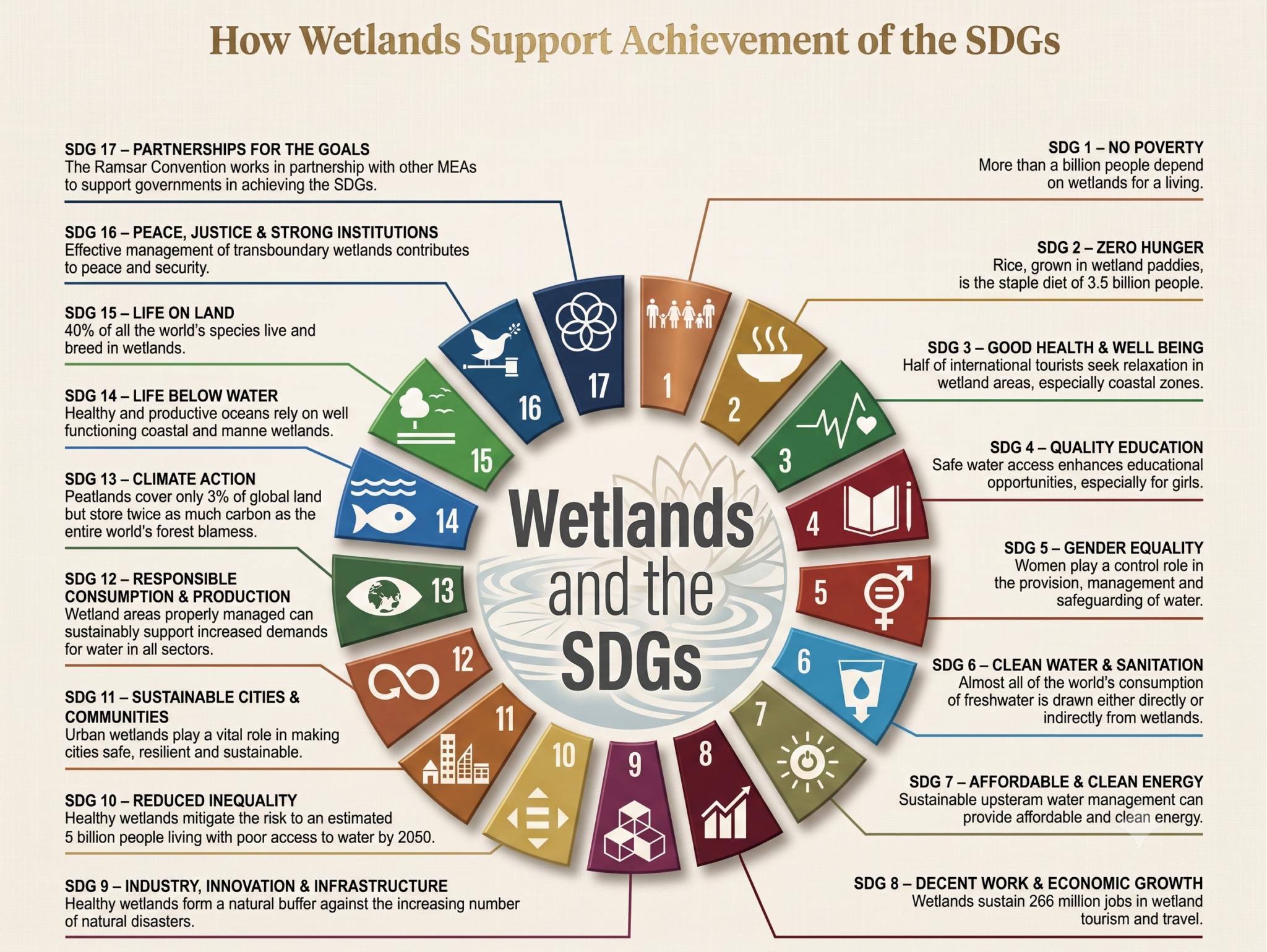
Wetlands and Sustainable Development Goals (SDGs)
Wetlands support biodiversity, human well-being, climate resilience, ecosystem services, and sustainable livelihoods. Their conservation and wise use contribute to achieving the Sustainable Development Goals (SDGs) and promoting sustainable development.
Wetland Way Forward
Wetland conservation requires an integrated approach combining technology, community participation, effective enforcement, awareness, and innovative restoration models to ensure long-term ecological and livelihood benefits.
- Technology-Driven Monitoring: Use satellite imagery and remote sensing for regular monitoring of wetland health, land-use changes, encroachments, and degradation.
- Community-Based Management: Involve local communities and stakeholders in wetland conservation through sustainable fishing, eco-tourism, and participatory management, creating livelihood incentives for conservation.
- Strengthen Legal Enforcement: Ensure effective implementation of wetland protection laws and strengthen institutional and judicial oversight to prevent encroachment, pollution, and other forms of degradation.
- Education and Public Awareness: Promote awareness of the ecological, economic, and cultural significance of wetlands through education programmes and citizen participation.
- Innovative Restoration Models: Encourage public-private partnerships and other collaborative models for wetland restoration and sustainable management.
- Example: The Boracay Island Rehabilitation in the Philippines demonstrates how coordinated public-private efforts can support the restoration of degraded wetland ecosystems.
Wetlands UPSC PYQs
Q1: What is wetland? Explain the Ramsar concept of ‘wise use’ in the context of wetland conservation. Cite two examples of Ramsar sites from India. (UPSC Mains 2018)
Q2: “If rainforests and tropical forests are the lungs of the Earth, then surely wetlands function as its kidneys.” Which one of the following functions of wetlands best reflects the above statement? (UPSC Prelims 2022)
(a) The water cycle in wetlands involves surface runoff subsoil percolation and evaporation.
(b) Algae form the nutrient base upon which fish, crustaceans, molluscs, birds, reptiles and mammals thrive.
(c) Wetlands play a vital role in maintaining sedimentation balance and soil stabilization.
(d) Aquatic plants absorb heavy metals and excess nutrients.
Ans: (d)
Q3: Consider the following pairs:
Wetland/Lake Location
- Hokera Wetland Punjab
- Renuka Wetland Himachal Pradesh
- Rudrasagar Lake Tripura
- Sasthamkotta Tamil Nadu
How many pairs given above are correctly matched? (UPSC Prelims 2022)
(a) Only one pair
(b) Only two pairs
(c) Only three pairs
(d) All four pairs
Ans: (b)
Q4: Consider the following statements:
1.Under Ramsar Convention, it is mandatory on the part of the Government of India to protect and conserve all the wetlands in the territory of India.
2.The Wetlands (Conservation and Management) Rules, 2010 were framed by the Government of India based on the recommendations of Ramsar Convention.
3.The Wetlands (Conservation and Management) Rules, 2010 also encompass the drainage area or catchment regions of the wetlands as determined by the authority.
Which of the statements given above is/are correct? (UPSC Prelims 2019)
(a) 1 and 2 only
(b) 2 and 3 only
(c) 3 only
(d) 1, 2 and 3
Ans: (c)

 Last updated on Oct, 2026
→ UPSC 2027 Notification will be released on 13 January 2027 at upsconline.nic.in.
→ Check Nobel Prize 2026 Winners List here.
→ Download PIB PRiSM Monthly Magazine 2026 here.
→ Check UPSC Monthly Current Affairs Magazine The Recitals here.
→ Check out the latest UPSC Syllabus here.
→ Download UPSC Model Answers for Mains 2026
→ UPSC Mains Question Paper 2026 is out now for Essay & GS Paper 1, 2, 3 & 4.
→ UPSC Calendar 2027 has been released.
→ Enroll in Vajiram & Ravi’s UPSC Mains Test Series 2027 for structured answer writing practice, expert evaluation, and exam-oriented feedback.
→ Join Vajiram & Ravi’s UPSC Mentorship Program 2027 for personalized guidance, strategy planning, and one-to-one support from experienced mentors.
→ Go through the UPSC Mains Previous Year Papers to enhance your preparation.
→ UPSC has released UPSC Toppers List 2025 with the Civil Services final result on its official website.
→ Also check Best UPSC Coaching in India
Wetlands FAQs
Q1. What are wetlands?+
Q2. What is an example of wetlands?+
Q3. What are five types of wetlands?+
Q4. What is another name for wetlands?+
Q5. Is Ramsar a wetland?+
Tags: quest UPSC Environment and Ecology Notes wetlands