A terrestrial ecosystem is an ecosystem that exists primarily on land, where living organisms interact with one another and with non-living components such as soil, air, water, sunlight, and temperature. Terrestrial ecosystems cover diverse environments ranging from dense tropical forests and grasslands to deserts, tundra, and mountain regions.
They are essential for maintaining biodiversity, nutrient cycling, carbon storage, soil formation, water regulation, and climate stability. In India, terrestrial ecosystems such as the Western Ghats, Eastern Ghats, Himalayan forests, grasslands, and Thar Desert support a wide variety of species and provide important ecosystem services.
Terrestrial Ecosystem Meaning
Terrestrial ecosystems are land-based ecosystems where living organisms interact with each other and with abiotic components such as soil, air, water, sunlight and climate. Their distribution and characteristics are mainly influenced by temperature, rainfall, soil type and seasonal variations. They include diverse ecosystems such as forests, grasslands, deserts, tundra and mountains, each supporting species adapted to specific environmental conditions.
Terrestrial Ecosystem Example
Terrestrial ecosystems occur across diverse landforms and climatic conditions, including tropical and temperate forests, grasslands, savannas, deserts, tundra, alpine regions, mountains, and agricultural ecosystems. In India, notable examples of terrestrial ecosystems include the Western Ghats, Himalayas, Thar Desert, Deccan Plateau, Northeast India, and Sundarbans, each supporting distinctive vegetation, wildlife, and ecological processes.
Terrestrial Ecosystem Components
A terrestrial ecosystem consists of both living (biotic) and non-living (abiotic) components that interact with each other. These components work together to maintain the balance and function of the ecosystem.
- Biotic Components: Living organisms, including plants, animals, fungi, and microorganisms. They can be broadly classified as producers, consumers, and decomposers.
- Abiotic Components: These are the non-living physical and chemical factors, including:
- Soil: Provides physical support, water, and nutrients for terrestrial organisms.
- Moisture: Water available in the soil and atmosphere, essential for the survival and growth of organisms.
- Temperature: Influences the distribution, metabolism, growth, and reproduction of organisms.
- Light: Provides energy for photosynthesis and influences plant growth and ecosystem productivity.
- Air: Provides essential gases such as oxygen, carbon dioxide, and nitrogen, supporting various biological processes.
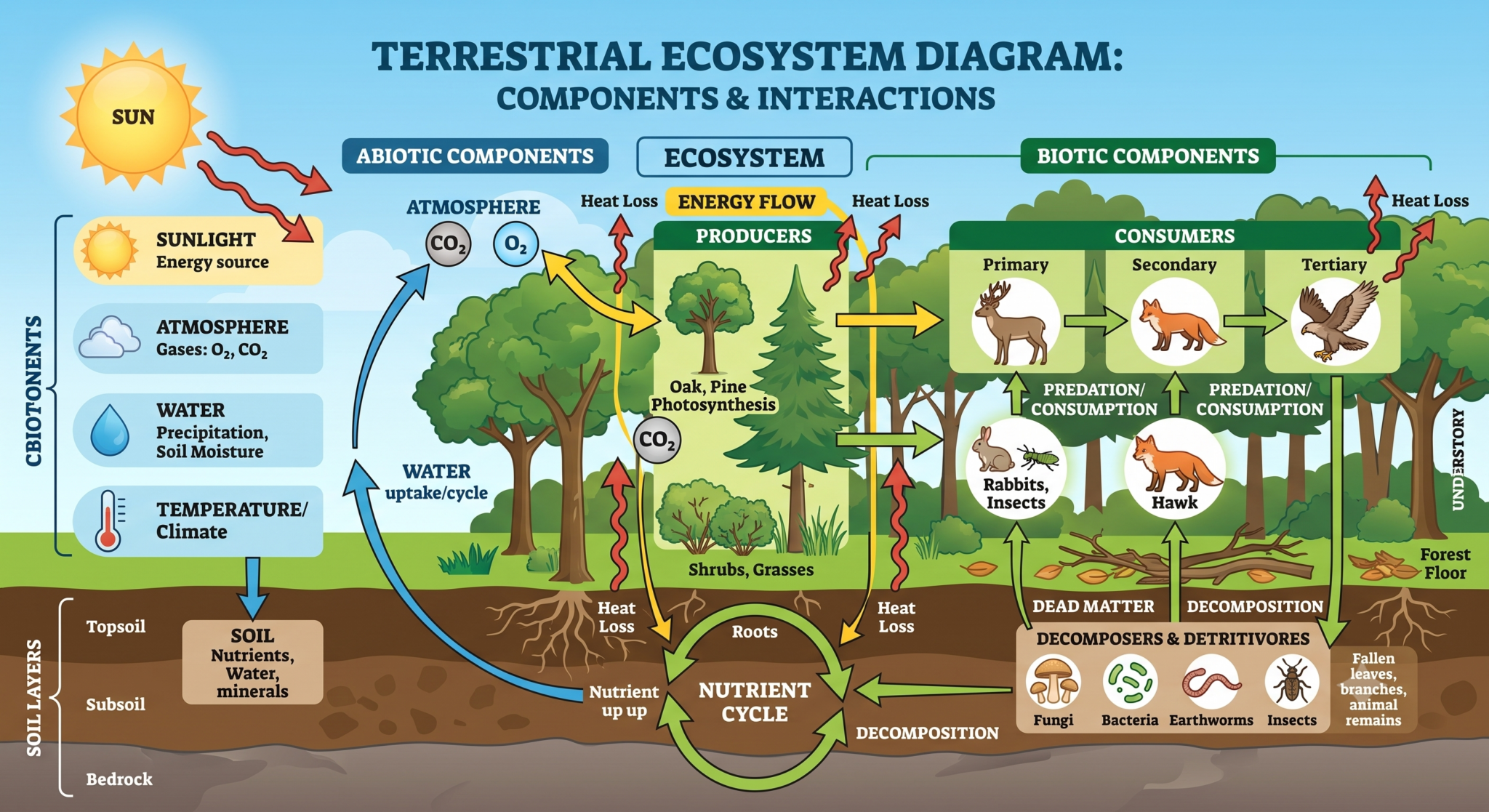
Terrestrial Ecosystem Diagram
A terrestrial ecosystem diagram shows interactions between producers, consumers, decomposers, and abiotic factors, illustrating energy flow, nutrient cycling, food chains, and relationships within land-based ecosystems.


Terrestrial Ecosystem Types
The types of terrestrial ecosystems can be categorised into four types: forests, grasslands, deserts, and tundra. Here is a structured breakdown of the components of each type:
Forest Ecosystem
Forest ecosystems represent a type of land-based ecosystem that fosters the abundant growth of various tree species. Forest ecosystems worldwide are categorised into three main types: tropical, temperate, and coniferous forests. These are explained below in detail:
- Tropical Rain Forests: Found near the equator, with high temperatures, humidity, and over 200 cm of annual rainfall. Known for their rich biodiversity and tall trees, supporting epiphytes and various tree-dwelling animals.
- Temperate Deciduous Forests: Located in North America, Europe, and Asia, with moderate climates, 75-150 cm rainfall, and trees that shed leaves in fall. Common animals include deer, raccoons, and rodents.
- Boreal Coniferous Forests (Taiga): Spread across northern North America and Eurasia with cold climates and poor soils. Dominated by spruce, fir, and pine trees and animals like moose, wolves, and bears.
Grassland Ecosystem
Grasslands are diverse ecosystems found in tropical and temperate regions, characterised by vast stretches of grasses and scattered trees. These grasslands are located in mid-latitude regions and within the interior areas of continents, where the amount of rainfall is generally low to moderate.
- Tropical Grasslands (Savannas): Found in Africa, South America, and Australia, with scattered drought-resistant trees. Support grazing animals like zebras and antelopes and various reptiles and insects.
- Temperate Grasslands: Include prairies, steppes, and pampas. Dominated by grasses and is home to grazing animals, foxes, and rodents. These regions support the dairy and leather industries.
- Grasslands are referred to by various names across different regions of the globe, such as Pampas in Argentina, Downs in Australia, Prairies in the Central North American Plains, Pustaz in Hungary, Steppes in Russia, and Velds in South Africa.
Desert Ecosystem
Desert ecosystem is the driest on Earth, leading to sparse vegetation and limited biodiversity. As a part of the terrestrial ecosystem, plants and animals in deserts have adapted remarkably to thrive in these extreme conditions. Desert ecosystems worldwide are categorized into Hot and Dry Desert, Semi-Arid Desert, Coastal Desert and, Cold Desert ecosystem.
- Hot and Dry Desert Ecosystem: This type of desert ecosystem experiences high temperatures, arid conditions, and minimal annual rainfall.
- Commonly located in regions like Central America, South Asia, North America, Africa, and Australia, these areas are characterised by extreme temperature fluctuations and rough, harsh soil.
- Semi-Arid Desert Ecosystem: Similar to hot and dry deserts, semi-arid deserts are distinguished by their hard rocky surfaces, stable terrain, and fewer sand dunes.
- Though less extreme in temperature compared to hot deserts, semi-arid regions, such as the Great Basin, receive relatively more rainfall.
- Coastal Desert Ecosystem: These regions often experience winter fogs and support a greater diversity of plant and animal life compared to other desert types.
- The Atacama Desert in Chile and the Namib Desert in Africa are located near coastal areas and are influenced by ocean currents.
- Cold Desert Ecosystem: Summers are short, moderately warm, and damp. Snow dunes are a common feature in these regions.
- Cold deserts, such as those found in Greenland, Antarctica, and the Nearctic realm, receive substantial rainfall during winter, along with snowfall.
Tundra Ecosystem
Tundra ecosystems exist in regions with long, harsh winters and brief, cool summers, receiving less than 25 cm of snow-based precipitation. Tundra ecosystems worldwide are categorized into Arctic Tundra and Alpine Tundra, both known for their extreme survival conditions.
- Arctic Tundra: Found in northern Canada, Siberia, and Alaska. Vegetation includes cotton grass and lichens, with animals like reindeer and arctic hares adapted to cold conditions.
- Alpine Tundra: Occurs in high mountains, with flora and fauna similar to Arctic Tundra, including short-growing plants and fur-covered mammals for insulation.
Mountain Ecosystem
Mountain ecosystems are terrestrial ecosystems characterised by high altitude, steep slopes, variations in temperature and precipitation, and changes in vegetation with elevation.
- Temperature generally decreases with increasing altitude.
- Vegetation changes with elevation, from forests to alpine grasslands and tundra.
- Support high levels of biodiversity and many endemic species.
- Act as important water towers, supplying freshwater to downstream regions.
- Vulnerable to climate change, deforestation, landslides and unsustainable tourism.
Ghats Ecosystem
Western and Eastern Ghats are important terrestrial ecosystems in India, supporting forests, grasslands and high biodiversity.
- Western Ghats are a biodiversity hotspot extending parallel to India’s western coast. They receive heavy orographic rainfall and support tropical evergreen and semi-evergreen forests, with high endemism and importance for major peninsular river systems.
- Eastern Ghats are discontinuous hill ranges along India’s eastern coast. They receive comparatively less rainfall and support deciduous forests and scrub vegetation, with significant biodiversity and endemic species.
Terrestrial Ecosystem Importance
Terrestrial ecosystems play a crucial role in supporting biodiversity, regulating climate, and providing essential resources like food, water, and medicine. They offer vital ecosystem services such as carbon sequestration, nutrient cycling, and water purification, maintaining ecological balance and sustaining life.
- Biodiversity and Habitat Support: Terrestrial ecosystems provide habitats for a vast array of species, from plants and animals to microorganisms, ensuring biodiversity and ecological balance.
- Climate Regulation: Forests and other terrestrial ecosystems act as carbon sinks, absorbing about one-third of anthropogenic carbon emissions, thereby mitigating climate change.
- They regulate local and regional climates by influencing precipitation patterns and reducing extreme weather events like floods and droughts.
- Resource Provision: These ecosystems supply essential resources such as food, water, timber, medicine, and fibres, supporting human livelihoods and economies.
- Ecosystem Services: Terrestrial ecosystems contribute to nutrient cycling, oxygen production, and water purification, which are critical for sustaining life on Earth.
- They also maintain energy flow through food webs and trophic systems.
- Soil and Water Management: Terrestrial ecosystems prevent soil erosion, enhance soil fertility, and regulate water availability through processes like evapotranspiration.
- Support for Endemic and Keystone Species: They harbour endemic species that are unique to specific regions and keystone species that play critical roles in maintaining ecosystem structure and function.
Terrestrial Ecosystem and Climate Change
Climate change impacts terrestrial ecosystems by altering vegetation activity, carbon sequestration, and increasing natural disturbances like wildfires and droughts. These changes lead to habitat loss, desertification, and a significant decline in global biodiversity.
- Changes in Vegetation Activity: Climate change alters vegetation activity through shifts in air temperature, soil moisture, and precipitation patterns.
- For example, ecosystems in dry and warm regions like savannas are highly sensitive to soil moisture changes, while cooler regions like boreal forests are more affected by temperature increases.
- Decline in Carbon Sequestration: Rising temperatures initially enhance vegetation growth ("greening"), but prolonged warming can lead to soil drying and reduced vegetation activity.
- This reduces the ability of terrestrial ecosystems to sequester carbon, exacerbating climate change.
- Increased Natural Disturbances: Climate change intensifies natural disturbances such as wildfires, droughts, floods, and storms.
- These events disrupt ecosystem stability and reduce biodiversity by destroying habitats and altering ecological processes.
- Desertification: Increased aridity due to rising temperatures accelerates desertification in vulnerable regions, reducing arable land and biodiversity. This also leads to habitat loss for species dependent on specific ecosystems.
- Decline in Global Biodiversity: The combined effects of habitat loss, extreme weather events, and changing climatic conditions are driving a significant decline in global biodiversity, threatening ecosystem services critical for human survival.

 Last updated on Oct, 2026
→ UPSC 2027 Notification will be released on 13 January 2027 at upsconline.nic.in.
→ Check Nobel Prize 2026 Winners List here.
→ Download PIB PRiSM Monthly Magazine 2026 here.
→ Check UPSC Monthly Current Affairs Magazine The Recitals here.
→ Check out the latest UPSC Syllabus here.
→ Download UPSC Model Answers for Mains 2026
→ UPSC Mains Question Paper 2026 is out now for Essay & GS Paper 1, 2, 3 & 4.
→ UPSC Calendar 2027 has been released.
→ Enroll in Vajiram & Ravi’s UPSC Mains Test Series 2027 for structured answer writing practice, expert evaluation, and exam-oriented feedback.
→ Join Vajiram & Ravi’s UPSC Mentorship Program 2027 for personalized guidance, strategy planning, and one-to-one support from experienced mentors.
→ Go through the UPSC Mains Previous Year Papers to enhance your preparation.
→ UPSC has released UPSC Toppers List 2025 with the Civil Services final result on its official website.
→ Also check Best UPSC Coaching in India
Terrestrial Ecosystem FAQs
Q1. What is a terrestrial ecosystem?+
Q2. What type of ecosystem is terrestrial?+
Q3. What are 10 examples of terrestrial habitats?+
Q4. What is the largest terrestrial ecosystem?+
Q5. What are the 7 major types of terrestrial ecosystems?+
Tags: quest terrestrial ecosystem UPSC Environment and Ecology Notes