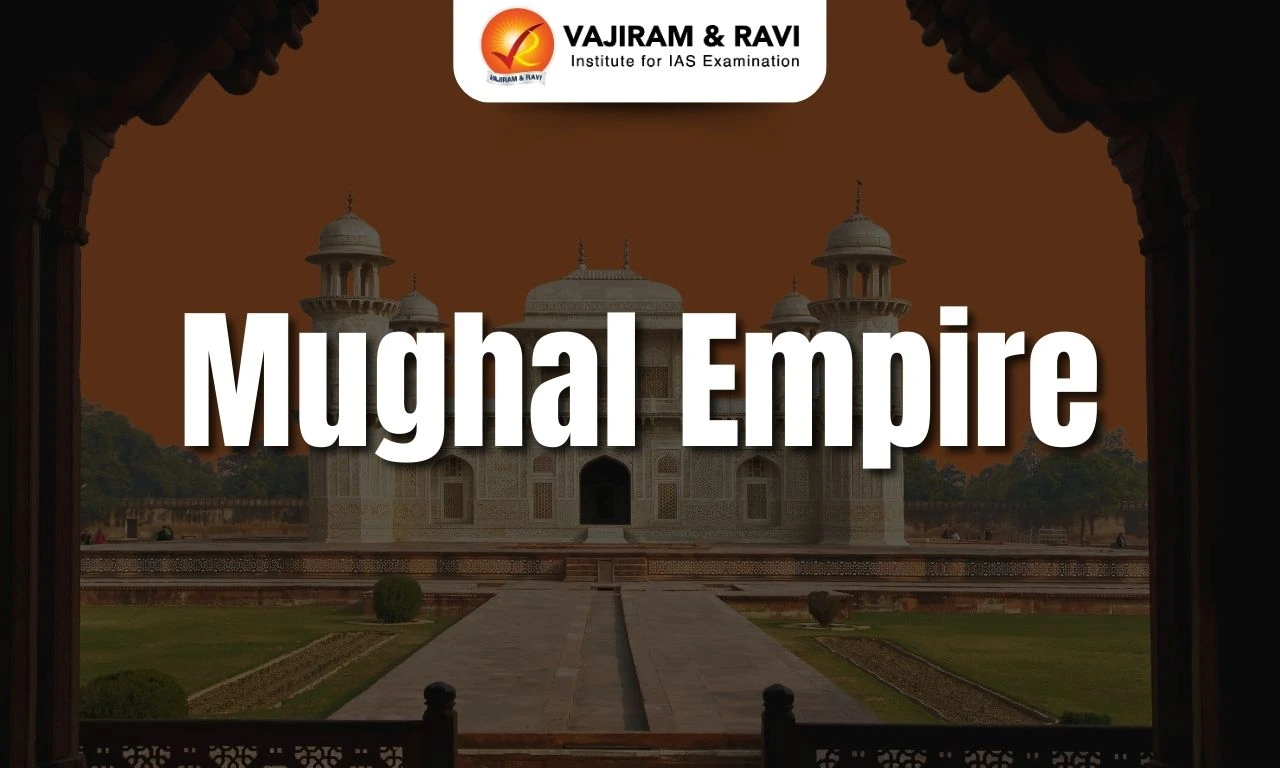
Mughal Empire ruled large parts of the Indian subcontinent from the early 16th to mid-19th centuries. The founder of the Mughal Empire was Babur, a Timurid prince descended from Turkic-Mongol ancestors. The Mughal dynasty expanded its territories under influential rulers like Akbar, Jahangir, Shah Jahan, and Aurangzeb.
The Mughal Empire ushered in an era of political unity, military strength, architectural marvels, and cultural synthesis of Persian, Central Asian, and Indian traditions. They left an invaluable legacy, including iconic monuments like the Taj Mahal, Red Fort, and Fatehpur Sikri, showcasing their architectural brilliance. The Mughal dynasty ruled over an incredibly prosperous empire until its decline in the early 18th century.
Mughal Empire History
The history of the Mughal Empire began in 1526 when Babur, a Timurid prince from Central Asia, defeated Ibrahim Lodi in the First Battle of Panipat, laying the foundation of one of the greatest empires in Indian history.
- Humayun Interregnum: Humayun succeeded Babur but lost the empire to Sher Shah Suri. He regained the throne in 1555, restoring Mughal rule shortly before he died in 1556.
- Expansion under Akbar: Under Akbar (1556–1605), the Mughal Empire expanded significantly through military conquests, efficient administration, the Mansabdari system, and the policy of Sulh-i-Kul, strengthening political unity.
- Golden Age of the Mughals: The reigns of Jahangir and Shah Jahan witnessed remarkable achievements in art, architecture, literature, and culture, including iconic monuments like the Taj Mahal, Red Fort, and Jama Masjid.
- Peak under Aurangzeb: During Aurangzeb's reign (1658–1707), the Mughal Empire reached its greatest territorial extent across most of the Indian subcontinent, but prolonged wars and administrative challenges weakened imperial authority.
- Decline of the Empire: After Aurangzeb's death, internal conflicts, regional revolts, foreign invasions, and the rise of the British East India Company led to the empire's decline, ending with the deposition of Bahadur Shah II in 1857.
Mughal Empire Timeline
Mughal Empire timeline spans from 1526 to 1857, beginning with its establishment by Babur after the First Battle of Panipat, thriving during the era of the Great Mughals (1526–1707) from Akbar to Aurangzeb, and eventually declining under the Later Mughals until its formal dissolution in 1857.
Mughal Empire Map
The Mughal Empire map illustrates its maximum territorial extent under Aurangzeb. The empire stretched from Kabul in the northwest to Bengal in the east and from Kashmir in the north to the Deccan in the south, covering nearly the entire Indian subcontinent except parts of the far south and the northeast.


Mughal Empire Rulers
Mughal Empire rulers, who were direct descendants of the Timurid dynasty, governed the Indian subcontinent from 1526 to 1857, with notable emperors like Akbar, Shah Jahan, and Aurangzeb shaping its cultural legacy and territorial expansion.
Mughal Empire Babur
Babur's victory over Ibrahim Lodi in the First Battle of Panipat in 1526 established the Mughal dynasty in Delhi. He consolidated his reign through subsequent victories against Rajput and Afghan forces. A scholar of Persian and Arabic, he left a lasting literary legacy with his acclaimed memoir, the Baburnama. Key battles include:
- First Battle of Panipat (1526): Babur defeated Ibrahim Lodi, conquering Delhi and Agra.
- Battle of Khanwa (1527): Rana Sanga of Mewar and his Afghan allies were defeated by Babur.
- Battle of Chanderi (1528): Babur defeated Medini Rai, securing the Malwa region.
- Battle of Ghagra (1529): He defeated Afghan rebels led by Mahmud Lodi.
Mughal Empire Humayun
Humayun (Nasir al-Din Muhammad) was the second Mughal emperor, ruling from 1530 to 1540 and again from 1555 to 1556. Humayun inherited a fragile, unstable kingdom surrounded by fierce regional rivals.
- Conflict with Sher Shah Suri: His reign was marked by continuous conflicts with Afghan rulers, especially Sher Shah Suri, who defeated him in the Battle of Chausa (1539) and Battle of Kannauj (1540), forcing him into exile in Persia.
- Reclamation of the Throne: With Persian support, Humayun regained Delhi in 1555 and restored the Mughal Empire. However, his second reign was short-lived, as he died in 1556 after falling from the stairs of his library, Sher Mandal, in Delhi.
Mughal Empire Akbar
Akbar, the third Mughal emperor, ruled from 1556 to 1605 and is regarded as one of India's greatest rulers. He succeeded Humayun at the age of 13, with Bairam Khan serving as his regent initially.
- Territorial Expansion: Akbar greatly expanded the Mughal Empire by conquering and integrating Gujarat, Bengal, Kashmir, Kabul, Sindh, and parts of the Deccan, strengthening imperial authority.
- Administration: Akbar introduced the Mansabdari and Jagirdari systems, while Raja Todar Mal's Dahsala System reformed land revenue administration and improved governance.
- Religious Policy of Akbar: Akbar promoted religious tolerance by abolishing the jizya and pilgrimage tax, introducing Sulh-i-Kul, and later establishing the syncretic faith Din-i-Ilahi.
- Cultural Legacy: Akbar encouraged a fusion of Indian, Persian, and Islamic traditions, reflected in the architecture of Fatehpur Sikri, his magnificent imperial capital.
Mughal Empire Jahangir
Jahangir (1605–1627), Akbar’s son, consolidated the Mughal Empire, maintained administrative stability, and strengthened imperial authority while continuing many of his father’s governance and revenue policies.
- Administration: Nur Jahan exercised significant influence over imperial administration and court politics, becoming one of the most powerful women in Mughal history.
- Art and Architecture: Jahangir patronised painting, architecture, and gardens, commissioning notable works such as the Shalimar Gardens in Kashmir and encouraging artistic excellence.
- Literary Legacy: His autobiography, Tuzuk-i-Jahangiri, provides valuable insights into Mughal governance, court life, natural history, and Jahangir's personal observations and policies.
Mughal Empire Shah Jahan
Shah Jahan became the fifth Mughal emperor in 1628 after defeating rivals in the war of succession following Emperor Jahangir's death.
- Golden Age of Architecture: His reign is regarded as the golden age of Mughal architecture, witnessing the construction of the Taj Mahal, Red Fort, and Jama Masjid.
- Administrative Prosperity: The empire reached its territorial expansion, political stability, and economic prosperity, while art, literature, and architecture flourished under royal patronage.
- Imprisonment: Succession conflicts among his sons weakened the empire. In 1658, Aurangzeb deposed and imprisoned Shah Jahan in Agra Fort, where he remained until his death.
Mughal Empire Aurangzeb
Aurangzeb, also known by his regnal title Alamgir I, was the sixth and last of the "Great Mughal" emperors, ruling for nearly 49 years from 1658 until he died in 1707.
- Territorial Expansion: Under Aurangzeb, the Mughal Empire reached its greatest territorial extent, extending across most of the Indian subcontinent through prolonged military campaigns.
- Religious and Administrative Policies: He pursued orthodox Islamic policies, reimposed the Jizya tax, enforced Islamic law more strictly, and expanded the Fatawa-i-Alamgiri legal code.
- Decline of the Empire: Continuous Deccan campaigns, regional revolts, and administrative overextension exhausted imperial resources, contributing to the gradual decline of Mughal power after he died in 1707.
Mughal Empire Later Mughals
Later Mughals saw a rapid decline after Aurangzeb died in 1707. Weak emperors like Bahadur Shah I became puppet rulers amid court intrigues, civil wars, and Maratha, Afghan, and Persian attacks. Nadir Shah’s 1739 invasion stripped their remaining wealth, reducing the empire to Delhi under eventual British control.
Mughal Empire Administration
The administration of the Mughal Empire was a sophisticated, centralised system that integrated military, civilian, and judicial functions. It efficiently managed a vast empire through tiered divisions and innovative revenue mechanisms.
- Central Administration: The Emperor (Badshah) exercised supreme authority, supported by a council of ministers called the Diwan-i-Kul. Key positions included the Wazir (Prime Minister), Diwan (Finances and Expenditure), Mir Bakshi (Military), Sadr-us-Sadur (Religious Affairs), and Mir Saman (Imperial Karkhanas).
- Administrative Divisions: The empire was partitioned into provinces (Subas) governed by Subahdars. Subas were further divided into Sarkars (districts) and Parganas (groups of villages), with Faujdars maintaining law and order.
- Provincial Administration: Provincial heads included the Sipahsalar (Emperor's representative), Diwan (revenue), Bakshi (army organization), and Sadr (judicial affairs).
- District and Village Administration: Districts were managed by the Fauzdar (administrative head) and Amalguzar (revenue collector). Village affairs were overseen by the Muqaddam (headman) and records managed by the Patwari (accountant).
- Revenue System: Primary income came from land revenue, typically one-third of the produce. Key systems included the following:
- Jagirdari: These were transferable land assignments given to nobles in place of cash.
- Dahsala: 'Dahsala' referred to standardized measurement and collection introduced in 1580.
- Zabt/Bandobast: Developed by Raja Todar Mal, it was a land revenue model based on systematic land measurement and soil fertility classification.
- Zamindari: Zamindari referred to hereditary land rights under which owners paid a fixed annual revenue.
- Mansabdari System: Officials held non-hereditary ranks (mansabs) with dual designations: zat (status) and sawar (cavalry). Salaries and responsibilities were determined by rank and usually paid through jagirs.
- Legal System: Justice was administered by Qazis (judges) and muftis (legal experts) based on a blend of Sharia (Islamic law) and local customs.
Mughal Empire Economy
The economy of the Mughal Empire was driven by a robust agrarian base and a sophisticated urban-commercial sector thriving under political integration. This system facilitated extensive regional and international trade networks across the subcontinent.
- Agriculture: The chief economic activity; land revenue served as the primary source of state income.
- Crops: The Ain-i-Akbari categorised crops by Rabi and Kharif seasons. New introductions included tobacco, maize, potato, tomato, and pineapple. Indigo and sericulture (silk) were vital commercial crops.
- Urban Economy: Thrived on craft industries like cotton textiles, metalworking (iron/copper), diamond mining, and gun making. Karkhanas (workshops) handled expensive craft production.
- Trade and Commerce: Facilitated by political integration and a network of Sarais (inns).
- Trading Centres: Bengal (muslin, silk, rice), Coromandel coast (textiles), and Lahore (shawls, carpets).
- Financial Tools: Hundi (letters of credit) eased the movement of goods.
- Communities: Included Banjaras, Marwaris, Bohra Muslims, Chettiars, and Europeans.
Mughal Empire Society
The society of the Mughal Empire was a complex, hierarchical structure defined by rigid stratification across religious and occupational lines. Despite these divisions, the era witnessed significant cultural synthesis and efforts toward administrative inclusivity.
- Social Hierarchy: Society was organised hierarchically, with stratification rooted in birth, occupation, and religion.
- Dominant Groups: The aristocracy, religious scholars, and landowners constituted the dominant social classes.
- The Nobility: This group comprised Turks, Persians, Afghans, and Indian Muslims holding key administrative and military positions.
- Religious Status: Hindus were permitted to practise their faith but were subject to specific taxes, such as jizya.
- Rural and Urban Life: Rural society included powerful zamindars, peasants, and artisans organised into guilds. Urban centres featured court-patronised merchants, bankers, artisans, and intellectuals.
- Social Mobility: Despite restricted social mobility, Akbar implemented policies to foster a more inclusive society.
- Position of Women: A patriarchal framework confined women’s roles largely to the domestic sphere.
Mughal Empire Religion
Mughal Empire’s religious landscape was marked by evolving imperial policies—from Akbar's syncretic tolerance to Aurangzeb's orthodoxy—alongside the vibrant growth and peaceful coexistence of Bhakti, Sufi, and Sikh traditions.
- Akbar’s Syncretism: Akbar promoted a syncretistic approach with Din-i-Ilahi and abolished the jizya tax on non-Muslims.
- Orthodox Reassertion: Under Aurangzeb, religious orthodoxy was reasserted; he reimposed jizya and pursued a conservative Islamic policy.
- Emergence of Sikhism: Sikhism evolved into a distinct religion during this period, shaped by Guru Nanak and subsequent Gurus.
- Spiritual Movements: The Bhakti movement (Mirabai, Tulsidas, and Surdas) and Sufism flourished, deeply influencing literature and music.
- Religious Coexistence: Overall, the era was defined by the active coexistence of these diverse religious traditions.
Mughal Empire Art and Architecture
The Mughal Art and Architecture uniquely combined Persian, Indian, and Central Asian influences. India saw remarkable advancements in painting, architecture, literature, and art during the Mughal era.
Mughal Architecture
Mughal architecture represents a magnificent synthesis of styles, evolving through successive reigns. The Mughal dynasty’s grand legacy is visible in its monumental mosques, forts, gardens, and tombs across the Indian subcontinent.
- Babur (1526–1530): He constructed the Kabuli Bagh Mosque in Panipat to mark his victory.
- Humayun (1530–1540, 1555–1556): His reign saw the creation of Humayun's Tomb in Delhi, along with the Purana Qila and Dinpanah.
- Akbar (1556–1605): He built the grand Agra Fort and founded the city of Fatehpur Sikri, which includes the Buland Darwaza, Panch Mahal, and Jami Masjid.
- Jahangir (1605–1627): He commissioned the Tomb of Akbar in Sikandra, the Shalimar Gardens in Lahore, and the finely detailed Tomb of Itmad-ud-Daulah in Agra.
- Shah Jahan (1628–1658): Known as the master builder, he created the world-famous Taj Mahal in Agra, the Red Fort and Jama Masjid in Delhi, the Shalimar Gardens in Delhi, and the Moti Masjid inside Agra Fort.
- Aurangzeb (1658–1707): His key architectural contributions include the massive Badshahi Mosque in Lahore, Bibi Ka Maqbara in Aurangabad, and the Musammam Burj inside Agra Fort.
Mughal Painting
Mughal paintings flourished under royal patronage, with Humayun bringing Persian painters Mir Sayyid Ali and Abdal Samad to India.
- Akbar commissioned illustrations of literary and religious texts by Hindu and Muslim artists like Baswan, Miskina, and Daswant, depicting works like the Mahabharata and Akbar Nama using Indian colours.
- Under Jahangir, painters like Abul Hasan and Bishan Das excelled in portraits, animal paintings, and scenes influenced by European styles.
- Reduced patronage by later rulers like Aurangzeb due to religious orthodoxy led to a decline in Mughal painting.
Mughal Empire Music and Dance
The Mughal Empire witnessed a golden age for music and dance, with the emperors actively promoting art forms and providing a platform for renowned artists to showcase their talents.
- The legendary Hindustani classical singer Tansen, along with Baiju Bawra, Nayak Bakshu, and Sukhvira, was among the renowned musicians patronised by Akbar.
- Jahangir and Shah Jahan also appreciated and promoted music, continuing the legacy of the Mughal dynasty.
- Classical dance forms like Kathak, incorporating Persian and Central Asian elements, evolved under Mughal patronage.
Mughal Empire Literature
The Mughal Empire witnessed a flourishing of literature, with the emperors patronising writers and poets. Mughal rulers patronised literature in languages like Persian, Urdu, and Turkish, fostering a rich literary culture.
Persian was the language of the Mughal administration. Sufi and Bhakti movements propelled the growth of regional languages like Hindi, Bengali, Rajasthani, and Gujarati, enhancing cultural diversity. Urdu emerged as a common language of communication during Mughal rule.
|
Book |
Author |
Details |
|
Tuzuk -i-Baburi |
Babur |
- Describes Babur’s military tactics and administrative organisation |
|
Humayun Nama |
Gulbadan Begum |
- Biography of Humayun |
|
Akbar Nama |
Abu Fazl |
- History of Akbar’s reign |
|
Ain-i-Akbari |
Abu Fazl |
- Administration of Akbar’s reign |
|
Muntakhab-ul-Tawarikh |
Badauni |
- Account of Akbar’s reign |
|
Tuzuk-i-Jahangiri |
Jahangir |
- Jahangir’s autobiography |
|
Iqbalnamah-i-Jahangir |
Mutamid Khan |
- Biography of Jahangir |
|
Padshahnama |
Abdul Hamid Lahori |
- History of Shah Jahan’s reign |
|
Alamgir Nama |
Munsi Mirza Muhammad Kazin |
- History of Aurangzeb’s rule |
|
Fatwa-i-Alamgiri |
Aurangzeb |
- Sharia law for the empire |
|
Majma-ul-Bahrain (The Confluence of the Two Seas) |
- Diversity and harmony of religions |
|
|
Bhagavad Gita, Upanishads |
Dara Shikoh |
- Translated into Persian |
|
Shahnameh |
Firdausi |
- History of Persian kings. |
|
Nuskho-i- Dilkusha |
Bhimsen |
- Analysis of Aurangzeb’s rule |
|
Ramcharitmanas |
Tulsidas |
- Ramayana in Awadhi |
|
Sursagar |
Sur Das |
- Poetry collections (in Brij bhasha) |
|
Rag Darpan |
Sarang Dev |
- Treatise on Indian classical music |
|
Padmavat |
Malik Muhammad Jayasi |
- Story of Padmavati and Alauddin Khilji. |
Mughal Empire Decline
The decline of the Mughal Empire resulted from a combination of internal political decay, economic instability, military weakness, rising regional powers, and devastating foreign invasions that eroded central imperial control. Factors leading to the Decline of the Mughals are:
- Internal conflicts: Power struggles and infighting among the royal family members weakened the central authority and drained the empire's resources.
- Degeneration of nobility: The decline in nobility's character and capabilities mirrored the weakening empire.
- Rise of regional powers: The emergence of powerful regional kingdoms, such as the Marathas and the Sikhs, challenged the Mughal dynasty’s dominance and sparked prolonged conflicts.
- Economic decline: The decline in agricultural productivity, coupled with the drain of wealth through extravagant expenditures and mismanagement of resources, led to economic instability.
- Declining military strength: The once formidable Mughal army lost its edge due to outdated military tactics, inadequate training, and a lack of modernisation.
- Foreign invasions: The Mughal Empire faced repeated invasions from the Persians and the Afghans, further eroding its power and territorial holdings.
Mughal Empire UPSC PYQs
Q1: Examine the main aspects of Akbar’s religious syncretism. (UPSC Mains 2025)
Q2: Persian Literary sources of medieval India reflect the spirit of the age. Comment. (UPSC Mains 2020)
Q3: With reference to Mughal India, what is/are the difference/differences between Jagirdar and Zamindar? (UPSC Prelims 2022)
- Jagirdars were holders of land assignments in lieu of judicial and police duties, whereas Zamindars were holders of revenue rights without obligation to perform any duty other than revenue collection.
- Land assignments to Jagirdars were hereditary, and revenue rights of Zamindars were not hereditary.
Select the correct answer using the code given below.
- 1 only
- 2 only
- Both 1 and 2
- Neither 1 nor 2
Ans: (d)
Q4: Who among the following Mughal Emperors shifted emphasis from illustrated manuscripts to albums and individual portraits? (UPSC Prelims 2019)
- Humayun
- Akbar
- Jahangir
- Shah Jahan
Ans: (c)
Q5: Consider the following: (UPSC Prelims 2015)
The arrival of Babur into India led to the
- introduction of gunpowder in the subcontinent
- introduction of the arch and dome in the region’s architecture
- establishment of the Timurid dynasty in the region
Select the correct answer using the code given below:
(a) 1 and 2 only
(b) 3 only
(c) 1 and 3 only
(d) 1, 2 and 3
Ans: (b)

 Last updated on Oct, 2026
→ UPSC 2027 Notification will be released on 13 January 2027 at upsconline.nic.in.
→ Check Nobel Prize 2026 Winners List here.
→ Download PIB PRiSM Monthly Magazine 2026 here.
→ Check UPSC Monthly Current Affairs Magazine The Recitals here.
→ Check out the latest UPSC Syllabus here.
→ Download UPSC Model Answers for Mains 2026
→ UPSC Mains Question Paper 2026 is out now for Essay & GS Paper 1, 2, 3 & 4.
→ UPSC Calendar 2027 has been released.
→ Enroll in Vajiram & Ravi’s UPSC Mains Test Series 2027 for structured answer writing practice, expert evaluation, and exam-oriented feedback.
→ Join Vajiram & Ravi’s UPSC Mentorship Program 2027 for personalized guidance, strategy planning, and one-to-one support from experienced mentors.
→ Go through the UPSC Mains Previous Year Papers to enhance your preparation.
→ UPSC has released UPSC Toppers List 2025 with the Civil Services final result on its official website.
→ Also check Best UPSC Coaching in India
Mughal Empire FAQs
Q1. Who was the founder of the Mughal Empire?+
Q2. Who was the 7th Mughal Emperor?+
Q3. Who defeated Mughal 17 times?+
Q4. What is the order of the Mughal dynasty?+
Q5. Did Aurangzeb defeat Shivaji?+
Tags: mughal empire quest UPSC Medieval History Notes