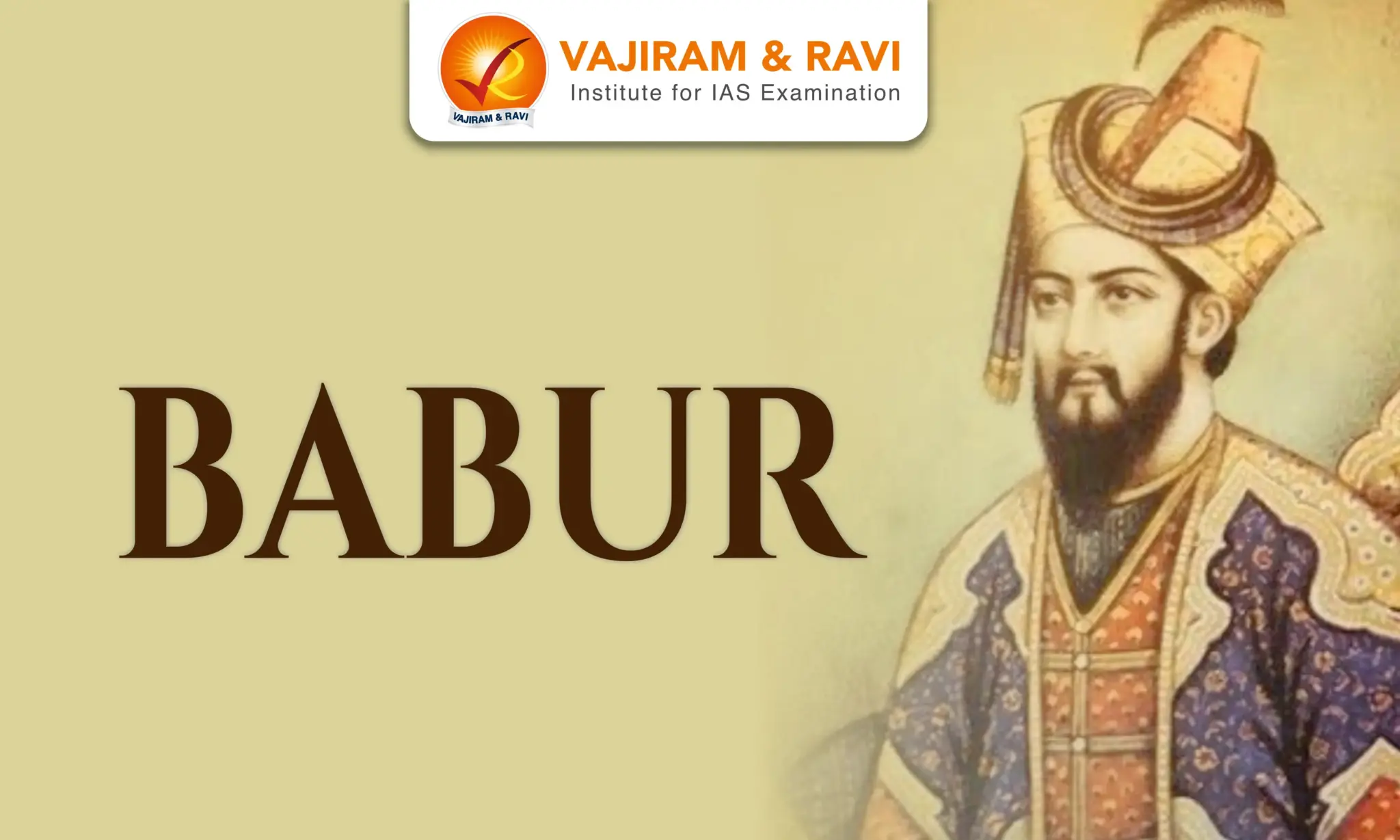
Babur, also known as Zahiruddin Muhammad Babur, founded the Mughal Empire in India. He was a Timurid prince from Central Asia who defeated Ibrahim Lodi in the First Battle of Panipat in 1526, establishing Mughal rule in northern India.
Babur ruled India for only four years, 1526-1530. Nonetheless, his victories over the Delhi Sultanate, the Rajput confederacy, and Afghan forces laid the political groundwork for an empire later consolidated by his grandson, Akbar. Babur's use of mobile cavalry, field artillery, matchlocks, and battlefield tactics provided a decisive advantage over larger armies.
Babur About
Babur (also known as Zahiruddin Muhammad), born in 1483 in Ferghana (now in Uzbekistan), was the Mughal emperor (1526-30) and founder of the Mughal dynasty of northern India. He died on December 26, 1530, in Agra, India. Bābur was a descendant of Genghis Khan and Timur and was a military adventurer, distinguished soldier, poet, diarist, and statesman. His autobiography, "Baburnama," offers a rare insight into his life and the world he lived in.
Early Life of Babur
Babur hailed from the Barlas tribe, which had Mongol roots. However, over time, members of the tribe, having lived in Turkish regions for generations, adopted the Turkish language and customs, identifying more as Turks.
- Ruler of Farghana: In 1494, at the age of eleven, Babur succeeded his father, Umar Shaikh Mirza, as the ruler of Farghana. The situation in Central Asia was volatile, and Babar encountered significant opposition from the nobility. Despite successfully capturing Samarqand, he was forced to retreat due to the desertion of some of his nobles. He also lost Farghana to the Uzbeks.
- Conquest of Kabul: After the defeat at the hands of the Uzbeks, Babur turned his attention southwards. In 1504, Babul captured Kabul and established it as his base of operations. This strategic move positioned him closer to the wealthy lands of India, which had long been a target for Central Asian conquerors.
Babur’s Conquest of India
Babur became interested in conquering India. Finally, starting in 1517, he made decisive moves towards India and launched four expeditions between 1519 and 1524. Babur was successful in capturing Bhira (1519–1520), Sialkot (1520), and Lahore (1524) in Punjab.
- Political Instability: The political instability in India after Sikandar Lodi's death highlighted the growing unrest within the Lodi Empire, mainly due to conflicts between Afghan chiefs and Ibrahim Lodi.
- Invitation to Babur: Daulat Khan Lodi, the Governor of Punjab, and Rana Sanga, the Rajput king of Mewar, both challenged Ibrahim’s authority. They invited Babur to invade India, which likely fuelled his ambitions for conquest.
Babur Military Conquests
Babur's military campaigns in India were marked by strategic brilliance and technological innovation. His most significant victories include the First Battle of Panipat, the Battle of Khanwa, the Battle of Chanderi, and the Battle of Ghagra.
- First Battle of Panipat (1526): The First Battle of Panipat was a decisive fight between Babur, the founder of the Mughal Empire, and Sultan Ibrahim Lodi of the Delhi Sultanate. The battle took place on April 21, 1526, near Panipat, marking Babur's entry into India and the beginning of the Mughal Empire.
- With a much smaller army, Babur used advanced tactics and the Tulguma system of warfare to defeat Ibrahim Lodi's larger forces. These innovations, combined with Babur’s disciplined troops, overwhelmed Lodi's outdated army.
- Battle of Khanwa (1527): Babur confronted Rana Sanga of Mewar near Agra, defeating his forces, which included Afghan allies, Mahmud Lodi, and Hasan Khan Mewati. This victory led to Babur's capture of Gwalior and Dholpur, strengthening his rule in the region.
- Battle of Chanderi (1528): Babur defeated Medini Rai at Chanderi, securing dominance over Malwa, and then turned his focus to suppressing Afghan rebellions.
- Battle of Ghagra (1529): Babur's final battle was against Afghan forces led by Mahmud Lodi and Sultan Nusrat Shah. His victory along the Ghagra River ended major resistance, consolidating his power in northern India.


Challenges Faced by Babur in India
Babur’s victories did not immediately create a stable empire. He faced several political, military, and social challenges after Panipat.
- Afghan Resistance: The Lodi dynasty's supporters, particularly Mahmud Lodi, continued to oppose Mughal authority.
- Rajput Opposition: Rana Sanga and the Rajput chiefs posed a significant military challenge to Babur's expansion.
- Limited Resources: Babur's army had limited resources and relied heavily on the loyalty of nobles and commanders.
- Unfamiliar Environment: Babur was initially unfamiliar with India's climate, cuisine, social customs, and landscape.
- Administrative Instability: The territories conquered from the Lodis necessitated new arrangements for revenue collection, military control, and governance.
Significance of Babur’s Advent
Babur’s advent marked a major turning point in medieval Indian history. His victory in the First Battle of Panipat (1526) ended Lodi rule and laid the foundation of the Mughal Empire. His subsequent victories at Khanwa, Chanderi and Ghaghra consolidated Mughal authority in northern India. Babur also introduced effective use of field artillery, firearms and cavalry tactics, influencing the nature of warfare. His arrival thus initiated a new phase of imperial expansion and political consolidation.
Babur Legacy
Babur, descendant of Timur and Genghis Khan, founded the Mughal Empire in 1526, fundamentally transforming India's political trajectory through his visionary and bold military leadership.
- Military Innovation: Babur introduced advanced artillery and Tulughma tactics, securing a decisive victory at Panipat, which permanently ended the Delhi Sultanate and established Mughal dominance.
- Imperial Foundation: His campaigns at Khanwa and Ghagra consolidated Northern India, providing the essential political framework and momentum his successors used to institutionalize the vast empire.
- Literary Legacy: Babur authored the Baburnama, a candid masterpiece in Chagatai Turkic language that serves as an invaluable historical record and remains a celebrated work of world literature.
- Culture: He introduced symmetric Charbagh gardens and patronized a refined synthesis of Persian, Turkic, and Indian aesthetic elements, defining the early Mughal courtly style.
Babur UPSC PYQs
Q1: Consider the following: (UPSC Prelims 2015)
The arrival of Babur into India led to the
- introduction of gunpowder in the subcontinent
- introduction of the arch and dome in the region’s architecture
- establishment of the Timurid dynasty in the region
Select the correct answer using the code given below:
(a) 1 and 2 only
(b) 3 only
(c) 1 and 3 only
(d) 1, 2 and 3
Ans: (b)
Q2: Consider the following Bhakti Saints: (UPSC Prelims 2013)
- Dadu Dayal
- Guru Nanak
- Tyagaraja
Who among the above was/were preaching when the Lodi dynasty fell and Babur took over?
(a) 1 and 3
(b) 2 only
(c) 2 and 3
(d) 1 and 2
Ans: (b)

 Last updated on Oct, 2026
→ UPSC 2027 Notification will be released on 13 January 2027 at upsconline.nic.in.
→ Check Nobel Prize 2026 Winners List here.
→ Download PIB PRiSM Monthly Magazine 2026 here.
→ Check UPSC Monthly Current Affairs Magazine The Recitals here.
→ Check out the latest UPSC Syllabus here.
→ Download UPSC Model Answers for Mains 2026
→ UPSC Mains Question Paper 2026 is out now for Essay & GS Paper 1, 2, 3 & 4.
→ UPSC Calendar 2027 has been released.
→ Enroll in Vajiram & Ravi’s UPSC Mains Test Series 2027 for structured answer writing practice, expert evaluation, and exam-oriented feedback.
→ Join Vajiram & Ravi’s UPSC Mentorship Program 2027 for personalized guidance, strategy planning, and one-to-one support from experienced mentors.
→ Go through the UPSC Mains Previous Year Papers to enhance your preparation.
→ UPSC has released UPSC Toppers List 2025 with the Civil Services final result on its official website.
→ Also check Best UPSC Coaching in India
Babur FAQs
Q1. What did Babur do in the Mughal Empire?+
Q2. What was Babur famous for?+
Q3. Why was Babur called Mughal?+
Q4. Who defeated Babur?+
Q5. At what age did Babur become king?+
Tags: babur quest UPSC Medieval History Notes