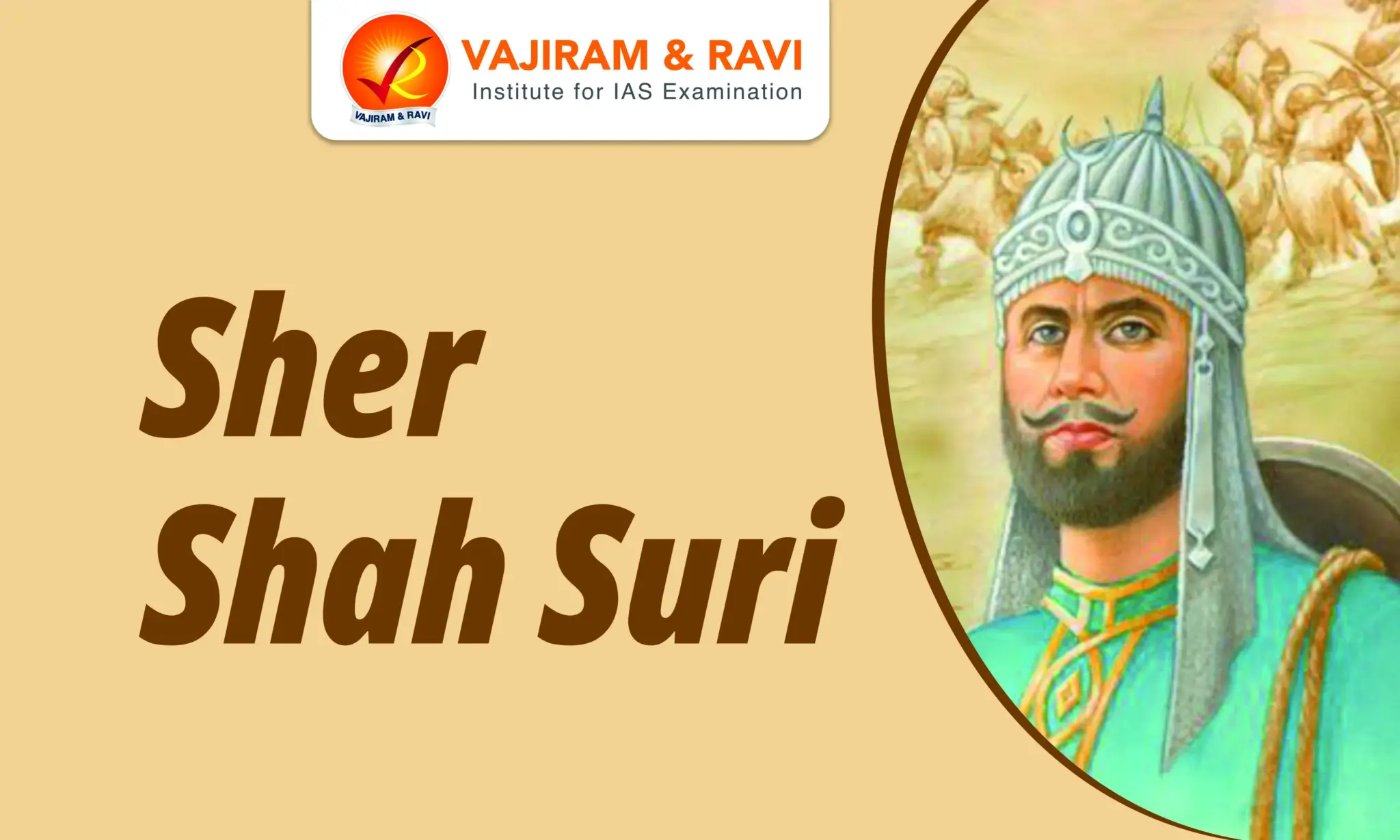
Sher Shah Suri was one of the most capable rulers in mediaeval India. Though he only governed for five years, from 1540 to 1545, he built a powerful Afghan empire in North India and implemented significant improvements in administration, revenue collection, currency, communication, roads, and trade.
Born as Farid Khan, he founded the Sur Dynasty after overthrowing Mughal Emperor Humayun. His effective form of governing impacted Emperor Akbar's administration. Sher Shah is remembered for the Grand Trunk Road, the silver Rupiya, land revenue reforms, postal systems, sarais, and a well-organised army.
Sher Shah Suri About
Sher Shah Suri, originally named Farid Khan, was born in 1486 in Sasaram, Bihar. He was the emperor of North India (1540-45) in the Islamic Sūr (Afghan) dynasty. Sher Shah fought extensive wars with the Rajputs, expanding his empire.
- He conquered Punjab, Malwa, Sind, Multan, and Bundelkhand. His empire included all of North India except Assam, Nepal, Kashmir, and Gujarat.
- He established a long-lasting bureaucracy accountable to the ruler and a carefully calculated revenue system.
- He efficiently administered the army and tax collections and built roads, rest houses, and wells for the people.
- He was generally tolerant of non-Muslims, except for his massacre of Hindus following Raisen's surrender. His tomb at Sasaram is among the most magnificent in India.
Sher Shah Suri Conquests
Sher Shah was the son of Hasan Khan, a minor Afghan jagirdar of Sasaram in Bihar. Sher Shah rebelled against his father and enlisted as a soldier in the service of Jaunpur's governor, Jamal Khan.
- Early Rise: He later worked for the Mughal king of Bihar, who rewarded him for his bravery with the title of "Sher Khan" after reportedly killing a tiger with his bare hands. After defeating a Bengal army, Sher Shah Suri gained control of Bihar.
- In early 1539, he conquered Bengal and cleverly seized the Rohtas stronghold through strategic deception.
- Battle of Chausa, 1539: On June 26, 1539, Sher Shah triumphed over the Mughal emperor Humayun of the Mughal Empire at the Battle of Chausa and adopted the royal title of Farid al-Din Sher Shah.
- Battle of Kannauj: In May 1540, he once again defeated Humayun at the Battle of Kannauj, driving his enemies out of Bengal, Bihar, Hindustan, and Punjab.
- He also suppressed the Baluch chiefs on the northwestern frontier.
- Later Conquests: After expelling Humayun, Sher Shah began to strengthen his position in northern and eastern India.
- In 1542, he defeated and conquered Malwa, followed by Chanderi.
- In Rajasthan, he directed campaigns against Marwar, Ranthambhore, Nagor, Ajmer, Merta, Jodhpur, and Bikaner.
- He defeated the rebellious Afghans in Bengal. By 1545, he had established himself as the supreme ruler of Sindh and Punjab, as well as the entire Rajputana region in the west and Bengal in the east.


Sher Shah Suri Administration
Sher Shah Suri's administrative system was a combination of traditional practices and innovative reforms. He established a centralised administration that would later shape Mughal governance, especially under Mughal Emperor Akbar.
- Council of Ministers: The king was assisted by four important ministers:
- Diwan –i- Wizarat - in charge of Revenue and Finance.
- Diwan-i-Ariz – in charge of the Army.
- Diwan-i-Rasalat- Foreign Minister.
- Diwan-i-Insha- Minister for Communications.
- Division of Empire: Sher Shah's empire was organised into 47 administrative divisions known as sarkars. Each sarkar was overseen by two key officials: the Chief Shiqdar, responsible for maintaining law and order, and the Chief Munsif, who acted as a judge.
- These sarkars were further subdivided into Parganas, where the Shiqdar managed military affairs, the Amin handled land revenue collection, the Fotedar acted as the treasurer, and Karkuns served as accountants. Additionally, there were smaller administrative units known as iqtas.
- Military Administration: During his tenure, the police force was reorganised more efficiently, and crime was reduced. The military administration was also reorganised efficiently, and Sher Shah borrowed many ideas from Alauddin Khalji, such as branding horses.
Sher Shah Suri Economy
Sher Shah Suri implemented changes to boost agriculture, trade, revenue administration, transportation, and currency. His economic policy sought to provide consistent state revenue while safeguarding cultivators from undue demands from bureaucrats.
- Land Revenue System: He implemented a highly organised land revenue system. He ensured thorough land surveys, categorising all cultivable land into three classes: good, average, and poor.
- The state's share was set at one-third of the average produce, which could be paid either in cash or crops.
- Farmers were given a written document known as a Patta that detailed the land acreage, crop, revenue rate, and payable revenue.
- The cultivator signed a written agreement known as a Qabuliyat acknowledging the parameters of revenue payment.
- Currency Reforms: He issued a standard silver coin known as the Rupiya. It became a significant forerunner of the present Indian rupee.
Sher Shah Suri Religion
Sher Shah Suri was a devout Muslim, but his administration was largely practical and accepting of people of different religions. He did not build his government entirely on religious affiliation. Instead, he focused on keeping public order, collecting revenue equitably, and assuring his subjects' devotion.
Sher Shah Suri Religion Art and Architecture
Sher Shah Suri made significant contributions to Indo-Islamic architecture. His buildings represent a transition between Delhi Sultanate architecture and later Mughal style. His most notable architectural achievements include forts, mosques, tombs, highways, sarais, and public buildings.
- Sher Shah Suri Tomb: His most well-known architectural work is Sher Shah Suri's tomb in Sasaram, Bihar. It stands in the middle of an artificial lake and is regarded as a masterpiece of Indo-Islamic architecture.
- Rohtas Fort: Sher Shah built the Rohtas Fort in present-day Pakistan to dominate the region and keep Humayun from returning by the northwestern route.
- Purana Qila: He is linked with additions to Purana Qila in Delhi. Sher Mandal and Qila-i-Kuhna Mosque are two important constructions associated with his reign.
- Literature: Malik Muhammad Jayasi finished his famous epic poem Padmavat in 1540 CE, during the reign of North Indian ruler Sher Shah Suri.
Sher Shah Suri Reforms
Sher Shah Suri implemented a series of reforms that touched various aspects of governance, economy, and infrastructure. These reforms aimed to improve administration, boost trade, and enhance the overall welfare of the people.
- Peasant Welfare: Suri introduced a flexible land revenue system based on soil fertility and ensured army movements didn’t damage crops, prioritising peasant prosperity for stability.
- Trade and Commerce: He simplified taxes, collecting them only at entry and sale points, and standardised the metal content of coins, setting the foundation for Indian coinage through the Mughal and British periods.
- Infrastructure Development: Sher Shah repaired and built key roads, including the Grand Trunk Road, and established four major highways. He also set up sarais (rest houses) to support trade and travel.
- Currency Reforms: He introduced new silver coins, the "Dam", and a tri-metallic currency system with gold, silver, and copper coins.
- Justice and Law Enforcement: Known for his impartial justice, Sher Shah punished even nobles and relatives when necessary, enforcing strict law and order and supporting the poor with stipends.
Sher Shah Suri's Death
Sher Shah died in 1545 during the siege of Kalinjar Fort after suffering fatal injuries from a gunpowder explosion. He was succeeded by his son Islam Shah Suri, who initially maintained the empire.
- However, after Islam Shah’s death in 1554, succession disputes and conflicts among Afghan nobles weakened the Sur state.
- Rival claimants further fragmented the empire, allowing Humayun to defeat Sikandar Shah Suri and recapture Delhi and Agra in 1555, marking the effective end of Sur rule.
Sher Shah Suri UPSC PYQs
Q1: Evaluate the contribution of Sher Shah towards trade and commerce, administration and agricultural reforms. (UPSC Mains 2020)

 Last updated on Oct, 2026
→ UPSC 2027 Notification will be released on 13 January 2027 at upsconline.nic.in.
→ Check Nobel Prize 2026 Winners List here.
→ Download PIB PRiSM Monthly Magazine 2026 here.
→ Check UPSC Monthly Current Affairs Magazine The Recitals here.
→ Check out the latest UPSC Syllabus here.
→ Download UPSC Model Answers for Mains 2026
→ UPSC Mains Question Paper 2026 is out now for Essay & GS Paper 1, 2, 3 & 4.
→ UPSC Calendar 2027 has been released.
→ Enroll in Vajiram & Ravi’s UPSC Mains Test Series 2027 for structured answer writing practice, expert evaluation, and exam-oriented feedback.
→ Join Vajiram & Ravi’s UPSC Mentorship Program 2027 for personalized guidance, strategy planning, and one-to-one support from experienced mentors.
→ Go through the UPSC Mains Previous Year Papers to enhance your preparation.
→ UPSC has released UPSC Toppers List 2025 with the Civil Services final result on its official website.
→ Also check Best UPSC Coaching in India
Sher Shah Suri FAQs
Q1. Who was Sher Shah Suri?+
Q2. Why was Sher Shah Suri famous?+
Q3. What was the cause of death of Sher Shah Suri?+
Q4. Was Sher Shah Suri a Mughal?+
Q5. Which king defeated Sher Shah Suri?+
Tags: quest sher shah suri UPSC Medieval History Notes