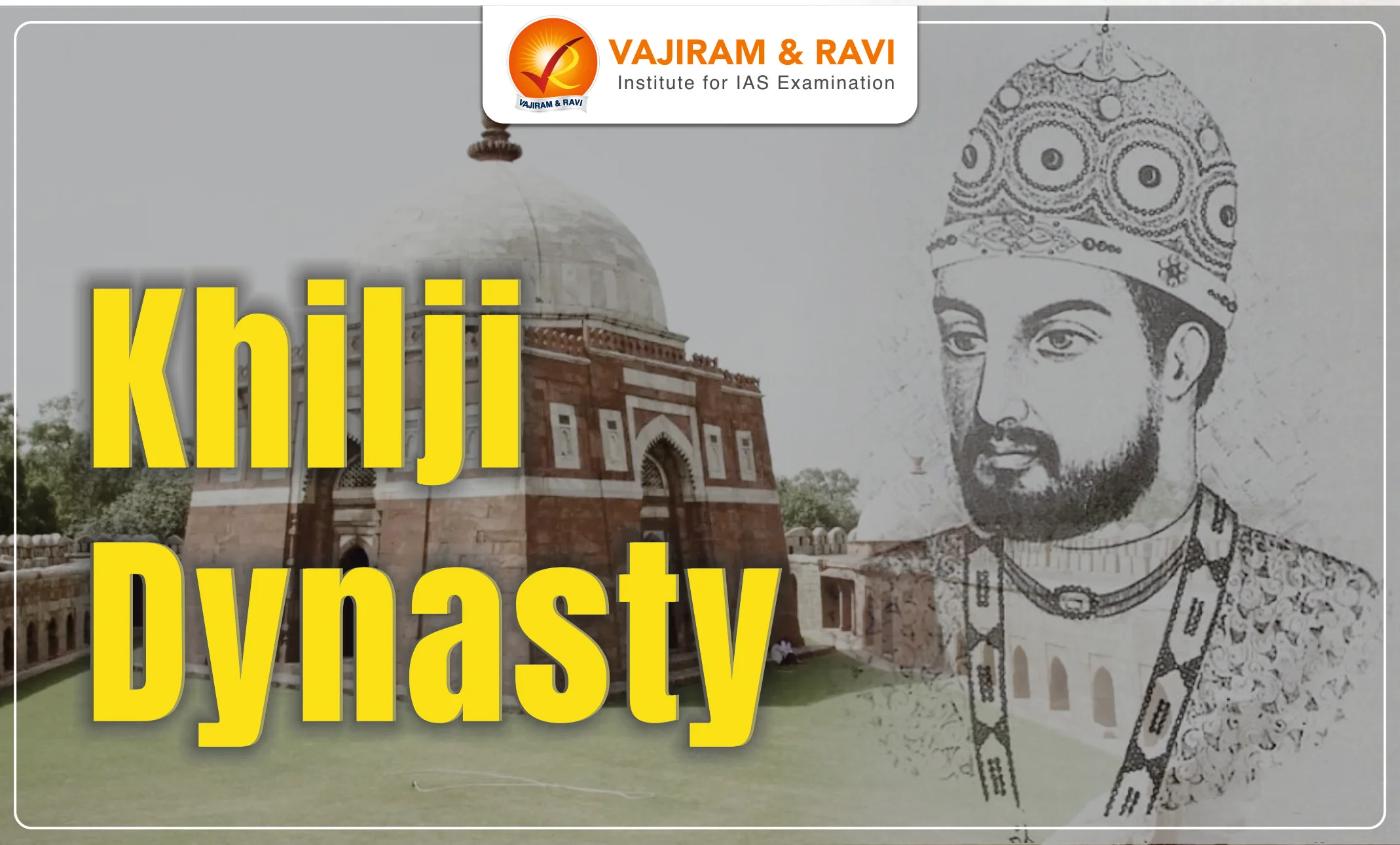
The Khilji Dynasty (1290–1320) marked a significant phase in Delhi Sultanate history, with Alauddin Khilji being its most powerful ruler. Known for his military conquests and administrative reforms, he expanded the empire and strengthened its economy. However, the period also saw a decline in art and architecture, as Alauddin prioritised military expansion over cultural patronage.
Unlike earlier dynasties, which promoted grand structures, the Khilji era saw fewer artistic developments. This decline reflected a shift in priorities, emphasising power and defence over artistic and architectural advancements.
Khilji Dynasty Overview
The Khiljis were of Turkic origin and had settled in Afghanistan’s Khalj region for generations, which contributed to their identification as Khiljis. By the late 13th century, they had become culturally and politically distinct from the Central Asian Turkish elite of the Delhi Sultanate. The dynasty rose to power amid growing dissatisfaction with the Slave Dynasty (Mamluk) and the weakening of the old Turkish nobility.
Khilji Dynasty Founder
The founder of the Khilji dynasty was Jalal-ud-Din Khalji. In 1290, Jalaluddin Firuz Khilji overthrew the last Mamluk ruler, Muizuddin Qaiqabad, and established the Khilji Dynasty, beginning a new phase in the history of Delhi.
Khilji Dynasty Time Period
The Khilji Dynasty ruled the Delhi Sultanate from 1290 to 1320 CE, lasting about 30 years. This period witnessed significant territorial expansion, military campaigns, administrative changes, and economic reforms, particularly during the reign of Alauddin Khilji.
Khilji Dynasty Capital
The main capital of Khilji dynasty was Delhi, which remained the political centre of the Delhi Sultanate. Jalaluddin Khilji established Kilokhri (Kilokari) as his royal seat, while Alauddin Khilji built Siri around 1303 as a fortified capital to protect against Mongol invasions. Thus, Delhi, Kilokhri, and Siri were important seats of Khilji rule.
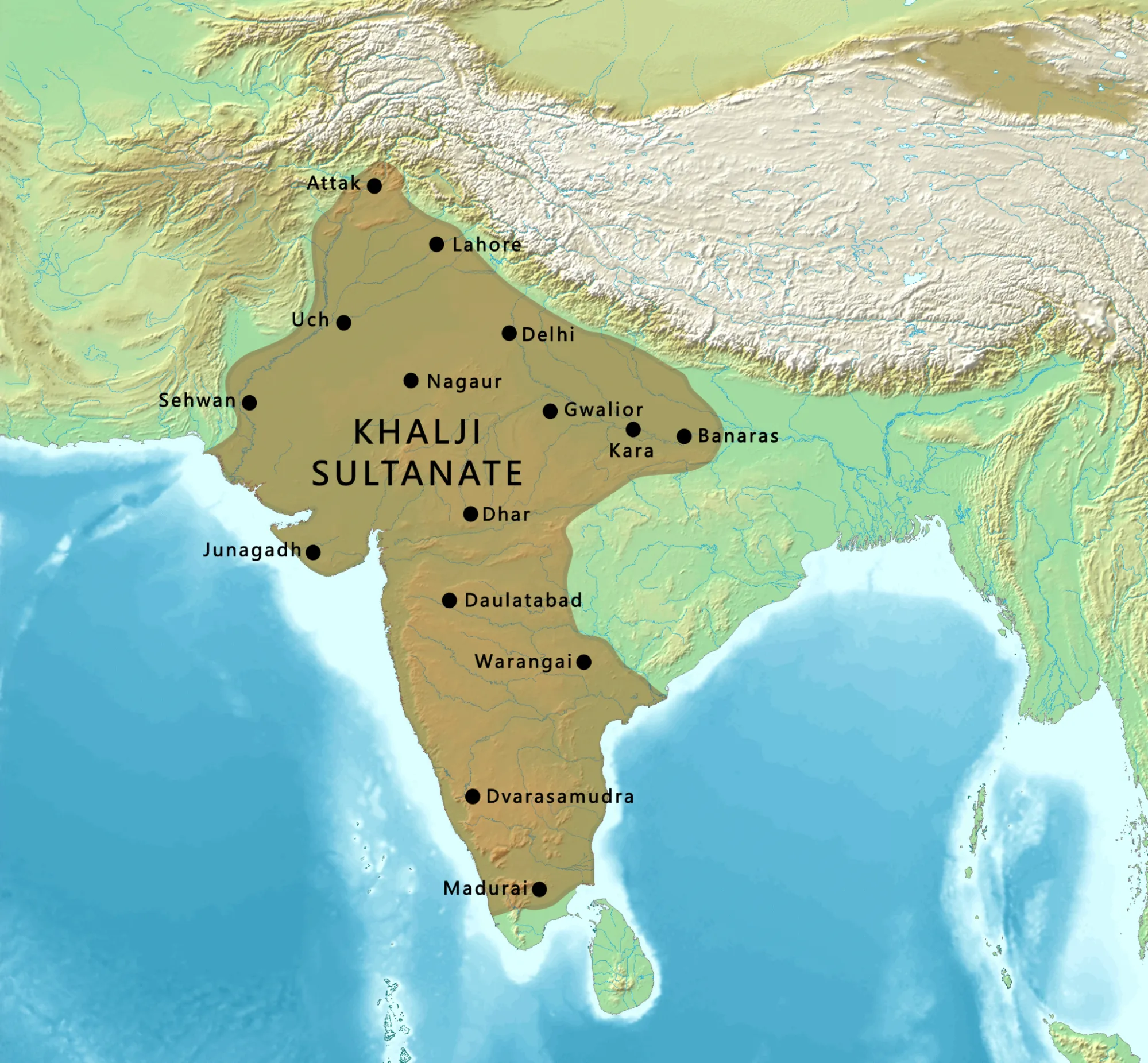
Khilji Dynasty Map
The Khilji Dynasty’s core territories covered Delhi, Punjab, Haryana, Rajasthan, Gujarat and parts of central India, including Malwa. The expansion strengthened Delhi’s control over much of northern and western India.
- Alauddin Khilji’s campaigns under Malik Kafur extended Khilji influence into the Deccan and southern India, reaching Devagiri, Warangal, Dwarasamudra and Madurai.
- However, most southern kingdoms were tributary states rather than directly administered territories, making the Khilji Empire more extensive in influence than in direct territorial control.


Khilji Dynasty Rulers List
The Khilji Dynasty marked a major phase of expansion in the Delhi Sultanate, with Alauddin Khilji transforming it into a powerful empire through military conquests, administrative measures, and economic reforms.
|
Ruler |
Reign |
Key Features |
|
Jalaluddin Khilji |
1290–1296 |
- Founded the Khilji Dynasty, overthrowing the Mamluks in 1290 C.E. - He halted Mongol invasions (1292) and sent embassies to Delhi. Amir Khusrau commemorated his victories in Miftah al-Futuh. |
|
Alauddin Khilji |
1296–1316 |
Greatest Khilji ruler; expanded the empire; introduced market controls, revenue reforms and military reforms; successfully resisted Mongol invasions. |
|
Shihabuddin Umar |
1316 |
Minor son of Alauddin; ruled briefly under the influence of Malik Kafur. |
|
Qutbuddin Mubarak Shah |
1316–1320 |
Ended many of Alauddin's strict regulations; faced political instability and rebellions. |
|
Khusrau Khan |
1320 |
Overthrew Mubarak Shah; his brief rule ended with his defeat by Ghiyasuddin Tughlaq, marking the end of the Khilji Dynasty. |
Khilji Dynasty Alauddin Khilji
Alauddin Khilji, the most powerful ruler of the Khilji Dynasty, ascended the throne in 1296 C.E. after assassinating his uncle, Jalaluddin Khilji. His reign was marked by military conquests, administrative reforms, and economic regulations.
- Mongol Invasions: Successfully repelled multiple Mongol invasions, strengthening Delhi’s defence.
- Revenue Reforms: Increased land tax, confiscated jagirs of nobles, and centralised administration to weaken aristocratic power.
- Abolition of Iqta System: Restricted hereditary land grants, ensuring greater control over revenue collection.
- Policy of State Control: Banned wine and social gatherings to curb rebellions and maintain discipline among the nobles.
Military Reforms
Alauddin was the first Sultan to establish a large permanent standing army, which he paid for with cash from the royal treasury. He established an innovative Chehra and Dagh System, in which the Chehra (full description of each soldier) and Dagh (Horse branding) were preserved.
Expansionist Policy
Alauddin Khilji (1296–1316 CE) pursued an aggressive expansionist policy to strengthen the Delhi Sultanate and secure wealth, tribute, and strategic territories. His campaigns can broadly be divided into northern/western conquests and Deccan–southern expeditions.
- Gujarat (1299): Led by Ulugh Khan and Nusrat Khan; Gujarat was conquered, and considerable wealth was acquired. Malik Kafur was captured during this campaign and later became Alauddin's leading general.
- Devagiri (1307–08): Malik Kafur led the expedition against the Yadava ruler Ramachandra. Devagiri accepted Delhi's supremacy and became an important base for further southern campaigns.
- Warangal (1309–10): Malik Kafur invaded the Kakatiya Dynasty under Prataparudra II. Warangal submitted and agreed to pay tribute.
- Dwarasamudra (1310): Malik Kafur defeated the Hoysala Dynasty ruler Ballala III, who accepted Delhi's authority and paid tribute.
- Madurai (1311): Malik Kafur marched into the Pandya kingdom, exploiting the succession conflict between Sundara Pandya and Vira Pandya. The expedition brought substantial wealth to Delhi.
Market Reforms
Market reforms by Alauddin Khilji were aimed at maintaining a large army; he, therefore, lowered and fixed the price of the commodities of daily use. Alauddin introduced strict price control measures, set up separate markets for grains, cloth, and horses, and regulated trade under the supervision of Shahna-i-Mandi.
- Three Markets in Delhi: Alauddin Khilji established separate markets for different commodities to control prices:
- Grain Market (Mandi)
- Cloth Market (Sarai Adl)
- Market for Horses, Slaves, and Cattle.
- Market Regulation: A superintendent (Shahna-i-Mandi) was appointed, assisted by an intelligence officer to enforce price control.
- Surveillance System: Daily reports were received from Barid (intelligence officers) and Munhiyans (secret spies) to ensure compliance.
- Diwan-i-Riyasat: A separate department under Naib-i-Riyasat was created to regulate merchants, all of whom were registered.
- Horse Market Control: Horse dealers and brokers (Dalals) were prohibited from purchasing horses in Delhi to maintain low prices.
Khilji Dynasty Art and Architecture
Art and Architecture of the Khilji Dynasty left a lasting impact on Delhi's architectural landscape, blending Indo-Islamic and Persian influences. Their structures reflected both grandeur and strategic utility, emphasising fortifications, mosques, water reservoirs, and gateways.
Siri
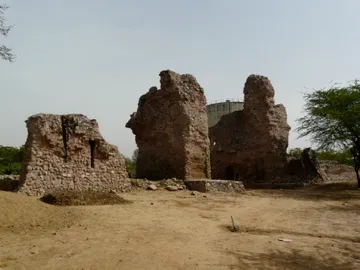
Siri, built around 1303 C.E., was the second of Delhi’s seven medieval cities. A prosperous and flourishing urban centre, it housed royal palaces, bustling markets, and remarkable buildings. The most famous among them was Qasr-i-Hazar Satur, Alauddin Khilji’s palace, known for its impressive number of pillars.
Alai Minar
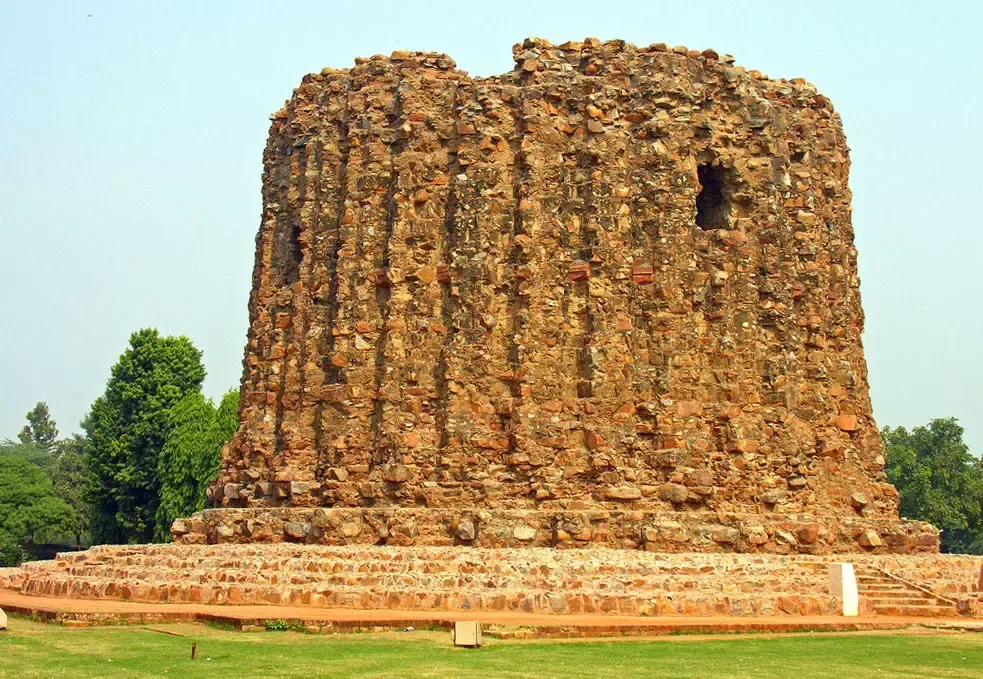
Alai Minar (Delhi), located within the northern boundaries of the Qutub complex, was commissioned by Alauddin Khilji in 1311 C.E. with the ambitious plan of constructing a minar twice the height of the Qutub Minar. However, the construction came to a halt after the Sultan died in 1316 C.E., leaving only the first storey completed. Today, the structure remains as the unfinished Alai Minar, a towering mound of rubble masonry, reflecting the unfulfilled vision of its creator.
Alai Darwaza
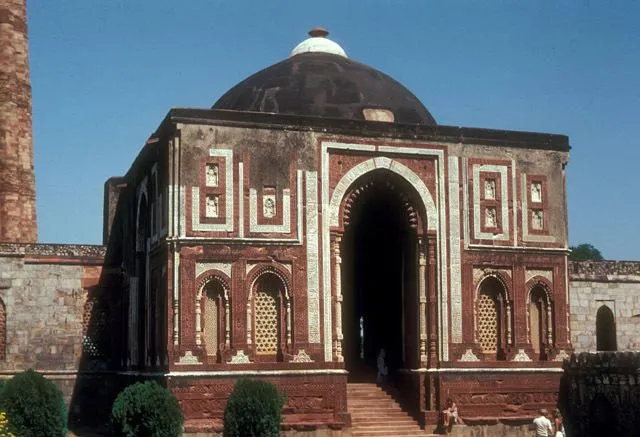
Alai Darwaza in Delhi is an exquisite example of Indo-Persian architecture, constructed using red sandstone and marble. Built as the primary gateway for the ambitious expansion of the Quwwat-ul-Islam Mosque, it stands on a high plinth with a cubical structure.
- The gateway features a broad, bulging dome with a central knob, resting on distinctive horse-shoe-shaped arches.
- While the dome itself remains unadorned, the rest of the structure is intricately carved with geometric patterns and artistic Arabic inscriptions, showcasing the remarkable craftsmanship of the era.
Jamaat-Khana Mosque
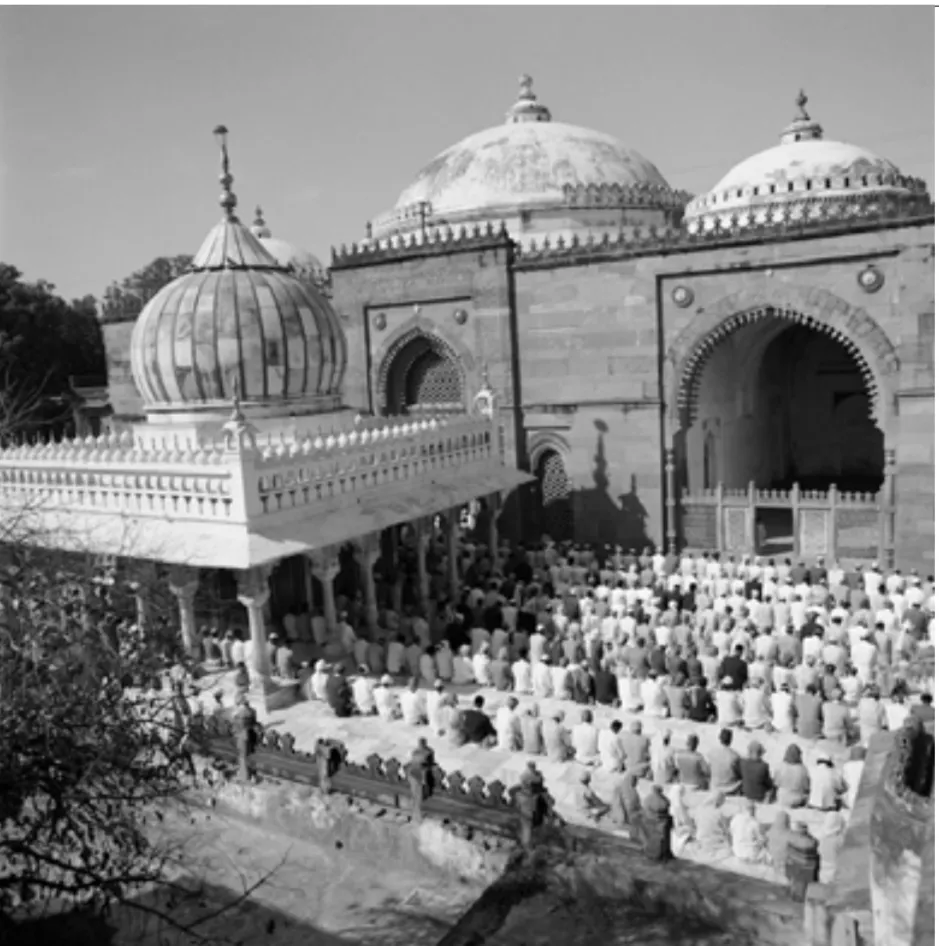
Jamaat-Khana Mosque in Delhi was built by Khizr Khan, son of Alauddin Khilji, and is one of the earliest mosques designed entirely on Islamic principles.
- Located west of Saint Nizamuddin Auliya’s tomb, it features three adjoining compartments, each with a broad arched entrance on its six facades.
- The original structure, made of red sandstone, was later expanded by the Tughlaqs using plastered rubble.
- Its walls are beautifully adorned with geometric motifs and Quranic inscriptions, reflecting the artistic finesse of the period.
Hauz-i-Alai
Built in 1305 C.E., Hauz-i-Alai (Delhi) was a large water tank in the city of Siri, enclosed by masonry walls and spanning 70 acres. Filled with rainwater during the monsoon, it served as a vital water source for the city's inhabitants.
Madrasa and Tomb of Alauddin Khilji
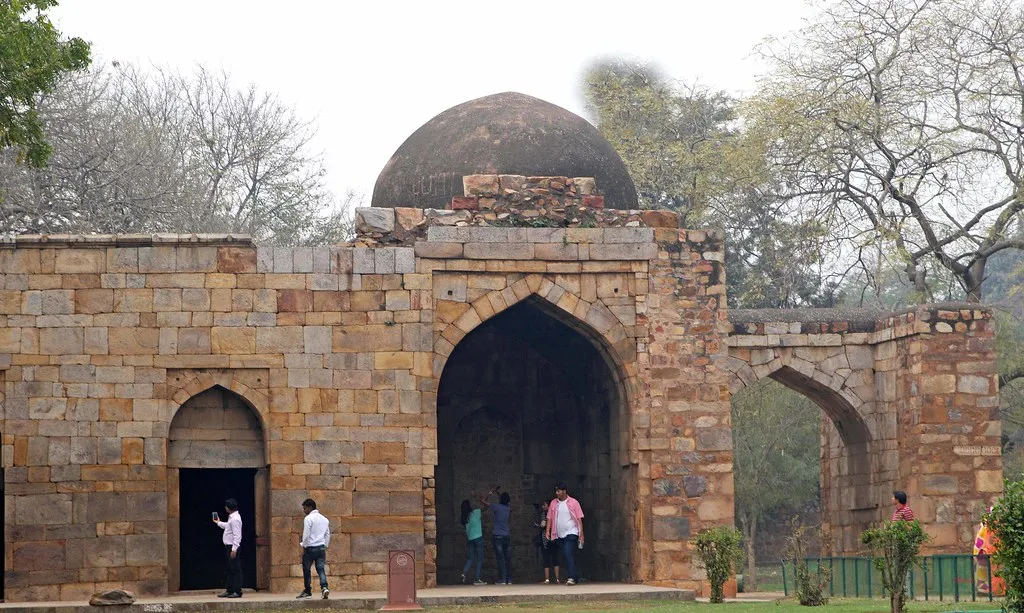
Built in 1315 C.E., the tomb of Alauddin Khilji was uniquely integrated within the Madrasa (Delhi), marking the first instance in India where a tomb and Madrasa (school) were combined. Inspired by the Saljuqian traditions of the 11th–12th century C.E., the structure was designed in an L-shape around a quadrangular courtyard, showcasing an innovative architectural approach of its time.
Khilji Dynasty Last Ruler and Decline
The Khilji Dynasty, which reached its peak under Alauddin Khilji, declined rapidly after he died in 1316 C.E. due to weak successors, internal strife, and court conspiracies.
- Death of Alauddin Khilji (1316 C.E.): His passing led to instability, as his trusted general, Malik Kafur, briefly took control but was soon overthrown.
- Short-lived Successors: Qutbuddin Mubarak Shah ascended the throne but faced rebellions in Deogir, which he harshly suppressed. However, he was later murdered, leading to further turmoil.
- Khusro Khan’s Rule: After killing Mubarak Shah, Khusro Khan, the last ruler of Khilji dynasty, took power but faced resistance from discontented nobles.
- Tughlaq Takeover (1320 C.E.): Ghiyasuddin Tughlaq led a revolt, defeated Khusro Khan in battle, and established the Tughlaq Dynasty, marking the end of Khilji rule just four years after Alauddin’s death.
Khilji Dynasty UPSC PYQs
Q1: Examine critically the agrarian and economic reforms of Alauddin Khalji. How did it strengthen the Sultanate? (UPSC Mains 2011)
Q2: With reference to Indian history, consider the following statements: (UPSC Prelims 2022)
- The first Mongol invasion of India happened during the reign of Jalal-ud-din Khalji.
- During the reign of Ala-ud-din Khalji, one Mongol assault marched up to Delhi and besieged the city.
- Muhammad-bin-Tughlaq temporarily lost portions of the north-west of his kingdom to Mongols.
Which of the statements given above is/are correct?
- 1 and 2
- 2 only
- 1 and 3
- 3 only
Ans: (b)

 Last updated on Oct, 2026
→ UPSC 2027 Notification will be released on 13 January 2027 at upsconline.nic.in.
→ Check Nobel Prize 2026 Winners List here.
→ Download PIB PRiSM Monthly Magazine 2026 here.
→ Check UPSC Monthly Current Affairs Magazine The Recitals here.
→ Check out the latest UPSC Syllabus here.
→ Download UPSC Model Answers for Mains 2026
→ UPSC Mains Question Paper 2026 is out now for Essay & GS Paper 1, 2, 3 & 4.
→ UPSC Calendar 2027 has been released.
→ Enroll in Vajiram & Ravi’s UPSC Mains Test Series 2027 for structured answer writing practice, expert evaluation, and exam-oriented feedback.
→ Join Vajiram & Ravi’s UPSC Mentorship Program 2027 for personalized guidance, strategy planning, and one-to-one support from experienced mentors.
→ Go through the UPSC Mains Previous Year Papers to enhance your preparation.
→ UPSC has released UPSC Toppers List 2025 with the Civil Services final result on its official website.
→ Also check Best UPSC Coaching in India
Khilji Dynasty FAQs
Q1. Who was the founder of the Khilji dynasty?+
Q2. Who defeated the Khilji dynasty?+
Q3. Who came first, Khilji or Akbar?+
Q4. Did Alauddin Khilji defeat the Mongols?+
Q5. Is Khilji related to Aurangzeb?+
Tags: khilji dynasty quest UPSC Medieval History Notes