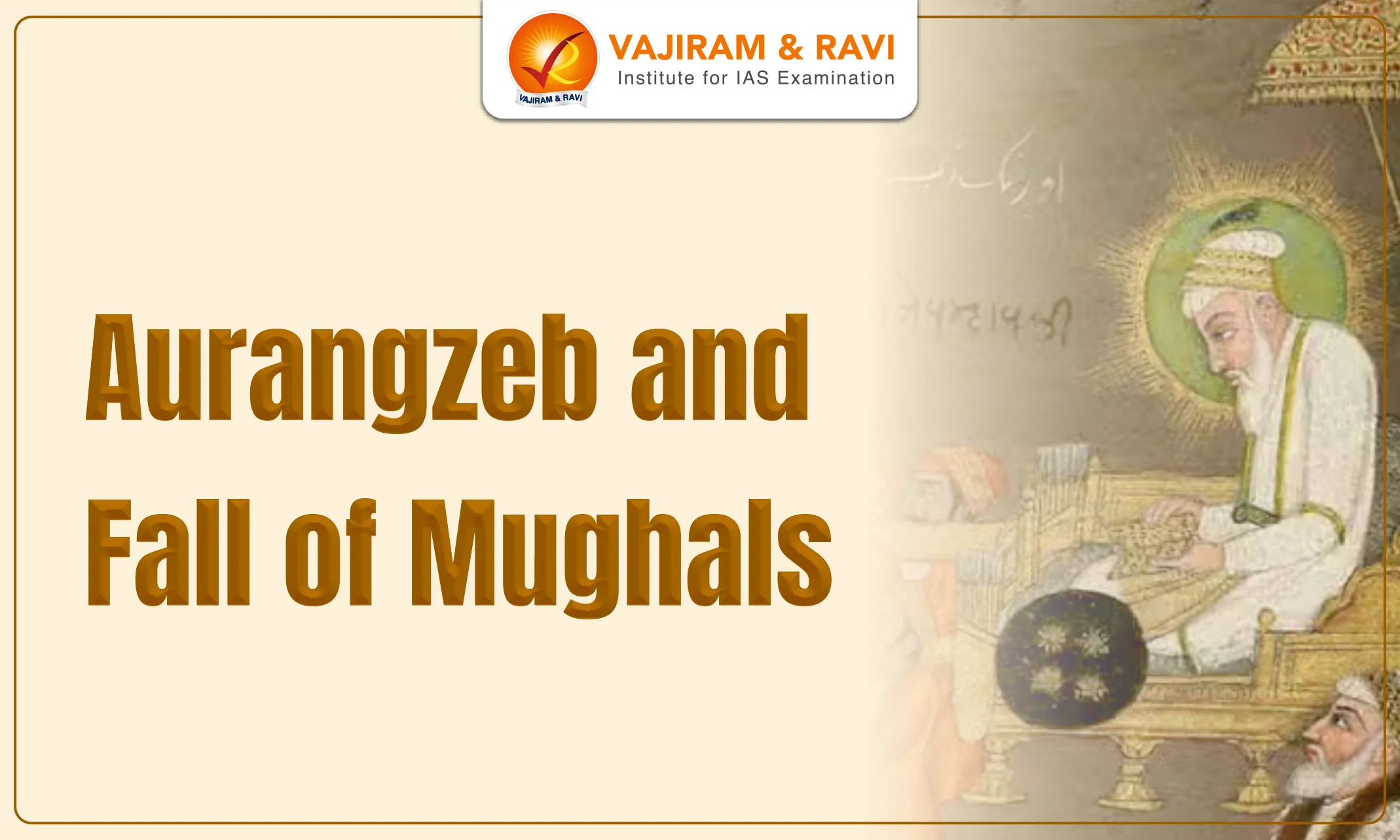
Aurangzeb Alamgir was the sixth Mughal emperor and one of the most powerful rulers of medieval India. He ruled from 1658 to 1707 and expanded the Mughal Empire to its greatest territorial extent. His reign was marked by extensive military campaigns, particularly in the Deccan, administrative changes, conflicts with the Marathas and Rajputs, and a more orthodox approach to Islamic law and governance.
Hiss reign is also closely associated with the beginning of the long-term decline of the Mughal Empire. However, historians generally view the decline as a result of multiple political, economic, military and administrative factors, rather than attributing it entirely to one ruler or one policy.
Mughal King Aurangzeb
Aurangzeb Alamgir (World Conqueror), whose original name was Muhi-ud-Din Muhammad, was the third son of Shah Jahan and Mumtaz Mahal. He ascended the throne in 1658 after eliminating all competitors, including Dara Shukoh, Shuja, and Murad, in a war of succession.
- Aurangzeb Born: He was born on 24 October 1618 at Dahod, then in the Mughal Empire.
- Aurangzeb Father: His father was Shah Jahan, the fifth Mughal emperor and builder of the Taj Mahal. Shah Jahan ruled from 1628 to 1658.
- Sons of Aurangzeb: He had several children, including Muhammad Sultan, Muazzam (Emperor Bahadur Shah I), Muhammad Azam Shah and Muhammad Akbar. The succession dispute among his sons after his death further weakened the Mughal political system.
- Aurangzeb Died: He died on 3 March 1707 at Ahmednagar in the Deccan, after a reign of nearly 50 years. He was buried at Khuldabad, near Aurangabad, in a simple open-air tomb according to his wishes.
- Aurangzeb Tomb: The Aurangzeb tomb is located at Khuldabad in Maharashtra. Unlike the grand Mughal mausoleums of earlier emperors, Aurangzeb's grave is notably simple.
Aurangzeb’s Reign
His reign of fifty years can be divided into two equal parts. During the first twenty-five years, he resided in the north, primarily in Delhi, and personally handled the affairs of northern India while delegating control of the Deccan to his viceroys. Around 1681, prompted by the rebellion of his son, Prince Akbar, he went to the Deccan. He never returned to Delhi and died disheartened in Ahmadnagar in 1707.
Aurangzeb's Conquests
Aurangzeb pursued an expansionist policy throughout his reign. His military campaigns eventually made the Mughal Empire territorially larger than at any previous point. His major conquests included the following:
- War of Succession: In the Battle of Samugarh, he defeated his eldest brother and primary rival, Dara Shikoh, in May 1658. He imprisoned his father Shah Jahan in the Agra Fort, eliminated his brothers Shah Shuja and Murad Bakhsh, and crowned himself Alamgir ("Conqueror of the World") in Delhi.
- Subjugation of Palamau: The Mughal forces invaded the Chero kingdom of Palamau (modern Jharkhand) in 1661, forcing the local ruler to accept Mughal suzerainty.
- Conquest of Chittagong: In 1666, Mughal forces under Shaista Khan defeated Arakanese pirates, capturing Chittagong and renaming it Islamabad, securing the eastern Bengal frontier.
- Deccan Sultanates: Aurangzeb conquered the two major Deccan Sultanates: Bijapur in 1686 and Golconda in 1687. Their annexation brought large parts of the Deccan under direct Mughal control.
- Maratha Conflict: The Marathas remained the major obstacle to Mughal consolidation in the Deccan. Aurangzeb fought Shivaji and later his successors, including Sambhaji and Rajaram.
- Although the Mughals captured important forts and territories, Maratha resistance continued through guerrilla warfare.
Revolts During Aurangzeb
During Aurangzeb's reign (1658–1707), the Mughal Empire faced numerous widespread revolts driven by religious orthodoxy, heavy taxation, and aggressive centralisation.
- Maratha Resistance: Led by Shivaji and his successors, the Marathas waged a long-running guerrilla war in the Deccan, draining Mughal resources until Aurangzeb died.
- Jat Uprisings: Beginning in 1669, peasants and local leaders such as Gokla and Rajaram rebelled around Mathura and Agra against exorbitant land revenue and oppressive rule.
- Sikh Conflicts: Tensions rose dramatically after Aurangzeb ordered the killing of the ninth Sikh Guru, Guru Tegh Bahadur, in 1675, sparking organised armed opposition led by Guru Gobind Singh.
- Satnami Revolt: Following a local clash with Mughal soldiers in 1672, a sect of lower-caste Hindus and peasants took up arms at Narnaul, briefly establishing their own local administration before being suppressed.
- Rajput Rebellions: Interference in the succession of Marwar following Jaswant Singh's death prompted a long, destructive fight between the Rathores of Marwar and Mewar.
- North-Western & Tribal Revolts: Afghan tribes, including the Yusufzai Pashtuns, revolted against imperial frontier policies, closing vital trade routes like the Attock-Kabul road.
- The Ahoms in Assam also decisively defeated Mughal forces at the Battle of Saraighat in 1671


Aurangzeb’s Religious Policy
Aurangzeb's religious policy was characterised by his strong commitment to orthodox Sunni Islam and his attempts to enforce Islamic law and customs throughout the Mughal Empire.
- Islamic Orthodoxy: Aurangzeb was profoundly religious and sought to uphold what he considered a puritanical interpretation of Sunni Islam.
- He emphasised enforcing Islamic law and promoted religious scholars who supported his conservative views.
- He was known for his piety and observed strict religious practices.
- Imposition of Jizya: This tax was reinstated during his reign and was considered discriminatory against Hindus and other religious minorities.
- Persecution of Religious Leaders: He executed Guru Tegh Bahadur (the ninth Sikh Guru) when he refused to convert to Islam. This religious persecution contributed to the subsequent Sikh rebellion against Mughal rule.
Aurangzeb’s Deccan Policy
Aurangzeb's Deccan policy aimed to extend Mughal control over the Deccan Sultanates, particularly Bijapur and Golconda, and bring them under direct Mughal rule. Aurangzeb saw the Deccan as a crucial region, both politically and economically.
- Annexation of Bijapur and Golconda: He launched military campaigns and besieged these Sultanates for several years. Eventually, in 1686, he successfully captured Bijapur, followed by the fall of Golconda in 1687, bringing them under Mughal rule.
- Maratha Resistance: Under leaders like Shivaji and later his son Sambhaji, the Marathas resisted Aurangzeb's expansionist plans and forced him to divert significant resources to counter their activities.
- Economic Drain: Aurangzeb's prolonged military campaigns in the Deccan significantly drained the empire's resources. The cost of maintaining a large army and administering the newly acquired territories put a strain on the Mughal treasury.
- Impact on Stability: Aurangzeb's focus on the Deccan campaigns diverted attention from other parts of the empire, leading to the neglect of governance in regions like Bengal and Punjab.
- The prolonged military engagements, coupled with the suppression of local rulers and communities, eventually contributed to the decline of the Mughal Empire after Aurangzeb's death.
Role of Aurangzeb’s Policies in the Fall of the Mughal Empire
Aurangzeb's reign is often associated with the decline of the Mughal Empire due to several factors. While multiple factors influenced it, Aurangzeb's policies and actions played a significant role.
- Religious Policies: He implemented measures favouring Islam over other religions, such as imposing jizya (tax on non-Muslims).
- This policy alienated non-Muslim subjects, leading to widespread discontent and resistance.
- Deccan Campaigns: The Deccan wars drained the treasury, stretched the military, and diverted attention from other pressing issues within the empire. The prolonged conflicts in the south weakened the central authority and exacerbated regional tensions.
- Financial Mismanagement: He faced financial difficulties due to increased military spending, a lack of revenue reforms, and inadequate revenue collection mechanisms.
- The empire faced a persistent fiscal crisis, leading to inflation, economic instability, and the inability to sustain its vast territorial holdings.
- Rebellion and Regional Fragmentation: The Jats, Sikhs, Rajputs, and Marathas, among others, challenged Mughal authority and sought to establish their own independent kingdoms.
- These rebellions drained the empire's resources, weakened its control over provinces, and contributed to the fragmentation of the empire.
- Administrative Centralisation: His strong centralisation of power and autocratic rule led to administrative inefficiencies.
- This centralised approach hindered the empire's ability to respond to local challenges and led to an increased administrative burden.
- Succession Crisis: His long reign and the tensions caused by his policies resulted in a succession crisis after his death.
- The subsequent Mughal rulers were often weak and inexperienced and faced challenges from rival claimants to the throne.
Decline of Mughal Empire
The Mughal Empire experienced a significant decline in power and prestige, leading to the emergence of independent principalities and the decline and disappearance of the Mughal Empire.
Shifting allegiance of Zamindars
The Zamindars played a crucial role in the empire as they assisted in revenue collection and local administration, maintaining their soldiers.
- Powerful Zamindars: Although the Mughals attempted to limit the power of the Zamindars and establish direct contact with the peasants, they were only partially successful in their endeavours.
- Support for Nobles: Many local zamindars supported the nobility, the other powerful class within the empire, in exploiting the weakened state of the empire to establish independent kingdoms for themselves.
Jagirdari Crisis
The nobility in the Mughal Empire consisted of individuals who held large jagirs (land assignments) and mansabs (ranks) or were appointed as subahdars (governors) of Mughal provinces, with the responsibility of maintaining them.
- Factions of Nobles: Despite the well-organized structure provided by Akbar, divisiveness within the nobility emerged based on factors such as religion, homeland, and tribe, leading to the formation of distinct groups.
- Undermined the central power: During the later Mughal period, in the absence of strong central leadership, mutual rivalry, jealousy, and power struggles among these various groups undermined the emperor's prestige and contributed to the empire's decline.
Rise of regional aspirations
During his reign, powerful regional groups such as the Jats, Sikhs, and Marathas emerged and challenged the authority of the Mughal state in their pursuit of establishing their own kingdoms.
- Persistent struggle: Their continuous struggle against the Mughal Empire for political dominance weakened the empire.
- Rajputs: Aurangzeb's policies, particularly his attempts to suppress the Rajputs, inadvertently provoked them to rise against the Mughals.
- Marathas:
- The Marathas emerged as a formidable enemy, with their initial goal being the regain control over the region of Maharashtra.
- However, their ambitions quickly expanded, and they sought legal sanction from the Mughal emperor to collect Sardeshmukhi (levy on land) and Chauth (tribute) throughout India.
- They expanded their influence northwards and, by 1740, had successfully extended their power over the provinces of Gujarat, Malwa, and Bundelkhand.
Political and administrative problems
Over time, the number of amirs (nobles) in the Mughal Empire increased significantly, resulting in a scarcity of land available to be distributed among them as jagirs (land assignments).
- Aurangzeb inflated the recorded income from the jagirs to address the acute shortage of jagirs.
- This proved to be a short-sighted solution as the amirs, in turn, pressured the peasantry to recover the inflated income from their jagirs.
- Consequently, both the amirs and the peasantry became antagonised.
- Lagged development in Science and Technology: Moreover, there were no significant scientific or technological advancements that could have propelled the stagnant economy forward.
- Failure to reap trade benefits: Despite the growth of trade, particularly with the increasing presence of European traders along the coastal regions of India, the empire did not benefit significantly from this flourishing trade.
- Death of Aurangzeb: Following the death of Aurangzeb, these economic and administrative problems only multiplied. The empire had become too vast to be efficiently governed under a centralised system, especially during periods of weak and incompetent rulers.

 Last updated on Oct, 2026
→ UPSC 2027 Notification will be released on 13 January 2027 at upsconline.nic.in.
→ Check Nobel Prize 2026 Winners List here.
→ Download PIB PRiSM Monthly Magazine 2026 here.
→ Check UPSC Monthly Current Affairs Magazine The Recitals here.
→ Check out the latest UPSC Syllabus here.
→ Download UPSC Model Answers for Mains 2026
→ UPSC Mains Question Paper 2026 is out now for Essay & GS Paper 1, 2, 3 & 4.
→ UPSC Calendar 2027 has been released.
→ Enroll in Vajiram & Ravi’s UPSC Mains Test Series 2027 for structured answer writing practice, expert evaluation, and exam-oriented feedback.
→ Join Vajiram & Ravi’s UPSC Mentorship Program 2027 for personalized guidance, strategy planning, and one-to-one support from experienced mentors.
→ Go through the UPSC Mains Previous Year Papers to enhance your preparation.
→ UPSC has released UPSC Toppers List 2025 with the Civil Services final result on its official website.
→ Also check Best UPSC Coaching in India
Aurangzeb FAQs
Q1. What is Aurangzeb most famous for?+
Q2. Does Shivaji defeat Aurangzeb?+
Q3. Who is stronger, Akbar or Aurangzeb?+
Q4. Who died first, Aurangzeb or Shivaji?+
Q5. How cruel was Aurangzeb?+
Tags: aurangzeb quest UPSC Medieval History Notes