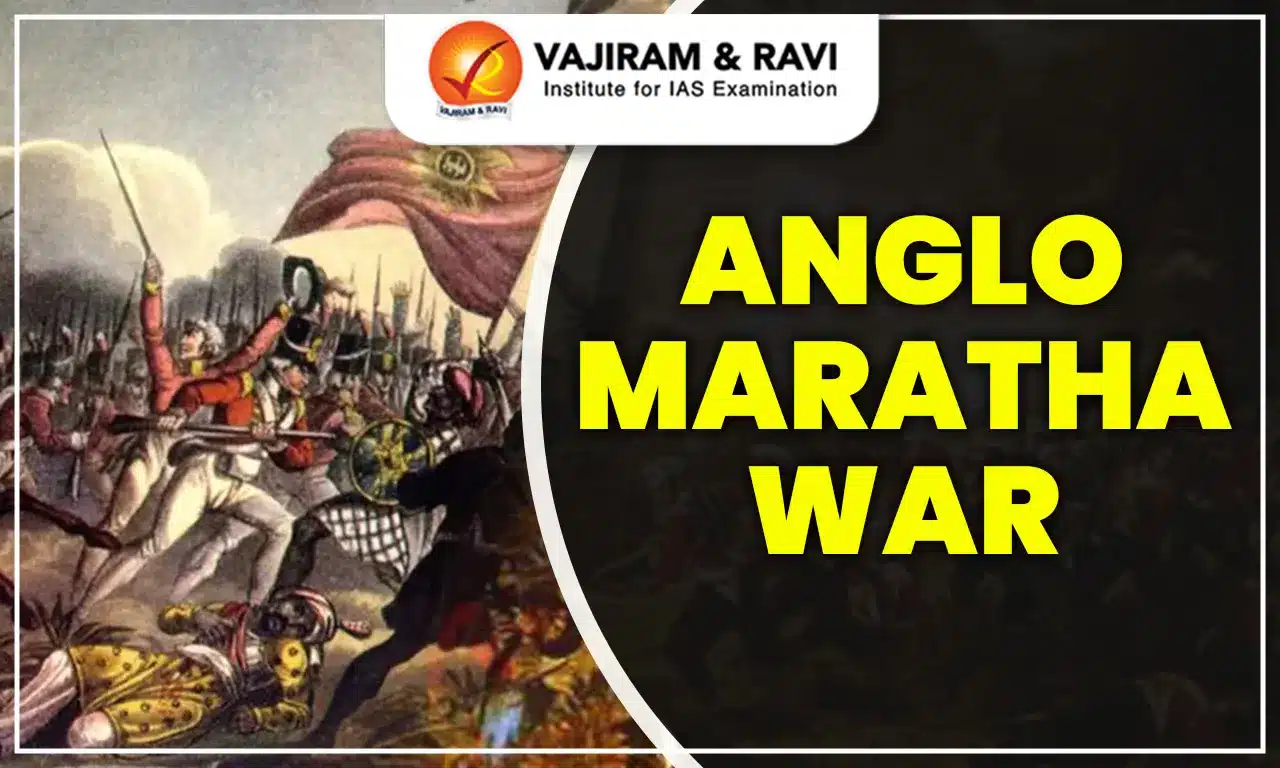
Anglo Maratha Wars, fought between the late 18th and early 19th centuries, were pivotal in shaping India’s political future. The Marathas, once a powerful force, were weakened by internal divisions and the aftermath of their defeat at the Third Battle of Panipat in 1761. Although they had controlled vast territories and played a central role in the subcontinent’s power dynamics, their decline allowed the British East India Company to expand its influence.
As the wars unfolded, marked by shifting alliances and strategic manoeuvres, the Marathas struggled to regain their strength. Despite some temporary victories, the British emerged victorious, leading to the collapse of the Maratha Empire and the rise of British dominance, ushering in a new colonial era.
Anglo Maratha Wars Background
The Anglo Maratha Wars were a series of three conflicts fought between the British East India Company and the Maratha Empire in the late 18th and early 19th centuries, significantly shaping India's history. As the Mughal Empire declined, the Marathas emerged as one of the most powerful forces in India, controlling vast territories and receiving tributes from areas beyond their control.
- Defeat of Maratha Empire: Following their defeat in the Third Battle of Panipat in 1761, the Maratha Empire fractured, with internal power struggles and succession disputes weakening their unity.
- British Exploit Disarray: The English, seeking to expand their influence, found an opportunity in this disarray.
- Internal Divisions: The Maratha confederacy, despite occasional unity, was divided over leadership and direction, allowing the British to capitalise on these divisions.
- Consolidation of British Power: The wars were fuelled by the British desire to establish control over key regions, particularly in western India, leading to the eventual defeat of the Marathas and the consolidation of British power across much of India.
Rise of Peshwa
The rise of the Peshwa in the 18th century transformed the Maratha Empire, with the Peshwa evolving from prime minister to de facto ruler. Derived from the Persian pēshwā ("leader"), the title was first used in the Bahmani Kingdom. Chhatrapati Shivaji Maharaj formalised the role in 1674 by appointing Moropant Trimbak Pingle as the first Peshwa. Under Chhatrapati Shahu, the position became hereditary, gaining substantial political power.
- Balaji Vishwanath (1713-1720): The first hereditary Peshwa, he secured Shahu’s rule and Mughal recognition, marking the shift of power from the Chhatrapati to the Peshwa.
- Bajirao I (1720-1740): He is considered the greatest of all the Peshwas; he started a confederacy of prominent Maratha chiefs to manage the rapidly expanding Maratha power and, to some extent, appease the Kshatriya section of the Marathas led by the Senapati Dabodi.
- Maratha Confederacy: Under the arrangement of the Maratha Confederacy, each prominent family under a chief was assigned a sphere of influence which he was supposed to conquer and rule, but in the name of the then Maratha king, Shahu.
- Families of the Confederacy: The prominent Maratha families that emerged were: (i) the Gaekwad of Baroda, (ii) the Bhonsle of Nagpur, (iii) the Holkars of Indore, (iv) the Sindhias of Gwalior, and (v) the Peshwa of Poona.
- Defeat at Panipat: After their defeat in the Third Battle of Panipat in 1761, the Marathas regrouped, regained their strength, and within a decade, achieved a position of power in India.
- Peshwaship Weakened: The defeat at Panipat, and later the death of the young Peshwa, Madhavrao I, in 1772, weakened the control of the Peshwas over the confederacy.
- Even though the confederacy's chiefs occasionally worked together, as they did when fighting the British (1775–82), they quarrelled more frequently among themselves.
Entry of the British into Maratha Politics
The entry of the English into Maratha politics in the late 18th century was a strategic effort to exploit the internal divisions within the Maratha Confederacy. This calculated intervention set the stage for a series of conflicts between the Marathas and the British, culminating in three major clashes for political supremacy between the late 18th and early 19th centuries, with the English ultimately emerging victorious.
- Cause of the Conflicts: The inordinate ambition of the English and the divided house of the Marathas encouraged the English to hope for success in their venture.
- English Ambitions: The English in Bombay wanted to establish a government along the lines of the arrangement made by Clive in Bengal, Bihar, and Orissa.
- So it was a longed-for opportunity for the English when dissensions over succession divided the Marathas.
Anglo Maratha Wars List and Timeline
The Anglo Maratha Wars were three major conflicts fought between the Maratha Confederacy and the British East India Company for political and territorial control in India. The following is the list and timeline of Anglo Maratha Wars.
|
War |
Period |
Key Event |
Result |
|
First Anglo-Maratha War |
1775–1782 |
Treaty of Surat and prolonged conflict |
Marathas won; Treaty of Salbai (1782) |
|
Second Anglo-Maratha War |
1803–1805 |
British defeated major Maratha powers |
British victory; Maratha power weakened |
|
Third Anglo-Maratha War |
1817–1818 |
Final conflict against the Peshwa and other Maratha chiefs |
British victory; Peshwa's rule ended |


First Anglo Maratha War
The First Anglo Maratha War (1775-1782) marked the beginning of a prolonged and complex struggle between the British and the Marathas for supremacy in India. Sparked by internal Maratha power struggles and external British interventions, the conflict saw significant battles, strategic manoeuvring, and shifting alliances.
- The war ultimately concluded with the signing of the Treaty of Salbai in 1782, which temporarily restored peace and addressed key territorial and political issues between the two powers.
- Governor-General: During the First Anglo Maratha War, Warren Hastings (1773–1785) was the Governor-General of India.
First Anglo Maratha War Background
The First Anglo Maratha War was rooted in the power struggles following the death of Madhavrao I in 1772. Madhavrao’s brother, Narayanrao, succeeded him as the fifth Peshwa. However, his uncle, Raghunathrao, orchestrated Narayanrao’s assassination to claim the Peshwa position, despite not being the legal heir.
- Legal Heir: The situation changed when Narayanrao's widow, Gangabai, gave birth to a son, Sawai Madhavrao, who was the rightful successor.
- Barabhai Council: The Barabhai Council, led by Nana Phadnavis, was formed by twelve Maratha chiefs who declared the infant Sawai Madhavrao as the new Peshwa and assumed regency to govern on his behalf.
- Treaties of Surat: Raghunathrao, unwilling to give up his position in power, sought help from the English at Bombay and signed the Treaty of Surat in 1775.
- Under the treaty, Raghunathrao ceded the territories of Salsette and Bassein to the English, along with a portion of the revenues from the Surat and Bharuch districts.
- In return, the English were to provide Raghunathrao with 2,500 soldiers.
- Treaty of Purandar: The British Calcutta Council condemned the Treaty of Surat and sent Colonel Upton to Pune to annul it and make a new treaty (Treaty of Purandar, 1776) with the regency renouncing Raghunath and promising him a pension.
- The Bombay government rejected this and gave refuge to Raghunath.
- In 1777, Nana Phadnavis violated his treaty with the Calcutta Council by granting the French a port on the west coast.
- The English retaliated by sending a force towards Pune.
First Anglo-Maratha War Major Events
The First Anglo Maratha War witnessed intense battles between the Maratha and English armies, with strategic manoeuvres and military tactics shaping the course of the conflict.
- Maratha Army's Strategic Advantage: The English and Maratha armies met on the outskirts of Pune. Though the Maratha army had more soldiers than the English, the latter had superior ammunition and cannons.
- Role of Mahadji Sindhia: The Maratha army was commanded by a brilliant general, Mahadji Sindhia (Mahadji Shinde). He lured the English army into the ghats (mountain passes) near Talegaon, trapping the English from all sides and attacking their supply base at Khopali.
- Scorched Earth Policy: The Marathas utilised a scorched earth policy, burning farmland and poisoning wells to weaken the English forces.
- Retreat and Surrender: As the English began to withdraw to Talegaon, the Marathas attacked, forcing them to retreat to the village of Wadgaon. The English army was surrounded and cut off from food and water supplies.
- Treaty of Wadgaon: By mid-January 1779, the English surrendered and signed the Treaty of Wadgaon, which forced the Bombay government to relinquish all territories acquired by the English since 1775.
First Anglo Maratha War Treaty
The outcome of the First Anglo Maratha War culminated in the signing of the Treaty of Salbai in 1782, which brought a temporary peace between the Marathas and the British. The treaty addressed territorial disputes, military engagements, and alliances, while also reshaping the balance of power in the region.
- Treaty of Salbai (1782): Warren Hastings, the Governor-General in Bengal, rejected the Treaty of Wadgaon and sent a large force of soldiers under Colonel Goddard, who captured Ahmedabad in February 1779 and Bassein in December 1780.
- English Capture of Gwalior: Another Bengal detachment led by Captain Popham captured Gwalior in August 1780.
- Defeat of Sindhia at Sipri: In February 1781, the English, under General Camac, defeated Sindhia at Sipri.
- Proposal for Peace and Treaty Negotiation: Sindhia proposed a new treaty between the Peshwa and the English.
- Treaty of Salbai: The Treaty of Salbai was signed in May 1782, ratified by Hastings in June 1782, and by Phadnavis in February 1783. The following were the key provisions of the Treaty of Salbai:
- Salsette Retained: Salsette should continue in the possession of the English.
- Restoration of Territory: The whole of the territory conquered since the Treaty of Purandar (1776), including Bassein, should be restored to the Marathas.
- Territorial Rights in Gujarat: In Gujarat, Fateh Singh Gaekwad should remain in possession of the territory that he had before the war and should serve the Peshwa as before.
- Withdrawal of Support to Raghunathrao: The English should not offer any further support to Raghunathrao, and the Peshwa should grant him a maintenance allowance.
- Continued Trade Privileges: The English should enjoy the privileges of trade as before.
- Prohibition on Peshwa: The Peshwa should not support any other European nation.
- Peace Agreement: The Peshwa and the English should undertake that their several allies should remain at peace with one another.
- Guarantor of Treaty Terms: Mahadji Sindhia should be the mutual guarantor for the proper observance of the terms of the treaty.
Second Anglo Maratha War
The Second Anglo Maratha War (1803-05) was a crucial conflict in the Anglo Maratha relationship, emerging from internal strife within the Maratha Confederacy. Following the death of Peshwa Madhavrao Narayan and the rise of the ineffective Bajirao II, the Marathas became politically fragmented, offering the British an opportunity to intervene. This war marked the further decline of the Marathas' power, leading to their eventual vassalage under the British.
Second Anglo Maratha War Background
The Second Anglo Maratha War emerged from a power struggle within the Maratha Confederacy, reminiscent of the First Anglo Maratha War. After the death of Peshwa Madhavrao Narayan in 1795, his son Bajirao II, an ineffective ruler, ascended the throne, leading to political instability.
- Nana Phadnavis, a staunch rival of Bajirao II, had held significant power as the chief minister, but his death in 1800 deepened the internal divisions within the Maratha Confederacy, offering the British an advantageous opportunity to intervene.
- Governor-General: During the Second Anglo Maratha War, Lord Wellesley (1798–1805) was the Governor-General of India.
Second Anglo Maratha War Major Events
The course of the Second Anglo-Maratha War was marked by internal Maratha conflicts and English intervention.
- Murder of Vithuji and Conflict Escalation: On April 1, 1801, Peshwa Bajirao II murdered Vithuji, brother of Jaswantrao Holkar, which led to escalating tensions and conflict.
- Jaswant's Victory at Hadapsar: On October 25, 1802, Jaswantrao Holkar defeated the armies of Bajirao II and Sindhia at Hadapsar near Poona and installed Vinayakrao, son of Amritrao, as Peshwa.
- Bajirao II's Flight and Treaty: A terrified Bajirao II fled to Bassein, where, on December 31, 1802, he signed a treaty with the English.
- Treaty of Bassein (1802): Under the treaty, the Peshwa agreed:
- To receive from the Company a native infantry with the usual proportion of field artillery and European artillerymen attached to be permanently stationed in his territories.
- To cede to the Company territories yielding an income of Rs 26 lakh; to surrender the city of Surat.
- To give up all claims for Chauth on Nizam’s dominions.
- Not to keep in his employment Europeans of any nation at war with the English.
- To subject his relations with other states to the control of the English.
- Reduced to Vassalage: After the Peshwa accepted the subsidiary alliance, Sindhia and Bhonsle attempted to save Maratha independence.
- English Victory: The well-organized British army defeated the combined forces of Sindhia and Bhonsle, leading to separate subsidiary treaties.
- Jaswant Rao Holkar's Failed Coalition: Jaswant Rao Holkar's attempt to form a coalition of Indian rulers against the English in 1804 failed.
- Marathas Reduced to British Vassalage: The Marathas were defeated and isolated, becoming vassals of the British.
Second Anglo Maratha War Treaty
The Treaty of Bassein, signed by a weakened Peshwa, gave the British a strategic advantage by allowing them to station troops permanently in Maratha territories. This strengthened the British presence, with troops already in Mysore, Hyderabad, and Lucknow, and added Poona to their network, enabling quick deployment.
- Although the treaty didn’t grant complete control over India, it marked a major shift toward British dominance. It positioned the British to expand their influence and control over the Indian subcontinent.
Third Anglo Maratha War
The Third Anglo Maratha War (1817-1818) was the final and decisive conflict between the Maratha Empire and the British East India Company, marking the end of Maratha power in India. The war was triggered by internal Maratha divisions, British imperial ambitions, and the growing threat from the Pindaris, who were supported by the Marathas.
- The British emerged victorious, resulting in the dissolution of the Maratha Confederacy and the consolidation of British control over India.
- Governor-General: During the Third Anglo Maratha War, Lord Hastings (1813–1823) was the Governor-General of India.
Third Anglo Maratha War Background
The background of the Third Anglo Maratha War (1817-1818) was shaped by British imperial ambitions, internal Maratha struggles, and the growing threat posed by the Pindaris.
- Lord Hastings’ Imperialistic Design: Lord Hastings aimed to impose British paramountcy across India.
- End of East India Company’s Monopoly: The Charter Act of 1813 ended the Company’s monopoly on trade in China, increasing the need for new markets.
- Pindaris and Maratha Weakness: The Pindaris, once mercenaries for Maratha armies, began plundering due to the Marathas’ decline in power, targeting neighbouring territories including those of the Company.
- Marathas Accused of Sheltering the Pindaris: The British accused the Marathas of harbouring the Pindaris, leading to tensions.
- Pindari Leaders’ Surrender and Flight: Key Pindari leaders like Amir Khan and Karim Khan surrendered, while Chitu Khan escaped into the jungles.
- Wounding of Maratha Pride by Treaty of Bassein: The Treaty of Bassein (1802), seen as unfair and damaging to Maratha sovereignty, alienated many Maratha leaders.
- Unification of Maratha Confederacy: Lord Hastings’ actions against the Pindaris led to a resurgence of unity within the Maratha Confederacy.
- Bajirao II’s Last Bid: Bajirao II attempted to rally Maratha chiefs against the British in 1817, initiating the Third Anglo Maratha War.
Third Anglo Maratha War Major Events
The course of the Third Anglo Maratha War (1817-1818) saw a series of desperate attempts by the Marathas to reclaim power, but internal divisions and weakened leadership ultimately led to their defeat by the British.
- Peshwa and Appa Sahib's Attacks: The Peshwa attacked the British Residency at Poona, while Appa Sahib of Nagpur launched an attack on the residency at Nagpur.
- Internal Weakness within Maratha States: The Marathas had lost critical elements required for power, with disorganized and inefficient political and administrative conditions in all Maratha states.
- Decline of Key Maratha Leaders: The Bhonsle at Nagpur and Sindhia at Gwalior were weak, allowing the English to successfully prevent the Peshwa from regaining control over the Maratha Confederacy
Third Anglo Maratha War Treaty
The Third Anglo-Maratha War resulted in the final defeat of the Marathas, the dissolution of the Maratha Confederacy, and the establishment of British dominance in India.
- Defeat of Peshwa, Bhonsle, and Holkar: The Peshwa was defeated at Khirki, Bhonsle at Sitabuldi, and Holkar at Mahidpur.
- Treaties: Some important treaties were signed. Those were:
- Treaty of Poona, with the Peshwa, June 1817
- Treaty of Gwalior, with Sindhia, November 1817
- Treaty of Mandasor, with Holkar, January 1818
- Peshwa Surrendered: In June 1818, the Peshwa finally surrendered, and the Maratha Confederacy was dissolved. As a result, the Peshwaship was abolished.
- Peshwa as British Retainer: Peshwa Bajirao became a British retainer at Bithur near Kanpur.
- Formation of Satara under Pratap Singh: Pratap Singh, a lineal descendant of Shivaji, was made ruler of a small principality, Satara, formed out of the Peshwa’s dominions.
Anglo Maratha Wars and Treaties
|
Anglo-Maratha War |
Key Treaties |
|
First Anglo-Maratha War |
|
|
Second Anglo-Maratha War |
|
|
Third Anglo-Maratha War |
|
Anglo Maratha Wars Impact
The Third Anglo-Maratha War (1817–1818) was the final conflict between the British East India Company and the Maratha Confederacy, leading to complete British dominance over India. Its significance and impact can be understood from multiple angles:
- End of Maratha Power: The war resulted in the dissolution of the Maratha Confederacy, ending their centuries-old dominance in Indian politics.
- British Control Over India: The British East India Company emerged as the undisputed power in India, establishing control over most of the subcontinent.
- Annexation of Maratha Territories: Key Maratha territories, including Pune, Nagpur, and Gwalior, were annexed into British rule.
- Treaty of Mandeswar (1818): The treaty officially ended the war, reducing Maratha rulers to mere pensioners under British authority.
- Abolition of Peshwaship: The Peshwa, Baji Rao II, was exiled to Bithoor (near Kanpur) with a pension, and the office of Peshwa was abolished.
- Introduction of British Administration: British officials took direct control over former Maratha regions, expanding their administrative framework.
- Decline of Maratha Nobility: The traditional Maratha chieftains (Sardars) lost power, affecting local governance.

 Last updated on Oct, 2026
→ UPSC 2027 Notification will be released on 13 January 2027 at upsconline.nic.in.
→ Check Nobel Prize 2026 Winners List here.
→ Download PIB PRiSM Monthly Magazine 2026 here.
→ Check UPSC Monthly Current Affairs Magazine The Recitals here.
→ Check out the latest UPSC Syllabus here.
→ Download UPSC Model Answers for Mains 2026
→ UPSC Mains Question Paper 2026 is out now for Essay & GS Paper 1, 2, 3 & 4.
→ UPSC Calendar 2027 has been released.
→ Enroll in Vajiram & Ravi’s UPSC Mains Test Series 2027 for structured answer writing practice, expert evaluation, and exam-oriented feedback.
→ Join Vajiram & Ravi’s UPSC Mentorship Program 2027 for personalized guidance, strategy planning, and one-to-one support from experienced mentors.
→ Go through the UPSC Mains Previous Year Papers to enhance your preparation.
→ UPSC has released UPSC Toppers List 2025 with the Civil Services final result on its official website.
→ Also check Best UPSC Coaching in India
Anglo Maratha Wars FAQs
Q1. How many Anglo-Maratha Wars are there?+
Q2. Who fought the First Anglo-Maratha War?+
Q3. Who won the Third Anglo-Maratha War?+
Q4. Who won the First and Second Anglo-Maratha Wars?+
Q5. What is the Treaty of Purandar?+
Tags: anglo maratha wars quest upsc modern history notes