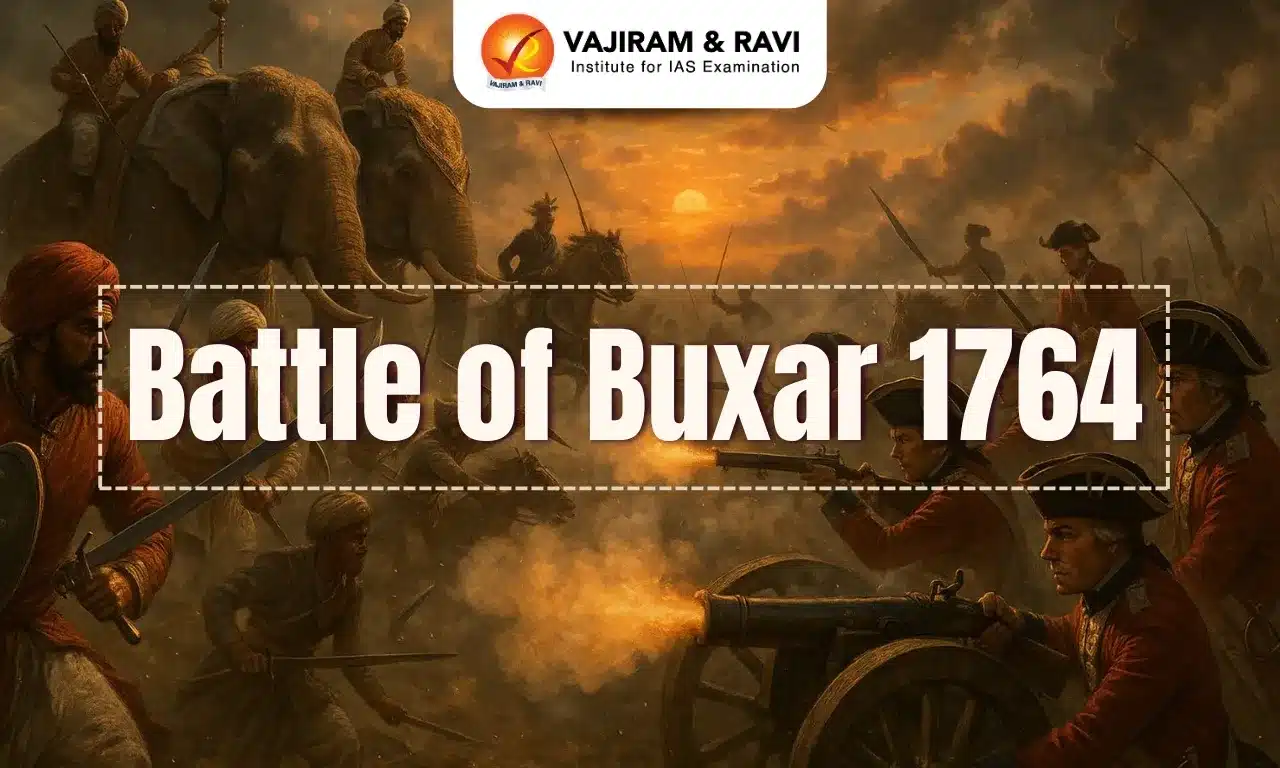
The Battle of Buxar (1764) was one of the most important battles in the history of British expansion in India. It established the military and political supremacy of the British East India Company in eastern India and paved the way for its control over the revenue administration of Bengal, Bihar and Orissa.
The Battle of Buxar was fought between the forces of the British East India Company and a combined army associated with Mir Qasim, Shuja-ud-Daula and Mughal Emperor Shah Alam II. The Company forces were commanded by Major Hector Munro. The battle ended in a decisive British victory. Unlike the Battle of Plassey, where political conspiracy and betrayal played a major role, Buxar was a major pitched military confrontation.
Battle of Buxar 1764 About
The Battle of Buxar was a major conflict between the British East India Company and a combined alliance of Indian rulers. It was fought near Buxar, in present-day Bihar, on the banks of the Ganga River.
- Battle of Buxar Date: The Battle of Buxar date was 22 October 1764. Some historical accounts describe military engagements around 22–23 October, but 22 October 1764 is generally accepted as the date of the decisive battle.
- Parties: The Battle of Buxar was fought between the British East India Company and the combined forces of three Indian powers: Mir Qasim, the former Nawab of Bengal; Shuja-ud-Daula, the Nawab of Awadh; and Shah Alam II, the Mughal Emperor.
- Rise of Company as a Military Power: The battle demonstrated that the Company was no longer merely a trading organisation. It had become a strong military and political power capable of defeating major Indian rulers and influencing the Mughal Empire.
Battle of Buxar Background
The background of the Battle of Buxar lies in the growing conflict between the East India Company and Mir Qasim, who had become Nawab of Bengal after Mir Jafar.
- The Company initially supported Mir Qasim because it expected him to protect its commercial privileges. However, Mir Qasim soon attempted to strengthen Bengal’s administration, increase state revenue, modernise his army, and reduce British interference.
- His independent policies brought him into direct conflict with the East India Company. The dispute gradually developed into a larger struggle involving Bengal, Awadh, and the Mughal Emperor.


Battle of Buxar Causes
The major causes of the Battle of Buxar were connected with the Company’s misuse of trade privileges and Mir Qasim’s efforts to defend the autonomy of Bengal.
- Mir Kasim’s Assertion: Ram Narayan, the deputy governor of Bihar, refused to submit the accounts of Bihar's revenues despite repeated requests from Mir Kasim. This open defiance of Mir Kasim's authority led to tensions.
- Furthermore, English officials in Patna supported Ram Narayan, exacerbating the situation.
- Misuse of Dastaks: The Company officials also misused their trade permits, known as dastaks, which exempted specified goods from paying duties.
- Thе misusе of dastaks rеsultеd in rеducеd tax rеvеnuе for Mir Kasim and unfair advantagеs for Company mеrchants ovеr local tradеrs.
- The Company had obtained the right to trade in Bengal without paying transit dues or tolls through a Mughal imperial farman.
- However, Company servants claimed the same privileges for their private trade and sold dastaks to Indian merchants for a commission.
- They also resorted to coercive methods to obtain goods at cheaper rates, which contradicted the spirit of duty-free trade.
- Abolition of Duties: Mir Kasim decided to abolish the duties altogether, but the British protested and demanded preferential treatment. Thе disputе ovеr transit dutiеs еscalatеd into armеd conflict, lеading to wars bеtwееn thе English and Mir Kasim in 1763.
- Alliance Against the Company: Mir Qasim joined hands with Shuja-ud-Daula and Shah Alam II to challenge the growing power of the Company.
- Thus, the immediate conflict between Mir Qasim and the Company developed into a wider struggle involving Bengal, Awadh and the Mughal Empire.
Course of the Battle of Buxar
The Battle of Buxar was led by Major Hector Munro on behalf of the British East India Company. The Indian alliance included: Mir Qasim, former Nawab of Bengal; Shuja-ud-Daula, Nawab of Awadh; and Shah Alam II of the Mughal Empire. The allied forces faced the British East India Company’s army at Buxar on 22 October 1764.
- Battle: The Company army had greater discipline, training, and battlefield coordination. The combined forces of Mir Qasim, Shuja-ud-Daula, and Shah Alam II were unable to maintain effective unity during the battle. The Company defeated the alliance decisively.
- Post-Battle: After the battle, Mir Qasim fled and later disappeared from the political scene. Shuja-ud-Daula surrendered to the Company. Shah Alam II entered into negotiations with the Company.
- The British victory turned the East India Company into the dominant military power in eastern and northern India.
Battle of Buxar Consequences
The Battle of Buxar stands as a monumental turning point in Indian history. Its true significance lies in the fact that the British East India Company defeated not only the Nawab of Bengal but also the Mughal Emperor of India and the Nawab of Awadh. This decisive victory established the English as a major military power in northern India and prime contenders for total supremacy over the entire subcontinent.
- English as a Major Power: The English victory established them as a major power in northern India and contenders for supremacy over the entire country.
- Mir Jafar Reappointed as Nawab: Following the battle, Mir Jafar was reappointed Nawab in 1763 as the relations between Mir Kasim and the English East India Company became strained.
- He agrееd to cеdе thе districts of Midnaporе, Burdwan, and Chittagong to thе English for thе maintеnancе of thеir army.
- The English were also granted permission for duty-free trade in Bengal, except for a two per cent duty on salt.
- Real Power with English: After the death of Mir Jafar, his minor son, Najim-ud-daula, was appointed as the nawab, but the real power of administration remained in the hands of the naib-subahdar, who could be appointed or dismissed by the English.
Battle of Buxar Treaty of Allahabad 1765
The Treaty of Allahabad was signed between Robert Clive, representing the British East India Company, separately with two parties: the Mughal Emperor Shah Alam II and the Nawab of Awadh, Shuja-ud-Daulah, in August 1765.
- Treaty with Nawab Shuja-ud-Daulah:
-
- Territorial Losses: The Nawab surrendered Allahabad and Kara to Emperor Shah Alam II.
- War Indemnity: He agreed to pay Rs. 50 lakh to the Company as war indemnity.
- Estate Grants: The Nawab granted full possession of the estate of Balwant Singh, Zamindar of Banaras.
- Treaty with Shah Alam II:
- Residency: He agreed to reside in Allahabad, which would be ceded to him by Nawab Shuja-ud-Daula under the Company's protection.
- Grant of Diwani Rights: The Emperor issued an official farman granting the Diwani (revenue collection rights) of Bengal, Bihar, and Orissa to the East India Company in exchange for an annual payment of Rs. 26 lakh.
- Nizamat Funds: The Emperor allocated Rs. 53 lakh to the Company for Nizamat functions (military defense, police, and administration of justice).
- Robert Clive’s tactics:
- He intended to avoid annexing Awadh, as it would have made the Company responsible for protecting an extensive land frontier against Afghan and Maratha invasions.
- The treaty established a friendly relationship with the Nawab and transformed Awadh into a buffer state.
- Clive's arrangement with Shah Alam II served practical purposes, making the emperor a useful figurehead for the Company.
- Additionally, the emperor's farman legalised the political gains of the Company in Bengal.
Battle of Buxar Dual Government of Bengal
After the Battle of Buxar, the East India Company emerged as the dominant power in Bengal. Robert Clive introduced the Dual Government of Bengal, where both the Company and the Nawab had a role in governing Bengal, establishing a structure of power without responsibility.
- Division of Administrative Powers: Under this system, the Company controlled the Diwani functions (revenue collection) and Nizamat functions (police and judicial matters).
- The Diwani functions were acquired from the Mughal emperor, while the Nizamat functions were obtained from the subahdar of Bengal.
- Advantages to the Company: The Nawab appeared to be the ruler, while the Company held the real sovereign power. The Nawab was responsible for maintaining peace and order but depended on the Company for funds and military support, as the Company controlled revenue and the army.
- Failure of the Dual Government: It caused administrative breakdown and severely harmed public welfare. Company officials abused dastaks and private trade privileges, ruining Indian merchants.
- Impact on Trade: The Company exploited Bengali silk producers and systematically weakened the cotton industry by controlling quality, production and prices. Harsh treatment forced many artisans to abandon their occupations or leave Bengal.
- Impact on Agriculture: Land revenue collection was auctioned to the highest bidder, encouraging tax farmers to maximise profits. Rising revenue demands intensified peasant exploitation, forcing many farmers to abandon their lands, contributing to widespread distress and famine.
- Abolition of the Dual Government: In 1772, Warren Hastings abolished the Dual Government, removing the Naib Diwans and taking direct control of revenue and civil justice. The Nawab lost Nizamat powers, while the Company assumed effective control over Bengal, Bihar and Orissa.
Battle of Buxar Significance
The Battle of Buxar was one of the most significant military events in modern Indian history. The decisive victory of the East India Company transformed the British from a trading group into a political ruler, leading to control over Indian revenues and starting two centuries of colonial rule.
- Established Company Supremacy: The battle confirmed the East India Company’s supremacy in Bengal and Bihar. It showed that the Company could defeat a powerful alliance of Indian rulers.
- Weakened Mughal Authority: The defeat of Shah Alam II exposed the decline of the Mughal Empire. The Emperor became dependent on the Company for financial and political support.
- Expanded British Influence: After Buxar, the Company became a decisive power in north India. It could intervene in the affairs of Awadh, Bengal, Bihar, and neighbouring regions.
- Beginning of Territorial Empire: The Battle of Buxar marked the transition of the East India Company from a trading body into a territorial and imperial power.
Battle of Buxar and Battle of Plassey
The Battle of Buxar and the Battle of Plassey were both turning points in British expansion, but their nature and impact were different.
- At Plassey, Robert Clive defeated Siraj-ud-Daulah with the help of conspiracy and betrayal, establishing Company influence over Bengal.
- In contrast, Major Hector Munro secured a decisive military victory at Buxar against Mir Qasim, Shuja-ud-Daula, and Shah Alam II.
- While Plassey marked the beginning of British political influence in Bengal, Buxar consolidated Company power and paved the way for the acquisition of Diwani rights over Bengal, Bihar, and Orissa through the Treaty of Allahabad (1765).
Battle of Buxar UPSC PYQs
Q1: Why did the armies of the British East India Company–mostly comprising of Indian soldiers–win consistently against the more numerous and better equipped armies of the Indian rulers? Give reasons. (UPSC Mains 2022)

 Last updated on Oct, 2026
→ UPSC 2027 Notification will be released on 13 January 2027 at upsconline.nic.in.
→ Check Nobel Prize 2026 Winners List here.
→ Download PIB PRiSM Monthly Magazine 2026 here.
→ Check UPSC Monthly Current Affairs Magazine The Recitals here.
→ Check out the latest UPSC Syllabus here.
→ Download UPSC Model Answers for Mains 2026
→ UPSC Mains Question Paper 2026 is out now for Essay & GS Paper 1, 2, 3 & 4.
→ UPSC Calendar 2027 has been released.
→ Enroll in Vajiram & Ravi’s UPSC Mains Test Series 2027 for structured answer writing practice, expert evaluation, and exam-oriented feedback.
→ Join Vajiram & Ravi’s UPSC Mentorship Program 2027 for personalized guidance, strategy planning, and one-to-one support from experienced mentors.
→ Go through the UPSC Mains Previous Year Papers to enhance your preparation.
→ UPSC has released UPSC Toppers List 2025 with the Civil Services final result on its official website.
→ Also check Best UPSC Coaching in India
Battle of Buxar FAQs
Q1. Which Nawab was defeated in the Battle of Buxar?+
Q2. What is the Battle of Plassey and Buxar?+
Q3. Which Treaty was signed after the Battle of Buxar?+
Q4. Who betrayed Nawab of Bengal?+
Q5. Who won the first Battle of Buxar?+
Tags: battle of buxar 1764 quest upsc ancient history notes