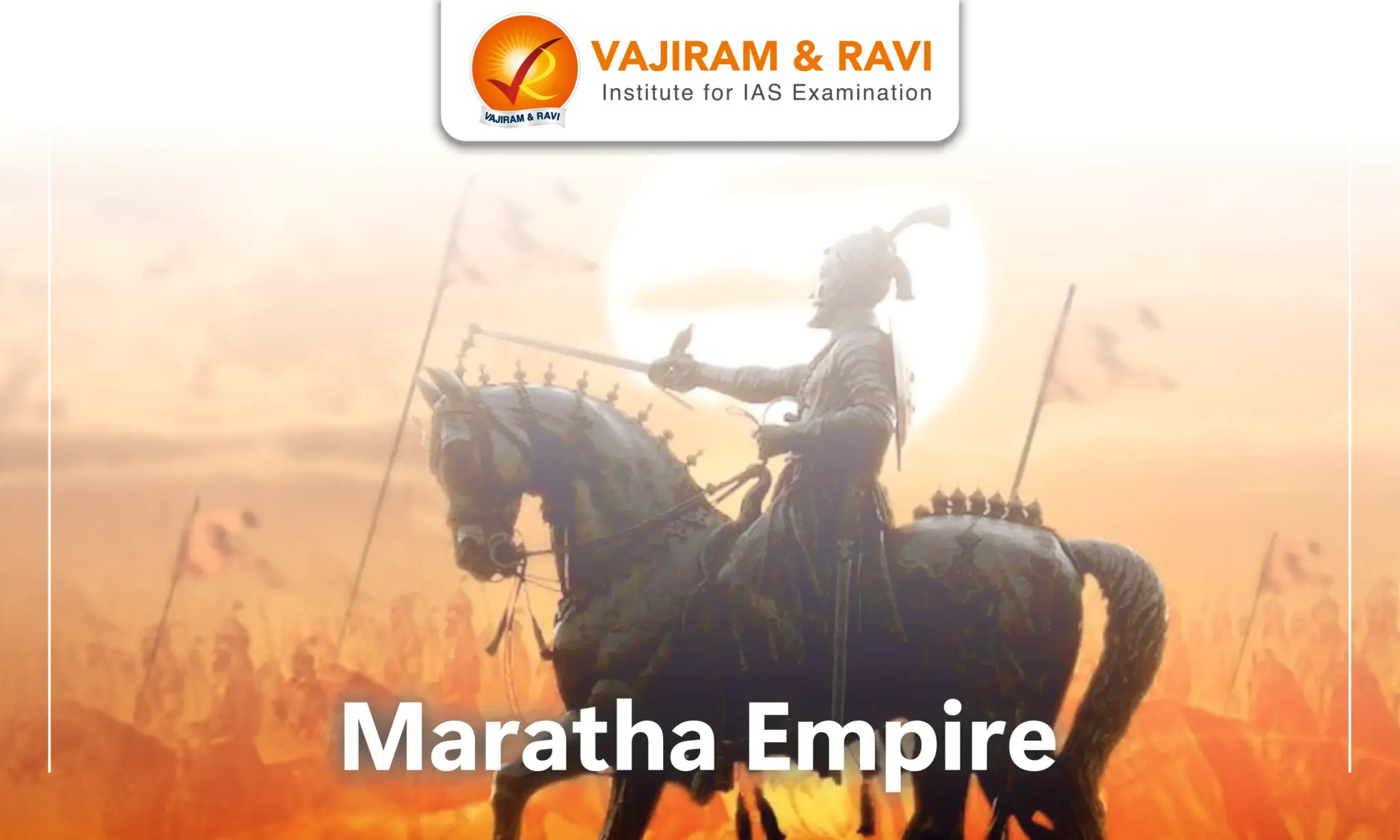
The Maratha Empire was an early modern Indian confederation that rose to prominence in the 18th century, dominating much of the Indian subcontinent. The Maratha Empire was established by Chhatrapati Shivaji Maharaj in the late 17th century as a response to the chaos and misrule in the Deccan region.
The confederacy was officially recognized as a tributary state by Emperor Bahadur Shah I in 1707 after a long rebellion. From 1737 to 1803, the Marathas played a crucial role in the imperial politics of Delhi, influencing the power dynamics of the region and shaping the course of Indian history during this period.
Maratha Empire History
The growth of Maratha power occurred against the backdrop of political instability in the Deccan. The territory was divided between the Mughal Empire and the Deccan Sultanates, with local Maratha lords holding key military and administrative posts.
- The Bhonsle family, particularly Shahji Bhonsle and his son Chhatrapati Shivaji Maharaj, were instrumental in establishing an independent Maratha state. Shivaji progressively conquered forts and areas around Pune, establishing a robust military and administrative structure.
- Following Shivaji, the Marathas faced succession disputes and Mughal pressure. Nonetheless, they survived Aurangzeb's lengthy Deccan war. Following Aurangzeb's death, Shahu assumed the title of Chhatrapati, although the Peshwas progressively established themselves as the true executive authorities.
- Under Baji Rao I and Balaji Baji Rao, Maratha power expanded rapidly across northern and central India. The defeat at the Third Battle of Panipat in 1761 temporarily halted this expansion, but the Marathas recovered under Madhavrao I and again became a major power.
Founder of Maratha Empire
Chhatrapati Shivaji Maharaj is generally regarded as the founder of the Maratha Empire/Maratha state. He established an independent kingdom in the western Deccan and formally assumed the title of Chhatrapati after his coronation at Raigad in 1674. Shivaji's father, Shahji Bhonsle, had already established the Bhonsle family's political and military importance in the Deccan, but Shivaji transformed this base into an independent sovereign state.
Maratha Empire Time Period
The Maratha Empire emerged in the 17th century under Chhatrapati Shivaji Maharaj and remained a major political power in India until 1818. Its power expanded significantly during the Peshwa era, reaching its peak in the 18th century before declining due to internal conflicts and British expansion.
Maratha Empire Family Tree
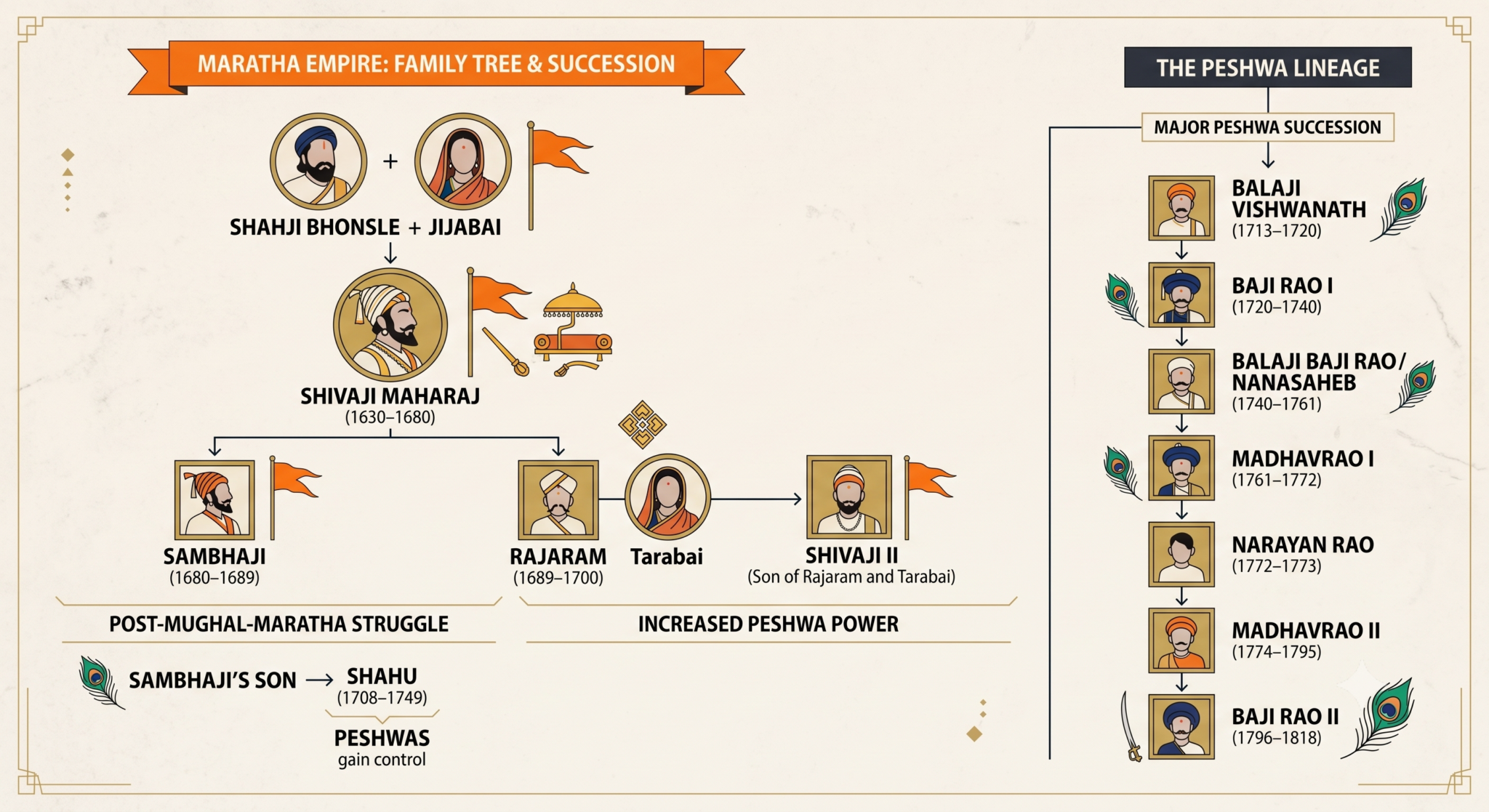
The family tree of Maratha Empire began with Shahji Bhonsle, whose son Shivaji Maharaj founded the Maratha state. Shivaji was succeeded by Sambhaji, followed by Rajaram. Later, Shahu became Chhatrapati, while the Peshwas—Balaji Vishwanath, Baji Rao I, Balaji Baji Rao, and their successors—became the dominant rulers.
Maratha Empire Rise
The Marathas rose to prominence during the seventeenth century in the Indian subcontinent under the leadership of Chhatrapati Shivaji Maharaj. He challenged the Adil Shahi dynasty and the Mughal Empire, establishing a kingdom with Raigad as its capital. Aurangzeb's religious policies turned non-Muslims against him, causing his forces to suffer heavy losses in both manpower and finances during the Maratha uprising. This allowed the Marathas to gain power and control over large parts of the former Mughal territories in northern India.
Various factors played a role in the rise of the Marathas during the sixteenth and seventeenth centuries, including:
- Geographic Advantages: The physical geography of the Maratha region, with its mountainous terrain and dense forests, fostered their bravery and skill in guerrilla warfare. They constructed numerous forts on these mountains to strengthen their defences.
- Decline of Deccan Sultanates: Internal conflicts and wars among the Bijapur and Golconda sultanates weakened them and allowed the Marathas to rise.
- Religious and Political Unity: Political unity was largely achieved through the leadership of Shivaji. The Bhakti movement, which spread through Maharashtra, instilled a sense of religious unity among the Marathas.
- Spiritual leaders such as Tukaram, Ramdas, and Eknath promoted social cohesion.
- Sovereignty: Chhatrapati Shivaji's coronation in 1674 at Raigad formally established an independent sovereign state (Hindavi Swarajya).
- Maratha Political Influence: Many Marathas held important positions in the administration and military of the Deccan Sultanates of Bijapur and Ahmadnagar.
- While notable clans like the Mores and Nimbalkers had their roles, the strong Maratha state was mainly founded by Shahji Bhonsle and his son, Shivaji.


Maratha Empire Kings
The Maratha Empire was ruled by two main lines of leaders: the Chhatrapatis (sovereign monarchs) and the Peshwas (de facto prime ministers who later held real power). Important kings of Maratha Empire included Shivaji, Sambhaji, and Shahu. However, after Shahu's reign, the Peshwas increasingly became the effective rulers, while the Chhatrapati retained important symbolic and nominal authority.
- Chhatrapati Shivaji Maharaj (1674–1680): The visionary founder of the Maratha Empire who established Swarajya (self-rule).
- Chhatrapati Sambhaji Maharaj (1681–1689): Shivaji's eldest son, known for his fierce resistance against the Mughal Emperor Aurangzeb.
- Chhatrapati Rajaram Maharaj (1689–1700): Shivaji's younger son who sustained the state through guerrilla warfare from Gingee.
- Tarabai (1700–1707): Queen regent who led the Maratha resistance against the Mughals in the name of her young son, Shivaji II.
- Chhatrapati Shahu Maharaj (1707–1749): Shivaji's grandson, under whose reign the Peshwa administration system took prominence.
Maratha Empire Under Shivaji (1630-1680)
Chhatrapati Shivaji Maharaj(1630–1680) founded the Maratha state and fought against the Sultanate of Bijapur in 1645, capturing forts like Torna. He established Hindavi Swarajya, made Raigad his capital, defended his kingdom against the Mughals, and was crowned Chhatrapati in 1674.
- After the Battle of Purandar ( 1665 ), Shivaji yielded 23 forts and agreed to provide military support. His son Sambhaji was granted a Mughal mansab, avoiding direct vassal status for Shivaji.
- He set up an improved administration, brought back Hindu traditions, and promoted Marathi and Sanskrit over Persian.
- Shivaji was known for treating women with respect and for his inclusive policies, hiring people from all castes, religions, and even Europeans in his administration and military.
Maratha Empire During Peshwa Era
The Peshwa period began when Shahu appointed Balaji Vishwanath as Peshwa in 1713. One of his first major achievements was the Treaty of Lonavala in 1714 with Kanhoji Angre, who later accepted Shahu as Chhatrapati.
Maratha Empire Under Balaji Viswanath (1713-1720)
Balaji Viswanath started as a minor revenue official and became Peshwa in 1713, establishing a powerful hereditary position. In 1719, Balaji Viswanath obtained important rights from Mughal emperor Farrukh Siyar, who recognised Shahu as king. He helped Shahu become the Maratha king by gaining support from other Maratha leaders.
Maratha Empire Under Baji Rao I (1720-1740)
Baji Rao was the eldest son of Balaji Viswanath and became Peshwa at the young age of twenty. Under his leadership, the Marathas' power reached its peak.
- He established a confederacy among the Maratha chiefs, granting each chief the autonomy to govern their designated territory independently.
- This approach enabled numerous Maratha families to gain prominence and authority across India, including the Gaekwads in Baroda, the Bhonsles in Nagpur, the Holkars in Indore, the Scindias in Gwalior, and the Peshwas in Poona.
- During Baji Rao I's reign, he is said to have fought over 40 battles, including the Battle of Palkhed (1728), the Battle of Delhi(1737), and the Battle of Bhopal(1737).
Maratha Empire Under Balaji Baji Rao (1740-1761)
Balaji Baji Rao, also known as Nanasaheb, succeeded his father as Peshwa at just nineteen. He supported agriculture, protected the local population, and greatly enhanced the region's conditions.
- In 1752, the Peshwa agreed to protect the Mughal Empire in exchange for collecting Chauth from northwest provinces and total revenue from Agra and Ajmer.
- Third Battle of Panipat: The Battle was fought between the Marathas and Ahmad Shah Abdali in 1761.
- The Marathas were responsible for defending India during Abdali's invasion and fought bravely but were ultimately defeated.
- After Balaji Baji Rao died, the Third Battle of Panipat greatly weakened the Marathas' power and caused internal conflicts within the confederacy.
Maratha Empire Administration
The Maratha Empire had four types of administration: Central, Provincial, Revenue, and Military.
- Central Administration: Ashtapradhan, or Council of Eight, was a group of eight ministers responsible for governing the Maratha Kingdom. This system was established by Shivaji. The titles of the ministers were derived from Sanskrit and comprised:
- Peshwa or Pantpradhan: Prime Minister responsible for overseeing the entire administration.
- Amatya or Mazumdar: Finance Minister, managing the Empire's accounts.
- Shurunavis or Sacheev: Secretary, who prepared royal orders.
- Mantri: Interior Minister, overseeing internal affairs and intelligence.
- Sarr-i-Naubat or Senapati: Commander-in-Chief, in charge of the military and defense.
- Sumant or Dabir: Foreign Minister, managing relationships with other rulers.
- Nyay Adhyaksh: Chief Justice, handling civil and criminal justice.
- Panditrao: High Priest, managing religious matters.
- Chitnis: The Chitnis acted as personal secretary to the Chhatrapati but was independent of the Ashtapradhan.
- Provincial Administration: Shivaji divided his kingdom into several provinces for taxation and administration. He stopped the practice of outsourcing land revenue collection and had state officials collect taxes directly from the farmers (ryots).
- Parganas and Tarafs: Each province was subdivided into Parganas and Tarafs, with villages serving as the smallest units.
- Provinces were divided into Tarafs (districts), which were further split into Parganas (sub-districts).
- Officers called Deshpande and Deshmukh were responsible for law and order in the Parganas, which were made up of villages called Mauza, headed by hereditary officials known as Kulkarni and Patil.
- Prants and Sarsubedar: Conquered lands were organised into provinces called prants, each overseen by a sarsubedar and subedar officers. The district officer was known as the Havaldar.
- Revenue Administration: Shivaji developed a revenue system based on Malik Amber’s Kathi system to assess land value. Local farmers had to pay 40% of their harvest in taxes.
- Chauth tax: Shivaji introduced the Chauth tax, which took one-fourth of the earnings from nearby Mughal territories for military support, and a 10% additional tax called Sardeshmukhi.
- Ryotwari System: Shivaji developed the Ryotwari system to enhance communication between the government and farmers (ryots). This reduced corruption from middlemen.
- Mirsadars: Shivaji kept strict control over the Mirsadars, who had inherited land rights and paid little tax. He later challenged their power and took control of their land.
- Military Administration: Shivaji established a strong military administration, paying ordinary soldiers in cash and giving chieftains revenue payments called Saranjam.
- His cavalry, known as Paga, included 30,000 to 40,000 troops managed by Havaldars.
- Shivaji was the first Indian king to recognise the need for a naval force, building dockyards and ships for trade and defence.
- He also trained his troops in guerrilla warfare and mountain combat.
Maratha Empire Map
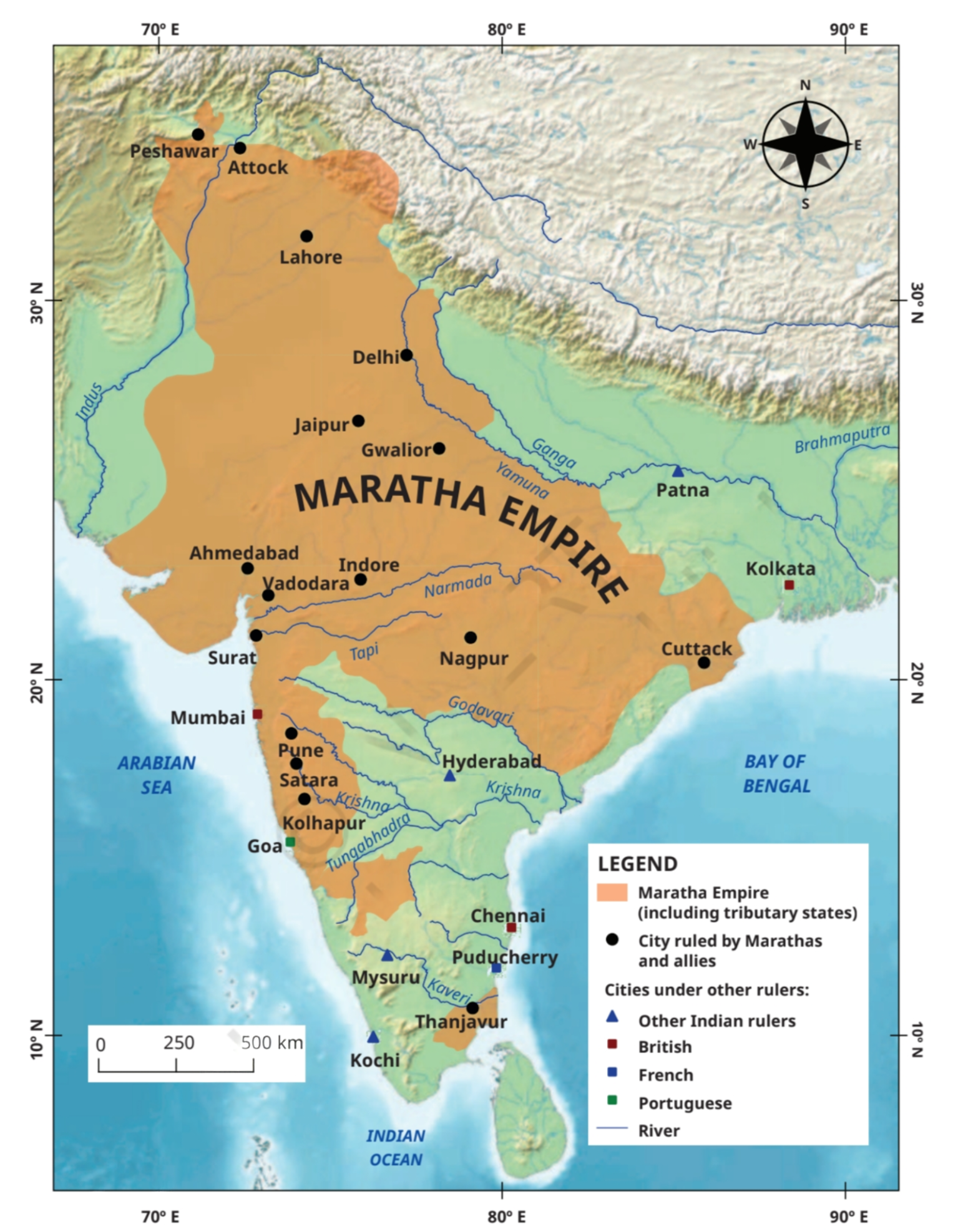
The Maratha Empire at its peak extended over a large part of the Indian subcontinent across 18th-century India. The Marathas even briefly controlled Delhi, Lahore, Attock and Peshawar during their period of expansion.
Maratha Empire vs Mughal Empire
The Marathas and the Mughals were two influential powers in India during the 17th and 18th centuries. Maratha warriors, skilled in guerrilla warfare, resisted Mughal authority, using their terrain knowledge to confront the formidable Mughal army.
- The conflict between the Marathas and the Mughals lasted many years, involving numerous battles and negotiations.
- Eventually, the Marathas emerged as a significant force in Indian politics, challenging the Mughal Empire's authority.
Maratha Empire Confederacy
The Maratha Confederacy was an 18th-century military and political alliance that emerged from Shivaji Maharaj's Maratha Empire. Power was decentralised from the Chhatrapati (King) to the Peshwa in Pune and major regional Maratha chiefs who dominated large swaths of India.
Led by the Peshwa in Pune as the central prime minister, the Maratha Confederacy relied on strong regional ruling families. These primary autonomous chiefs included the Gaekwads of Baroda, Holkars of Indore, Scindias of Gwalior, and Bhonsles of Nagpur.
- Mughal Collapse: The confederacy expanded rapidly across northern and central India by filling the power vacuum created by the decline of the Mughal Empire.
- Decentralised Expansion: Autonomous regional chiefs effectively enlarged and managed vast territories under the nominal oversight of the Pune Peshwa.
- Panipat Defeat: A devastating loss to Afghan forces at the Third Battle of Panipat in 1761 permanently halted their aggressive northern conquest.
- British Subjugation: Deepening internal rivalries among the chiefs and losses in three Anglo-Maratha Wars led to the empire's complete dissolution by 1818.
Anglo-Maratha Wars
The Anglo-Maratha Wars were fought in the late 18th and early 19th centuries, the Marathas and the English fought three times for political control, with the English emerging victorious. The conflicts were fueled by British ambition and internal Maratha divisions, allowing the English to establish control, as in Bengal.
- The First Anglo-Maratha War ( 1775- 1782 ): The First Anglo-Maratha War was fought between the Maratha Empire and the British East India Company. It began with the Treaty of Surat and concluded with the Treaty of Salbai.
- Treaty of Surat: The Treaty of Surat in 1775 enabled the English to gain control of the territories of Salsette and Bassein, along with a portion of the revenues from the Surat and Bharuch districts.
- Treaty of Salbai: The Treaty of Salbai, signed and ratified in 1782, ended the First Phase of the Struggle by establishing a twenty-year peace between the English and Sindhia.
- This treaty followed several English military victories, including the captures of Ahmedabad, Bassein, and Gwalior.
- The Second Anglo-Maratha War (1803-1805): The Second Anglo-Maratha War (1803-1805) represented the second significant clash between the two powers, culminating in a decisive victory for the British.
- The war ended with the Treaty of Rajpurghat (1806), which greatly weakened the Marathas' power and influence in India.
- This defeat caused a substantial weakening of their empire.
- The Third Anglo-Maratha War (1817-1818 ): The Third Anglo-Maratha War occurred from 1817 to 1818 and was the final conflict between the Maratha Empire and the British East India Company.
- This war is also referred to as the Pindari War, as it involved fighting between the Pindaris and the British forces.
- Ultimately, the Marathas were defeated by the British East India Company in this conflict.
Maratha Empire Decline
In June 1818, the Peshwa surrendered, which led to the collapse of the Maratha Confederacy. The position of Peshwa was abolished, and Bajirao was made a British retainer in Bithur, near Kanpur. Pratap Singh, a direct heir of Shivaji, was appointed as the ruler of the small principality of Satara. Several factors contributed to the Marathas' defeat by the English, with the primary reasons outlined below.
- Ineffective Leadership: The Maratha state's governance was influenced by despotic leaders, but later leaders, including Bajirao II, proved to be ineffective and failed to match the English officials' capabilities.
- Flaws in the Maratha State: Since Shivaji's time, the unity among the Maratha people has been weak and unplanned.
- It lacked real efforts for community development, education, or unification.
- This became clear when they faced a well-organised European power based on Western practices.
- Fragile political structure: The Maratha Empire, led by the Chhatrapati and Peshwa, was a loose confederation with powerful chiefs like Gaikwad, Holkar, Sindhia, and Bhonsle forming their semi-independent kingdoms.
- The rivalry and lack of cooperation among these chiefs weakened the Maratha state.
- Weak Military Structure: Although the Marathas were brave fighters, they were not as organised or equipped as the English in terms of military strategy, weapons, discipline, and leadership.
- Their failures were due to divided command, betrayal among their ranks, and a lack of effective use of modern artillery techniques.
- Weak Economic Framework: The Marathas did not establish a stable economic policy to meet changing needs, which resulted in a lack of industries and foreign trade opportunities.
- This situation made the Maratha economy unsuitable for a stable political environment.
- Proficient English Diplomacy: The English were skilled in diplomacy, forming alliances, and isolating their enemies, while the disunity among the Maratha chiefs made it easier for them to attack.
- Unlike the Marathas, who were unaware of their enemies, the English had an effective spy network that gathered crucial intelligence.
Maratha Empire UPSC PYQs
Q1: Clarify how mid-eighteenth-century India was beset with the spectre of a fragmented polity. Discuss the role of the Marathas in this context. (UPSC Mains 2017)

 Last updated on Oct, 2026
→ UPSC 2027 Notification will be released on 13 January 2027 at upsconline.nic.in.
→ Check Nobel Prize 2026 Winners List here.
→ Download PIB PRiSM Monthly Magazine 2026 here.
→ Check UPSC Monthly Current Affairs Magazine The Recitals here.
→ Check out the latest UPSC Syllabus here.
→ Download UPSC Model Answers for Mains 2026
→ UPSC Mains Question Paper 2026 is out now for Essay & GS Paper 1, 2, 3 & 4.
→ UPSC Calendar 2027 has been released.
→ Enroll in Vajiram & Ravi’s UPSC Mains Test Series 2027 for structured answer writing practice, expert evaluation, and exam-oriented feedback.
→ Join Vajiram & Ravi’s UPSC Mentorship Program 2027 for personalized guidance, strategy planning, and one-to-one support from experienced mentors.
→ Go through the UPSC Mains Previous Year Papers to enhance your preparation.
→ UPSC has released UPSC Toppers List 2025 with the Civil Services final result on its official website.
→ Also check Best UPSC Coaching in India
Maratha Empire FAQs
Q1. Who was the founder of Maratha Empire?+
Q2. Who defeated the Maratha Empire?+
Q3. Who was stronger, Maratha or Mughal?+
Q4. Who is the king of Marathas?+
Q5. Did Aurangzeb defeat Shivaji?+
Tags: maratha empire quest upsc modern history notes