Interior of the Earth is divided into layers based on chemical composition and mechanical properties. These include the crust, lithosphere, asthenosphere, mantle, outer core and inner core. Except for the liquid outer core, these layers are largely solid, with the asthenosphere behaving as a weak, semi-molten zone.
The differences between these layers arise mainly from variations in temperature, pressure, density and composition during Earth’s evolution. Our understanding of Earth’s interior is based on both direct and indirect sources, especially seismic waves, which change their speed and behaviour as they pass through materials of different composition and physical state.
Interior of the Earth About
The interior of the Earth consists of three main layers: crust, mantle, and core. The crust is the outermost layer, the mantle lies beneath it, and the core is the innermost part, mainly composed of iron and nickel.
- Crust: The outermost solid layer, varying from 5 to 70 kilometers deep.
- Mantle: A hot, dense layer of semi-solid rock extending 2,900 kilometers down.
- Core: Divided into a liquid iron-nickel outer core and a scorching, solid iron inner core at the center.
Interior of the Earth Sources
The materials of the Earth’s surface are different from the interior. Therefore, to study the Earth’s internal structure, direct and indirect sources are taken into consideration.
Direct Sources of the Interior of the Earth:
- Mining: The most readily available Earth material is its minerals, which can be obtained through mining. Mines can also be very deep; for example, Gold mines in South Africa are as deep as 3 - 4 km.
- Drilling Projects: There are many projects to penetrate deeper depths to explore the conditions in the crustal portions such as the “Deep Ocean Drilling Project” and “Integrated Ocean Drilling Project”.
- Volcanic eruption: During a volcanic eruption, molten material (magma) explodes onto the Earth's surface and is then available for laboratory investigation. However, it is difficult to determine the depth of the magma's source.
Indirect Sources of the Interior of the Earth:
- Temperature, Pressure, and Density: Knowing the total thickness of the Earth, scientists have estimated the values of temperature, pressure, and the density of materials at different depths.
- Seismic Activity: The shadow zones of P- and S- waves help understand the different densities of the Earth’s layers.
- For example, the S-waves cannot be transmitted through fluids. The sudden “shadow” where S-waves disappear indicates that the Earth has a liquid outer core.
- Different discontinuities within the Earth’s interiors are based on the propagation and velocities of seismic waves through the layers of the Earth.
- Gravitation: The gravitational force differs at different latitudes on the Earth. Gravity anomalies provide information on the mass distribution of materials in the Earth.
- Magnetic surveys: These also offer information regarding the distribution of magnetic materials in the crustal portion, as well as the distribution of materials in this region.
- Meteors: The material and the structure observed in the meteors are similar to that of the Earth. Hence, this becomes a source of information about the interior of the Earth.


Structure of the Interior of the Earth
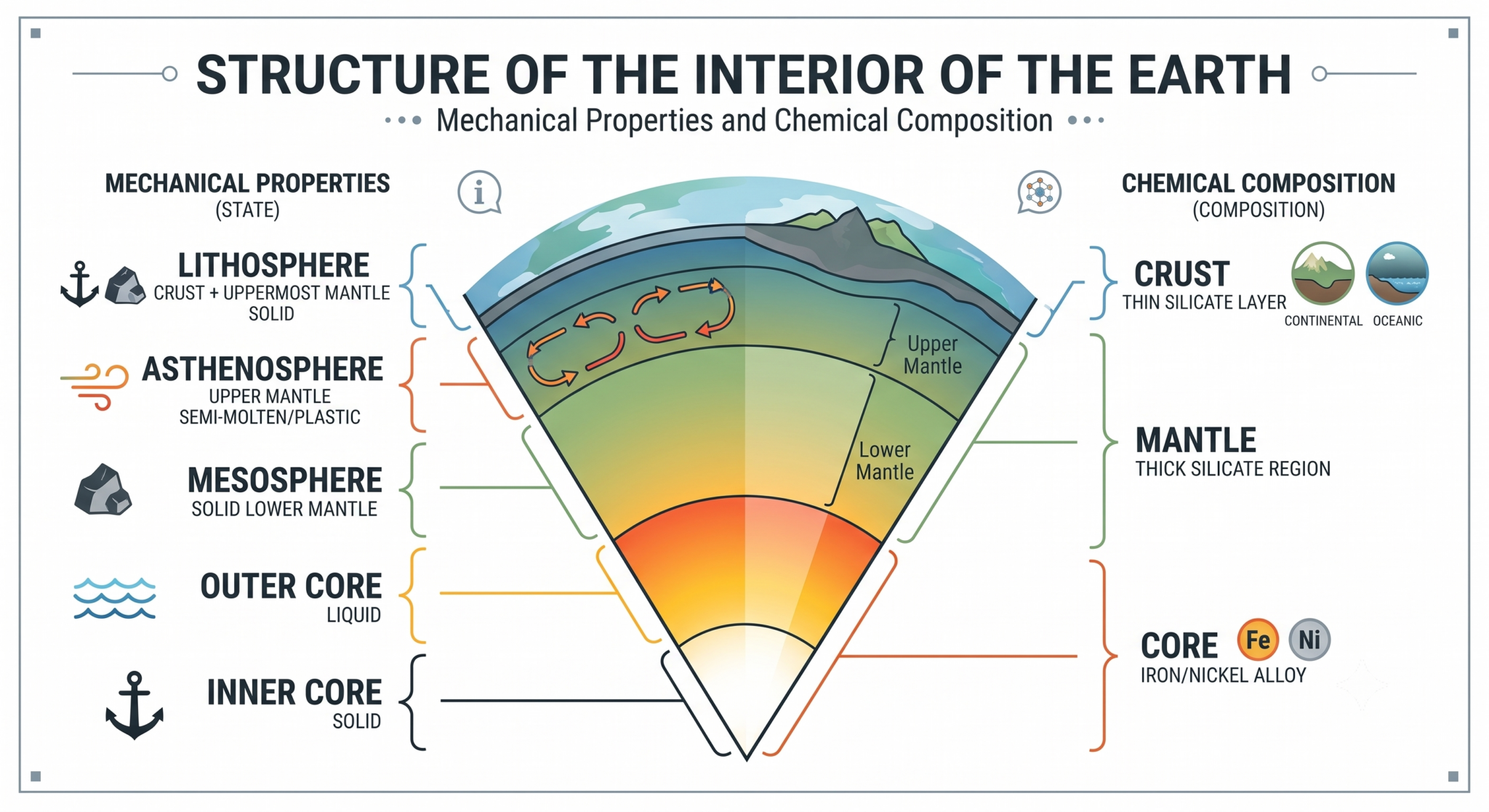
Earth is made up of several layers. According to the mechanical properties, Earth's layers are the Lithosphere, Asthenosphere, Lower mantle (also known as mesospheric mantle), Outer core, and Inner core. Chemically, the layers are the Crust, Mantle, and Core.
Interior of the Earth Evolution
When Earth was formed about 4.5 billion years ago, it was a uniform ball of hot rock. Radioactive decay and leftover heat from planetary formation caused the ball to get even hotter.
- Iron Catastrophe: Eventually, after about 500 million years, Earth’s temperature rose to the melting point of iron—about 1,538° Celsius. This key stage in Earth's history is known as the Iron Catastrophe. The Iron Catastrophe allowed more rapid movement of Earth’s molten, rocky material.
- Formation of layers: The early core was formed when droplets of iron, nickel, and other heavy metals gravitated to the Earth's centre to form the core of the new planet. Relatively buoyant materials, such as silicates and water, stayed close to the planet’s exterior.
- This process is known as planetary differentiation.
- The molten material that surrounded the core was the early mantle.
- Materials that initially stayed in their liquid phase during this process, called “incompatible elements,” ultimately became Earth’s brittle crust. The crust is still evolving due to plate tectonics.
- Solidification of Mantle: Water held within minerals erupted as lava, a process known as "outgassing". As more water was expelled, the mantle solidified.
Interior of the Earth Thermal and Physical State
Temperature, pressure, and density are responsible for the generation of the present state of affairs.
- Temperature: In deep wells and mines, the temperature rises as the depth increases. This evidence, along with molten lava erupting from the Earth’s interior, supports the idea that temperature increases towards the centre of the Earth.
- The pace of increase is not linear. Within the upper 100 kilometres, the temperature gradient is between 15° and 30°C per kilometre. It then decreases substantially through the mantle, increases more swiftly at the base of the mantle, and finally gradually increases through the core.
- The temperature is around 1000°C at the crust's base, 3500°C at the mantle's base, and 5,000°C at the Earth's centre.
- The disintegration of radioactive elements and chemical reactions occurring under high pressure may be the reason for the Earth's extremely high temperature.
- Pressure: Due to the enormous weight of the overlying rocks, there is also an increase in pressure from the surface of the Earth towards its core. As a result, the pressure is extremely high in deeper areas.
- The pressure near the centre is considered to be 3 to 4 million times the pressure of the atmosphere at sea level.
- Density: On average, the density of the Earth’s interior is 5.5 g/cm³.. Due to the increase in pressure and the presence of heavier materials towards the Earth’s centre, the density of the Earth’s layers also increases.
Interior of the Earth Crust
The crust is the uppermost layer of the Earth. It possesses just 1% of Earth’s mass but contains almost all known life in the universe. The crust, created by the dynamic geologic forces, continues to be shaped by the planet’s movement and energy. Plate tectonics is responsible for the formation and destruction of crustal materials.
- Composition: It is made up of solid rocks and minerals.
- Earth’s crust is composed of igneous, metamorphic, and sedimentary rocks.
- Igneous rocks such as granite and basalt, which form when magma cools, are the most prevalent types of rocks in the crust.
- Density: less than 2.7 g/cm³.
- Types: The crust is subdivided into two types – oceanic and continental crusts.
- The oceanic crust is found under oceans.
- The continental crust floats higher on the mantle because it is less dense than the oceanic crust.
- Discontinuity: The transition zone between oceanic and continental crust is known as the Conrad discontinuity.
|
Difference between Oceanic and Continental Crust |
||
|
Features |
Oceanic Crust |
Continental Crust |
|
Composition |
- Mafic and ultramafic intrusive igneous rocks. - Rocks of the oceanic crust referred to as “SiMa” stand for Silicate and Magnesium, the most abundant minerals in the oceanic crust. |
- Granitic (felsic) intrusive igneous rocks. - The term "SiAl" refers to rocks of the continental crust that contain silicate and aluminium, the most abundant minerals in the crust. |
|
Formation |
- Formed from magma that rose from the mantle and cooled at the ocean floor. |
- Formed from the melting of rocks and the accumulation of sediments. |
|
Mineralogy |
- Rich in iron and magnesium |
- Rich in silicon and oxygen |
|
Thickness |
- Oceanic crust is typically about 5-10 kilometres thick. |
- Continental crust can be up to 40 kilometres thick. |
|
Density |
- 2.9 grams per cubic centimetre |
- 2.7 grams per cubic centimetre |
Interior of the Earth Mantle
It is the 2,900 km thick layer between Earth’s dense, superheated core and its thin outer layer, the crust.
- Volume: The mantle lies below the crust and is by far the largest layer, making up 84% of Earth's volume and 67% of the Earth’s mass.
- Density: The density of the mantle is 3.9 g/cm³
- Composition: The majority of the rocks that make up the mantle of the Earth are silicates.
- Olivine, garnet, and pyroxene are the common silicates found in the mantle.
- Magnesium oxide is the other main type of rock that can be found in the mantle.
- Other elements include aluminium, iron, calcium, sodium, and potassium.
- Discontinuity: The Mohorovicic Discontinuity, or Moho, marks the beginning of the mantle. The Moho is defined as the density contrast from the less dense crust to the denser mantle and where seismic wave velocities increase.
Layers of Mantle
The Earth’s Mantle is divided mainly into two layers, i.e., the Upper mantle and the Lower mantle. The discontinuity between the upper mantle and the lower mantle is known as the Repetti Discontinuity.
- Upper Mantle: Despite being mostly solid, the upper mantle's more malleable regions contribute to tectonic activity.
- The thickness of the Upper mantle is around 410 km.
- Two parts of the upper mantle are often recognised as distinct regions in Earth’s interior, i.e., the lithosphere and the asthenosphere.
- Transition zone: It is present at a depth from 410 Km to 660 Km. It prevents large exchanges of material between the lower and upper mantle.
- The most important aspect of the mantle’s transition zone is its abundance of water. Crystals in the transition zone hold as much water as all the oceans on Earth’s surface.
- Lower Mantle: The lower mantle extends from about 660 kilometres to about 2,700 kilometres beneath Earth’s surface.
- Compared to the upper mantle, the lower mantle is hotter and denser.
- D’’ (D-double prime): It is a shallow region beneath the lower mantle. In some areas, it is a razor-thin boundary with the outer core, while in others, it has thick accumulations of iron and silicates.
Lithosphere
It is the solid, outer part of Earth. It is made up of the crust and the upper mantle, above the asthenosphere. Of all the layers of the Earth, the lithosphere is both the coolest and the most rigid.
- Thickness: The average thickness of the lithosphere is 100 km and may go up to 300 km below the orogenic mountains.
- The thickness of the lithosphere is less than 50 km below the oceanic crust.
- Composition: The lithosphere consists of many different large segments or blocks, called lithospheric plates or tectonic plates.
- These plates are considered rigid bodies floating horizontally over the asthenosphere, and tectonic deformations typically occur at the plate boundaries as a result of plate interactions with other plates.
Asthenosphere
The asthenosphere is a hot, soft, mechanically weak, ductile, and semi-viscous region and consists of semi-molten rock materials.
- Properties: The Asthenosphere is part of the upper mantle, also known as the Low-Velocity Zone (LVZ) because the velocity of seismic waves decreases in this zone.
- This zone allows the lithospheric plate to float and move over it.
- Thickness: The average thickness is between 180 and 220 km.
- Depth: It lies below the lithosphere at an average depth of 100 km and extends to a depth of 350 to 650 km.
- Composition: It is composed of peridotite rock, containing mostly the olivine and pyroxene minerals.
Interior of the Earth Core
The extremely hot and dense center of our planet is known as the Earth's core. The Gutenberg discontinuity signals the end of the mantle and the commencement of Earth's liquid outer core.
- Volume: The core accounts for 33% of the Earth’s mass and 16 percent of the Earth’s volume.
- Composition: Unlike the mineral-rich mantle and crust, it is made almost entirely of metal - iron (Fe) and nickel (Ni); hence, sometimes called the NiFe layer.
- Siderophiles, the elements that dissolve in iron (gold, platinum, cobalt, etc), are also found in the core.
- The core contains 90% of the Earth's sulfur.
- The other elements speculated to be part of the core are oxygen and silicon.
- Two layers: The core is further divided into two layers - inner core and outer core. The Lehmann discontinuity or the Bullen discontinuity is the boundary separating these regions.
Outer Core
The 2,200 km thick outer core is composed of liquid iron and nickel, in a molten state.
- Properties: The hottest part of the core (at the Bullen discontinuity) is as hot as the surface of the Sun (around 6,000° Celsius). The liquid metal in the outer core has low viscosity.
- Earth's magnetic field: The Earth's magnetic field is created in the outer core by a self-exciting dynamo process.
- The magnetic field is generated by electrical currents flowing through slow-moving molten iron.
Inner core
Earth’s inner core is solid and extends from 5150 Km to 6370 Km, and is mostly composed of iron.
- Solid core: Despite the temperature of the inner core being more than the melting point of iron, the inner core is solid. This is due to the intense pressure and density of the inner core.
- Rotation: The inner core rotates eastward but at a slightly faster rate than the other part of the Earth.
- Growth: The inner core grows by about a millimeter every year as the Earth is slowly cooling. Consequently, the outer core is solidifying or freezing.

 Last updated on Oct, 2026
→ UPSC 2027 Notification will be released on 13 January 2027 at upsconline.nic.in.
→ Check Nobel Prize 2026 Winners List here.
→ Download PIB PRiSM Monthly Magazine 2026 here.
→ Check UPSC Monthly Current Affairs Magazine The Recitals here.
→ Check out the latest UPSC Syllabus here.
→ Download UPSC Model Answers for Mains 2026
→ UPSC Mains Question Paper 2026 is out now for Essay & GS Paper 1, 2, 3 & 4.
→ UPSC Calendar 2027 has been released.
→ Enroll in Vajiram & Ravi’s UPSC Mains Test Series 2027 for structured answer writing practice, expert evaluation, and exam-oriented feedback.
→ Join Vajiram & Ravi’s UPSC Mentorship Program 2027 for personalized guidance, strategy planning, and one-to-one support from experienced mentors.
→ Go through the UPSC Mains Previous Year Papers to enhance your preparation.
→ UPSC has released UPSC Toppers List 2025 with the Civil Services final result on its official website.
→ Also check Best UPSC Coaching in India
Interior of the Earth FAQs
Q1. What is the interior of the Earth?+
Q2. Which layer is the Earth's thinnest?+
Q3. What is the deepest layer of Earth?+
Q4. What is inside the Earth?+
Q5. Is Earth's core still hot?+
Tags: interior of the earth sources quest UPSC Geography Notes