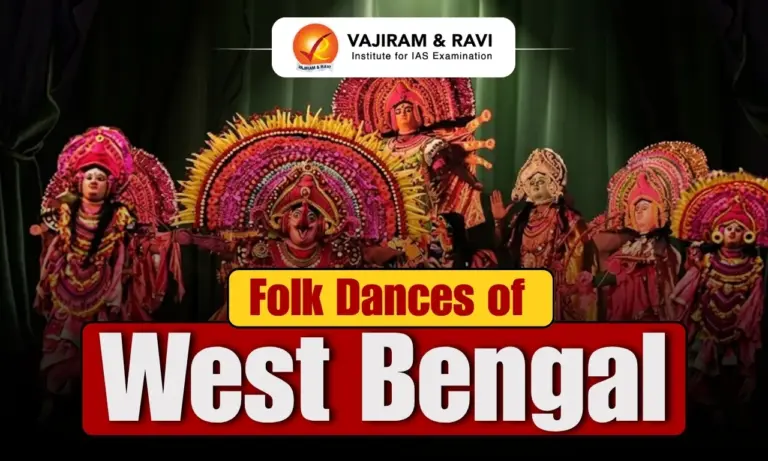
Folk dances are traditional community-based performances that reflect the customs, beliefs, festivals and everyday life of local communities. Folk Dances of West Bengal reflect the State’s tribal traditions, rural life, agriculture, religious practices and martial heritage.
Major Folk Dances of West Bengal
Major folk dances of West Bengal include Purulia Chhau, Jhumur, Tusu, Bhadu, Santhali dance, Raibenshe, Gambhira, Gomira, Rabankata, Pata Naach, Brita, Lathi Dance and Alkap. These dances are closely associated with different communities, festivals and regions of Bengal, making them an important part of its living folk heritage.
Also Read: Folk Dances of Uttar Pradesh
Purulia Chhau
- Purulia Chhau is a masked martial dance mainly performed in Purulia.
- It combines martial movements, acrobatics and storytelling, with themes from the Ramayana, Mahabharata and Puranas.
- It is mainly performed during Chaitra Parva with instruments such as dhol, dhumsa and mohuri.
- Chhau has three forms – Purulia, Seraikella and Mayurbhanj; Purulia and Seraikella use masks, while Mayurbhanj does not.
- Chhau was inscribed on UNESCO’s Intangible Cultural Heritage List in 2010.
- Charida village in Purulia is famous for Chhau-mask making, and the Purulia Chhau Mask has GI recognition.
Jhumur
- Jhumur is a folk dance-and-song tradition of western Bengal, especially Purulia, Bankura and Jhargram.
- It is performed by rural and tribal communities, with women usually dancing in linked formations.
- Madal, dhol and flute are commonly used.
- Its songs are closely linked with agriculture, seasons, love and village life.
- Jhumur also spread to Assam and North Bengal through tea-garden labour migration.
Tusu
- Tusu is a harvest tradition of western Bengal, particularly Purulia, Bankura and parts of Medinipur.
- It is associated with the Poush month and culminates around Makar Sankranti.
- It combines folk songs, group performances and dance and is strongly linked with rural and tribal communities.
Bhadu
- Bhadu is a traditional women-led folk song and dance tradition of western West Bengal, performed in honour of Bhadu Devi during the Bengali month of Bhadra.
- It is mainly popular in Purulia, Bankura, Birbhum and parts of Bardhaman.
- According to local tradition, Bhadu was Princess Bhadravati of the Panchakot royal family, and the festival developed around her worship.
- Women and girls sing Bhadu songs in groups, often accompanied by dance and traditional drums.
- The songs cover love, marriage, family life, happiness and sorrow, giving a glimpse into the everyday lives of rural women.
- The celebrations continue through Bhadra month and traditionally end with the immersion of Bhadu’s image.
Santhali Dance
- Santhali dance is a group of traditional dances of the Santhal community, closely connected with their festivals, rituals, agriculture and everyday community life.
- In West Bengal, it is mainly practised in Jhargram, Purulia, Bankura and Paschim Medinipur.
- Different dances are performed during festivals such as Baha, associated with spring and flowers, and Sohrai, associated with harvest and cattle.
- Men and women participate together, with women often dancing in linked rows or circles while men provide musical accompaniment.
- Madal, dhamsa, flute and banam are among the traditional instruments used during performances.
- The Akhra, an open community space, is an important place for Santhal dance, music and social gatherings.
Raibenshe
- Raibenshe is a martial folk dance mainly associated with Birbhum, Bardhaman and Murshidabad.
- It was traditionally associated with Bagdi and Bauri communities.
- Dancers use a long bamboo staff called raibansh and perform mock combat and acrobatics.
- It preserves elements of the older martial culture of rural Bengal.
Gambhira
- Gambhira is a folk dance-drama of Malda, traditionally associated with the Gajan festival of Shiva.
- The traditional performance revolves around Nana and Nati, presented as grandfather and grandson.
- It combines dance, song and dialogue.
- Performers use the Nana-Nati conversation to comment on social and political issues, making Gambhira an important form of folk satire.
Gomira
- Gomira is a masked ritual dance of North and South Dinajpur.
- Performers wear large wooden masks representing gods, demons and mythological characters.
- Its central theme is the struggle between good and evil.
- Kushmandi is an important centre of the associated wooden-mask craft.
Rabankata
- Rabankata is a traditional masked performance of Bishnupur, Bankura, based on the Ramayana and performed during the closing days of Durga Puja.
- It is performed mainly during Vijaya Dashami to Dwadashi.
- The performance depicts the battle between Rama and Ravana.
- Ravana and other characters are represented through masks.
- The Rabankata Utsab of Bishnupur is particularly associated with this tradition.
Pata Naach
- Pata Naach is a folk dance of Jhargram associated with Kurmi and Santhal communities.
- Men generally sing and play instruments, while women perform the dance.
- It is performed with traditional songs and local instruments.
Brita
- Brita is a women’s ritual folk dance performed as an invocation for the fulfilment of wishes, especially the blessing of children.
- It is traditionally performed by women.
- Women perform it while praying for children and seeking divine blessings.
- It is therefore mainly associated with fertility, prayer and religious devotion.
Lathi Dance
- Lathi dance is a stick-based folk performance associated with Muharram traditions in Bengal.
- Performers use bamboo sticks in coordinated, martial-style movements.
- It reflects the religious and martial elements of Bengal’s folk culture.
Alkap
- Alkap is a folk theatre tradition of Malda and Murshidabad.
- It combines dance, songs, acting and dialogue.
- Humour and satire are commonly used to comment on social life.
Baul Tradition
- Baul is primarily a mystic musical tradition of Bengal, with distinctive movements accompanying its songs.
- It combines influences from Vaishnava Bhakti and Sufi traditions.
- The ektara, dotara and dubki are commonly used.
- Birbhum and Nadia are important centres of Baul culture in West Bengal.
- Baul Songs were inscribed by UNESCO in 2008, but the UNESCO element is registered under Bangladesh, although the tradition is also deeply rooted in West Bengal.
Also Read: Folk Dances of Bihar
Folk Dances of West Bengal Key Features
- Tribal roots: Many folk dances have developed among Santhal, Munda, Oraon and other tribal communities.
- Religious connection: These traditions are often performed during religious festivals and rituals, such as Shiva festivals, Durga Puja and Muharram.
- Agricultural life: Jhumur, Tusu and Bhadu reflect the importance of farming, harvests and changing seasons in rural life.
- Mythology and storytelling: Chhau, Gomira and Rabankata bring stories from the Ramayana, Mahabharata and Puranas to local audiences.
- Social commentary: Forms such as Gambhira and Alkap go beyond entertainment and comment on social and contemporary issues.
- Combination of art forms: Most traditions bring together dance, music, songs, costumes, masks and drama, creating a complete folk performance.


 Last updated on Oct, 2026
→ UPSC 2027 Notification will be released on 13 January 2027 at upsconline.nic.in.
→ Check Nobel Prize 2026 Winners List here.
→ Download PIB PRiSM Monthly Magazine 2026 here.
→ Check UPSC Monthly Current Affairs Magazine The Recitals here.
→ Check out the latest UPSC Syllabus here.
→ Download UPSC Model Answers for Mains 2026
→ UPSC Mains Question Paper 2026 is out now for Essay & GS Paper 1, 2, 3 & 4.
→ UPSC Calendar 2027 has been released.
→ Enroll in Vajiram & Ravi’s UPSC Mains Test Series 2027 for structured answer writing practice, expert evaluation, and exam-oriented feedback.
→ Join Vajiram & Ravi’s UPSC Mentorship Program 2027 for personalized guidance, strategy planning, and one-to-one support from experienced mentors.
→ Go through the UPSC Mains Previous Year Papers to enhance your preparation.
→ UPSC has released UPSC Toppers List 2025 with the Civil Services final result on its official website.
→ Also check Best UPSC Coaching in India
Folk Dances of West Bengal FAQs
Q1. Which are the major folk dances of West Bengal?+
Q2. Which folk dance of West Bengal has UNESCO recognition?+
Q3. Which folk dance of West Bengal is closely linked with agriculture and seasons?+
Q4. Which folk tradition is associated with the Poush harvest season and Makar Sankranti?+
Q5. Which folk dance is associated with the Santhal community?+
Q6. Which folk dance of Bengal has strong martial traditions?+
Q7. Which folk dance-drama is associated with Malda and social satire?+
Q8. Which folk dance of West Bengal uses large wooden masks representing mythological characters?+
Q9. Which folk dance is associated with Muharram in Bengal?+
Tags: folk dances of west bengal